Submitted by summerbaker on May 9, 2009 - 8:22am

bagels with old fermented dough

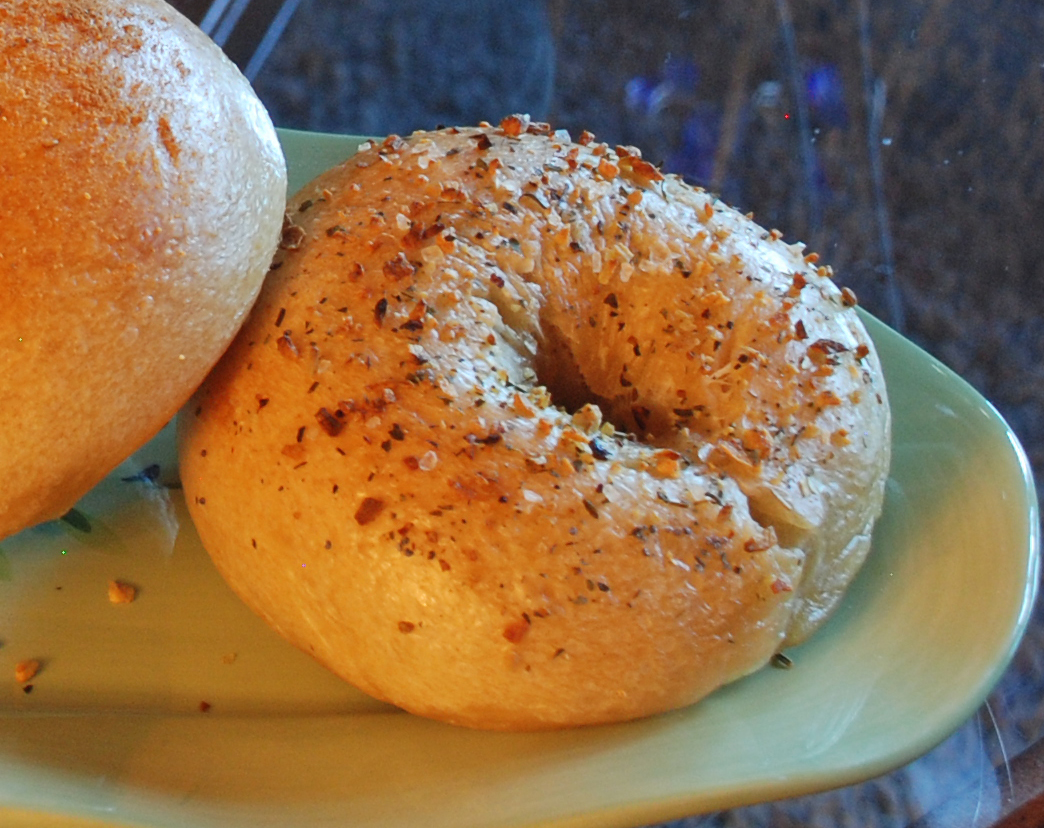
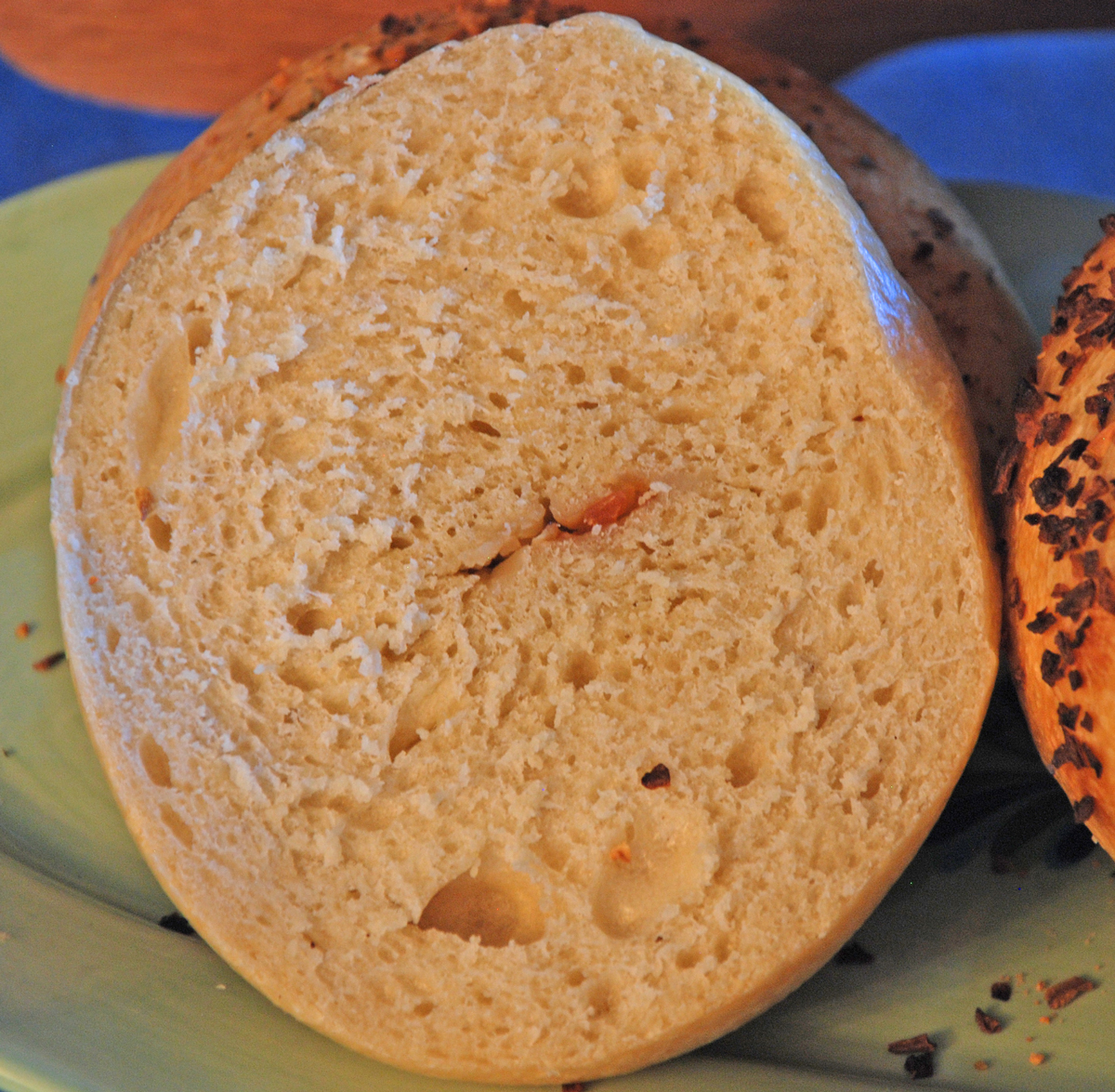
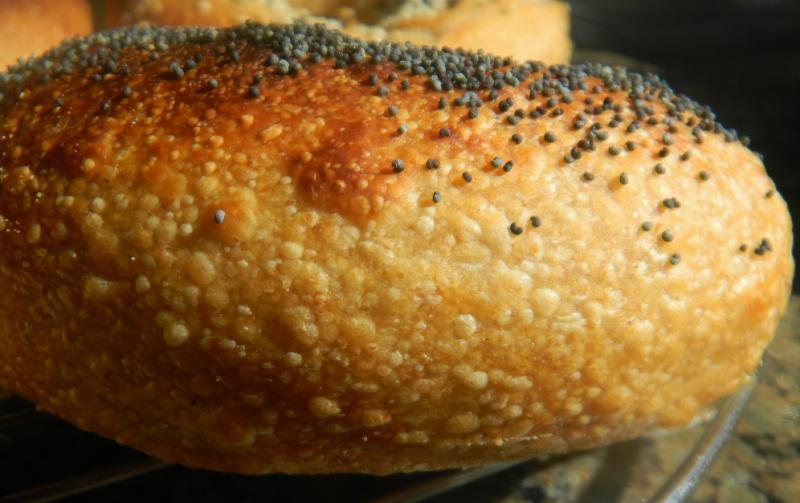
A little while ago there was some conversation about how long fermented commercially yeasted dough can keep without losing it's strength.  I don't have the final word on it or anything but since then i have been pushing the limits with the age of my ferment in various recipes.  This basically entails giving myself permission to NOT stress out every time I open the fridge and see last week's bowl of dough!  This brings me to the reason that I waited to post about it now.  Basically until yesterday, with the exception of pizza dough, I had been using the old dough only in recipes that also used the addition of dry yeast in the final dough so there was no way to tell if some part of the rise came from from the ferment or not.  Yesterday I made a batch of bagels with my seven day old ferment with no added dry yeast in the final dough and they came out great.  During the proofing stage they nearly doubled in volume. They were delicious!


One is plain and one has black sesame seeds.

Summer

Submitted by mrosen814 on March 18, 2009 - 8:48am

Butter in Bagel Dough?


Beranbaum's bagel recipe calls for butter in the dough....have you done this?  If so, how do you compare it to bagels without butter included in the dough?  Thanks.

Submitted by Floydm on February 28, 2009 - 5:26pm

Birthday cake and wood oven bagels


A busy morning today.  First up was a birthday party for my son at a local rollerskating rink.  The high point was the Spy vs. Spy theme cake that dstroy decorated:

Based on this image.  Note that the wick of the bomb was a candle.

After that it was over to Tastebud, where Peter Reinhart was meeting with a bunch of Portlanders who are testing the recipes for his upcoming book.

I met a number of his testers and tried a few of their creations, which were all good.  As I said in my previous post, I'm looking forward to trying the new set of recipes they are coming up with.

We also tried some of the wood oven bagels that they make at Tastebud.

Delicious, dense, shiny, and chewy, definitely the best bagels I've had in Portland. 

Tastebud is walking distance from the apartment I lived in in college and where we lived when we got married.  Sigh... if only it had been there when I lived in the neighborhood, back when "weekend mornings" meant "brunch," not "cartoons."  Oh well...

Submitted by Stefania on February 25, 2009 - 4:26pm

Lye Bagels


Lye bagel Crumb Fresh and Toasted

Latest Batch of Lye bagelshttp://farm4.static.flickr.com/3431/3309379231_9b8f8e1f30_o.jpg


Some photographs of my latest batch of Lye Bagels.  I've been working on this for some time and feel I have finally achieved the bagels I remember as a child in Philadelphia in the 1960's.  The lox in the picture are home made, this cream cheese wasn't but sometimes it is.  I grew up in an Italian household but my mother frequently craved bagels and lox and knew the Jewish Delicatessen to get them.  I remember her stressing "novies" for the lox and then the deli manager would smile and out would come the good stuff.  The bagels were chewy and moist and did not require toasting to be edible.  I now live in the South and can't buy good bagels (lox/novies are now accessable but I prefer to continue to make them.)  Recently at a Jewish wedding in Gainsville, Florida, I was invited to the family's brunch the following day and sat at a long table discussing the bagels.  To a person they all lamented that, while good novies were available, there were no good bagels in the town, hell, the south, including all of Florida, down to Miami.  I bragged that I knew what they wanted and had learned to make them.  In May I plan to bring them a couple of batches (10 bagels to a batch).  Since I'm finally happy with the recipe (and I'm really picky) let me share it with you.

(recipe ADAPTED from "The Professional Pastry Chef" by Bo Friberg, 4th edition, 2002, John Wiley and Sons press, pp 187, 188)

All Measurements are by WEIGHT, grams for small quantities and ounces for larger ones, that includes the water, measure by weight.


7 grams Instant Dry Yeast

10 1/2 ounces of Water at 115 deg. F.  By the time you get the yeast into it in the bowl it will have dropped a few degrees.

About 1 Tablespoonful of honey (just guess but don't leave it out)

20 grams Sugar (I use raw or turbinado)

10 grams Salt (I use kosher but may try sea)

1 pound 4 ounces of High Gluten Bread Flour


Dissolve the honey, salt and sugar in a mixing bowl, when fully dissolved add the yeast and stir until its disssolved (suspended).  Add all but about a 1/4 cup of the flour and mix with the paddle.  The dough will be heavy and dense.  If the dough is not, add the rest of the flour.  change to dough hook and knead for 5 minutes, pausing to pull the dough back into the bowl if it climbs the hook and test for smoothness/density.  Add more flour if dough is sticky at all.  You should not need bench flour to work this dough after rising.


cover with plastic wrap and rise for 60 minutes on top of the local water heater, about 85 degrees F.  When doubled, place onto a board and work with fingertips and knuckles to keep a round log about 20 inches long.  Try to compress the dough and redistribute the co2 avoiding folds.  Cut into 2 inch rounds.  Poke a finger though the middle of the round and form a ring with about a two inch hole in the center, keep the ring even in thickness by pushing thin areas together and stretching fat ones.  Put on a silpat and let rise while you bring the water to a boil.  Add a ratio of 1 teaspoonful of lye crystals (available at Lowes in the plumbing section labeled as Crystal Drain Opener) to 1 quart of water, I use a 6 quart pot with 2 quarts of water and 2 teaspoonfuls of lye. You may want to start heating the water earlier so the bagels have time to rise to slightly less than double their volume before boiling.  Do not let alot of water evaporate and concentrate the lye or you will make round pretzels. (in fact for pretzels use 1 tablespoonful of lye per quart and the same recipe but roll into pretzel shapes)


Boil the bagels 3 at a time for 1 minute turning at 30 seconds with chopsticks.  Place on silpat for 1 minute or so to cool enough to handle with only minimal pain and no permanent damage.  The lye will not burn you once dissolved to this concentration (more on lye later).  Once you can handle the bagels apply topings if desired.  I put sesame seed, poppy seed, dried minced onion, dried minced garlic, caraway seed, charnuska or any combination thereof and kosher salt, or nothing, they're good plain and plain good.


Bake for 7 minutes (or until deep golden brown) at 410 degrees F. under convection, rearrange trays halfway through if your oven is uneven. Use 450 degrees F. for 10 minutes or so if no convection. Cool on wire rack, they freeze realy well.


About Lye.  I have yet to have a bagel that I would consider as even anywhere close to my childhood memories that was not boiled in lye.  Same goes for pretzels, remember I'm from Philadelphia.  So here goes my treatise on lye in baking written from the point of view of a Pharmacist, yes, I'm a pharmacist.  Lye is the strongest of alkalies and is dangerous in concentrated solutions.  The crystal form is not dangerous per se, but mix in a little water, say dampness on your skin and it will burn.  Do Not Get Crystals Or Solution in Your Eyes. Once diluted to the degree used in baking the solution will not burn the skin in brief contact (don't soak in it and rinse your hands if you get some on you and there will be no problem.) If you spill the crystals immediately dilute it with water and mop up, remember once sufficiently diluted it will not burn you.  the crystals will, however, pull enough moisture out of the air if left on a counter top or floor to form a very concentrated and dangerous solution, once again, just dilute further.  Lye, while toxic itself, does not contain toxic ingredients.  It contains sodium (Na), just like table salt and a hydroxyl group (OH) as in Baking Soda.  It just the degree of dissassociation between the OH in baking soda and lye that make the difference.  Nothing can live in lye crystals (for many reasons), so its basically sterile in the container.  Be sure the container you use states Sodium Hydroxide as the only ingredient.  I've read the discussions in the forums on this site and many other references and have come to the conclusion that lye is safe when properly handled and the only available compound to do with it does.  What does it do? It hydrolizes proteins in the flour and makes them brown by the malliard reaction like nothing else.  Or you could just say it makes things brown, tasty, and chewey.  Keep the lye container in the safest of places, away from kids and pets and accidents.  Only open the container to measure the needed amount and immediately close tightly and put away. Don't shake it up before opening and don't breath any dust. Keep it in the original container (once again, for may reasons).


Enjoy,

Stefania (the husband half)

Submitted by Ryan Sandler on February 15, 2009 - 8:04pm

The Great Bagel Experiment

Since making a foray into pretzels and discovering the impact of a strong-ish baking soda solution on the crust of said pretzels, I've been wondering how different qualities of water affect the results on bagels.  I know from around the forums that some do without baking soda, some do a little, some go for malt syrup instead. The Bread Bakers Apprentice recipe (also the one in Floyd's bagel post) calls for 1 tablespoon soda in an unknowable amount of water.  By comparison, the concensus in the pretzel thread was 1 tablespoon soda per cup water, a 1/16 solution.  But would that work for bagels, or make a pretzel-tasting bagel?  I endeavored to find out this morning.

I made up a batch of the BBA bagel dough, shaped and refrigerated last night.  This morning I got two pots of water going with 8 cups of water in each, and did six different dipping combinations, with each bagel boiled 1 minute per side.  In this first one, from right to left, you can see plain water, 1 tbsp baking soda (the amount called for in the recipe, though probably stronger than usual since I typically use more than 8 cups water), and 4 tbsp baking soda (a 1/32 solution, half the amount recommended on the forums for pretzels).

As you can see, the amount of soda makes a big difference! The rightmost pair in the next pan had 8 tbsp of baking soda--pretzel quantity.  It's hard to tell from the picture, but these were much darker than the 1/32 solution pair. After this I switched to the other pot of water, and the last two pairs of bagels were boiled with 1tbsp and 2 tbsp of malt syrup in 8 cups water, respectively.  No, it wasn't the camera's fault, I couldn't really tell them apart either.

Of course, this left my wife and me with six type of bagels to taste, and only two taste testers.  We tried the 1/32 and 1/16 baking sodas, and one of the malt syrup ones (I think the 2 tbsp, but I forget).  The 1/32-solution bagel was quite good, although with a little bit of the alkaline "pretzel" taste in places where a lot of moisture from the pot stuck to the bagel.  The 1/16 solution bagel tasted like a bagel in preztel's clothing--pretzel-y on the outside, yet bagel-y on the inside.  Weird.  The bagel boiled in malt had much the same texture as the 1/32 and 1/128 baking soda bagels, though with a slightly different flavor.  My wife and I decided we like the baking soda flavor a bit better, but I figure that's a matter of taste.  I think for future I'd shoot for something like a 1/64 or 3/128 solution of baking soda (2-3 tbsp in 8 cups water).

The Great Bagel Experiment!

Submitted by tangled on February 6, 2009 - 3:18am

First attempt at bagels

I've blogged about it here in more detail, and have posted a pic on the forum.


Submitted by gaaarp on January 3, 2009 - 12:04pm

Weekend Bake - December 27


Last weekend I baked with two ideas in mind.  One, to make use of some of my sourdough discard (more on that later).  And two, to make bagels.  I buy two bags of bagels every week; my family eats them like it's their job. 

For the starter, I found two recipes for sourdough English muffins.  They were similar and both looked good, so I thought I'd do one recipe of each.  I had made English muffins before and was really pleased with the results.  My wife ate them for several days, thinking they were Thomases' before she realized I had made them.  I followed both recipes, staggering my times so they would be ready to bake at different times.  Both came out about the same:  dense, doughy, and kind of flat.  They were still edible, but not nearly as good as the yeasted ones I had made before.  I think if I make them again, I'll either just make the yeasted ones or will add a bit of yeast to my sourdough discard.

The bagels, on the other hand, were a huge hit.  My parents and aunt were here visiting, and everyone said they were the best bagels they had ever tasted.  I used the BBA recipe, with the cinnamon raisin option, as that's the favorite around here.  The only thing I did differenty was that I made the dough and baked them on the same day, as my schedule didn't allow for the overnight retardation of the dough.  I am making them again this weekend, and will use the 2-day method to see how it compares.

I also made my weekly loaves of sourdough from my starter.  The one thing I did differently this week was that, after I took out the starter I needed to make the bread, I only refreshed the starter up to one cup, which gives me the 2/3 cup I need for my bread next weekend, and another 1/3 to refresh for the next batch.  Inspired by Mini and some of the other bakers, I'm trying to cut my sourdough starter back to the point where I don't have any discard.

Submitted by Trin on December 21, 2008 - 5:47pm

Power Bagels

Does anyone have a good power bagel recipe?  I noticed that about 2 years ago someone posted  a request, but it doesn't look like anyone responded with a recipe.  I am looking for something similar to the Einstein's power bagel.  I tried one recipe, but the result was a very heavy dough.  I tried changing the ratios of whole grain to white flour without much success. I also tried increasing the yeast.

I am looking for a recipe that has some white and whole grain flours, dried cranberries, raisins, and nuts.  If anyone has had success with a similar recipe I would love to see it.  Or if anyone has suggestions on creating a lighter bagel dough that would help as well.


Submitted by Tacomagic on June 30, 2008 - 10:15am

Smooth Looking Bagels

Hello,

 With the recent increase in food prices everyone is suffering under, I've been making more and more of my families food in the kitchen, rather than buying it pre-fab (or whatever you call pre-made food).  Among many success at this I've "conquered"*: english muffins, crumpets, granola bars, bread, hot dog/hamburger buns, fruit roll-ups, salsa, tomato sauce, etc...  However, I seem to have one daily commestable that eludes my cooking genius**; the bagel.

I've made many attempts at these wonderful, round, single-serve, vehicles for cream cheese, but have met with limited success.  The first attempt left me with rather dry, salty, uninspired little rounds.  They were servicable, but not nearly what I think of when I picture a bagel.  The second attempt met with more success, producing "bagel sticks" (as I lacked the ambition for proper shaping) that were fluffy, nicely chewy, tasty, yet homunculus looking and with no outer crust (very homogenious softness).  I figured my failures there were due to the accidental omission of salt, and a low baking temperature.

 Undaunted I tried again, this time carefully setting out all the ingredients I would need so that the salt wouldn't fall by the wayside.  I also cooked them at a higher temperature, dropping it after 5 minutes (as I do with bread 500 -> 450).  However, they still failed to produce a nice, shiny, chewy/crunchy crust.  Rather, they looked shriveled and raisen like.  They hadn't lost any size during the baking... they just didn't seem to grow and smooth out any.  They just seemed to "freeze" in the same semi-wrinkled, post-boiling shape that they went into the oven with.

So I'm asking for help to tweak my method so that I have a chance at producing truely impressive "bagel shop" bagels.  Here is my method so far:

-Make the dough and allow to double in size (You're basic mix and proof).  During the ferment, I do one de-gas and fold.
-Seperate dough with a sharp knife and shape.  Shaped bagels are placed between two sheets of wax paper and allowed to rise for 45 minutes to an hour... until puffy.
-Bagels are placed in boiling water and allowed to boil for 2 minutes, turned, and boiled 2 minutes longer.
-They are removed from the water and placed on a baking sheet covered in corn flower.  The bagels are allowed to rest for 15 minutes, then baked.
-Last batch was baked at 500º F for 5 minutes, then lowered to 450ºF for another 15.
-Finally, they are cooled on a wire rack.

I wish I could provide a picture of these bagels, but I'm pretty sure my wife ate the last one yesterday morning (as I said, they looked funky, but tasted pretty good).  If I find a spare one sitting around somewhere... or if I have another partial success, I'll take a snapshot of it and post it here.

I'm planning on giving the sourdough bagel recipe I saw here a try, since the bagels pictured are exactly what I'm trying to accomplish... and I have some starter that's looking at me with big doe-eyes, wanting to be used in something.

Any help is greatly appreciated in this endevour.

Cheers,
Taco


*Conquered read as "Met or exceeded market quality."

**Genius read as "Base level of competence".

Submitted by Dutchbaker on March 28, 2008 - 6:08pm

Cinnamon Crunch Bagel Recipe?

I recently started making bagels at home for the family on the weekends using TBB recipe.  I have been pleased with the results, but my shaping technique needs a lot of help, as you can see from the photos.   I have two young boys, and their favorite bagel is Panera's cinnamon crunch bagels.  I was curious, if anyone has tried to replicate these cinnamon bagels at home.  If so, what did you use for the cinnamon mixture to mix in the dough and sprinkle on top?  Thanks,  Dutchbaker