The Fresh Loaf

News & Information for Amateur Bakers and Artisan Bread Enthusiasts

Blogs

  • Pin It
PMcCool's picture
PMcCool

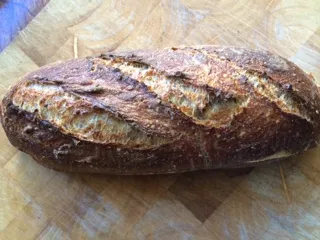
My wife purchased a copy of BBA as a birthday present some weeks back and I finally got around to using a formula from the book; in this case, the New York Deli Rye sandwich loaf. It is a definite keeper. I have been admonished to put a big star next to that particular formula.

The bread is a wonderful base for a corned beef and swiss cheese sandwich, to start with. We'll keep experimenting and see what else works, too. The onions in the bread are a a delicious complement to other savory flavors, but somehow manage not to overwhelm the other components.

Since it was my first attempt for this formula, I made sure to follow the instructions closely. I opted out of the use of caraway seeds, since my wife does not enjoy that flavor. Next time I may try either dill or fennel seeds, since it seems either of those would make a good flavor complement.

The use of commercial yeast, brown sugar and buttermilk in the formula were a bit surprising. I think that the buttermilk (and the shortening) contributed to the finished bread's moistness. For the next attempt, I will probably skip the yeast. My starter seems to have plenty of boost, so the yeast really isn't necessary to ensure an adequate rise. I do need to follow some of JMonkey's recommendations for increasing the sourness of the starter. Mine is more mild than wild in the flavor department, even with having refrigerated the second build of the starter overnight. A longer, cooler rise with no commercial yeast would probably increase the sour flavor.

The other thing that I should have done was keep a closer eye on the dough during the final rise. When I came back in from some outdoor chores to check on it, it was almost 2 inches above the edge of the pan, instead of the recommended 1 inch! Warm day plus commercial yeast--who'd have thought it? Anyway, I got lucky in that there aren't tunnels and that the bread holds together instead of crumbling in the middle of the slice, like some other over-risen breads that I have made.

All things considered, this was a very satisfactory experiment with a new recipe. And it will definitely be back for an encore.

longlivegoku's picture
longlivegoku

I have been on a quest for several months now to build a brick oven. I bought Alan Scott's book and also ordered some building CD's from a guy in Australia named Rado. While Alan's book was amazing (I will be re-reading it here soon) I ended up going with Rado's plans for what he calls a Masterly Tail oven. He gives amazingly detailed pictures of each step along with instructions for the mixtures needed. I think in all, I received 1000 photos of him building an MTO. Anyhow, I'm less than a month away (hopefully) from finally being able to bake and thought I would post some pics of the progress so far. It's been fun and a challenge to build. Fireclay was the only ingredient I've had trouble finding locally. I ended up running out yesterday while building the arches or there would be more done at this point. So it goes!

Hearth

Hearth with wall

One arch

maggie664's picture
maggie664

Have made this 3 times for my cafe and it sells rapidly. Blueberry and cream cheese combination is a new flavour combinatiion for New Zealanders. I drizzle a little lemon juice icing over the braid which adds to ita appeal. Thank you for the recipe as muffins are becoming passe

JMonkey's picture
JMonkey

A comment from Joe Fisher in this lesson I put together got me thinking about trying a really wet starter to see how it turned out. I usually make my sourdough with a 50% hydration starter (1 part water to 2 parts flour) which makes a really stiff starter. What if I reversed it? What if I had a starter at 200% (2 parts water to 1 part flour)?

Well, I tried it. On Wednesday, I converted part of my stiff starter to a 200% hydration starter and fed it about three times before making bread.

The result?

It was still sour, but a different kind of sour. Less tart, more smooth. I liked it. Now, it's possible that my starter hadn't fully adjusted to the super wet environment and I had some stiff starter microbes hanging out, I dunno. But I'm beginning to think that time and temperature may be much more important to the sourness of one's bread than the starter itself.

Anyway, I'm still keeping my starter stiff. Less chance of a spill in my cramped fridge, and it's easier to give away as a solid dough that a liquid. Fun experiment though!

Pat_T's picture
Pat_T

I finally overcame my anxiety and made bread dough in the food processor. I have the KA 11-cup (red, of course). I had purchased a book off eBay called the Food Processor Bread Book by the Editors of Consumer Guide. I was just too scared to try it. But seeing all of the pictures that another friend had taken of breads she had made in her FP encouraged me greatly.

So yesterday evening, I decided to make some cinnamon rolls for breakfast this morning, as I am taking a vacation day today.

I made the dough - just whizzed it right up. And was totally astounded at how easy it really was. Let it rise for about 2 hours (we keep it kinda cold in our house). Rolled it out, buttered it, sprinkled with cinnamon/sugar, and sliced into rolls. Placed them onto a silpat-lined 17 x 10 baking sheet and covered them with Saran wrap. Stuck them into the fridge.

I pulled them out about 5:30 this morning and sat them on top of the stove. While the oven was preheating, they rose a bit. Baked them for 20 minutes and had a lovely icing ready to spread on them while hot. Oh, the aroma was heavenly.

I only wish I had a digital camera so I could post a picture of how pretty they were.

Here's the recipe:

    BASIC SWEET DOUGH FOR FOOD PROCESSOR

This handy recipe really is a basic for many breads, coffee cakes, and rolls. You can add nuts, candied or dried fruits, and spices to the dough. Shape it any way you like - in rolls or buns, regular or round loaves, braids, twists, pretzels, rings, wreaths - whatever suits your fancy or the occasion.

1/2 to 3/4 cup warm water (105° to 115° F.), divided
3 Tblsp. sugar, divided
1 pkg. active dry yeast
2-3/4 cups all-purpose flour
2 Tblsp. instant nonfat dry milk
2 Tblsp. butter, cut into 4 pieces
1 tsp. salt
1 egg, beaten

Combine 1/4 cup of the water, 1 Tblsp. of the sugar, and the yeast. Stir to dissolve yeast and let stand until bubbly, about 5 minutes.

Fit processor with steel blade. Measure flour, dry milk, buter, remaining 2 Tblsp. sugar and salt into the work bowl. Process until mixed, about 20 seconds.

Add yeast mixture and egg to the flour mixture. Process until blended, about 15 seconds.

Turn on processor and very slowly drizzle just enough remaining water through feed tube into flour mixture so dough forms a ball that cleans the sides of the bowl. Process until ball turns around bowl 25 times. Turn off processor and let dough stand 1 to 2 minutes.

Turn dough onto lightly floured surface. Shape into ball and place in a lightly greased bowl, turning to grease all sides. Cover loosely with plastic wrap and let stand in a warm place (85° F.) until doubled, 1 to 1-1/2 hours.

    To make Cinnamon Rolls:

Punch dough down. Roll out dough into a 15-inch square.

Spread 1/4 cup softened butter over dough. Combine 1/2 cup sugar and 1 Tblsp. ground cinnamon and sprinkle over buttered dough. Roll up dough jellyroll fashion. Pinch seam to seal. Cut into 1-inch wide slices and place cut side down in greased 13 x 9 x 2 inch baking pan. Brush with oil. Let stand in warm place (85° F.) until doubled, about an hour.

Heat oven to 375° F. Bake rolls until golden, 15 to 20 minutes. Remove rolls from pan and place on wire rack. Drizzle with sugar glaze. Serve warm or at room temperature.

    Sugar Glaze:
1 cup confectioners' sugar 1 to 2 Tblsp. milk or strong coffee (I used half-and-half)

Mix sugar and enough milk to make a smooth mixture thin enough to pour.

    To make rolls for the next morning:
Prepare, shape, and refrigerate the dough the night before. Let stand at room temperature in the morning while the oven is preheating. Bake as directed above.

From Food Processor Bread Book, by the editors of Consumer Guide.

Joe Fisher's picture
Joe Fisher

Boy was this a busy weekend! Had the day off today, so I spent part of it baking.

First, the 'basic' sourdough recipe from The Bread Baker's Apprentice. Always a big winner.

Photobucket - Video and Image Hosting

Had a bit of a blowout on the boule ;) It probably could have used some more rising time before going into the oven. The oven spring was beautiful!

Here's Pane Siciliano, also from TBBA. It's a wonderful recipe. The interior is soft, almost fluffy, and the exterior has a nice crunch to it. The sesame adds a welcome nuttines.

Photobucket - Video and Image Hosting

The one on the end was supposed to be a spiral, but rose into something that looked remotely beehive-ish, then fell over :)

And here are my favorites in the looks department. I butchered a Pain de Campagne recipe in a bread book. The recipe was a 4-day recipe that told you to make a starter from scratch. I decided to use my rye starter (Clyde!) as the base, and modify the recipe to suit. Recipe follows.

Photobucket - Video and Image Hosting

It's comforting to know I can basically wing a recipe, and the experience from dozens of loaves lets me come out with a finished product.
The one that looks all knotted up is just that - it's a square knot made with 2 long pieces of dough. I put shallow slashes in it to make it look like rope. I think it came out pretty cool! I'm bringing it to my father-in-law who is a Boy Scout Scoutmaster.
Oh, and the donut is an off-cut from making the square knot :) It was delicious! teehee

Starter recipe:

9oz rye starter
5oz flour - bread and whole wheat in about a 4:1 ratio
4oz water

Mix, let sit overnight.

Bread recipe:
6cp bread flour
4tsp salt
1 1/2 cp water (+/- 1/2 cup or so to suit the flour)

Mix everything together, knead about 10 minutes until dough passes the windowpane test, proof 3-4 hours until double. Punch down, shape, proof 2-3 hours until double. Preheat to 450F, bake on a stone 25-30 minutes.

-Joe

Gedunkleberg's picture
Gedunkleberg

I haven't posted anything in over a month, but don't think I haven't been busy in the kitchen! The last time you heard from me, I was recovering from my first encounter with ciabatta. Since then, I have tried ciabatta for a second time, and with much greater success. What made the difference was flouring the counter heavily, as well as using flexible cutting boards to lift the risen dough off the counter and then slide the proofed loaves onto the baking sheet (I still don't have a baking stone). The shaping went better (thanks to step-by-step pictures on kyleskitchen.net), and I got some very nice, large holes in the finished product. I was quite pleased with myself, but there is still much work to be done.

One problem that I am consistently having with lean breads is crust color. I never seem to be able to achieve a nice deep brown. This may have something to do with another problem that has been plaguing me, which has to do with temperature. I always preheat the oven (mine is gas) for about a half hour, and I have a thermometer in the oven as well. But even when I follow a recipe to the letter, my loaves always seem to get too hot in the middle after a shorter bake time than the recipe calls for. I don't know what to do other than to always bake at a lower temperature.

I am also having trouble with scoring. I have only tried it twice (both times on the French bread recipe from BBA), but my results have been poor. The first time, I used a lame that I bought from a Viking store. I had a lot of difficulty slicing through the dough, so I can only conclude that my lame is lame. The second time, I tried a serrated knife, which worked much better. However, I can't seem to score the proofed dough without deflating it quite a bit. Also, the slashes don't "bloom" the way they are supposed to when baked. I am slicing fairly deep, but perhaps my slashes are too long or too horizontal. Or perhaps I am deflating the loaves too much and not achieving proper oven spring? I don't know, but I will try again.

One recipe that I had none of these problems with is the recipe for Portuguese sweet bread from BBA. No scoring needed, and the egg wash ensured a very deep brown crust...plus it was delicious. It's perfect for breakfast or a snack (with or without butter), especially alongside a nice juicy peach and some Greek yogurt drizzled with honey. Yum. I substituted orange and lemon zests for the orange and lemon extracts, because I didn't want to shell out the extra cash. The substitution worked well. I will definitely make this recipe again soon.

Mini Oven's picture
Mini Oven

Submitted by Mini Oven on June 17, 2006
Taking a tip from SourdoLady and since I had a little orange juice (that I didn't mix with Campari) I tried mixing it with oat flour. I'm curious if it is any faster than the process I used for my wheat starter. Smells like breakfast (like the OJ got poured into the cereal). What do you think of "Breakfast in China?" Smell it once a day. It is three days old and maybe I'll add more orange and oats. I'm very patient and it helps to park it out of the kitchen. I refuse to "watch the pot." My other starter is on holiday... no name. No guilt when i pitch it.
Bought more wheat flour and I'm back to step one. Seems like every bag has it's own idea of how it should be baked. Yesterday, hocky pucks, today I added oat flour and they came out super. It's enough to drive me crazy sometimes.

Strong Oat Starter

June 21, 2006
Breakfast in China or Chinese Breakfast is officially a starter. I added more flour and orange juice and within the hour it had gone thick, bubbly and doubled. Smells wonderful. Now the orange juice can go back into the Campari. In this heat, 44°c the ice cube tray is wearing out but my Chinese Breakfast is keeping cool in the living room. I think the name is too long... Chuzhou Sourdough is also a possibility and our ancient nearby park including Lang Yashan Mountain. O heck, let's be Chinese and call it: "Sourdough Breakfast with SourdoLady on Lang Yashan Mountain with Oat flours in her hair" in honor and praise to SourdoLady.

Tonight I will add one cup white wheat flour and 8 oz water, beat it and mess with it in the morning
Next Day: Mixed it real good and Took out one cup starter for the fridge. Then one cup for my recipe (780gm loaf) and the rest went into dry dock taking dulke's advice and pouring it out on baking paper on a tea tray to dry.

June 22, 2006
I didn't use any baker or commercial yeast but did a 3/4 cup each flour and water poolish using my Chinese Breakfast bowl with some of it still clinging to the sides ( as I moved the starter to a bigger bowl). Today as I came back from the market, the dough had trippled and still on the go. (It wouldn't degas by dropping or banging the bowl.) I shaped some rolls aprox. 95 -100gm each and will have some fun with my scissors.

Today I will test out my new stainless stone. Now I know some of you will think it's not "earthy" but steel doesn't come from outer space and this particular plate was fashoned with lots of TLC. I bake with baking paper because of the fantastic non-stick lift I get, and it doesn't breathe either. As the bread lifts, it also separates from paper and "stone" so I think the major point of the stone is to give that continous concentrated heat right there at the bottom center of the loaf and has less to do with "breathing." I'm curious, did anyone ever try baking a loaf on a hot cast iron pan or griddle?

Yep, Oat Starter
Submitted by Mini Oven on June 25, 2006
Yes, Oat starter and it formed rather quickly too!
Well I don't know if it is the heat or air pressure, my dough in the air-condition room or because of the nature of the yeast but it seems to produce a lot of rise in the first 3 hours and then get lazy. By the time I want to bake it, it gets down right sleepy. I got a picture of my Barley loaf (later please) and granted it is a little flat. Seemed the longer I let it rise, the worse the skin tention, it developed rips and tears and wouldn't hold a shape. I did use a lot (over 50%) of barley flour, like I would with rye and also white wheat and oat flour. I kneaded with wheat. It also stuck to my heavily floured cloth when I tried to basket it. So it did get knocked around.

The next loaf, will be a white wheat/oat one with pure oat starter. If it acts the same, then I'll have to skip the doubling rise and shape after a 30 minute rest from kneading. If that doesn't work, I'll add comercial yeast to stabilize it. I'm at or just below sea level and I need all the lifting help I can get! The bread does taste sour enough and barley has a slight bitter taste that I'm not used to. Make better bread sticks snacks for beer and the next Argentinian game! Now, That's an Idea!

And the next loaf...
Submitted by Mini Oven on June 27, 2006
And the next loaf is taking it's dear sweet time. Isn't it funny, just when you think ya know something, your dough has other ideas? But I think I know why, I'm always experimenting and what I did last time with my starter was to feed it and pop it back into the fridge. a couple of days have past but I guess that just wasn't long enough for my cold (5°c) starter. I will go back to my old habits of leaving my starter out till it rises and falls. But I think there is still something funny going on and will figure it out.

While I was waiting, I whipped up a batch of Sweet Corn Raisin Bread and like the recipe with only two changes: honey for sugar and nutmeg. I used real medium ground cornflour and also added the flour very slowly, very slowly, with lots of beating in between. Very nice skin this time and you are soon to see what my scissors has done. (If I can only get my picture to be accepted by this program.)The house smells lovely! It was fun to see something rise the way it should.

Barley flour 25%
Submitted by Mini Oven on June 29, 2006 - 8:18am.
At the moment, I've got problems and I think it's the Barley flour. Seems everytime I use it, my yeast refuses to cooperate. I was noticing that barley can be full of alpha-amylase. Could too much of this be killing my yeast? My loaf has been sitting in a 23°c living room since noon yesterday. It never really doubled so after 8 hours, I did a final fold and shape and put one in the fridge and left the other one out, covered to rise. It's now morning and nothing. Pulled the loaf from the fridge and set them both outside where it's warmer. We are expecting thunderstorms soon.

The oat starter on the otherhand is brewing away. How can this be? I cut the loaf to look for bubbles and some are there, not what I'd expect. Reshaped into rolls, and stuck into a plastic bag to rise. I am going to start a serious experiment to test my starter and the reaction of the flour to it. I will take two spoons of starter, put into two small bowls and mix one with barley flour and the other with oat. Could it be that barley neutralizes the pH? Add to my experiment: two more spoons of starter, two bowls, barley, oat, but with a little orange juice in each. I need a control so one bowl gets only starter. Covered all five bowls with plastic wrap and wait for a reaction.

My husband is telling me to stop breaking my head over it and go back to adding comercial yeast. Looks like this batch are doggy biscuits. Is there anything I can do without overworking the dough?

Letting the whole grain flour soak for an hour helped a great deal and the satiny texture looks good. Even now the surface is intact and smooth. Unfortunately it just lies there. :(

11:00 ....Dough 1 cm higher. I just baked the buns, cut them through first to look for bubbles, a few. Then stretched them into sticks. After one hour, baked them. they did puff up in the heat. Broke one open, does have air pockets. Taste? Bitter but rye like with aftertaste like chewing on aspirin. Crumb? Still hot but not bad, no soggy or heavy spots, little tiny bubbles. Suggestion? Forget Barley bread and leave it for beer and whiskey production. If I bake with it, then in very small quantities under 10%.

Oat/barley experiment looks so far like this: after 3 hours, nothing much going on in all 5 bowls and hard to see bubbles. So at 11:00 added to all bowls: 2 tsp water, tsp white wheat flour, pinch of sugar, stir one minute. Plastic wrap back on and wait.
15:00 Looks like no bubbles in barley-water, and very little action in control starter with white wheat flour... AHA! Barley with orange is thick and bubbly, so is oat and orange, pulling up second is oats and water. What does this mean? What did I do? Develope an oat starter that only works with oats or orange juice? (And I complicated matters by alternating oat and wheat flour when feeding my starter.)

For all practical purposes, since I'm not about to add orange juice to every recipe, the starter I made only works with oat flour. White wheat & Oat Sourdough Bread recipe will need oat starter for the oat flour and commercial yeast for the wheat flour. But will the sour have a chance to develop? Guess I should bring my wheat starter back from holiday. Then if I want pure wild yeasts I would have to use TWO starters for my sourdough bread. Does anybody else have a combo going on? I was looking through the write ups and can't find anything specific. Is this covered in Bread Baking 101?

rmk129's picture
rmk129

This blog entry is so that I don't forget what I did to make this loaf when I lose the scrap piece of paper I wrote it on :)

50% Whole Wheat Sourdough Bread 1 1/2 cups proofed white sourdough starter 1 1/2 cups warm water 2 Tbsp oil 1 Tbsp brown sugar 3 cups whole wheat flour ~1 cup of white flour 1 1/2 tsp salt 1 Tbsp vital wheat gluten

Baking schedule: -mixed together all ingredients (except salt) until moist -20 minute autolyze -added salt -kneaded with mixmaster for ~5 minutes 0 hrs->put in greased, covered bowl for first rise 2 hrs->folded dough 4 hrs->folded dough 5 1/2 hrs->shaped dough into two small round loaves and put them in my basket & tupperware "cloches" lined with floured dishtowels, then tied a plastic bag around the cloches. I put one in the refrigerator to retard overnight, and left the other out for the second rise. 9 1/2 hrs->sprinkled semolina flour on the exposed portion of dough mass (still in cloche), then carefully inverted onto baking mat, scored, and put in preheated oven

Still in oven right now...unbelievable oven spring!!!

Floydm's picture
Floydm

I made a simple dough this morning with the intent of making some type of a picnic bread today. Something with cheese and onion, perhaps olives or sausage mixed in. But then we ended up picnicing at the lake today as well. After a long day in the sun, I just couldn't face the prospect of baking in 90 degree weather. Actually, it wasn't the baking as much as having the house heat up, particularly the upstairs bedroom, which get sweltering on hot days. So I froze the dough for a later date.

The heat did not stop my son, however:

His toy broom, which has hardly a bristle left, has recently been transformed into a peel. A super peel, perhaps?

;^)

He spent a good half hour loading and unloading loaves in the oven (hot tub lid) while we made dinner.

Pages

Subscribe to RSS - blogs