The Fresh Loaf

News & Information for Amateur Bakers and Artisan Bread Enthusiasts

Xenophon's blog

  • Pin It
Xenophon's picture
Xenophon

Last week I was getting ready for a short easter break when I realized I still had some kalamata olives, fresh rosemary and an opened pack with assorted italian cold cuts (salami, cured ham...) lying around in my fridge.  It was all a bit too much to eat in one go so I decided to try my hand at a foccaccia-inspired bread that would incorporate all these ingredients.

The result was surprisingly tasty; I didn't have high hopes -especially because I wasn't working from a recipe- but it turned out really well and very tasty.

Preparation and recipe:

a) Spread the fresh rosemary in a baking pan and put in a cool oven (I used 60 centigrade) with air circulation on for a couple of hours.  The rosemary has to be dry but keep temperatures low or you'll lose some of the flavourful organic compounds.

b) Place the cold cuts into an oven dish and put it under the grill until they start getting crispy/crumbly when cooled.  Use tissue paper to blot up the fat that comes out (optional).  Allow to cool and chop/crumble into pieces.  Roughly chop the kalamata olives.  Reserve.

Formula:

- 500 grams white bread flour.

- 300 grams water, room temperature (which in my case was 31 centigrade)

- 7 grams bread machine yeast

- 15 ml (1 TBSP) of fine quality olive oil

- 100 grams roughly chopped kalamata olives

- 100 grams pumpkin seeds

- 50 grams dried and crumbled/cut cold cuts

- 7 grams (1.5 tsp) of rosemary, ground to powder

- Couple of sprigs of dried rosemary to decorate the crust

* No salt was added as the olives and dried cured meats are already salty but this is a matter of individual taste.

Straightdough method.

Combine flour, yeast, water, olive oil and mix well until absorbtion.  Allow to rest for 10 minutes after initial mixing, then knead vigorously for another 10 minutes.

Bulk fermentation until the volume has doubled (in my case, with the generous quantity of yeast and the high ambient temperature this took 25 minutes)

Punch down/fold the dough and roll it out into a rectangle that's about 1.5 cm thick.  Spread the meat, powdered rosemary, pumpkin seeds and chopped olives on the dough, fold closed and give a short kneading to mix in everything.  The objective is to obtain an even distribution but don't knead too long or the olives will turn to mush. 

Shape into a batard /oval shape, roll through some dried rosemary leaves and place in a well-oiled pullman pan (2 liter). Brush on a slight coat of olive oil.  Preheat oven to 210 centigrade.

Bench rest until doubled in volume (in my case once again after a mere 20 minutes), put the lid on the pullman and insert into oven.  Total baking time was 45 minutes, after 25 minutes I removed the lid from the pan so the top crust could brown.  Remove from oven/pan and let cool on a rack.

The result:

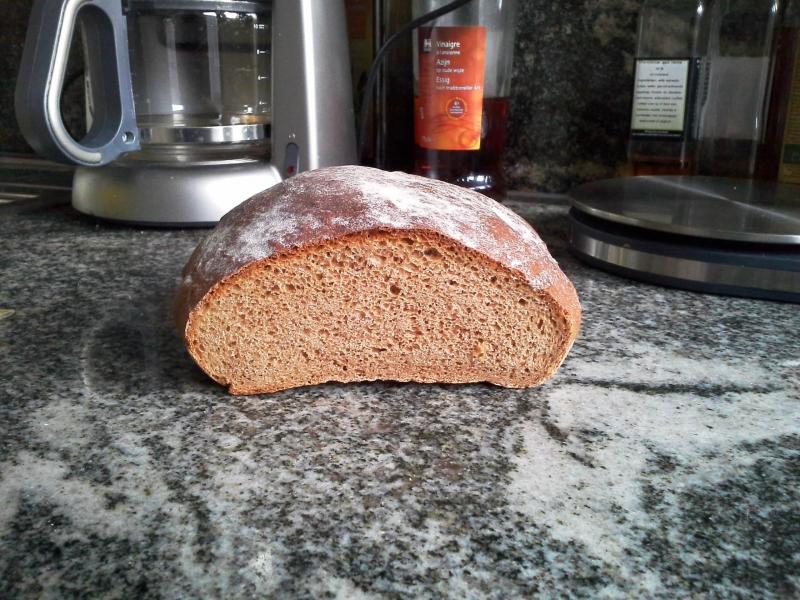
The crust was delicate but very crunchy and the taste and aroma delicious so while it was a hastily improvised experiment I'm quite pleased with it.  Did I mention it tasted fine also ;-)  Of course the quick rise times and absence of pre-ferment precludes any real taste development in the dough itself but in this case that's not an issue as taste was mainly a matter of the rosemary, olives and the meat.


Xenophon's picture
Xenophon

A couple of days ago I decided to try my hand at Jeffrey Hamelman’s Vollkornbrot with flaxseeds.  I did this with some trepidation because

a)     I’m a western expat living in New Delhi, India and THE key ingredient (rye flour) is not available here, meaning that I have to bring it in from Europe on each trip.  This one recipe  would blow about 1/7 th of my precious supply.

b)    The recipe as per Hamelman requires the  use of a sourdough starter, used to create a long fermenting sourdough and two soakers (flaxseeds and rye chops) .  To these are added the last fraction of the rye meal and the salt + some water and yeast so it’s not exactly a straight dough setup with minimal rise time.

The original recipe can be found in ‘Bread’ by Jeffrey Hamelman, I’m not going to reproduce it here for the obvious copyright reasons.

Modifications vs the recipe:

a)     I didn’t have rye chops and there’s no way for me to acquire those here.  So I used pinhead oats (also called steel cut oats) instead.  This worked without a hitch.

b)    One of the big challenges of baking breads here is dough temperature control.  We’re past the peak of summer but still, the temperature in my kitchen is about 35 centgrade.  This is an obvious problem when using ‘long’ rise times/preferments etc.  What it boils down to is that I shortened the sourdough rise time from the recommended 14-16 hours at around 21 centigrade to 9 hours at 33-35.


The dough (detailed instructions see the recipe in the book):

For the sourdough I used a sourdough starter that had been initiated 3 months ago, it started out as a rye sourdough starter but has been refreshed countless times with normal bread flour so it’s totally white now.  This is added to 100% rye flour and water.  Hydratation is 100% at this point.

While this is covered and put away to start its long rise, a flaxseed and –in my case- a pinhead oats soaker were prepared.  I added all the recipe’s salt to the oats soaker in order to inhibit enzyme activity (long rise at high ambient temperature).

After 5 hours I could definitely see activity in the sourdough, based on the look/consistency and the taste I decided it was ripe after 9 hours of fermentation.  Tasting/feeling/looking are imho the only sure ways to determine ripeness.  Let it ferment too long and the taste becomes harsh/vinegary.

Everything was brought together with some extra rye flour and mixed at slow speed for 10 minutes.  Bulk fermentation took 15 minutes.

After bulk fermentation I had a very slack, sticky dough that proved almost unmanageable and had a very dense texture.  This was dumped in a large cake tin (no pullman form available) that had been oiled and covered in rye flour.  I used a spoon to flatten the top somewhat.

Baking:

First 15 minutes in a hot oven (245 centigrade)  with steam, followed by 1 hour 15 minutes at 195, dry.   Hamelman remarks that a full bake is imperative and I concur, given the high hydratation and the density.

Unpanning and cooling:

15 minutes before the end of the bake time, the loaf is taken out of the baking tin (very easily, no stick at all) and baked off the remaining 15 minutes to remove some extra moisture and firm things up.

After baking I was stuck with what literally seemed to be a very dense brick.  This then has to cool/rest between 24 and 48 hours so the internal moisture has time to redistribute.  It took an almost superhuman effort but I managed to wait 30 hours.  Don’t give in to temptation, I think the bread really requires this long rest before slicing.

Some pictures: 


Rye sourdough with flaxseeds and pinhead oats after unpanning and cooling for 30 hours at room temperature.


As you can see, the crumb is very, very dense and looks underbaked.  However, it looked and tasted exactly like the German whole grain Vollkornbread that’s for sale in (North) Germany.  It can be sliced very thin (4 mm is not a problem at all) with a serrated bread knife and the taste is slightly sweet, nutty with a delicate sourdough tang.  If you really want an extremely pronounced sourdough taste I guess you’d have to let the sourdough ferment a couple of hours more.  The bread goes very well with cured meats, jam, (dark) chocolate spread and cheeses that have a pronounced taste.


Big warning: Only try this and the other Vollkornbrot mentioned by Hamelman if you really like very dense German breads like Pumpernickel (the German version, has nothing in common with what's sold as such in the US).  Do not try to make rolls or smaller loaves as the crust is very hard indeed and -in the case of rolls- these would be inedible because this bread can only be enjoyed if you slice it really thin.

Subscribe to RSS - Xenophon's blog