Submitted by LLM777 on August 31, 2009 - 10:21am

Question about folding

I am using Floyd's Whole Wheat bread recipe on the site and it says to stretch and fold 2-3 times during bulk rising. Does that mean during the 60-90 minute rise I am to interrupt it and fold the dough every 20-30 minutes and if not, what is the technique?

Thank you for your help. :)

Submitted by mountaindog on February 6, 2009 - 7:38am

More dough mixing trial and error


This is in response to Trailrunner's questions on a mixing discussion over at Hansjoakim's blog here on a fantastic-looking crumb he has on his Hazelnut bread.

Lately I seem to get best results with a combo of warm shorter bulk ferment with frequent early folding and long cold final proof. No mixer, no kneading with flour, no repeated French-folding. (warning, this could change as soon as I read of a better method, so please take with a grain of sea salt!):

  • Hand mix all the ingredients with a large dough whisk in large bowl (incl. salt)
  • Cover and let rest (autolyse) for 30 min. (I know you are supposed to leave out the salt but I find it easier to mix everything initially if not using a standmixer)
  • After 30 min. rest, use plastic dough scraper to fold dough onto itself in the same bowl, just like what Mark does in his video here. I count to about 100 as that takes me just about 3 min., and that has seemed to develop the dough well.
  • Next round up the dough with scaper and place it into a clean, lightly spray-oiled lidded dough bucket - or for large-size doughs where I double or triple the formula, I use a big square clear plastic food service container with lid.
  • Let the dough sit for 30 min. (preferably at 76F location), then do a single stretch & fold as per Hamelman: if dough is in smaller bucket, tip the dough out onto a lightly spray-oiled counterstop, stretch it out into a rectangle, and letter fold it onto itself once, rotate 90 degrees, letter fold again, and put it back in the bucket for another 30 minutes. If dough is in big square container, just fold it right in the container and turn upside down when done.
  • Repeat step above 2 more times for a total of 3 folding sessions spread 30 min. apart. Then leave the dough to finish bulk-fermenting at 76F, usually for another 90-120 minutes until just doubled (my home-made starter is not that fast a riser).
  • Next shape loaves, then I place the shaped loaves in a 45-50F location (my unheated mudroom) to retard overnight or 12 hrs min.
  • After cold retarding I place the proofed loaves in my room temp (65F) kitchen while I preheat my baking stone for 45 min. and bake with steam right after that, usually the loaves are proofed enough after all that time retarding, and the oven spring is great.

Here are results of a less slack dough (65% hydration pain au levain 10% whole wheat), not huge holes like you'd get with a very wet dough, but large enough and evenly distributed, and very flavorful crumb, chewy but not gummy:
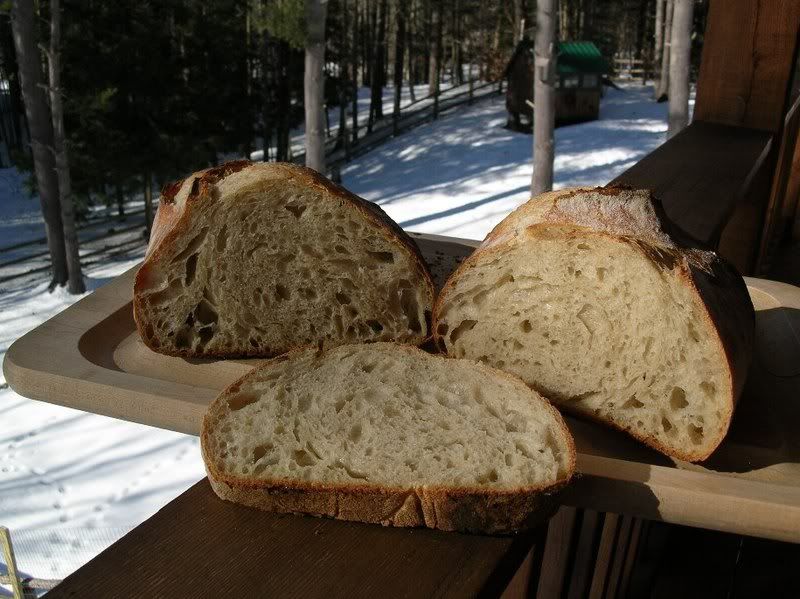

I still need to try SteveB's double-mixing technique he describes here. If anyone sees any error in my ways with how I've been doing this, I'm all ears! I'm sure I'll revise this after I read Advanced Bread and Pastry, due in soon.

Submitted by mcs on August 29, 2008 - 7:10pm

the latest video from The Back Home


The Fresh Loafers, This is the latest video where I'm working with some higher hydration (68%) doughs. Both of the breads are 'originals', and if you'd like to see the recipes you can probe around here for them or email me at the bakery. Anyway, I hope you like it. I decided to forego music this time and just add commentary. Nothing witty, strictly business. -Mark


Submitted by nosabe332 on March 16, 2008 - 11:55am

how does rise time work?

i have a general question to all those experienced bakers.


let's say a recipe says to let the dough rise until doubled, or about 2 hours. then punch it down/fold andd let rise again.

what if my schedule is such that i have to do the folding before the dough has doubled in size? can i compensate with a longer 2nd rise?


i'm making a ciabatta and i see that the ponsford recipe calls for folding at 20 minute intervals for an hour. how would this differ from doing all 4 folds at the same time and letting it rise for an hour thereafter? 

Submitted by mcs on March 12, 2008 - 10:52am

Kneading and Folding video- Español


Hey everybody. This is the same kneading and folding video as before, but with Spanish subtitles for the commentary, thanks to fellow FreshLoafian, Joe Martello. I have an Italian and German version in the works, and am looking for someone to transcribe it in French. If you're interested, I can send you the English version in Word, then you can put the matching French sentences underneath the English. Thanks.

-Mark


Submitted by mcs on February 4, 2008 - 8:39pm

kneading and folding re edit - video


Hey there everyone,

This is the *new and improved* version of the kneading and folding video I posted a couple of days ago. As per some of your suggestions, I addressed the volume levels, intro commentary and video angles. I like it a lot better, and I hope you do to. In addition, I used Hamelman's multigrain dough this time, instead of whole wheat. (Floyd, could you put this video on the first thread also instead of the first video? I removed the first one already from YouTube- thanks in advance). Next video will be on shaping.

-Mark

Submitted by mcs on February 2, 2008 - 10:59pm

a kneading and folding video


This is another video that my wife and I put together on kneading and folding. Just a little more detail than the PSB video with some commentary. Hope you guys like it.

Submitted by staff of life on November 3, 2007 - 1:50pm

Folding, windowpaning and dough strength

Are we supposed to assume that when a dough reaches the point that it windowpanes, the dough has enough strength?  I let my white sourdough reach just that point in the mixer the other day, and did not fold it.  It seemed a bit slack to me, but I was experimenting.  The result was a slack dough that spread quite a bit in the oven. (I did the final proof in a banneton.)  I have also taken that same formula and given it folds to the point that in the oven, it bursts because it's too strong.  How do we assess when I dough has hit that magic point of being strong enough but not too st

Submitted by bwraith on April 7, 2007 - 7:19pm

newbiebaker - 2nd rise, dough spreading out


Hi newbiebaker,

---

with a very wet dough, how do you get it to hold its shape during the second rising period? because, while letting a loaf do its second rise, it turned into like a giant pancake almost... or was this too wet?

---

Submitted by mountaindog on March 18, 2007 - 10:20am

Big Improvement: Oven Spring and Folding


I've been real busy the past few weeks so have not been online much, but did make time to bake each weekend.