SearchUser loginRecommended BooksFavorite Recipes
|
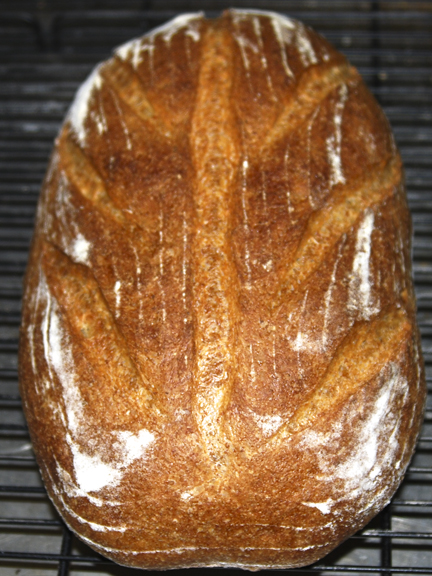
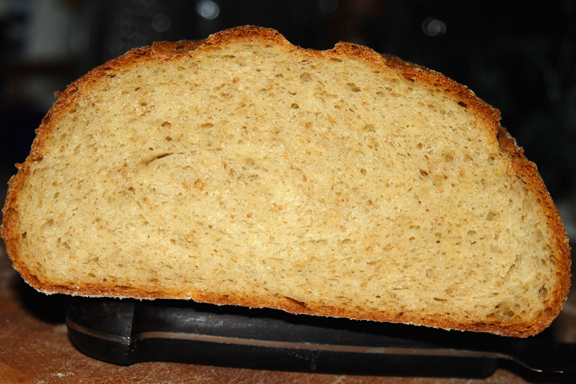
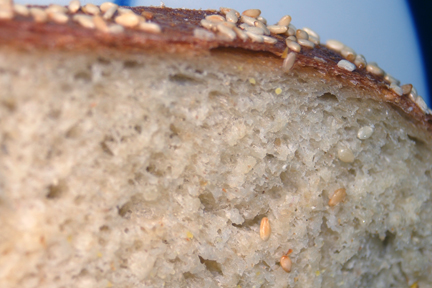
Submitted by ehanner on January 23, 2010 - 11:37pm My Take on DSnyder's Improved Greek BreadI've never had really good Greek bread. But, I have heard enough about how great it is that I've been interested in working on it for some time. When dsnyder and I were discussing the formula a while back, he let on he has a daughter-in-law from Greece and maybe she would help tune this up to a respectable loaf. Here is Davids posting of the improved version, after experimenting with his DIL. I followed Davids suggestions except for the mixing and folding. I mixed in my DLX after a 30 minute rest, for a total of 3 minutes, using the roller. Then I folded it 3 times in a bowl over the next 3 hours as it fermented. It was a silky smooth dough, very nice to handle. After dividing in two and pre shaping, I tightened the boules and placed them in linen lined baskets for proofing. It took 1-1/2 hours for the proof and the dough temp was 74F. I also added a few drops of toasted sesame oil to the dough, hoping to get some of that great aroma and boost the lightly toasted seeds on the surface. I'm afraid I would say the desired effect of the oil was not realized. There is a definate sesame aroma but I think it's from the seeds. After reading Davids comments about his oven temperature and the brown color he got, I thought I would start with 430F and reduce to 410 when I rotated the loaves. The crust color isn't as dark as it appears. I like the color but I also think it could be a little more golden and less orange/brown. A lower and slower bake perhaps. There is a little bitterness in the taste I'm not sure about. I don't have a lot of experience with Durum flour. Does anyone know if that is normal with Durum? My daughter was bugging me to cut it so after 20 minutes I relented and had her carve it up. There isn't a hint of sweetness, with 2 T of honey, I'm a little surprised. Eric
Submitted by thewat on January 4, 2010 - 2:45pm Italian sesame / olive oil flat bread / cracker?A year or two ago I spent a week in Marche, Italy, and at two separate bakeries - one in Ancona and one just South - I bought a flat bread / cracker, 1/2 to 3/4 inch thick, loaded with olive oil & sesame & sunflower seeds. It was thick & crunchy but not dry tasting (because of all the olive oil). I could see the sunflower seeds & taste the sesame. It looked like it had been a really wet dough, cooked in a rectangular pan. The second place I got it said it was called "Pizza Seca." I can't find anything like it, either in my books or on the web. Anyone know? I found it slightly addictive. Submitted by Susan on December 6, 2009 - 10:45am Seedy Triangle SDJust yesterday's bread...
100g starter (100% hyd.), 315g water, ~1/4 cup mixed sesame seeds, 9g salt, 1 tsp toasted sesame oil, 400g All Trumps high-gluten flour, 50g coarse whole wheat flour Keep your dough close to 76F throughout mixing and fermentation. Mix starter and water. Add seeds, salt and oil, mix. Add flours, mix just until flour is wet, rest 30 min, fold 3x at 30 min intervals. Let rise until near doubled. Shape, put in triangle brotform, and deposit in fridge for overnight. Bake at 500->460F after an hour out of fridge, under cover for first 20 minutes. It's a little lopsided 'cause I swiped the loaf with the edge of the roaster as I covered it. C'est la vie! Susan from San Diego Submitted by subfuscpersona on June 18, 2009 - 12:26pm Sourdough Sesame Seed Spelt BatardsFor over 3 years I've been baking artisan style breads in my (really lousy) gas oven without a baking stone but was never quite satisfied with the result. I finally purchased a good baking stone. This is my first effort with the baking stone... Sourdough Sesame Seed Batards with Spelt Flour The height of each of these batards is about 4 inches (compared to the 3-1/4 inch height I got without a stone) for a similar type of dough and prebaking dough weight. The recipe (one of my own devising) uses a white flour 100% hydration sourdough starter. About 20% of the total flour weight is spelt flour (home milled from organic spelt). In an attempt to add sesame flavor to the bread without compromising rising, I use 8% sesame seed meal, which is ground from whole sesame seeds using a small electric coffee mill. Additional sesame seeds are on the outside of the dough. Dough hydration is 68% I am pleased with this first effort using my new baking stone, although I obviously need to become familiar with this newest addition to my bread baking equipment arsenal. Onwards and upwards - SF ========================== For those who are interested, this stone is a Dacor baking stone. It is 1/2 inch thick and measures 15" x 20". This was a good size for my oven, as my oven rack measures 17" x 25". I believe that smaller size baking stones from Dacor are marketed under the brand name Old Stone Oven; these smaller stones are widely available. The stone was purchased from fantes.com for $50 USD plus shipping. The packaging was excellent and shipping was prompt. I am including two images of this baking stone from the fantes.com site in this post to give an idea of what the baking stone looks like...
Submitted by SteveB on March 7, 2009 - 2:10pm ScaliFor those who might be interested, I've detailed my baking of Scali here: http://www.breadcetera.com/?p=164 SteveB Submitted by LindyD on January 15, 2009 - 6:42pm Jeffrey Hamelman's sourdough seed breadMy daughter’s birthday is this week and as she loves hearty, artisan breads, I decided to bake Jeffrey Hamelman’s sourdough seed bread instead of a cake. I used King Arthur bread flour and Arrowhead Organic rye. The seeds were purchased from an organic food coop. The recipe was tweaked a bit. Liquid levain: The recipe calls for a liquid culture. I opted to try one ounce of my stiff sourdough culture straight from the refrigerator [it had been refreshed the day before] as an experiment.
Mix the levain and allow it to stand (covered, at 70F) for 12 to 16 hours. The photo shows my levain about two hours after it had been mixed. Flax seed soaker: After you’ve mixed the levain, place 2.2 oz. flax seeds in a container and gently add 6.7 oz. cold water. Cover and let stand for 12 to 16 hours. As the flax seeds absorb the water, the mixture will appear gelatinous.
Toast the sunflower and sesame seeds: The sunflower seeds were toasted on a cookie sheet in a 325F oven for about 20 minutes (stirred occasionally) until browned. The sesame seeds were browned in a cast iron pan over direct flame. Stir constantly or they’ll pop out of the pan all over your stove top.
The toasted seeds were mixed together (smelling oh, so heavenly), moved to a glass bowl, then covered and allowed to rest overnight so the nutty flavors could meld. Day two: Mixing, fermentation, shape, and retard: The desired dough temperature is 76F (see note at the end of this text).
All of the ingredients were added to my KA spiral mixer. Hamelman instructs to mix at first speed for three minutes, then at second speed for another three minutes. I think Bread was written primarily for professional bakers and that those mixing instructions are for a heavy duty commercial mixer, so I don’t follow them.
I used the first speed only long enough to make sure the levain, water, salt, flour, and seeds were well mixed, then let the dough autolyse for 20 minutes. After the autolyse, the dough was moved to my counter top where I stretched and folded until it felt supple. Bulk fermentation is 2.5 hours. The dough next was placed in a bowl for the bulk fermentation. I folded it twice at 50-minute intervals.
I retarded the bread on a full sheet of parchment placed on a three-sided cookie sheet. These three loaves were placed in a large food-grade plastic bag and moved to the refrigerator. The recipe calls for two large loaves, but I prefer three smaller loaves.
Final fermentation: The final fermentation can be up to 18 hours at 42F. Day three: Bake and cool.
These loaves rose nicely during the final fermentation and even while unbaked, the perfume of the toasted seeds was quite wonderful. The retarded breads had about an hour’s warm-up time while the oven was preheated to 460F. They were scored and moved to the hot oven stone, then half a cup of hot water was dumped in the broiler pan under the stone. Total bake time was 45 minutes. The fragrance of the cooling bread was awesome.
I’ll give myself a “D” for scoring, but at least it’s a small improvement.
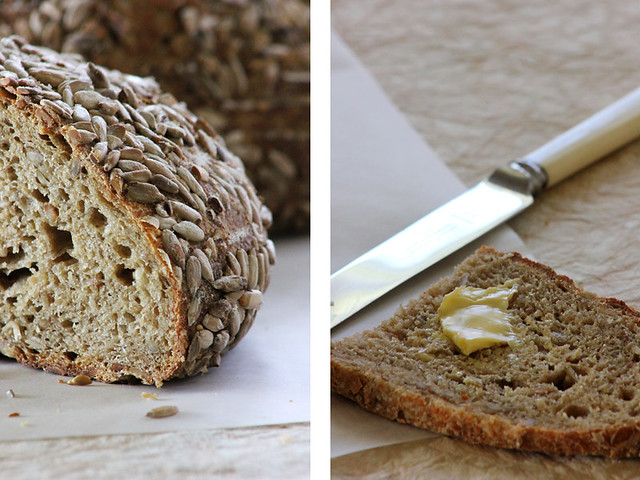
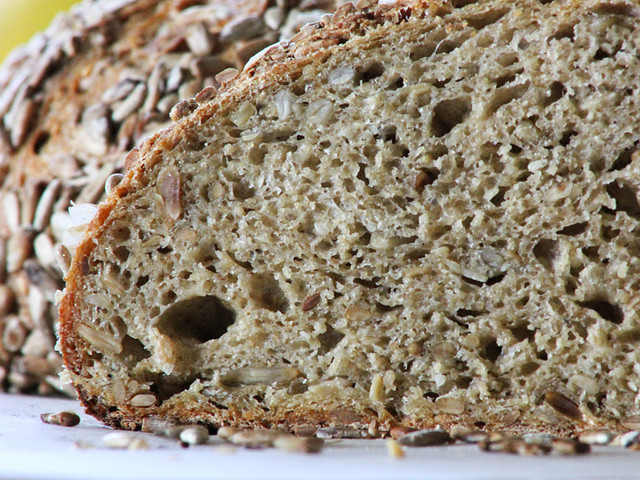
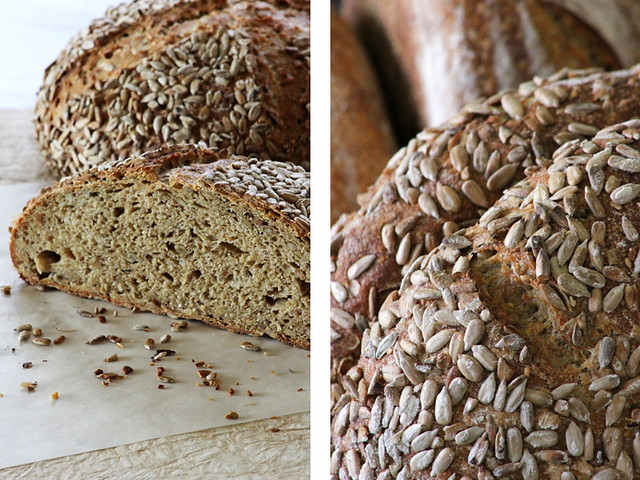
I waited 24 hours before slicing the bread, to allow the flavors to combine and mature. The mix of the sunflower, flax, and sesame seeds, combined with the caramelized crust, provides a burst of flavor that borders on smokiness. I loved the taste, fragrance, and texture of this bread. A different take on crumb: The kids and grandkids claim that too many holes means there’s too little bread, so they call it diet bread. This should make them all happy.
If you enjoy an aromatic hearty bread, I’d encourage you to try Hamelman’s SD seed bread. It's delicious toasted for breakfast, or with a bit of unsalted butter with a salad. Or even plain! Now, about desired dough temperature. If you have Hamelman’s Bread, you’ll have read pages 382-385. If you’re not familiar with the term, it is a formula used to determine the correct temperature of the water to be added to your flour and other ingredients. It makes a difference in the quality of your bread. Rather than reinventing the wheel, I direct you to WildYeast's blog where she so masterfully covers the subject and even provides a free downloadable calculator. (Thank you, Susan!). |
Advertisement |