The Fresh Loaf

News & Information for Amateur Bakers and Artisan Bread Enthusiasts

Blogs

  • Pin It
d_a_kelly's picture
d_a_kelly

I saw on thefreshloaf people talking about brioche feuilletee (I think the topic was started by andythebaker), specifically this link: http://www.parispatisseries.com/2011/05/03/la-patisserie-des-reves-brioche-feuilletee/

I was amazed by the crumb shot, but I didn't have a recipe so thought nothing else of it. Well, eventually I found a recipe and had a go. Not quite in the same league as the link, but they were lovely and delicous. Unfortunately I don't have the recipe to hand (it's in England and I'm not) but I'll post it when I can, for whoever's interested. 

I remember the recipe called for steel circles of 75mm diameter. I don't have these, but these little pirottini I bought from bakerybits were almost the same dimension. One word of warning here, I definitely rolled these too tight - halfway through proving I had to carefully unroll them and then reroll. I'm sure this damaged the crumb structure, but they were clearly struggling to expand in the centre. 

Here's my crumbshot:

The walls of the cells could be thinner, and the centre was a tiny bit denser than the rest, but to be honest, they were absolutely delicious. When I make them again I'll roll them much more loosely to start, to see if that makes a difference to the crumb. And I'll definitely make them again!!!


David

d_a_kelly's picture
d_a_kelly

Hi bakers everywhere,

this is my first bake in my temporary kitchen here in Perugia, Italy. I saw the recipe on Paul Hollywood's Bread on the BBC and, as he had stuffed it with Italian flavours, it seemed a suitable thing to try. I was dubious of the little oven I have here, which looks to be older than I am (and my oven therometer is still in transit) but, on the whole, I was happy with the result. It's pretty easy to make, and as light as a feather, dripping in melted cheese and salty prosciutto. Well done Paul Hollywood!

I slightly scaled down the recipe as his seemed to produce something far larger than I wanted. All measurements in grams.

strong white flour 300 (I used farina manitoba, which is like a very strong white in UK) 

salt 6

fresh yeast 12 (fresh yeast is easy to find here in supermarkets, but instant yeast almost impossible - the reverse of UK! I'd use 6 of instant if that's what you have)

whole milk at room temp 102

whole eggs 120 (this worked out luckily as exactly 2)

unsalted butter at room temp 150 (83% fat)

parma ham 6 - 8 slices

buffalo mozzarella 250 - 300

a bit of fresh basil

grated parmesan 

egg for glazing


Dissolve the fresh yeast in the milk and leave until it becomes bubbly (or use instant yeast and skip this step). Add the flour, eggs and salt. This is a soft dough so it's best done in a machine. I wouldn't want to try this one by hand! Work it until the dough is formed and then slowly add the butter. The dough is ready when it starts to come away from the side of the bowl and has a shiny surface. It's important to add the butter quite slowly. I think in total it took my about 10 minutes, but I had left the dough to autolyse for 15 minutes or so before I began working it. Leave in a warm place (I put it next to a lamp) until it has at least doubled in size - tripled is better. For me this took about 4 hours. 

When it's ready, dump it out onto some clingfilm, flatten it (careful, it's quite soft!) and put in the freezer, well wrapped. I found after about half an hour it was ready to be rolled. It ought to be firm to the touch. Roll it out on a lightly floured surface into a rectangle twice as wide as it is long, to a thickness of about 5mm. Keep moving it because it warms quickly and becomes sticky!

Place the parma ham across the surface and then rip the mozzarella and cover, like you were making a pizza. Then some basil and a healthy handful of grated parmesan. Roll it up (starting from the long axis) until you have a good long tube, with the filling tight inside. Trim the ends. Then take a good sharp knife and cut it down the middle, along the length of the long axis. Don't simply cut it in half!!! This done, turn the long pieces cut-side up, next to each other, and twist, one hand moving one way, the other in the other. This braids them. Stick the ends together to form a circle. This sounds more complicated than it is... it ought to look something like this when done:


You can see the filling where the dough has been cut. This melts wonderfully in the oven.

Leave that to rise, well covered to stop it forming a skin, for about 2 hours. It needs to double in size. Brush with eggwash, add more grated parmesan, and then put in the oven at 200C (without fan according to Hollywood - I couldn't turn the fan off, so I settled for somewhere in the region of 185 if the dial is to be trusted) for 25 minutes. It's best eaten warm or cold, but not oven hot.

A really tasty brioche recipe this, and I'd happily make it again now that I know the oven isn't as terrible as it looks :)


David


Floydm's picture
Floydm

As Breadsong already posted about, this past weekend the Bakery Congress 2013, the largest annual baking industry event in Western Canada, was held in Vancouver, BC.  As tradeshows go it was cheap and I was looking for an excuse for a bike ride on a beautiful sunny day, so I pedaled over to the PNE to take a look.  

The minute you walked in the door you could smell that this wasn't just any tradeshow.

Bakery Congress

Bakery Congress

Breads and sweets everywhere!

Bakery Congress

Bakery Congress

I chatted with Ross from Nunweiler's Flour Mill quite a bit and picked up a couple of bags of their organic flour, including their Red Fife Flour. I'm looking forward to giving it a try!

Bakery Congress

Lest we forget we are in Canada: hockey-themed giveaways.

Bakery Congress

Ah, the slicers. Do those every bring back memories...

Bakery Congress

Bakery Congress

Need a mixer, anyone?

Bakery Congress

This picture I took for Song of the Baker, who is always telling me about how great the flour from Anita's Organic Mill in Chilliwack is. I will get out there to check out their store, one of these days.

Bakery Congress

Baking presentations were running throughout the day.  Here Craig Ponsford, former BBGA chairman and part of the Gold Medal winning Team USA at Coupe du Monde de la Boulangerie, and Tracey Muzzolini, from Saskatoon and who has also competed in the Coupe du Monde de la Boulangerie with Team Canada, prepare to present on making whole wheat baguettes.

Bakery Congress

Scoring the loaves.

Bakery Congress

Craig asks "How many of you are getting asked by your customers about gluten free?"  He then went on to talk a bit about the benefits of "whole-milled" whole wheat flours as opposed to whole grain flours that are actually reconstituted from white flour.   

Bakery Congress

Back on the floor, you can see that there were a lot of vendors and attendees here. Vendors were selling ingredients, machines, packaging, ...

Bakery Congress

Errr.... probes too.  I think this was to measure the volume of the loaves?  A bit over the top, IMO, but if you bake tens of thousands of loaves a day that kind of precision matters, I suppose.

I had an enjoyable time and was able to snack on enough samples of sweets that I was thankful for the long bike ride home to work off some of it!


MaximusTG's picture
MaximusTG

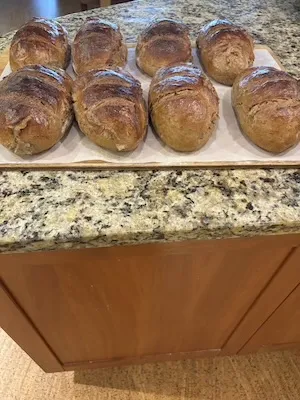
With mother's day at hand I decided to give her a bread-baking starterset from weekendbakery.com - a 750 gram round cane banneton, some flour, a mixing spatula, a lame, and a doughscraper, yeast and a recipe. Of course, that was the perfect excuse to order some more supplies for myself. Namely a 1 kg oval cane banneton, two 750 gram bannetons out of pressed wood material, round and oval and a lame for myself and a dough scraper.

Of course, I immediately wanted to try my new stuff! So I revisited the Norwich sourdough I had made before:

http://www.wildyeastblog.com/2007/07/08/my-new-favorite-sourdough/

though I did had to substitute a little amount of the white flour with whole wheat flour, since I did not have enough white flour. Also upped the hydration a bit.

First in the 750 gram oval banneton:


I then wanted to try the larger oval banneton, and came across this recipe:

http://thevicardiedlaughing.blogspot.co.uk/2013/04/white-sourdough-with-rye-ferment.html

which is similar to the Norwich recipe, but uses a different technique and a bit less rye. So I got some more flour and mixed the rye ferment yesterday evening.


Mebake's picture
Mebake

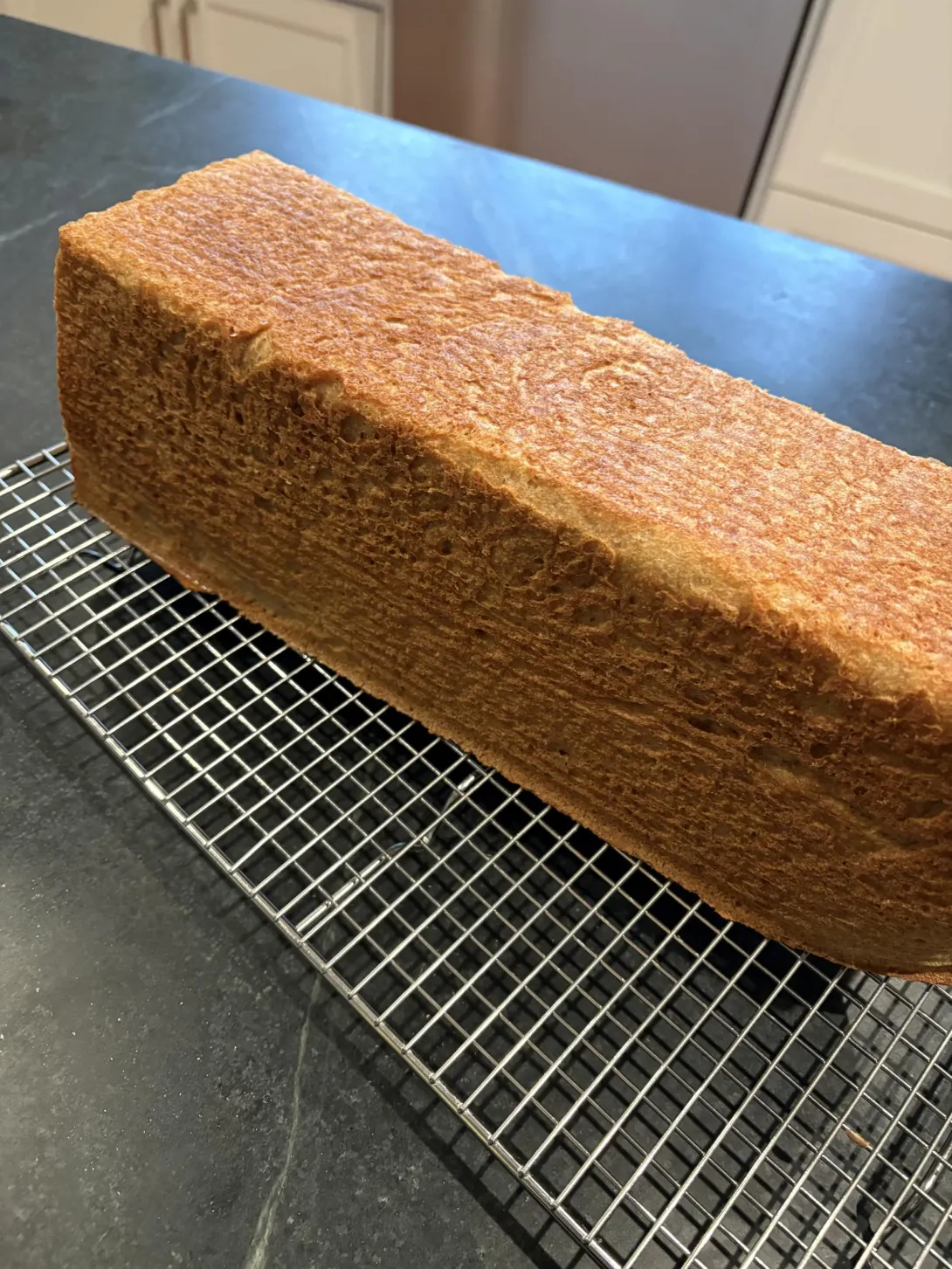
I wanted to bake a hearty Rye for many reasons. Firstly, to satisfy my Rye craving, and secondly to serve as a rye altus for further rye baking.

So, I have baked a 3-stage 80% Rye from Jeffery Hamelman’s book: BREAD, and it was high time that I bake it in my Pullman pan lookalike. The recipe calls for medium rye, and since I didn’t have any, I sifted my organic store bought Whole Rye flour. The sifting resulted in almost medium rye flour, and so I added back some of the bran to emulate medium Rye flour consistency.

I had thought that 3 stage detmolder Rye is time consuming,  precise , and daunting  to make. Now that I made it for the 3rd time, I have attuned myself to it’s schedule. It it really simple to make if you plan ahead.

After 36 hours of being wrapped in linnen, here it is:

Wonderful aroma, and flavor. Sweet, and sour, earthy and moist... very satisfying!

- Khalid

isand66's picture
isand66

FinishedRolls A few weeks ago I made some potato rolls using the Tangzhong  process and they came out excellent.

I decided I needed some rolls for some hot dogs and sandwiches for the week so I used the same process as before but this time I used some cream cheese and heavy cream as well as whole eggs and butter to really try to come up with a tasty and soft roll.

Just to pretend these rolls were a little healthy I used some spelt and Kamut flour along with the bread flour.

I mixed these up the same way as last time but cut back on the total mixing time and it didn't seem to make much of a difference.

The final rolls came out nice and fluffy and soft but with a ton of flavor.  I honestly can't stop eating them which is not good.

The final result was a nice soft crumb, crisp crust and tasty roll.

groupcloseup

Formula

Note: Tangzhong consisted of 50 grams Bread Flour and 250 grams heavy cream.  I included this in the overall formula below.

Tangzhong-Creamcheese-Rolls

Levain Directions

Mix all the levain ingredients together for about 1 minute and cover with plastic wrap.  Let it sit at room temperature for around 7-8 hours or until the starter has doubled.  I usually do this the night before.

Either use in the main dough immediately or refrigerate for up to 1 day before using.

 Main Dough Procedure

Prepare the Tangzhong.   Use a  5 to 1 liquid to solid ratio (so 250g liquid to 50g flour) and mix it together in a pan.  Heat the pan while stirring constantly.  Initially it will remain a liquid, but as you approach 65C it will undergo a change and thicken to an almost pudding like consistency.  Take it off the heat and let it cool before using it in your recipe.  Some people will refrigerate it for a while but you can use it right away as soon as it cools..

Mix the flours, Tangzhong and milk together in your mixer or by hand until it just starts to come together, maybe about 1 minute.  Let it rest in your work bowl covered for 20-30 minutes.  Next add the salt, starter (cut into about 7-8 pieces), and walnut oil, cream cheese and butter  and mix on low for a minute.   Mix for a total of 6 minutes in your mixer starting on low-speed and working your way up to speed #2 for the last 4 minutes.  Remove the dough from your bowl and place it in a lightly oiled bowl or work surface and do several stretch and folds.  Let it rest covered for 10-15 minutes and then do another stretch and fold.  Let it rest another 10-15 minutes and do one additional stretch and fold.  After a total of 2 hours place your covered bowl in the refrigerator and let it rest for 12 to 24 hours.

When you are ready to bake remove the bowl from the refrigerator and let it set out at room temperature still covered for 1.5 to 2 hours.  Remove the dough and cut into equal size pieces and shape into rolls.  Place on a baking sheet lined with parchment paper and cover with moist tea towels or plastic wrap sprayed with cooking spray.

Eggwash

The dough will take 1.5 to 2 hours depending on your room temperature.  Let the dough dictate when it is read to bake not the clock.

Around 45 minutes before ready to bake, pre-heat your oven to 500 degrees F. and prepare it for steam.  I have a heavy-duty baking pan on the bottom rack of my oven with 1 baking stone on above the pan and one on the top shelf.  I pour 1 cup of boiling water in the pan right after I place the dough in the oven.

Right before you are ready to put them in the oven, using a simple egg wash brush each roll and sprinkle on your topping of choice.   Next add 1 cup of boiling water to your steam pan or follow your own steam procedure.

After 1 minute lower the temperature to 425 degrees.  Bake for 35 minutes until the crust is nice and brown.

Take the rolls out of the oven when done and let them cool on a bakers rack before for at least 2 hours before eating.

GroupshotdistantCrumbCrumbcloseup

 
varda's picture
varda

When Floyd posted his Hokkaido Milk Bread I just had to try it.    Finally I got to it, and tasted it and then thought, I've made this before, even though I knew I'd never made a bread called Hokkaido bread.    I went back to the databanks and found that a year and a half ago, I made   Syd's Asian Style Pain de Mie, which is what I had been thinking of.  I must have had some sort of trauma interference with my memory as at the time my Kitchen Aid was not up to the task of intensive kneading, so I did it by hand which was a bigger workout than I had bargained for.   Fortunately, now I have upgraded to a tiny little Bosch which is much more suited to the task.   That freed me up to bake both of these breads. 

So being somewhat anal...ytical, I decided to bake them side by side and see how similar they really are.   First the formulas:


Syd's scaled to

472 g


Floyd's scaled to

472


factor

0.2


0.3


Final

Biga

Tang Zhang

Total

B %


Final

Tang Zhang

Total

`

AP Flour

67

157

16

240


AP Flour

222

15

236


Sugar

27

4

0.7

32

13%


Sugar

31


31

13%

Milk

22

97

16

135

56%


Milk

79

73

153

65%

Eggs

31


31

13%


Eggs

28


28

12%

Butter

22


7

29

12%


Butter

15


15

6%

Yeast

1

0.4


2

0.7%


Yeast

4


4

1.6%

Salt

3


0.2

3

1.2%


Salt

5


5

2.0%


472


472


Quite similar.  What the Pain de Mie lacks in hydration it makes up for in butter, and so forth. 

These formulas reflect two changes I made in the Hokkaido bread - for all the milk products listed in Floyd's formula, I used milk, as well as all the liquid in the Tangzhong.   Also I upped the salt to 2% which I meant to undo today, but which I forgot to undo.  

While the ingredients are the same, and percents at least similar, the methods are quite different.   Syd's is made over a four day period - first the tangzhong, then a biga like thing, then final dough.   Floyd's on the other hand is made all in one shot.   Also the tangzhong ingredients and procedures are different.   I followed each of the methods as written.  

The doughs handled fairly differently.   The Pain de Mie after around 10 minutes of pounding at high speed, came together in a tight ball.   The Hokkaido bread took a longer beating and while it window paned beautifully, it still remained somewhat slack and sticky.   At shaping, they also handled somewhat differently, with the Hokkaido being more airy and light, and the Pain de Mie more easy to manage. 

Now the crumb (or should I say the mie.)

First Hokkaido:

Now the Pain de Mie:

Similar yes?

And now the question - are they shreddably soft?

Yes - I think so.

First Hokkaido:

Now Pain de Mie:

And finally - the taste:

They are very similar.   However there are subtle differences:   The best distinction I can come up with is  the Pain de Mie is smooth and creamy, while the Hokkaido is a bit sharper.  Both are really delicious.  

So going forward, which version would I make?   If I remember my four day window, I'd go with the Pain de Mie simply to get that extra smooth and cream texture.    If I forgot the window, I'd make the Hokkaido.  

And that's that.

dabrownman's picture
dabrownman

Lucy has wanted to work on a Jewish Deli Rye for some time.   She has really - ever since Varda was trying to come up with the Tzitzel that Pratzels used to make in St. Louis, a bread we too like very much.  My wife and Varda share the same home town and Jewish bakery!


Then with Eric Hanner’s passing we made his Eric’s Favorite Rye several times.  No wonder it was his favorite and we like it too.  So my apprentice starts her JDR quest with good underpinnings.


Starting on the outside, we love the corn meal on the Tzitzel and the corn starch shine on EFR – so we decided to do both because my apprentice is just that kind of anything goes floozy baker.  Plus, we want to keep our recent track record of corn in the mix intact.


Lucy wanted to up the rye in EFR’s mix and the % of whole grains to 40%.  we wanted to get the hydration to around 72-74% thinking that, with a higher percent of whole grains, this wouldn’t be too wet to shape into a free form loaf.  Seems most all Jewish Deli Rye you will find out there in Bread Land is shaped into a batard.


We loved the idea of using re-hydrated onions in the dough like Eric recommended but, we didn’t read his recipe about using the left over onion water for the liquid until it was too late – so we saved it for the next iteration of this bread.


Stan and Norm did a Tzitzel in the fantastic book; ‘Inside the Jewish Bakery’ that Varda leaned on to get her recipe right.  Here is the link to Eric’s Favorite Rye recipe:

http://www.thefreshloaf.com/node/31047/it-took-me-forever-find-erics-favorite-rye

Varda’s beautiful Tzitzel post can be found here:

http://www.thefreshloaf.com/node/26383/tzitzel-bread-journey-ends


My example won’t be as professionally baked or as pretty as theirs but we are hoping the taste will come through.  We love combining similar breads to see what comes out of the union.  No first first clear flour available locally but, we did have rye berries to grind and bread flour - Lucy thought there must be some first clear to be found in there somewhere!


Changes from both (or one of the two) of the recipes include: No commercial yeast or sugar so we upped the % of rye sour levain to over 30%.   Added red and white malts with some Toadies for flavor and VWG to help the rye and get the poor bin based bread flour up in gluten content.


Other changes included:  baking the rye bread in the oval WagnerWare turkey roaster with 1 T of water, 10 minutes of slap and folds in place of mixing to develop the gluten,  no counter ferment, way too hot in this AZ kitchen for that and straight into the fridge for a 12 hour autolyse after 4 sets of S&F’s 15 minutes apart where the aromatic seeds and onions were incorporated on the 2nd and 3rd folds.


In the morning, we let the dough rest for an hour on the counter to come to room temperature after its overnight snooze.  After shaping we loaded the bread into a trash bag for final proof at 85 F on the counter.  The kitchen heat helped for once!


An hour later it was shaped, rolled in corn meal (per Varda’s Tzitizel) and slashed  3 times right before it was gently dropped onto the trivet of the roaster by holding onto the parchment paper.  The water was added to the bottom of the DO before the lid was securely placed on top and the whole shebang placed in the hot oven.


We preheated Big Old Betsy to 450 F with stones top and bottom and baked with trapped steam at 425 F for 2 minutes before turning the oven down to 400 F for another 8 minutes of sweat baking with the lid on.  When we removed the lid at the 10 minute mark, we turned the oven down to 370 F, convection setting this time.  After 10 minutes, we lifted the bread out of the DO with the parchment paper and placed in directly on the stone - rotating it 180 degrees.


We continued to rotate the bread on the stone every 10 minutes until it reached 200 F.  At that time we shut off the oven and let the bread come up to 205 F before removing it from the oven to a cooling rack and brushing it with the corn starch to shine it up some per Eric’s Favorite Rye.  Total baking time was 35 minutes.


It browned fairly well but not as boldly baked as Varda’s was nor even our usual.  Eric said to bake to 190 F but we have always thought this is a tad too low for my taste in crumb texture.   We didn’t want to go past 205 F either so it would still be moist.  This is the crust we got at 205 F.  It is what it is.  The crust went soft after the shine application.


It smelled great baking and still does on the cooling rack.  The re-hydrated minced onions dominate the nose even though there wasn't very much of them but this is a good thing as far as my apprentice is concerned.  Will have to wait on the crumb and will check Eric’s and Varda’s recipes to see when they recommend to cut it.  We couldn't wait that long so we cut it and we were really stunned.  The crumb is unbelievably soft and moist like it had cheese, YW and was Tang Zhonged!  Never had deli rye like that before.


This bread just plain tastes great.  We made a grilled pork, Brie and Smoked Gouda grilled cheese sandwich with the usual fixings.  Normally we cut a slice of bread in half for the sammy but not this time - no way - this bread is too good to limit!.  Everything on the plate was at it's very peak and the best my apprentice can muster and she put home made Dijon on the sandwich too!  Home grown tomato, home made kosher dill pickle, oil cured and kalamata olives, super ripe and sweet red bell pepper, salad from the garden with the same two cheeses, steamed and grilled vegetable medley, black berries, strawberries, the sweetest most ripe Minneola from the back yard and a combo salsa (Pico de Gillo, chipotle and grilled onion and peppers left over from CDM) on chips. 

Lucy is begging for some applause for this one!


Lucy won't have to come up with a better formula until we get tired of this one - and we won't ever do that.  This bread was also tasty for breakfast toasted; with butter, a schmear and caramelized minneola marmalade - with berries and mango.

Formula

Rye Sour Levain

Build 1

Build 2

Total

%

RyeSD Starter

20

0

20

4.35%

Dark Whole Rye

60

60

120

26.09%

Water

60

60

120

26.09%

Total

140

120

260

56.58%


Levain Totals


%


Flour

130

28.26%


Water

130

28.26%


Hydration

100.00%


Levain % of Total

30.65%


Dough Flour


%


Bread Flour

290

63.04%


Dark Rye

40

8.70%


Dough Flour

330

71.74%


Salt

9

1.96%


Water

220

47.83%


Dough Hydration

66.67%


Total Flour

460


Water

350


T. Dough Hydration

76.09%


Whole Grain %

39.57%


Hydration w/ Adds

72.92%


Total Weight

864


Add - Ins


%


Toadies

9

1.96%


Red Rye Malt

3

0.65%


White Rye Malt

3

0.65%


VW Gluten

5

1.09%


Total

30

6.52%


Bread Spices


%


Caraway, Anise, Coriander, Fennel

8

1.74%


Caraway

2

0.43%


Minced Dried Onion - Dry Weight

5

1.09%


Total

15

3.26%


evonlim's picture
evonlim

can't help myself, blue is my favorite color!! just have to stain my pretty white loaf ;)


of course the blue pea flower for the natural blue . it is for the visual effect :)

to add another dimension of taste, i used lavender sugar.

this is a hokkaido milk loaf recipe made with blue berry YW & SD


evon


breadsong's picture
breadsong


Hello everyone,

                              
                …pretty daisies on the exhibition grounds, greeting me as I arrived for the Baking Congress


Summer arrived this week – I’m happy for all the people who have travelled to Vancouver (at this time of beautiful weather!), to participate in the Baking Association of Canada’s Baking Congress, held yesterday and today.
I was able to attend yesterday, enjoyed the company of many really nice people, including TFL’s Floyd, running into him unexpectedly :^)
Floyd's post about the event is here - great coverage and lots of really good photos!


Craig Ponsford, Coupe du Monde de la Boulangerie gold medal winner (1996) and former chairman of the Bread Baker’s Guild of America (BBGA) conducted bread-baking demonstrations, ably assisted by Tracy Muzzolini, a member of Team Canada 2008 and the BBGA. Both taught at BBGA's WheatStalk event last summer in Chicago but I didn't have the opportunity to take their classes - so it was wonderful to seem them at this conference. Thanks to them both for the instruction, and their hard work putting together the demo!  

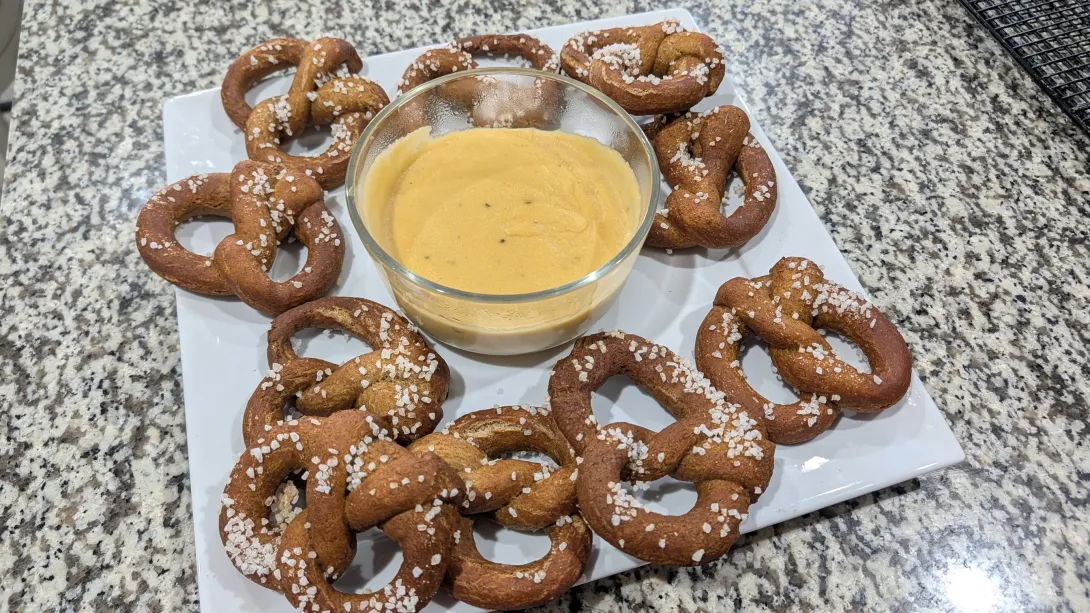
A nice variety of 100% whole-grain breads were prepared – baguettes and Red Fife and barley pretzels (baked that day) and I was able to see Craig shape pumpernickel, braid challah and mix Danish dough to be laminated the next day.

Craig has published a collection of whole-grain and gluten-free recipes for the California Raisin Marketing Board – formulas for delicious-looking pumpernickel and pretzels are here:
http://www.calraisins.org/wp-content/uploads/2012/03/WholeGrainGlutenFree-Ponsford_W.pdf
http://www.calraisins.org/professionals/processors-manufacturers/baking/spotlight


Craig shared lots of interesting information during the demonstration I saw.

 
(display of how the wheat berry components can be separated during milling, part of the lovely display at Nunweiler's Flour booth - the gentleman there very generous, sharing information about milling, and samples of their organic, whole-grain flour)

On whole-milled flour:
- the components of the wheat berry are never separated when flour is whole-milled; flour labelled as whole-wheat could have the endosperm, germ and bran separated and re-combined
- how to tell if the flour you have has been whole-milled: the flour will never sift out white, as the germ ‘smears’ when milling and gives color to the flour; the flour will have similar particle sizes so you won’t see large pieces of bran
- whole-milling stabilizes the germ
- you can use 2/3 less yeast when using whole-milled whole-wheat flour as this flour provides more food for the yeast


On mixing:
- 2nd speed mixing too aggressive for whole-grain flour
- recommended less mixing time and using folds, to preserve flavor
- add salt later on intensive mixes; if you add salt too soon, dough can build strength too fast and potentially break down before it’s fully mixed


On sweeteners:
An interesting thing Craig does to cut down on white sugar is to substitute agave syrup or fruit puree (applesauce, banana or prune puree, raisin paste, hydration may need adjusting if using a really wet puree). He mentioned he includes applesauce in his Pumpernickel bread – wish I could have been there to taste the baked bread!


On shaping:
Craig used wet hands and roughly air-shaped the pumpernickel paste, placed it in a tub of coarse pumpernickel meal, making sure it was completely coated in meal before placing in a greased pan, and noted you can keep the rye paste super wet as the coarse rye will keep on absorbing.

 
...really coarse pumpernickel meal, and a toss into the pan

And when braiding the challah, he demonstrated how you can braid ‘up’ instead of braiding on a horizontal plane; I think he said it was easier to see what you were doing. It was like he was braiding a little tower - I wish I could have captured that braiding method on video.


On pretzels and lye:
Craig sprayed the pretzels with a 4% lye solution, using a regular spray bottle. I thought this was a wonderful idea - no splashing or dripping as might happen when dipping, no distortion of the shape because you’re not moving the pretzels, and you might not have to mix as much solution?


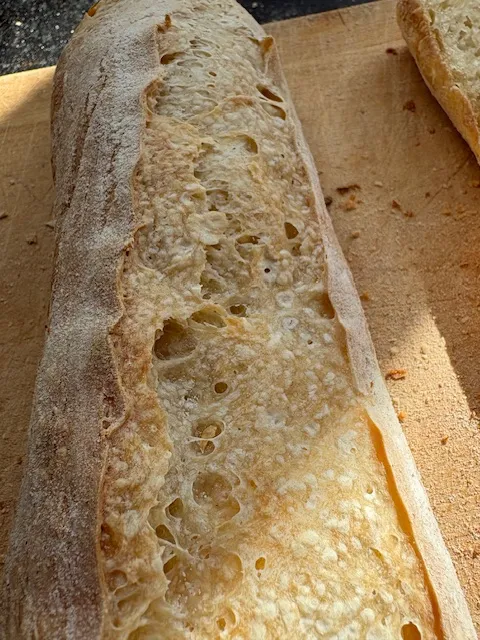
Here’s the baked baguette, super flavor!:

and the crumb... 


These are pieces of the pretzel cut up for tasting

(I was preoccupied taking the picture and regret not taking a piece, to sample)


A short seminar on sprouted grains was presented by Everspring Farms.

The lady presenting (I regret not catching her name) discussed the nutritional benefits of sprouting, and some variables to consider when sprouting - time and temperature (germination times of 12 to 48 hours were mentioned), and the variety of wheat (as germination weakens the grain).
The lady presenting also mention the duration of germination would affect the amount of sprouted grain you blended into your mix (the longer the length of germination, the lower the inclusion of rate of sprouted grain flour); and that using sprouted flour can give a softer crumb and slow staling.
She also said sprouted grains can be used as a wet mash, but to mill into flour, are the sprouted grain is dried down at a low temperature.
Here’s a picture of a wet mash:
(ground with the Kitchen Aid grinder)

I tried making a sprouted grain bread with that mash, along with additional sprouted whole-wheat flour once, and really liked the bread! The seminar was a good reminder to get organized and try this again.

Here are some pictures of Artistry, on display:


 (this bread was really good)


Dogwood flowers crafted by a young lady from Vancouver Island University, above in color, below, au naturel


This Spring, I've tried to take pictures of dogwood blooms and I'd say the ones above look very realistic!


It was a very enjoyable day at the Baking Congress, so glad I attended - met many helpful and kind people, saw some beautiful baking and got the chance to taste delicious things.

Happy baking everyone,
:^) breadsong

Pages

Subscribe to RSS - blogs