SearchUser loginBread BooksFavorite Recipes
|
Submitted by GSnyde on February 5, 2012 - 11:55am How I Roll: Old and New FavoritesOver the past couple weeks, I’ve been on a roll….Well, actually, sandwich fillings have been on a roll literally. I’ve been making rolls, but that’s not a figure of speech of which I am aware. I suppose I could say I’ve been roll-playing. Anyway…enough tropes. Last week I made an old favorite: the highly enriched sandwich buns SylviaH introduced us to back in 2010 (http://www.thefreshloaf.com/node/17329/buns-sandwiches). This is like a Challah in crust and crumb, with egg, honey, milk and butter in the mix. I’ve made these four or five times, and Sylvia’s formula is easy and the outcome is always wonderful. I’ve enjoyed it for burgers, sandwich meats, tuna salad or—most recently— oval shaped for Chicken Teriyaki sandwiches. This weekend I finally got around to trying the “Po-Boy Rolls” that ehanner posted about way back in 2007 (http://www.thefreshloaf.com/node/4329/po-boy-victory). This formula comes from Bernard Clayton, who calls it “Blue Ribbon French Bread”. I was looking for the perfect rolls for French Dip sandwiches, something with a thin crackly crust and a light, tender, regular crumb. This formula was perfect, just slightly enriched with a bit of milk and butter, very fully developed dough. Made into six rolls (instead of the two long batards Eric made), they absorbed the jus nicely, but held together. A bit of horseradish sauce, some thin sliced Tri-tip roast, and an herb- and garlic-infused jus—pretty perfect sandwich! And fresh out of the oven, with butter and jam, they were a nice accompaniment for an omelet, too. Two very different kinds of rolls, but both certain to be regulars in my baking rotation. Glenn Submitted by GSnyde on January 15, 2012 - 8:01pm Nothing Un-Yummy: Croissants, Morning Buns and Fruit-Nut BreadIn celebration of the first three-day weekend of the new year, I made a batch of laminated dough, using Txfarmer’s deservedly celebrated poolish croissant formula and procedures (http://www.thefreshloaf.com/node/22677/poolish-croissant-pursuit-perfection). As with my first attempt at this challenging but rewarding treat (http://www.thefreshloaf.com/node/24692/pâtisserie-lamentation), I split the batch in two and made some croissants and some morning buns. Again I found Txfarmer’s detailed notes to be very useful, especially the notes about being patient with the dough and letting it rest when it doesn’t want to be stretched to the required dimensions, and letting the shaped pastries proof fully (over 3.5 hours for me). Coupla notes about my procedures: I used Plugra butter, but about 30 grams less fold-in butter than Txfarmer specifies. I trimmed the dough sheets liberally before each fold to get nice square, layered edges (more on the trimmings below). I let the dough rest overnight in the fridge after the final fold. I haven’t been baking for that long, and each experience with a rolling pin is an education. I’m getting better at keeping the dough sheets regular in shape and even in thickness. The results were very satisfactory—not significantly better than my first try, but at least as good (repeatability is an encouraging thing). Thanks, again, Txfarmer! The morning buns pretty much followed the Tartine formula (linked in my earlier blog post), except I left out the orange zest and used a bit more butter in the muffin cups, so the bottoms of the buns are more caramelly. Since I had about 40 or 50 grams of dough scraps, I decided to try something different. I mooshed the scraps into a ball, rolled it out to about 3/16” thick, covered the sheet with grated Jarslberg cheese, rolled it up like a jelly roll, sliced 1” rounds, proofed for about 90 minutes, and baked them at 350 for about 40 minutes. These are delectable little cheese wheels, crispy and flaky outside and tender inside…very cheesy. Next time, I’ll add a touch of cayenne. In the midst of the patisserie adventure, I had to fulfill a spousal demand for my usual variation on Reinhart’s Cinnamon-Raisin-Walnut Bread. Mine includes a mix of walnuts and pecans and a mix of golden raisins and dried cranberries. This time I tried one little new twist—I soaked the raisins and cranberries in a rum soaker (1/4 cup dark rum, 1 ¼ cup hot water and 1 tbsp of sugar). There’re almost too many treats in the house now. So I haven’t cut into the Cinnamon-Rum Raisin-Cranberry-Walnut-Pecan Bread yet. I’ll post a crumb shot later. Added Note: Here's the crumb shot. There is a mild and enjoyable rum flavor in the raisins, an improvement on a really good bread. Kinda like Whisky for Breakfast.
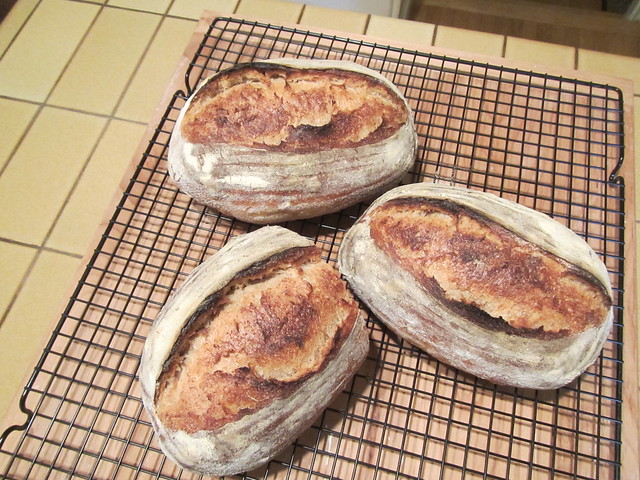
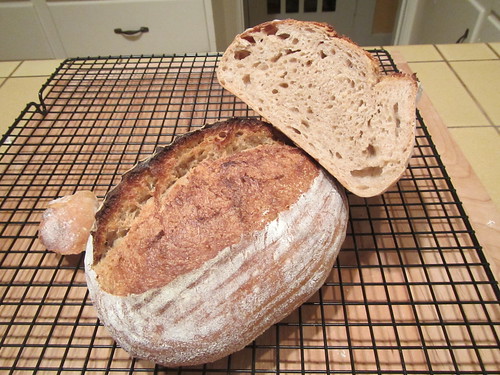
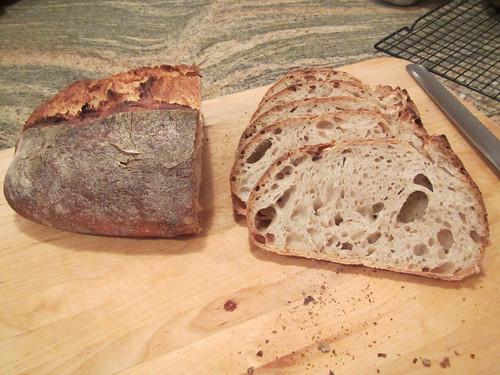
Glenn Submitted by GSnyde on January 8, 2012 - 9:24pm San Francisco Country Sourdough—New Sourer Variation with Wheat GermMy wife likes her sourdough sour. And a happy wife is better than the alternative. Not that I dislike sour sourdough. Indeed, for some purposes (along side a salad, or as toast, or as an appetizer with cheese, or….), I like my sourdough sour, too. I hadn’t changed anything up in my usual sourdough bread (which I call San Francisco Country Sourdough) for a while. I’d been meaning to try it with some toasted wheat germ added, a variation taken from the SFBI Miche formula many of us have played with. Also, the talk recently about the Larraburu Brothers bread, and means of achieving sournness, had me thinking I should go for the sour. So I followed my usual formula, but I added 2% toasted wheat germ (18 grams) and an additional 20 grams of water. To encourage sourness, I let my liquid levain ripen longer than usual (14 hours), retarded the loaf for 16 hours after a three-hour primary ferment, and baked the loaves four and a half hours after the dough came out of the fridge (90 minute warm up, 60 minutes between pre-shaping and shaping, and a two hour proof). The bread is nicely sour. The crust is crispy as usual. The crumb is moist and toothsome but not tough. The crumb is more regular (less full of irregular holes) than usual; this might be attributable to the wheat germ cutting gluten fibers. All in all, a good variation. My sour-loving wife liked it, and noticed the extra wheaty flavor. Here’s the formula: San Francisco Country Sourdough—With Wheat Germ (version 12-8-12) Yield: Two 770g Loaves; or Three Mini-Baguettes (245g each) and one 800g Loaf; or One 1000g loaf and two 270g baguettes; 0r Three 513 gram loaves; or… Ingredients LIQUID-LEVAIN BUILD 100 grams AP flour 24 grams Whole Wheat flour 12 grams Whole rye flour 170 grams Water, cool (60 F or so) 28 Mature culture (75% hydration) FINAL DOUGH (67% hydration, including levain) 640 grams All-Purpose flour (83%)* 85 grams Whole wheat flour (11%)** 45 grams Whole rye flour (6%) 18 grams toasted Wheat Germ (2%) 455 grams Warm water (80 F or so) (58%) 17 grams Salt (2%) 306 Liquid levain (48%) Directions 1. LIQUID LEVAIN: Make the final build 12 to 15 hours before the final mix, and let stand in a covered container at about 70°F 2. MIXING: Add all the ingredients to the mixing bowl, including the levain, but not the salt. Mix just until the ingredients are incorporated into a shaggy mass. Correct the hydration as necessary. Cover the bowl and let stand for an autolyse phase of 30 to 60 minutes. At the end of the autolyse, sprinkle the salt over the surface of the dough, and finish mixing 5 minutes. The dough should have a medium consistency. 3. BULK FERMENTATION WITH S&F: 3 hours. Stretch and fold the dough in the bowl twice 20-strokes at 45-minute intervals. Place dough ball in lightly oiled bowl, and stretch and fold on lightly floured board at 45 minutes. If the dough has not increased in size by 75% or so, let it go a bit longer. 4. RETARDED BULK FERMENTATION (optional): After second S&F on board, form dough into ball and then place again in lightly oiled bowl. Refrigerate 8-20 hours, depending on sourness desired and scheduling convenience. 5. DIVIDING AND SHAPING: [Note: if bulk retarded, let dough come to room temperature for 30-90 minutes before pre-shaping.] Divide the dough into pieces and pre-shape. Let sit on board for 30-45 minutes, and then shape into boules or batards or baguettes. 6. PROOFING: Approximately 1.5 to 2.5 hours at 72° F. Ready when poke test dictates. Pre-heat oven to 500 with steam apparatus in place. 7. BAKING: Slash loaves. Bake with steam, on stone. Turn oven to 450 °F after it hits 500F after loading loaves. Remove steaming apparatus after 12 minutes (10 for baguettes). Bake for 35 to 40 minutes total (for 750g loaves; less for smaller loaves). Rotate loaves for evenness as necessary. When done (205 F internal temp), leave loaves on stone with oven door ajar 10 minutes. Glenn Submitted by GSnyde on December 31, 2011 - 4:49pm Multi-Grain Hearth Bread, Salmon/Crab Chowder and the Hanukkah Miracle of Christmas DinnerAfter all the heavy food, sweets and rich baked goods at holiday time, I decided to bake some nice healthy loaves of bread and make some soup with local North Coast seafood. OK, the chowder has a good dose of cream in it, but I used a recipe without bacon, so it’s dietetic compared to my usual. The bread is Hamelman’s Whole Wheat Multi-Grain, a 50% whole wheat sourdough with just a touch of instant yeast and some honey. In the soaker, I used only rolled oats as that’s what I have on hand. I added toasted pumpkin seeds and sunflower seeds. The seeds plus oatmeal equaled the weight of the mixed grains in Hamelman’s formula. I used the total amount of water the formula calls for. The dough was dense but extensible, very easy to handle. I made three loaves, semi-retarding one on our 50 degree porch while the first two baked. All came out nicely. The crust is dark but not crispy, and the crumb is moist and wonderfully wheaty with the nice feel, smell and taste of seeds. The Salmon and Crab Chowder was adapted from a Food Network recipe (http://www.foodnetwork.com/recipes/bobby-flay/salmon-chowder-with-crab-whole-grain-croutons-and-pinot-glaze-recipe/index.html), but I added several pounds of salmon trimmings to the stock and added garlic to both the stock and the chowder; I also added a couple sliced leeks to the chowder. I skipped the croutons and the drizzle. It is quite a production with lots of steps, but the result was very well-received. Rich, hardy chowder with lots of well-melded flavors. It makes me grateful for the bounty of our local fishery. Sorry, no photos of the lovely chowder. Now, my holiday story of The Hannukah Miracle of Christmas Dinner. In case you don’t know the story symbolized by the Hannukah Menorah, it is told that when the Jews recaptured their temple from Greek occupation, there was only enough oil left to light the holy lamp for one night. But miraculously, the oil lasted eight nights. Thus Hannukah is celebrated as the eight night “Festival of Lights”. Cat and I have a mixed marriage (we joke that we’re a born-again Druid and a lapsed agnostic, but we don’t remember which of us is which). Cat’s family celebrates Traditional American Christmas with food, drink, a tree and presents, and drink. My family celebrates Traditional American Hannukah with food and presents, and food. For the last several years, I have spent “The Holidays” with Cat’s Family here on the North Coast. Her brother is a good cook, and he cooks Christmas Eve dinner and I cook Christmas dinner, or vice versa. This year, for Christmas dinner I made a Rib Roast rotiserried on charcoal, with many side dishes, including caramelized onions, sautéed mushrooms, and a potato gratin with shallots, Gruyere and cream. Several days later, after roast beef sandwiches, barbecue beef sandwiches, and several omelets of leftover potatoes gratin and caramelized onions, we realized that our Christmas dinner made EIGHT MEALS!! It’s a multi-religious miracle! It’s a miracle that we’re still standing. I might also mention that my Hannukah stocking this year included two wonderful baking books—Ortiz’s The Village Baker and Hensperger’s Bread Bible. I’m looking forward to new experiments. Happy New Year to all TFLers. Glenn Submitted by GSnyde on December 28, 2011 - 10:20pm End of Year Baking: Pizza, Bear Claws, Dutch Crunch Rolls and BagelsIt’s been a few weeks since I posted about my baking adventures—there hasn’t been much new and I’ve been busy getting my work life in order for vacation and then vacationing. A couple weeks ago I started my experiments with the pizza dough recipe from Pizzetta 211 (http://www.thefreshloaf.com/node/26335/furtherance-my-pizza-education). So far so good, but nowhere near as good as the restaurant’s. The 30 minute machine kneading gives this dough a good balance of elasticity and extensibility. I think what I need to work on is the shaping. To get the piece to 11 inches without overhandling takes a gentle touch and patience. This one is topped with homemade sausage, caramelized onions with balsamico and radicchio. With a house full of holiday visitors the last week, I sorta put my semi-sensible diet on hold. The leftover Christmas rib roast cried out to be sliced thin, barbecue-sauced and slapped on some Dutch Crunch rolls. And I haven’t the heart to ignore a crying rib roast. These were from Reinhart’s BBA formula for Vienna Bread (with thanks to Brother David for emailing me the formula since I left that book at home). Then, another try at my favorite Bear Claws, using the Cream Cheese Short Dough and the Bear Claw filling recipe and procedures from Inside the Jewish Bakery. Then the last couple days I’ve baked bagels, using the Krakowski formula from Stan, but ordinary bagel shaping. Monday night, I made one-and-a-half the volume of dough in the formula and made 20 bagels on two sheet pans. Them I boiled and baked 10 yesterday morning and 10 this morning. I can now tell you that leaving the uncooked bagels in the fridge for 36 hours does no major harm. Today’s batch was delicious. The only difference is there are some bigger holes in the crumb, so the thing was not quite as chewy. Before the year is out, I plan to find a Hamelman hearth bread formula I haven’t made before; need some crusty bread to accompany Salmon Chowder made from local fish. Happy Holidays to all. Glenn Submitted by GSnyde on December 11, 2011 - 4:32pm A Furtherance of My Pizza EducationCat and I decided to go for a hike yesterday on Mount Sutro, the wooded mountain in the middle of San Francisco. Since we knew we’d be in for some calorie-burning, we stopped on the way at our neighborhood pizzeria, Pizzetta 211, a tiny place that is often rated as the best in the City. Cat had a bacon and butternut squash pie with chipotle crème fraiche. I had one with homemade sausage, radicchio and Gruyere. Sorry, I didn't have my camera along. Though the toppings on their pizzas are often unusual (e.g., Pancetta, farm-fresh eggs, fingerling potato slices and sage), and always delicious, what makes their pizza so great is the perfect thin crust—tender but firm in the middle and super crispy around the crown. It’s also a really friendly place, staffed with latter-day hippies who are very serious about their ingredients. As we were finishing up, and resisting the ginger cake and apple tart, I asked the fellow who was clearing our table what flour they used in the dough. He told me they used Giusto Baker’s Choice, an all purpose flour, and asked if we had other questions. Since he seemed to want to chat, and since I’ve always wanted to make pizza like theirs, I told him I’d love to watch their dough-making process some time. He didn’t invite me to do so, but he launched into a lengthy discussion of their dough-making process. From the conversation, he gathered that I knew a thing or two—but not three—about making pizza, and his explanations were sophisticated and enlightening. Turns out he’s the founder of the place and the pizza master. I won’t go into all the details here, but—in short—he starts with a sort of poolish, about 90% hydration with cool water, then adds the remaining flour gradually during a 30 minute slow-speed mix. He didn’t know the hydration; he mixes by feel. The dough is then refrigerated overnight, punched down and scaled in the morning and put back in the fridge until used; they’re shaped right out of the fridge. This seems like a pretty novel approach, one he developed over many years of experimentation. He told me a modified—simpler—recipe is on Sunset.com (http://www.sunset.com/food-wine/techniques/pizza-00400000063254/), but it’s worth it to experiment with different hydrations, different mixing times and different retardation times, until we get it like we like it. I will start these experiments soon. As for my own baking, it’s mostly been repeats of favorites lately, after several weeks of pastry and bagel trials. Last week I made double knot rolls and sandwich buns from the ITJB Honey-Whole Wheat Challah. And yesterday I made a couple half-kilo boules of Tartine Basic Country Bread, with my usual twists (http://www.thefreshloaf.com/node/24002/my-variations-tartine-basic-country-bread–-more-whole-wheat-smaller-loaves-and-half-retar). I retarded half the dough and baked two more today. Happy Baking! Glenn Submitted by GSnyde on November 20, 2011 - 6:16pm Sunday Morning Deli BrunchThough my favorite bread to eat alone or with a dab of butter or cheese is French-style sourdough, there is nothing better than a good Jewish deli-style brunch, featuring bagels and rye bread. This morning we had some old friends over—East Coast-raised Jews; serious eaters. It was advertised as a lox and bagel meal, but while planning the meal, I remembered that these friends had expressed extreme interest several months ago when I told them about my homemade pastrami. And I had frozen some of the pastrami. So, in addition to bagels, I made some sour rye bread yesterday, too, and thawed and re-heated the pastrami. I used my favorite bagel formula--the ITJB Krakowski formula, but with 25% KAF Bread Flour and 75% Sir Lancelot—but didn’t shape many of the bagels with the Krakow twist (sounds like a dance … kinda like the Warsaw watusi). They were very pretty and quite delicious. Our friends brought some excellent Pacific Ocean lox (with Coho Salmon). But the pastrami was the real hit. And the rye bread (from Greenstein’s formula via dmsnyder) was much admired. It was a real deli meal right here in San Francisco, where—for all our touted food variety—one can’t find a decent deli. Another mutual friend—one of the Philadelphia Ginsburgs--dropped by for just a few minutes and had a quick bite, swooning at the bagels and the pastrami, and then left with a bag of bagels-to-go for his family. All agreed that it was like a taste of the Old Country. It makes me feel like I’ve done a service for the culturally deprived. And the best news is there’s enough left over for Pastrami and Eggs for dinner, with both bagels and rye toast! Glenn Submitted by GSnyde on November 13, 2011 - 9:31pm Overcoming A Rational Aversion to Pastry: Experiment in GluttonyI have said before that gluttony is among my favorites of the deadly sins; the craving for fat, salt and sugar is a delightful vice. Favoring gluttony, though, runs contrary to my part time dedication to rationality; good sense indicates that gluttony can be detrimental. This dissonance—which regularly afflicts bakers—is my topic today. More particularly, I want to resolve that dissonance by showing that a semi-scientific experiment with pastry can employ the rational mind in the service of gluttony and vice versa. One might—or might not—conclude that animal passion and mindfulness can co-exist happily in a wholeness of human experience. Or one might conclude that the chubby guy is rationalizing his excessive indulgence. The subject is pastry—specifically the Mini-Schnecken and Bear Claw recipes in Inside the Jewish Bakery. The goal is to bake goodies to match (or come close to) the remembered experience of the Ideal exemplars of these treats. I have previously baked Bear Claws using Danish Pastry Dough (a recipe from Fantasia Confections) and The ITJB Coffee Cake Dough. Neither was bad. The Danish Dough was poofier and lighter than my ideal and the filling in the Fantasia recipe expanded monstrously (too much egg, I think). The ITJB Coffee Cake dough version was closer, but a bit too heavy and dry. The ITJB filling was perfect! Last week I made some ITJB Mini-Schneckens using the Cream Cheese Dough formula, and a filling of Olallieberry jam and cake crumbs. I followed the formula to a fault…the fault being that the formula failed to say that the dough ball was to be divided in two before being rolled out to 18” x 8”. So my cookies—with double the dough and double the filling--were more like mutant Danish in appearance. Really good tasting though. The cream cheese dough—consisting of only cream cheese, butter, flour and a dash of salt (no sugar!)—bakes up light, tender and totally delicious. So, this weekend, purely for science, I made another batch of the cream cheese dough and a smaller batch of jam filling (Stan told me the filling should be spread very thin). I divided the dough in two, and rolled out half—nice and thin—to 18 x 8, and smeared a thin coating of jam filling on. I rolled it up and cut it into 1” pieces. The result, while not exactly like I remember, is terrific. The shape is about right, the texture is moist and delicate, and the flavor is incredible—not too sweet, but fruity and rich. The other half of the Cream Cheese Dough was destined to be Bear Claws, my favorite breakfast pastry. I rolled the dough out to about 12” by 6”, so not as thin as for the Mini-Scheckens. I smeared the ITJB Almond Filling over a little less than half of the dough sheet, leaving a margin to seal with egg wash and finger pressure. Then I proceeded with the Bear Claw shaping—folding the dough over the filling, stretching the whole thing lengthwise, then cutting it into pieces and shaping the claws (all with a bench knife). The round ones pictured below are rolled from scraps of dough. These Bear Claws are the best! The dough has a wonderful tenderness and the savoriness contrasts nicely with the sweet filling; the whole flavor is only slightly sweet. They look nice, too, though I regretted not having slivered almonds handy. Though seeking to replicate a remembered gustatory experience is not a very scientific objective, I can say that I did carry out an experiment—minding the variables, observing the conditions, following a protocol, and evaluating the results. The fact that the end result was the scientist and his lab assistant practically rolling on the floor in flavor ecstasy will not be written up in the scholarly journals. I know I should try to tame my sweet tooth. But the spirit of scientific inquiry compels me to bake more pastries until all the data is in. Note for David: the ITJB Cream Cheese Dough is what you want to use in your Cheese Pocket experiments. Very tender, not sweet, but quite rich. Very much like the Karsh’s cheese pockets. Glenn Submitted by GSnyde on November 6, 2011 - 8:55pm In Snyde, The Jewish Baker: More Trials from Stan And Norm's BookToday I baked two things from Inside the Jewish Bakery: one worked out very well, and one didn’t. The double knot rolls with Honey-Whole Wheat Challah dough are just as I hoped. The Mini-Schnecken came out all wrong. First, the Mini-schnecken. These are supposed to be like rugelach, except rolled up and cut rather than rolled in a crescent shape. I used the cream cheese short dough from ITJB, and it was easy to make and had a great texture. But as I was rolling out the dough to add the filling, I realized that the dough sheet was way too thick. I followed the instructions, rolling one recipe of the dough out to 18” by 8”, and ended up with a sheet of dough that was about 3/16”“ thick, and when I added the amount of jam filling the recipe called for, that was too thick too. I wonder if one recipe is supposed to make two sheets of 18x8 and the filling is supposed to cover both (more thinly). That would make a product more like my experience of rugelach. In any case, though they look nothing like mini-schneckens, they are delicious (some Apricot and some Olallieberry). I especially like the dough…might be great for bear claws. Here’s some photos: The double knot rolls were a breeze to make. I hand kneaded the dough and it had a great silky consistency. The instructions in ITJB for shaping the rolls were excellent. And the resulting rolls are superb. They’ll be great with leftover turkey. Glenn Submitted by GSnyde on October 30, 2011 - 9:20pm Recent BakesNot much novel in my baking life lately. Last weekend I tried bagels using 50% Type 85 flour and 50% High-gluten white flour (Sir Lancelot). The results were ok, but not as good as my previous formula (75% High-gluten flour and 25% bread flour). These were too extensible (could have lowered the hydration with the lower gluten flour blend) and the ends didn't want to cohere. The flavor was nice, but I think I'll stick with the proven recipe. Friday I made a couple pizzas using Reinhart's Neo-Napolitano formula. This one was delicious, with tart apples, walnuts and gorganzola. Then, today I made a nice batch of San Francisco Country Sourdough using my usual formula. Perhaps next week I'll try more goodies from ITJB. Glenn |
ALSO ON |