The Fresh Loaf

News & Information for Amateur Bakers and Artisan Bread Enthusiasts

GSnyde's blog

  • Pin It
GSnyde's picture
GSnyde

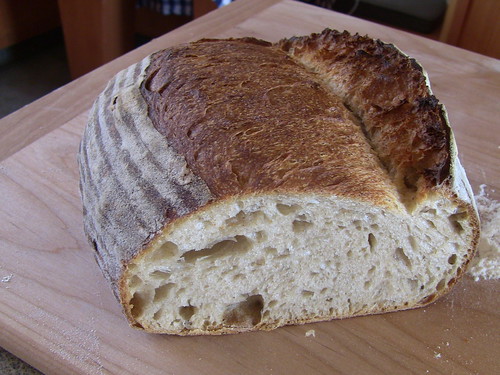
They say everything happens for a reason, and I believe them.  But I can’t always identify the reasons some things happen.  Why was this bake of the San Francisco Country Sourdough (my version of pain de campagne) the best ever?   This was probably the 7th or 8th time I’ve baked it, but this one had that je-ne-sais-what like my best bakes of Tartine BCB and last week’s bake of Hamelman’s pain au levain.  Beautifully caramelized, golden brown, crispy crust; moist, airy-but-substantial crumb, with nicely gelatinized membranes; complex wheaty flavor with a hint of rye.

I guess I should compare this to other bakes of the same formula.

Here’s what was the same:

  • The ingredients and the basic technique (described below).

Here’s what might have been different:

  • My starter was very active (after last week’s near-death experience).
  • Both the primary ferment (3 ¼ hours) and the proof (2 ¼ hours) were on the long side.
  • My handling/shaping skills are improving, and I got a nice taut sheath.
  • I made a recipe-and-a-half so I could cold retard one loaf’s worth to bake tomorrow for some friends.

Whatever factor(s) made the difference, I hope I can do it again.

And excellent with some early Autumn barbecue.

San Francisco Country Sourdough (Sourdough Pain de Campagne) version 10-8-11

Yield: Two 750g Loaves; or Three Mini-Baguettes (235g each) and one 800g Loaf; or One 1000g loaf and two 250g baguettes; 0r Three 500 gram loaves; or…   

Ingredients

LIQUID-LEVAIN BUILD

100 grams   AP flour

24 grams  Whole Wheat flour

12 grams  Whole rye flour

170 grams   Water, cool (60 F or so)

28     Mature culture (75% hydration)

FINAL DOUGH (67% hydration, including levain)

640 grams   All-Purpose flour (83%)*

85 grams  Whole wheat flour (11%)**

45 grams   Whole rye flour (6%)

435 grams   Warm water (80 F or so) (56%)

17 grams   Salt (2%)

306     Liquid levain  (48%)   

* used CM Artisan Baker’s Craft (malted)

** used CM Organic Hi-protein fine whole wheat

Directions

1. LIQUID LEVAIN:  Make the final build 12 to 15 hours before the final mix, and let stand in a covered container at about 70°F

2. MIXING: Add all the ingredients to the mixing bowl, including the levain, but not the salt. Mix just until the ingredients are incorporated into a shaggy mass. Correct the hydration as necessary.  Cover the bowl and let stand for an autolyse phase of 30 to 60 minutes. At the end of the autolyse, sprinkle the salt over the surface of the dough, and finish mixing 5 minutes. The dough should have a medium consistency. 

3. BULK FERMENTATION WITH S&F:  3 hours. Stretch and fold the dough in the bowl twice 20-strokes at 45-minute intervals.  Place dough ball in lightly oiled bowl, and stretch and fold on lightly floured board at 45 minutes.  If the dough has not increased in size by 75% or so, let it go a bit longer.

4. RETARDED BULK FERMENTATION (optional):  After second S&F on board, form dough into ball and then place again in lightly oiled bowl.  Refrigerate 8-20 hours, depending on sourness desired and scheduling convenience.

5. DIVIDING AND SHAPING: [Note: if bulk retarded, let dough come to room temperature for 30-90 minutes before pre-shaping.]  Divide the dough into pieces and pre-shape.  Let sit on board for 30-45 minutes, and then shape into boules or batards or baguettes.

6. PROOFING: Approximately 1.5 to 2.5 hours at 72° F. Ready when poke test dictates.  Pre-heat oven to 500 with steam apparatus in place.

7. BAKING: Slash loaves.  Bake with steam, on stone.  Turn oven to 450 °F after it hits 500F after loading loaves.  Remove steaming apparatus after 12 minutes (10 for baguettes). Bake for 35 to 40 minutes total (for 750g loaves; less for smaller loaves).   Rotate loaves for evenness as necessary.  When done (205 F internal temp), leave loaves on stone with oven door ajar 10 minutes.

Happy baking!

Glenn

Submitted to http://www.wildyeastblog.com/category/yeastspotting/


GSnyde's picture
GSnyde

I’ve been experimenting with bagels and pastries and I haven’t made sourdough in San Francisco for over a month, and I’d forgotten to feed my starter.  Then, we replaced our refrigerator and some things were unrefrigerated for a spell one day last week, including my starter.  This is not just any starter.  It is the starter made famous (in the bread baker section of the internet) by my brother David’s moving story (http://www.thefreshloaf.com/node/19250/premarital-counseling-advice-my-baby-brother-aspiring-sourdough-baker).

When I opened my starter jar Friday to feed it in anticipation of this weekend’s baking, it smelled a bit nasty, and looked lax and wimpy. I feared I’d killed it.  I fed it the usual white-whole wheat-rye mix at 60% hydration, and went to bed hoping that I wouldn’t have to go through the embarrassment of explaining to David that I was an idiot who could not to be trusted with the well-being of vital microbes.  Saturday morning the starter showed life (whew!), though it had not bloomed from feeding as usual.  So I remained concerned.

I made up the levain Saturday evening for my Sunday bake, and Sunday morning it looked, felt and smelled right.  Disaster averted!

My bake this weekend was Hamelman’s Pain au Levain with Whole Wheat Flour.  David has been encouraging me to try Hamelman’s Pain au Levain and its variations.  Reading the formulas, this one seemed like it would be resemble my favorite pain au levain (from Acme Breads in Berkeley).  And it does.

This marked the first time I’d mixed sourdough dough in my new Bosch mixer.  The mixer came in handy since the formula calls for mixing in the stiff levain after the autolyse, and that’s always tough by hand.  The BUP handled it easily and quickly.  I mixed only about 90 seconds and the dough was supple and shiny.

I’m happy with the results.  The crust is crisp and the crumb hits that wonderful sweet spot between chewy and tender.   The crumb aeration is just what I always hope for in this type of bread.

The flavor is complex, slightly sour.   I'll bake this bread again and again.

David was right…again.  Good bread.

Glenn

GSnyde's picture
GSnyde

I tried two very different doughs in my new Bosch Universal Plus this weekend.  The machine performed very well, and the breads were all good.

I made a batch (three pan loaves) of Hamelman’s Oatmeal Bread.  The machine handled the dough very nicely, and kneaded it to a moderate window pane in about 5 minutes (with a couple stops to scrape the bowl and shaft).  This formula calls for high gluten flour, along with whole wheat and rolled oats.  I had previously used bread flour, but used Sir Lancelot this time.  The resulting bread has a slightly firmer chew (a good change), but is still tender and moist.  The flavor is wonderful.  It was perfect for roast turkey sandwiches.

Then I put the BUP to the real test…bagels.  One major reason for getting this mixer was to let a motor knead stiff bagel dough, and save me from the sweat and strain.  In about 14 minutes of mixing/kneading on low speed, the BUP turned out a beautiful, silky dough.  I used 75% Sir Lancelot and 25% BRM enriched flour (a bread flour), and otherwise stuck with the Krakowski recipe in the upcoming Inside the Jewish Bakery.  After fermenting, the dough was very elastic, and it took quite an effort to roll out the strands.  After having experimented both with diastatic malt and honey in the boiling water, we’ve settled on honey for superior flavor.

The flavor and texture are very pleasing and they look nice too.

 So far, I love mah BUP.

Glenn

GSnyde's picture
GSnyde

 Since my Danish pastry adventure last week, I’ve been keeping it simple.  Last Sunday I baked some of my San Francisco Country Sourdough (8.5% whole wheat, 6% whole rye, 40% liquid levain, 75% hydration).  I’ve reported variations on this formula before, for instance here (http://www.thefreshloaf.com/node/22679/spring-air…and-oven).  Last week I used bread flour in the levain instead of all purpose, to get a bit chewier crumb.

It rose mightily and had good oven spring.  And the crumb was a bit denser than usual due to the higher-protein flour in the levain.  It had a nice,  mildly sour flavor.

Then today, I baked Maggie Glezer’s “My Challah”, with shaping assistance from my live-in semi-professional braiding advisor.

We did have a wide variety of previously frozen baked goods this weekend.  Brother David and his wife Susan were visiting, and we had some baguettes and some Tartine BCB and some of the gooey delicious Pecan Rolls I baked last week.  I heard no complaints (not that I was listening).

I also understand that David and Susan stopped for lunch today at Della Fattoria in Petaluma on their way back to Fresno.  Perhaps we’ll get a report on that nearly legendary bakery (maybe there are legends about it; I’ve just never heard them).

In addition to good eating, we enjoyed the cool North Coast weather and our late Summer garden, with its multi-colored Heathers.

Glenn

GSnyde's picture
GSnyde

For the first anniversary of my bread baking and for my upcoming birthday, my darling got me a Bosch Universal Plus (how did she know!?).  I should have tried it out with a recipe I know well so I could start to evaluate mixing times and speeds intelligently based on experience.  But that would be too sensible.  I’d already decided it was time to try making Danish pastry dough, and that was the first thing my new BUP got to do.

Danish pastry dough is very much like croissant dough, but with egg (one whole egg and one egg yolk per three and a half cups of flour or so).   For a whole bunch of great lessons (mostly applicable to this dough), see Txfarmer’s post about her croissant quest (http://www.thefreshloaf.com/node/22677/poolish-croissant-pursuit-perfection).  The recipe for the dough and the pastries are from the Love To Bake Pastry Cookbook, by Ernest Weill, the founder of Fantasia Confections, a famous San Francisco palace of sweets that made happiness from the 1950s through the early ‘90s.  The cookbook, which Brother David has mentioned before, can be obtained in pdf format over the web for a $25 contribution (http://lovetobakecookbook.com/).

This was my first time using that cookbook, my first time making Danish pastry dough and my first time using the BUP.  Surprisingly, there were no disasters (if no huge successes) and I learned a thing or two.

This cookbook uses volume measures, and sometimes shows weights, but I’m not sure they’re accurately translated.  (I’d promise to work on this dough and report back with a reliable formula, but I can’t eat this much sugar and butter again right away).  The dough formula in the cookbook called for too little flour (by weight) and too little mixing time.  I added both, but I’m not sure if I got it right.  I also departed from the procedures in the book somewhat.

Here’s where I ended up:

Danish Pastry Dough (yields 4 pastry rings or 32-48 pastries depending on size)

Ingredients

1 ¼ cups milk (120 F)

1 ¾ tsp instant yeast

heaping ¼ cup sugar

3 ½ cups AP flour (about 18 ½ ounces)

½ tsp salt

1 Tbsp lemon zest

2 tsp vanilla

1 whole egg

1 egg yolk

½ cube sweet butter, melted

Mixing

Mix all ingredients except the flour on low speed for one minute.  Add 3 cups of flour and mix on low speed for four minutes, stopping to scrape down the sides of the bowl occasionally.  Add the remaining ½ cup of flour slowly, then mix on low speed another 3-5 minutes (again, stopping to scrape down the bowl as necessary) until the dough forms a good ball.

Lamination

Once I had a workable dough (moderately strong if still somewhat loose), the lamination process begins (as for croissant dough).  Scrape the dough onto a very well floured board and shape into a rectangle.  While the dough rests, pound/roll 2 ½ cubes of cold sweet butter into a 9” by 8” sheet and then refrigerate it while you roll out the dough.  With a well-floured pin, roll the dough out to 10” by 15”.  Plop the butter sheet on top of one side of the dough sheet, fold the unbuttered part of the dough over the butter sheet (it’ll half cover it), then fold the opposite (buttered) side over into a tri-fold (there are good illustrations—worth a thousand words--in the cookbook).  Seal the seams.  Then, roll the dough block out to 16” by 8”, wrap well in plastic and refrigerate 30 minutes.  Put the dough again on a well-floured board and let it rest 10 minutes covered, then roll it out to 18” by 12”.  Then do a tri-fold as for croissants.  Then roll it to 16” by 8” and refrigerate 30 minutes again.  Repeat this process of rolling, folding, rolling and refrigerating two more times.  Then the dough (in a 16’ by 8” block) goes in the fridge overnight.

Pecan Rolls

The memory of Fantasia’s pecan rolls is what led Brother David on a search for the recipe, resulting in his discovery of the cookbook download.  I only vaguely remember them.  What I remember best are Fantasia’s opera cakes, Napoleans and eclairs.  These pecan rolls are a high-butter, high-sugar version of typical cinnamon-pecan rolls.  Half way between candy and bread.

Prepare a 12-cavity muffin tin with non-stick baking spray.  Then coat the bottom and sides of the cavities with glaze (see recipe below) and 1 ½ cups of pecan pieces. Take ¼ of the dough recipe above.  Roll out to 6” by 16”.  Slather on melted butter (about 2 Tbsp).  Then cover with 3 Tbsp of cinnamon-sugar and ½ cup of fairly finely ground pecans.  Press the filling into the dough and roll it up into a 16” log, jelly roll style.  Cut into 12 pieces and put one in each muffin cavity.  Cover loosely with plastic wrap and let rise until doubled (about 2 hours).  Then bake at 375 F for about 25 minutes, until golden brown.  Let cool 10 minutes, then invert onto a baking sheet (and scrape the nuts and caramel goo left behind in the muffin tin onto the rolls).

Glaze:  Mix ¾ cup brown sugar, ¼ cup honey and 3 Tbsp of soft sweet butter until well blended.

The cookbook calls for almost twice that amount of glaze, and the result was way too sweet.  Otherwise, the pecan rolls are delectable: excellent melt-in-the-mouth pastry dough, and the ground pecan-cinnamon filling is outstanding.

  Start of proofing

  Out of the oven

Ready to eat 

Crumb shot


I guess I should freeze some for Brother David’s visit next week, though he’ll think they’re too sweet too. 

Bear Claws

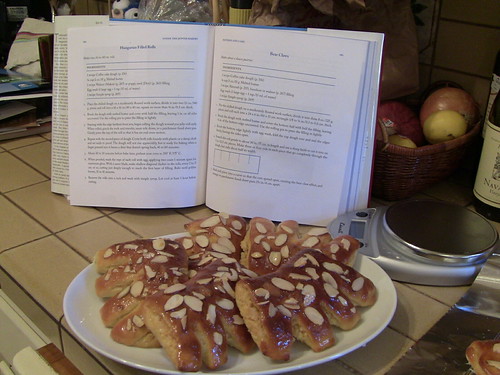
I’ve always loved bear claws.  I wish my first attempt had been closer to my ideal.   These had way too much marzipan filling (I’m beginning to see a trend with this cookbook).  Next time I’ll cut it in half.  The following recipe cuts the marzipan to what I think would be a more proper proportion.

Take ½ of the above dough recipe and roll it out on a well-floured board to 10” by 15” (about 1/8” thick).  Cut the dough into two halves of 5” by 15”.  For each of these pieces, spread a narrow strip of filling (see recipe below) in the middle along the long axis.  Fold the dough in half over the filling and press the seam to seal.  Cut ½” slits along the seam every ½ inch.  Pull the ends of the log to spread it to 16-17 inches.  Cut each log into four pieces and bend each into an arc to spread the “fingers”.  Place on a parchment lined baking sheet, brush with egg wash, sprinkle with sliced almonds and proof until doubled (about two hours).  Then bake at 400 F. for 15 minutes, then at 375 F. for another 10-15 minutes or so, until top and bottom are golden brown.

Filling:  Put ½ log of almond paste (3 ½ ounces) in food processer.  Pulse with metal blade until soft and smooth.  Add ¼ cup granulated sugar, 1/3 cup powdered sugar and ½ an egg white to the processer, and pulse until just mixed and not lumpy.  Keep covered until used.

As mentioned, the recipe had much too much filling, and was way too sweet.  The excess filling also expanded hugely and kinda tore some of the poor bear claws apart.  Once they cooled, their swelling subsided. And it turns out they were a bit underdone inside (probably due to the excess of filling).  I will try this recipe again some day, but even if all the proportions were right, I think the pecan rolls are the real winners.

Too much filling

Start of proofing

  Out of the oven

  Crumb shot

I have ¼ of the dough left over.  Maybe I’ll make something else tomorrow.

So that was my first try at Danish pastries.  It was a pretty good learning experience, and I have a lot more to learn.  I wish I could experiment on these regularly, but I’d have to take up running, and that would have to involve someone chasing me.

Glenn

GSnyde's picture
GSnyde

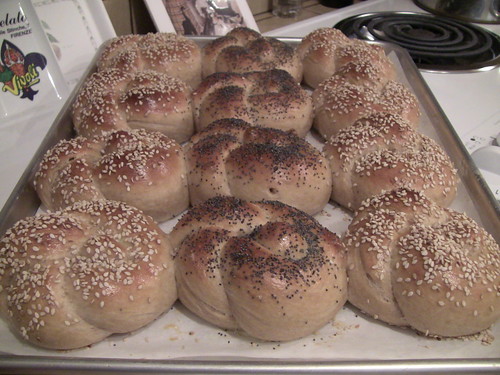
Ho hum.  More bread.  My N-teenth batch of Proth5’s “Bear-guettes” and another try at bagels using a variation on the Krakowski formula in the upcoming Inside the Jewish Bakery.

The baguettes are the best I’ve ever made in terms of both flavor and texture.  I followed Pat’s formula to the tee, using Central Milling Organic Artisan Bakers Craft Malted flour and a super-steamy oven.  I handled the dough and the baguettes more gently than usual, and they were more airy than usual.  I now have a stock of baguettes in the freezer for an upcoming party.

The bagels were very good, but not as pleasing as my first attempt last week—a bit too chewy, with a tougher crust.  There are a few possible reasons for the differences in result, but I think the main one is that this time I used all high gluten flour (80% KAF Sir Lancelot and 20% KAF First Clear); last time I used 20% Bread Flour and 80% Sir Lancelot.  I wonder if the use of malt syrup this time instead of honey in the boiling water made a difference in the crust.  I notice the crust is not as shiny this time.  Finally, in my San Francisco oven this week, it took about 16-17 minutes for the crust to get golden brown, and last week in my North Coast oven it took about 14-15. 

No serious complaints, just a shade off the mark I set the prior week.  On the other had, they made a truly wonderful vehicle for smoked Nova Salmon.

I also have a question about seed adhesion.  Seems like no matter what kind of bread I make with seeds on the crust, they fall off at the slightest provocation.  Any tips for keeping seeds where they’re put?  Should I dredge the bagels in seeds immediately after they come out of the water instead of waiting a few minutes for them to cool?  Pound them in with a mallet?  Is there some secret adhesive that savvy bakers use?  Thanks for any advice.

Glenn

GSnyde's picture
GSnyde

Reel  BayGulls


That's my pictogram for the day.  It shows what I baked this morning: Real Bagels!


And they were goood!

It started with the croissants.  Several people asked me what’s next now that I’ve made croissants.  It got me to thinking about what’s missing from my repertoire.

I thought to myself, “Self!” [That’s what I call myself.] “Your life would be richer and more meaningful if you made bagels.  Real bagels, like you couldn’t eat if you didn’t have good teeth.”  [I do have good teeth.]  “Or are you afraid?” [I am not afraid.  I do have good teeth.]

So, after that cheeky challenge from my self, I had to bake real bagels. 

I wish I could say I grew up eating really great bagels, but in truth, my youth was bereft of such bagels except on occasion when our cousins in Tarzana brought bagfuls from Western Bagel in Van Nuys.  Later, when I started to travel to New York on business, I learned what it meant to eat a Real Old School Urban American Bagel.  This is what I hoped to bake.

I looked to my usual sources for guidance—Peter Reinhart, Jeffrey Hamelman, David Snyder.  I settled on the formula for Krakow Bagels from the soon-to-be-published “Inside the Jewish Bakery”, which David reported upon favorably (http://www.thefreshloaf.com/node/18280/kraków-twisted-bagels).  This formula—which doubtless will make Stan and Norm’s fortune-- has been published in The Wall Street Journal (http://online.wsj.com/article_email/SB10001424052748703794104575545843564259642-lMyQjAxMTAwMDEwMjExNDIyWj.html).  The market was up that day.

After consulting TFL as to flour choices given my depleted stash of high gluten flour (http://www.thefreshloaf.com/node/24717/need-advice-flour-bagels), I decided to supplement the Sir Lancelot with some KAF Bread Flour; it ended up being about 75% Sir Lancelot.  I followed the formula, hand-mixing and then kneading, and kneading, and kneading the stiff dough… for about 18 minutes, ‘til it felt like it was ready and made a small window pane; and it threatened to make a small back pain too.

After dinner last night, my wife, Cat, and I divided the dough and shaped the pieces several ways—some rolled thin, then doubled and twisted per Stan and Norm’s directions; some just made into regular bagels.  The twisty ones were a challenge.  Cat made a couple that looked right, but mine were thin and too bracelety (my new word for the day).  They retarded overnight and were boiled in honey water, seeded and baked this morning. 

I have considered at length exactly how to describe the results, and have come up with the proper terminology:  Yummmmm!  These taste like, and have the texture of, Real Old School Urban American Bagels.  Right after half-cooling, they had a nice crunch to the crust, and it took a good tooth-grip and a serious tug to get a bite.  Good and chewy (even with only 75% high gluten flour).

They were delicious unadorned, and even better with cream cheese and kippered local King Salmon.

These bagels made a real meal.  And, of course, a real meal needs dessert.  So I also made some cinnamon roll sticky buns.

These were made using Floyd’s timeless recipe (http://www.thefreshloaf.com/node/2374/cinnamon-rolls), with the rolls laid on top of a layer of butter, cinnamon-brown sugar and pecan bits.  Awesome second breakfast!

My wife loves anything with cinnamon, sugar and nuts.  She said these cinnamon rolls came close to the ones she remembers from her junior high cafeteria, the ones that taunt her to this day.  That made me happy (I mean...if any cinnamon roll is going to taunt her, shouldn't it be mine?)

What made me even happier is she said the bagels were even better than the cinnamon rolls.  You have no idea how much she has to like these bagels to say that!

I guess bagels will be in my regular repertoire.

Glenn
GSnyde's picture
GSnyde


[

I’m coming up on my first anniversary.  It was late August last year when I first baked something like bread and wrote something like a blog post about it. 

So how do I celebrate this anniversary?  Perhaps by baking some wonderful bread to demonstrate the skill and experience I’ve gathered over the past year?  Of course not!  That’s would hardly be a meal fit for a glutton for punishment.  No, I have to try something new and difficult, to re-live the feeling of utter novice-hood that I remember as if it were just last year.

Croissants and Laminated Pastries!!  Something I could study for weeks, work at for days and finish by realizing how very much I have to learn.  Sounds like the kind of challenge that got me started baking bread. 

I started preparing myself for this experiment by reading everything I could find and watching lots of videos about making lamented dough (yes, I know that word is missing a letter; more about the lamentation later).  I was hoping that if I knew the mistakes other people had made, I would only make my own new and novel mistakes (of which I was sure there would be plenty).

Of all the writings on croissants on the World Wide Web, the best by far is Txfarmer’s TFL post about her pursuit of the perfect croissant (http://www.thefreshloaf.com/node/22677/poolish-croissant-pursuit-perfection).  I careful reviewed her lengthy and detailed description of all the lessons she learned in repeated attempts.  Her account is a perfect example of what makes TFL great.  So much work so generously shared, and a wonderful pictorial of a successful course of experimentation. In the process of making the dough and shaping the croissants with the benefit of her numerous tips, I realized that she probably saved my ten pounds of butter worth of inedible (or at least grossly imperfect) croissants. 

I made two batches of dough, one Friday for baking Saturday, and one Saturday for baking Sunday. Each batch was split, with some of the dough going into croissants, and some into pastries—morning buns Saturday and pains aux raisins Sunday.

The Morning Bun recipe is here (http://www.7x7.com/recipes/tartines-heavenly-morning-buns-recipe), as cited in Sue’s blog post a couple months ago (http://www.thefreshloaf.com/node/23704/tartine039s-morning-bun-best-eaten-fresh-morning-every-morning).  The pains aux raisins recipe is here (http://www.foodnetwork.com/recipes/jacques-torres/croissants-pain-au-chocolat-pain-raisin-and-danish-recipe/index.html). 

In general, I found the process challenging but manageable.  So many steps, a full weekend is needed, and almost as much patience as butter.  I found the dough to be very elastic after the third fold, and never could get it as thin as ¼ inch, even after repeated rests.  I also learned on the first batch to be very patient with the proofing…it does take a long while at 70 degrees F. for the pastries to get sufficiently jiggly.  The first batch was a bit underproofed, I think.

But, all told, the results were very satisfying, even delectable.  The croissants are flaky on the outside, tender on the inside—a wonderful mouthfeel.  I slightly oversweetened the morning buns the first time, and will cut back the sugar coating a bit next time  The texture of the morning buns is pretty close to the way they should be.  Just a bit too heavy and chewy, probably due to underproofing.  And the pains aux raisins (which I may re-name “raisins d’etre”) are delightfully tender and delicious, with their almond cream and rum-soaked raisins.

I’m pretty pleased with my first tries at laminated goodies, and grateful to my mentors.

The peak experience was a mid-morning macchiato with warmed pastries.  A real morning buzz.

Now, about the lamentation.  Yes, I admit I love a good pun almost as much as a bad one.  But I really do have a lament about this baking experience.  I knew pâtisserie had lots of butter.  But, until I saw and dealt with the quantity of butter in this recipe, I hadn’t realized that eating this stuff is basically eating butter and sugar held together with just enough flour and liquid.  I imagine if I ate these regularly, someone would need to bash my arteries with a rolling pin (per the proper lamenation technique) just to get the blood to squish past the plaque buildup.   I’d end up looking like our local pinniped friends, the elephant seals.

It is simply not fair that something soooo good is soooo bad!  Plus, I know that Txfarmer is right that it would take a lot more practice to get really good at it, and of course I have to eat my homework.  Plus, today I got an Amazon package with the Tartine cookbook with all their amazing cakes, tarts and pastries.  I’m doomed!

So, if I can muster the will power, this will not be a weekly, or even monthly, habit.  But I will return to these sinful pleasures on occasion, hopefully when I have a crowd of butter-loving carbotarians around so I don’t need to eat more than one or two myself.  Okay…maybe three.

Glenn

GSnyde's picture
GSnyde


Cat and I don’t throw dinner parties very often, but when we do we are reminded that we are pretty dang good at it.  And now that I have become a semi-competent baker, the parties are even better.

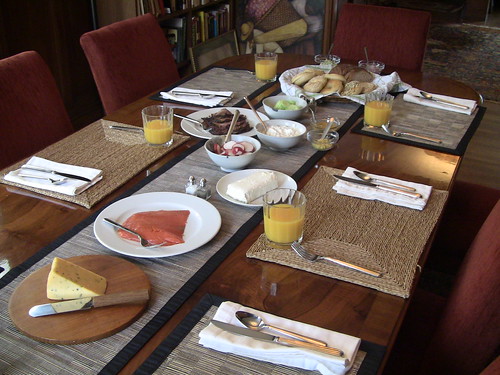
There were several reasons for last night’s event: (1) a business associate (and friend) of Cat’s is visiting from New Zealand, (2) he’s also a good friend of Cat’s boss, whom we had never hosted in our home, (3) he’s also a good friend of Cat’s brother and brother-in-law, who are also friends of Cat’s boss and always entertaining, and (4) we had so much bread in the freezer that Cat and I would have been eating Panzanella for a month to whittle it down.  Oh, yeah, and (5) we like feeding and fermenting friends into a frenzy of frivolity.

I should mention that “having the boss and his wife over for dinner” may sound like a tense occasion (ala how many old movies).  But in Cat’s case, her boss recruited her years ago, already knowing her intelligence, skill and good nature, and his opinion of her has only grown higher over the years.  I suppose we could have messed up her work life by poisoning the boss, but I didn’t even think about that scary prospect until now.  I am conscious of the reversal of classic roles here: the wife, a manager in a big corporation, invites the boss and his wife over for a dinner prepared by the husband (whom she likes to keep in the kitchen). 

The menu included baguettes and cheeses and toasted Curry-Onion-Bacon-Cheese Bread (http://www.thefreshloaf.com/node/22549/some-spice-breads-–-one-sweet-and-one-savory) to start, with a main course of charcoal-grilled butterflied leg of lamb (Julia Child marinade), bulgur pilaf, and Panzanella with heirloom tomatoes and herb fried Tartine BCB (http://www.thefreshloaf.com/node/24230/continuing-italian-theme-panzanella).  Dessert was vanilla ice cream, awesome strawberries and Chewy Chocolate Cherry Cookies. 

Cat’s boss is a widely recognized gourmand and his wife was (before kids) a talented professional chef.   So I chose to prepare proven recipes (except the cookies, of which more below).  Having a Kiwi visitor was an opportunity to prove the superiority of California Lamb over the New Zealish variety (I don’t really mean that—the lamb in New Zealand is spectacular, much better than what they export to the U.S.).

Anyway, enough background.  I should say something about baking since this is still, to a large degree, a bread-oriented web site, pastrami and pickles to the contrary notwithstanding.

I have been experimenting with different baguette formulas lately, but the most reliable for me, and the one I like best, is proth5’s formula now known as “bear-guettes” (recipe below).   The dough is a dream to work with, and the result is crispy-crackly crust and tender creamy crumb…perfect as a cheese conveyance.  The formula makes 6 mini-baguettes.  I divided the dough after an hour of bulk fermentation and put half in the refrigerator for 90 minutes, so I could bake in two batches, the second after leaving enough time for the steaming skillet to get back up to temperature.  The results were quite satisfactory, with many oohs and ahs (attributable in part, I’m sure, to the creamy goat cheese the baguettes conveyed).

The main course was also very good.  Grilled lamb and bulgur pilaf are nicely enhanced by a puddle of tart vinaigrette from the salad.  Cat’s boss’s wife—the chef—commented appreciatively on how perfect the bread in the Panzanella was; she thought I’d gotten the bread from Tartine Bakery, and seemed impressed when she learned I’d baked it myself from the Tartine recipe.  As much as I treasure my wife’s favorable reaction to my bread, there’s nothing like unbiased third-party expert validation.  The feast was washed down with a pretty fair duo of 2001 pinot noirs, one from the Russian River Valley (Dehlinger) and one from Burgandy (a Gevrey-Chambertin).  

Then, the dessert.  I’ve toyed with chewy chocolate cookie recipes for years, my favorite being a Mocha cookie with bitter-sweet chocolate, fresh ground dark roast coffee and (I hate to admit) instant coffee crystals.  Somewhere recently I saw a formula for a chocolate bread with sour cherries and nuts, and thought that chocolate-cherry cookies would be pretty good.  So I modified my Mocha cookie recipe to replace the coffee with more chocolate and added dried tart cherries.  Awesome!  Very soft and chocolaty, with the extra chew and tartness of dried fruit. 

After some coffee and music, our guests waddled off into the late night and I’m confident Cat’s job is safe.

Here’re the recipes:

Proth5’s Bear-guettes

(adapted from dmsnyder’s report on proth5’s formula. See further notes at http://www.thefreshloaf.com/node/21620/proth5039s-quotstarting-get-bearquot-baguettes)


Poolish


Ingredients

Wt (oz)

AP flour

3.7

Water

3.7

Instant yeast

“generous pinch”


Levain


Ingredients

Wt (oz)

AP flour

1.7

Water

1.7

Ripe sourdough

0.35


Final dough


Ingredients

Wt (oz)

AP flour

31.35

Water

19.2

Instant yeast

0.05

Salt

0.70

Poolish

All

Levain

All


Total dough


Ingredients

Wt (oz)

Baker's %

AP flour

37.1

100

Water

25

67.25

Instant yeast

0.1

0.25

Salt

0.70

1.9

Starter

0.35

9

Total

63.1

178


                  Mix the poolish and the levain and let them ferment at room temperature for 8-12 hours.

                  Mix all the ingredients except the salt to a shaggy mass. Cover and let rest for 30 minutes.

                  Add the salt and hand mix in a large bowl.

                  Bulk ferment for 4 hours with a stretch and fold at 2 hours. (I cold retarded half after the S&F for 90 minutes).

                  Divide into 10.5 oz pieces and pre-shape as logs. Rest the pieces, covered, for 20-30 minutes.

                  Shape as baguettes.

                  Proof en couche for 1.5 hours.

                  Pre-heat oven to 500ºF with baking stone and steaming apparatus in place.

                  Transfer loaves to peel. Score them and transfer them to the oven.

                  Reduce oven temperature top 460 F and bake with steam for 10 minutes, and bake dry for another 9-11 minutes.

                  Transfer to a cooling rack and cool thoroughly before eating.


                                    CHEWY CHOCOLATE CHERRY COOKIES


                                    INGREDIENTS:


2 cups all-purpose flour

1/2 teaspoon baking soda

1/2 teaspoon salt

1/2 cup unsweetened cocoa powder    (Scharffenberger)

3/4 cup unsalted butter (1 ½ sticks), melted

1 cup packed brown sugar

1/2 cup white sugar

1 tablespoon vanilla extract

1 egg

1 egg yolk

4 oz. Scharffenberger bittersweet baking chocolate, chopped or shaved

2 cups dried cherries


                                    DIRECTIONS:


1.

Preheat the oven to 350 degrees F. Grease cookie sheets or line with parchment paper.


2.

Sift together the flour, baking soda, salt, and cocoa powder; set aside.

3.

In a medium bowl, cream together the melted butter, brown sugar and white sugar until well blended. Beat in the vanilla, egg, and egg yolk until light and creamy. Mix in the sifted ingredients until just blended.  Stir in the chopped baking chocolate and cherries by hand using a wooden spoon.


Refrigerate dough at least one hour.


Drop cookie dough (about ¾ of a 1/4 cup measure per piece) onto the prepared cookie sheets. Cookies should be at least 1 ½  inches apart.  Flatten each cookie a bit.


4.

Bake for 12-13 minutes in the preheated oven, or until the edges are lightly toasted. Cool on baking sheets for a few minutes before transferring to wire racks to cool completely.

Glenn

GSnyde's picture
GSnyde


It’s Summer in San Francisco, and that means soup weather.  And what goes better with soup than a nice tender, wheaty dinner roll with whole grains and seeds?  I’d never made such a bread, but why not try?

I’ve never really invented a formula before, just tried adaptations of proven formulas.  But I didn’t find a formula that looked quite like what I was after: something in between the Hamelman Whole Wheat Multigrain and an enriched whole wheat-oatmeal bread.  So I looked to my experience with enriched whole wheat and oatmeal breads, read a number of TFL entries about how to achieve a soft crust and about seedy breads.  Then I looked at a bunch of formulas from Hamelman and Reinhart, and put pencil to paper (with calculator at hand).

Since I had a very active starter going, I decided to make a leavened dough, with a pinch of instant yeast.

I also had in mind trying the Central Milling Organic Type 85 flour for something besides a Miche.  So that’s the flour I used for this experiment (but I think a mix of 50% whole wheat and 50% bread flour would work fine).

I mixed the levain last night, and this morning I soaked some Bob’s Red Mill whole grain cereal (Five Grain with Flax seed) and toasted some wheat germ and some pumpkin, sunflower and sesame seeds.

My calculation on paper of the proper hydration for this dough was a ways off, presumably due to the thirsty whole grains, and I ended up having to add more water during the initial mix.  Reminded me of proth5’s discussion of the “hydration neutral” concept.

But once I got the dough texture feeling right (kind of like the Hamelman Oatmeal bread), it was a joy to handle.  Having no clear idea how long the bulk ferment should be for this dough, I just watched the dough, not the clock (hmmm…where have I heard that before).  After about 1 ¾ hours, the dough had expanded about 50% and seemed nice and airy. 

So that’s when I divided and pre-shaped the dough into 3 oz balls, waited 30 minutes, and then shaped the balls into round rolls.

They proofed 1 ¼ hours, then baked for 18 minutes, the first half with steam.

They came out a nice golden brown, and they make the house smell delicious.

I let them cool about 40 minutes before I couldn’t resist any longer.  They are about the density of a firm whole wheat bread; nice and springy, but firm; the structure would be good for a sandwich loaf.  The seeds and whole grains make for a nice mix of feel and flavor.

The flavor is nutty and complex, just the slightest bit sweet.   It would be excellent with a sharp cheese or with peanut butter, or just sweet butter.  My wife enjoyed the first taste a lot, and said it would be great with raisins added…and nuts and cinnamon (she has a thing for cinnamon-fruit-nut breads).  That’s a variation I’ll try.

All in all, a good experiment.  The formula follows a few more photos.

Multi-grain Seedy Rolls

(7/31/11)

Liquid Levain

.4 oz ripe starter

2.4 oz water

1.9 oz Type 85 flour

Soaker

2 oz BRM 5-grain cereal mix

2.5 oz hot water

Final Dough

14.1 oz Type 85 flour

.4 oz baker’s milk powder

.05 oz instant yeast

6.8 oz warm water

.7 oz honey

.8 oz vegetable oil

liquid levain (all)

soaker (all)

.35 oz salt

1.2 oz toasted seeds (mix of sesame, pumpkin and sunflower) and wheat germ

Procedure

1.        The night before baking, mix the liquid levain and leave covered at room temperature 10-14 hours.

2.        An hour before mixing dough, (a) toast seeds and wheat germ in 300 F oven for 40 minutes, then let cool, and (b) pour hot water over cereal for soaker, and cover bowl.  

3.        Mix flour, milk powder and instant yeast.

4.        Mix water, liquid levain, honey, vegetable oil, then add soaker.

5.        Pour dry ingredients into liquid ingredients and mix to shaggy mass.

6.        Cover for 30 minute autolyse.

7.   Add salt and toasted seeds and wheat germ, and mix thoroughly, then knead five minutes to medium development.

8.        Bulk ferment at 70 F. for two hours with four way stretch-and-folds at 45 minutes and 90 minutes.

9.    Divide into approx. 3 oz pieces and pre-shape in balls.  Rest 30 minutes.

10.  Shape as round rolls, place on parchment, and proof one hour.

11.  Pre-heat oven, with baking stone and steam apparatus, to 450 F.

12.  Transfer parchment to baking stone and bake 9 minutes with steam, then remove steam apparatus and lower  temperature to 400 F.  Bake an additional 9 minutes or so (to internal temperature of 195-200 F), rotating the parchment for even browning as necessary.

13.  Remove rolls from oven, and brush with milk (if you like softer crust).  Cool on rack for 30 minutes or more.

Submitted to Yeastspotting (http://www.wildyeastblog.com/category/yeastspotting/)

Glenn

Pages

Subscribe to RSS - GSnyde's blog