The Fresh Loaf

News & Information for Amateur Bakers and Artisan Bread Enthusiasts

GSnyde's blog

  • Pin It
GSnyde's picture
GSnyde


My wife, Cat, is away in Australia on business.  Yes, my wife’s name is Cat, which may cause some confusion because we also have a cat.  But the cat’s name is not “Wife”, which would make it even more confusing…and be pretty weird.  Especially since one of my wife’s many nicknames is “Wife”.


Anyway, I’m stuck in boring San Francisco while she’s off traveling the World.  So, I have to find a way to entertain myself.  And what entertains me these days is baking.  So, here’s the plan:


IMG_2057


It’s now Friday night, and I’m on schedule.  Last night I mixed the levain, toasted the walnuts and soaked the cranberries for Cranberry-Walnut Bread, based on the SFBI Raisin-Walnut Bread that David blogged on (http://www.thefreshloaf.com/node/21289/walnut-raisin-sourdough-bread-sfbi-artisan-ii).  I have made that bread with raisins (http://www.thefreshloaf.com/node/21384/sfbi-walnutraisin-bread-–-northern-version) and thought it might be even better with dried cranberries in place of the raisins.  This morning I mixed the dough—the cranberries were a bit watery, but it all worked in with extra kneading.  I let it ferment while I started my work day (many hours on the phone and email). Oh, yeah, I also mixed the levain and poolish for proth5’s new baguette formula (aka “Bear Baguettes”).


The Cranberry-Walnut dough rose like crazy even though the dough temperature was below the prescribed 78-80F.  I think my sourdough starter might have rabies (Is that possible? Anyone?).


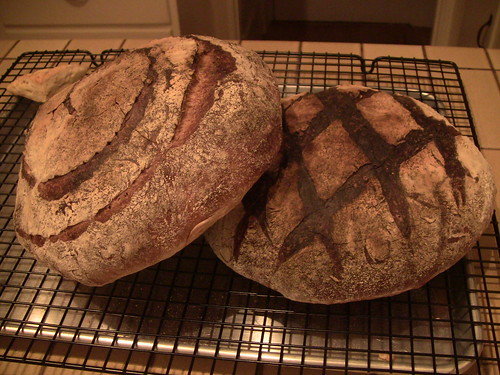
During a self-imposed lunch break, I pre-shaped and shaped the Cranberry-Walnut loaves, one batard and one boule.   The loaves also rose more quickly than I would have expected.  During a self-imposed coffee break  (a delicious macchiato), I slashed, steamed and loaded.  By time my 3:30 call started, the loaves were cooling.


By time that call was over, I was hungry, and I happened to have some cream cheese--the perfect topping for this bread.  Totally delicious!  The crust is toothsome, the crumb is tender, the cranberries are tart and chewy and the nuts are nutty!  A good bread.


IMG_2053


IMG_2054


Later, the poolish and levain for the Bear Baguettes (maybe we should just call them “Beargettes”?) were ready.


IMG_2059


I mixed the baguette dough ‘til massively shaggy, let it autolyse 45 minutes, and mixed it up gently…a light mix as David and Pat have recommended.   I found that my initial mix had not been adequate to incorporate the flour, and there were small clumps of dry flour.  But I didn’t panic.  I put on my “c’est la fleepin’ vie” hat, tried to hydrate the whole big ball of dough without over-mixing, and covered the bowl.  If it doesn’t all work out, I’ll know better next time.  Besides the flour clumps, the dough felt great.  And after the stretch and fold, it seems silky and strong.


‘Nuff for now.   More to follow.


UPDATE:  Saturday Eve


My attempt at proth5's new baguette formula (http://www.thefreshloaf.com/node/20831/starting-get-bear) is out of the oven, cooled and tasted.  I retarded the dough overnight, let the dough come to room temperature for a couple hours, shaped, glued on seeds, proofed 90 minutes, slashed and baked at 475, using Sylvia's steaming towel technique.


The flour is 100% Central Milling's Organic Artisan Baker's Craft with Malt (except the tiny bits of WW and Rye in my mother starter).


The result is gooood. Crispy on the outside and airy-chewy on the inside.


IMG_2061


IMG_2068


I had said earlier maybe we should call these "bearguettes."  But since I had most of one with a dinner of lamburgers, I think they are "baaaguettes".


Tomorrow I bake the big SFBI miche.


Glenn


GSnyde's picture
GSnyde


IMG_2044


Last week I made San Francisco Sourdough, and learned a lot.  I decided to try it again this weekend with some variations relating to flour mix, dough handling, retardation time and loaf shape.


I again used the formula in Peter Reinhart’s Crust and Crumb, and I again used primarily Bob’s Red Mill bread flour.  But this time, instead of 100% bread flour I used about 9% dark rye flour and about 11% whole wheat flour.  I used the rye and whole wheat in each of the three mixes: the liquid starter, the firm starter and the main dough.  I did not adjust the hydration (64%).


My other departures from the C&C formula were:


  • Though the formula calls for kneading the dough, then letting it sit unmolested in a bowl for four hours, I gave it a four-way letterfold every hour.  The dough was firmer (less slack) this time, compared to last weekend when I did no folds.


  • I followed the formula’s specifications for ripening and then retarding the two starters, but I decided to test the effects of retardation after proofing and to test the attributes of different loaf shapes using this formula.  I scaled the dough for 3 mini-baguettes of 250 grams each and a boule and a batard of 615 grams each.  The baguettes I baked as soon as they were proofed; the larger loaves were put in the fridge overnight after proofing 3 hours as in the formula.


I should also mention that I proofed the baguettes and the batard on linen couche, and the boule in a linen-lined basket.  I did not spray oil on the loaves at the beginning of proofing as Reinhart specifies.  The baguettes were covered with a fold of couche fabric and a tea towel over that.


Here’s the fermented dough after a 3 ½ hour rise.


IMG_2035


Here’s the proofing loaves. 


IMG_2039 


The baguettes baked at 450 on a stone with steam for 10 minutes, then without steam at the same temperature for another 10 minutes.   Then I left them to sit on the stone with the oven off and the door ajar for another 10 minutes.  The internal temperature was 209F.  They’re really pretty to look at.


IMG_2040 


IMG_2042


The crust is darkish, and very hard.  Indeed, it is positively tough, as in hard to bite through.


The crumb is very good tasting and nicely chewy, not what I’d call tough.  Not a very open crumb, but not really dense.


It was a really good thing I had delicious Chicken Cacciatore to dip the bread in to moisten it (the bread made a fine mop).  Thanks for the recipe, David.


IMG_2045


So, you experienced bakers, what caused the rock hard crust this time?


  • ·      Increased gluten strength from the folds during ferment?

  • ·      Baguette shaping?

  • ·      Baguettes getting too much air (not sealed in plastic) during proofing?

  • ·      Too low hydration?

  • ·      Too bold a bake or too much time drying on the stone?


Any help would be appreciated.  The boule and batard just came out of the oven, and I’ll report results later.


Thanks.


Glenn


GSnyde's picture
GSnyde

Saturday 1/15/11.  Today, I am musing on my bread-ucation.  Sort of a milepost marking.  I have been baking for five months.  But I am beginning to feel somewhat knowledgeable about a narrow category of breads, due in large part to (1) The Fresh Loaf and readings recommended here and advice given here, and (2) an enthusiasm for baking that has me making lots of bread as often as I can.  I learn stuff every time I handle dough and bake bread.


In that short span of baking experience, here are some things I've learned about baking simple sourdough breads:


  • To make bread the way you like it takes lots of study and gathering of general information (reading, watching videos, asking questions, and the like) and even more hands-on trial and error (the error part is very important). It's good to know some bread science--what factors have what results and why--but you can only improve your bread-baking by keeping track of what you do each time and making adjustments the next time.

  • You may like bread to be a certain way that others don't, and your tastes may change.  Some like big holes in the crumb, others don't; some like really dark crusts, others don't; some like sourer flavor than others do, etc.  Make it the way you like it and  be your own judge.

  • There are lots of variables that affect the crust, crumb and flavor: to name a few: flour choices; hydration; attributes of your starter culture; dough handling at each stage (including mixing, kneading and/or folding, dividing, pre-shaping, shaping, scoring and loading); time of each stage; temperature of ingredients; temperature of environment; type, quality and duration of steam during the bake; characteristics of the oven; attention to, understanding of, and reaction to the sensory information the dough provides; and luck, blessedness, karma, whatever you choose to call it.  All of these variables are important, but I think the last two in the list are the most important.  

  • There is no perfect loaf.  Striving for improvement can yield improvement, but can also yield higher expectations.  The Earth is round; the horizon keeps receding.

  • The more I learn, the more I realize how little I know.

  • Bread tastes better when it's been well photographed and shared, and your friends ooh and ahh at it.


This weekend, I am making San Francisco Sourdough from Reinhart's Crust and Crumb.  This is the first time I have made something called "San Francisco Sourdough".  I have made 20 or 30 sourdough breads, mostly variations on Hamelman's Vermont Sourdough (including Brother David's San Joaquin and my own San Francisco Country).  But I love the sour flavor, the crispy crust and the moist, chewy crumb of classic San Francisco Sourdough, and I've lived in San Francisco and environs for most of my life.  So isn't it time? 


I have read the formula and all the commentary in the book, and I've looked at several TFL blog posts on this bread.  What I learned: my brother David really likes this bread (or at least he did in 2008-09 when he blogged many times about it).  I chose the formula from Crust and Crumb because (1) I have the book, (2) the formula won some whoop-de-doo award, (3) my brother David really likes this bread and he has good taste, and (4) it's a weekend when I can focus on this formula which takes several days of attention.  


In comparison with most of the other sourdoughs I've made, this formula calls for a firmer starter, considerable kneading, and a more passive fermentation approach.  There are no stretch and folds during the long (4 hour) primary ferment.  I am also--for the first time--making a sourdough with all white flour, and no rye or whole wheat.  I am using BRM enriched white flour, made--according to the bag--from high gluten hard red wheat.  


I can't say I am following Professor Reinhart's formula exactly (I rarely follow anything exactly).  I made a liquid starter from my stock starter, and let it ripen, then chill (but not as long as the formula prescribes).  I then made a firm starter from the liquid starter, and let it ripen, then chill (but not as long as the formula prescribes).  I suspect the shortened retardation time on the starters will make the bread less sour than it would have been, but I will get to finish the process in time to enjoy the bread before the end of the weekend.  Some day I will give this formula all the time it asks, and see if the result is sourer or otherwise different.


I mixed the firm starter, flour, water and salt with my fingers and a plastic scraper.  At least 90% of the dough ended up in the bowl at the end of the mixing.  I then kneaded it on my granite counter, sprinkled with flour.  What I learned. I like kneading dough (I sort of knew that from a few past kneading experiences); it gives immediate visual and tactile feedback on dough development.  Unlike stretching and folding over several hours, when you knead dough, you feel the strengthening of the gluten with every few turns.  Also, I like kneading on floured granite.  Seems like just the right amount of sticky friction.  The dough is now fermenting.  Giving me time to muse.  What I learned as I mused and watched the activity in my sunny courtyard: voles and sparrows will riotously gorge themselves on scattered birdseed, while totally ignoring each other.  The sparrows will chase each other away, but the sparrows don't even seem to acknowledge the voles, and vice versa.


Later 1/1/5/11.  I have now shaped the 1 pound dough pieces into boules.  What I learned. This dough is loose and silky though the hydration is fairly low.  Is it because the gluten develops less strength when the dough is not stretched and folded periodically?  Or because the all white flour absorbs less water than my usual dough which has 15-25% whole grain?  Or because the fermentation (and looseness) is enhanced by the high proportion of stiff levain?  I also learned that un-floured granite is an excellent surface for using the boule shaping technique that Brother David has famously video-recorded.  I strove for a really taut sheath, but the little blobs seem to think they're 75% water when they're more like 60%.  


Now the boules are in their bannetons in their plastic bags, proofing.  They will proof in the kitchen until they have once-and-a-halfled (half a doubling).  Then they will go in the refrigerator for the night.


Sunday 1/16/11.  90 minutes after being taken out of the refrigerator, the boules were gently flopped from their bannetons onto pieces of parchment, then placed on a cookie sheet and scored.  The oven, with baking stone, was pre-heated at 475 F for an hour steamed using Sylvia's magic towels and a cast iron skillet with lava rocks. In addition, contrary to my usual procedure, I misted the loaves with water when they were loaded and again after a couple minutes.  After 15 minutes, I removed the steaming apparati and reduced the temperature to 425 F on convection setting.  After 30 minutes total (and a 207 F internal loaf temperature), I turned the oven off and left the loaves on the stone with the door ajar for another 10 minutes.


The oven spring was very good, though not the mighty spring of some other sourdoughs I've baked.  The loaf scored with a star rose about 20% more than the one with the hash mark (is this a commentary on telephone keypads?). The crust is perfectly colored, deep caramel and quite even, shiny, with little crust bubbles here and there. What I learned.  Spritzing loaves seems to add to shine and crust bubbles.  The star scoring pattern seems to encourage upward spring.  Convection baking (in a good oven) seems to enhance evenness of crust color.  I love my North Coast oven.


IMG_2022


IMG_2027


As the loaves cool, I can take a few minutes to look off to sea, where a large group of grey whales are commuting South, presumably looking for real Wharf Bread.  They are spouting off and waving hello with their flukes.


Later 1/16/11.  The loaves are mostly cooled.  They spray crust crumbs widely as they are sliced.  The crumb is moist, airy but chewy.  Very much a classic SF sourdough.  The holes are mostly small, with a few bigger pockets, but not what you'd call an open crumb.  This is just as I like it.  The flavor is simple but good.  Mildly sour.  What I learned.  Maybe the longer retardation of the starters is key to stronger sourness.  The less open crumb may be linked to the passive bulk retardation (with no stretch-and-folds and thus less gluten strength to hold bigger bubbles). 


IMG_2031


IMG_2032


Update:  An hour later, the structure of the crumb has solidified and become a bit denser.  I'd say medium dense.  Good texture.  The flavor's also become a bit more sour.


All in all, this is a bread I'll make again, probably adding some stretch-and-folds and some whole grains.  And definitely trying the longer retardation of the starters that the recipe calls for. That would combine the more complex flavors, more gluten strength and the sourness I'm seeking.  I learned a lot from this bake.


Glenn


GSnyde's picture
GSnyde


I joined in the Dutch Oven craze with a Pain de Campagne bake a few weeks ago, and the outcome was fine, but I think I get my best results with Sylvia’s magic towel technique.  So, for my first try at a Tartine-like Country Bread, I baked two sloppy boules on the stone.


IMG_1998


I used the formula Brother David posted last week (http://www.thefreshloaf.com/node/21389/country-bread-freshmilled-flours, except I used professionally-milled flours rather than home-milled (since I don’t have a hackmesser of my own, nor a KitchenAid grinder attachment [which would not be very useful in that I don’t have a KitchenAid <geez, this sentence has lots of digressions>]).  I used my favored white flour, Central Milling Co.’s Organic Artisan Baker’s Craft, along with KAF Whole Wheat flour and BRM Whole Grain Spelt flour.  (This was the first time I’d used spelt flour and now I have a hankering to fry up some of those small Pacific surf fishes so I can have smelt on spelt.)


The 77% hydration dough was silky and malleable, but it was gumby-in-a-toaster-like to shape.  With a good deal of flour on the board and on my hands, I managed to form pretty tight boules.  I proofed one in the garage (52 F) so they could be baked in succession without the second one being overproofed.


As soon as they were gently plopped from the bannetons to the peel, they spread out.  But they did rise nicely in the oven.


IMG_1994


And there was much crust crazing.


IMG_2000


And this is kinda what I like the inside of my bread to look like.


IMG_2003


The texture is about ideal for me—very moist, tender and airy crumb, but with some chew to it.  The flavor is good, but not the most interesting.  Not quite sour enough and I miss the touch of rye I usually have in my Pain de Campagne.


I think the next test is to try to get the flavor of San Francisco Country Sourdough with the crumb texture of this loaf.  Maybe 70% white/20% whole wheat/10% rye with 75% hydration and a three hour primary ferment.


Of course, Tasha thinks I should forget about bread and learn to bake kitty treats.


IMG_2011


Glenn


GSnyde's picture
GSnyde


My first try at scones (with thanks to Breadsong!)


IMG_1987


Breadsong’s post last week about flaky scones (http://www.thefreshloaf.com/node/21414/flaky-scones-flavor-variations#comment-151182) got my sweet tooth going (and so soon after the holidays).  My wife and I love scones—if they’re flaky, tender and a bit moist inside--but had never made them.


The two variations--cheddar cheese and Irish Cream with chocolate-chip--breadsong baked looked scrumptious, but I decided to change them up a bit.  I made a small batch using her cheddar cheese scone formula, but added crispy bacon chopped into bits. 


IMG_1982


IMG_1985


And for the sweet scone, I used her second formula as the starting point, but instead of Irish Cream and chocolate, I mixed in dried pineapple soaked for three days in dark rum and Grand Marnier, and I added small quantities of rum, Grand Marnier and orange extract to the dough.  This was an attempt at a “mai-tai scone” but didn’t really taste like a mai-tai so much as a rum punch.


IMG_1990


Breadsong’s formula and technique produce scones that are flaky, light and tender, crispy on the outside and moist on the inside.  Both varieties came out wonderfully, but the rum-pineapple version is especially good.  I had intended to ice them with a rum-lime icing, but my Number One Taster said they didn’t need anything on top.   


Here’s the ingredients list for my adaptation of the sweet scone formula (for 18 small scones).


1 cups (5 ounces) unbleached all-purpose flour


½ Tbsp baking powder 


1/4 tsp kosher salt


scant 1/4 cup golden brown sugar


2 ½ Tbsp cold unsalted butter, cut into 1/2-inch cubes 


1/2 cup chopped dried pineapple (soaked three days in dark rum and/or orange liqueur)


Just less than 1/2 cup heavy cream (100-105 grams)


½  Tbsp dark rum


1/4 Tbsp Grand Marnier or Curacao


1/4 teaspoon orange extract


Half-and-half (for brushing)


Having been warned about the importance of keeping the dough cold, and knowing my first try would not go fast enough, I took a couple precautions.  I dusted the silpat and dough lightly with flour before I rolled the dough out each time; I put the mixing bowl in the fridge for a while before using it to mix the dough; and—as breadsong recommended-- I did my best to keep my hot hands off the dough. 


It worked out well, and I will try some additional variations soon.  I think the bacon-cheddar scones would be even better with the addition of green onions. Or give it an Italian accent with pancetta and parmagiano.  And the rum-fruit scone could use any one of a number of kinds of liqueur and dried fruit.  Maybe use eggnog in place of the cream in a rum-raisin scone.


Breadsong, my wife wanted to make sure I passed along her gratitude for sharing your winning recipe.  Truly awesome outcome, and on my first try.


My thanks, too.


Glenn


GSnyde's picture
GSnyde

As the year ends, and I look back, I see the start of my baking experience. And it’s Pizza! Making pizza is part cooking and part baking. Pizza is a good segue, a path for a cook to start becoming a baker.


My last bake of the year was two pies: a main course pizza of sausage, fresh Mozzarella, and two sauces, and a “dessert pizza” of Bosc pear, Walnuts and Gorgonzola cheese, drizzled with a Balsamic reduction.


The sausage pizza features a dough made with Stan Ginsburg’s personally imported Tipo 00 flour, fresh homemade pesto, the tomato sauce from TFL’s Pizza Primer, and homemade Turkey sausage from a recipe Brother David provided to me some time ago. I hadn’t planned on two sauces until I saw the beautiful fresh basil at the store, and we already had pine nuts and fresh Parmesan, so what was I to do?


I painted a “tricolore” pizza.


IMG_1946


Then added sausage and Mozzarella.


IMG_1947


And baked it on the stone for 10 minutes at 500F.


IMG_1948


The other pizza was really special. Beautiful pears, walnuts and delicious mild Gorgonzola. After baking, it was drizzled with Balsamic syrup I made by boiling down some good Balsamic vinegar.


IMG_1949


Both pizzas were enjoyed with good friends and good wine. I look forward to more such meals in the new year. And I look forward to sharing baking ideas and experiences with all of you, my TFL compadres. Thanks for all the good times, the support, and the guidance.


Wishing you and yours a very Happy New Year, as the sun sets on 2010.


IMG_1939


Best,


Glenn

GSnyde's picture
GSnyde

 IMG_1938


Continuing my bread baking jag on the North Coast, yesterday I baked the best-looking breads I’d ever produced. The formula is the same “San Francisco Country Sourdough” I’ve posted before (http://www.thefreshloaf.com/node/20471/san-francisco-country-sourdough—take-two), except I used Central Milling Artisan Baker’s Craft flour in place of KAF AP, and I rolled the three mini-baguettes in KAF’s seed mix. I also made a 800+ gram batard.


I have gotten comfortable enough with this dough that I could focus on visual aesthetics.  I took care to divide the dough ball so that part of the taut surface formed one side of each piece. I was able to shape the three mini-baguettes so all were about the same size and shape, and the scoring was pretty good.  My very happy starter and my magic SFBI linen helped provide good grigne. The downside of good open cuts with seeded baguettes is you don’t end up with as many seeds on top…a small price to pay.


IMG_1932


I’ve got to find a stronger glue for the seeds.


IMG_1945


The batard was preshaped as a boule, then shaped as a tight oblong, not a long torpedo shape.  In baking, it opened up and sproinged hugely. It has a really nice moist chewy crumb.


IMG_1936


IMG_1940


IMG_1942


Even if I hadn’t enjoyed the Challah, the pastries, the rye breads, and the other sourdoughs I’ve learned to bake this year, this bread alone would make all my baking efforts worth it. I wonder how I’ll tweak it next.


Pictured below is the bread bowl shared with our dinner guests last night—seeded SFCSD baguette, SFCSD batard and SFBI Walnut-Raisin Sourdough. Sourdough can be pretty sweet.


IMG_1943


Glenn


Submitted to YeastSpotting (http://www.wildyeastblog.com/category/yeastspotting/)

GSnyde's picture
GSnyde

 IMG_1921


When Brother David finished the Artisan II course at SFBI a few weeks ago, he didn’t have to plead with us to take some of the products of his craft off his hands. All of the breads were good, but two stood out—the Miche and the Walnut-Raisin Bread. I’m sure he will get around to baking the Miche at home, and I’ll try to be patient waiting for that recipe to be shared.


Happily, he baked the fabulous Walnut-Raisin bread at home the week after his course, and posted the formula (http://www.thefreshloaf.com/node/21289/walnut-raisin-sourdough-bread-sfbi-artisan-ii). The texture and flavor of this bread are very similar to Acme’s Cranberry-Walnut bread, which is one of our very favorites.


The other day, in my kitchen on the North Coast, I tried to replicate that wonderful bread. And my first attempt at a Suas formula was highly edible. Kinda purdy, too. It is an almost 30% whole grain bread made with a firm sourdough starter that accounts for about 15% of the final dough. The substantial volume of toasted Walnuts in the bread seems to complement the sourness of the dough, and the raisins add a nice bit of sweetness. My only departures from David's formula were to use Central Milling Organic Artisan Baker’s Craft Flour (which includes a bit of malted barley) and our unique Mendocino Coast high-hydration well water.


The dough was very sticky and not easy to hand-mix. I tried to follow instructions, but I have to say that mixing at “Speed 2“ for eight minutes gave me serious tendonitis. As evidence of my very active sourdough starter, the dough rose very nicely in two hours.


IMG_1900


IMG_1913


I had made 150% of the amount in David’s formula to have a loaf to eat, one to freeze and one to give as a gift. I formed two batards and one boule, and proofed them in oval willow brotforms and a round linen-lined basket.


IMG_1915


The batards were baked in our electric oven with the proven combo of Sylvia’s magic towels and lava rocks in a cast iron skillet. The boule was baked in the gas oven in an old Magnalite Dutch Oven (does that brand even exist anymore?).


IMG_1916


As you can see from the top photo and those below, the loaf in the Dutch Oven came out with a lighter crust. I can’t tell you what the texture difference is, since the boule has been frozen for future enjoyment. The batard we cut into had a nice thick crust. Not very crunchy. The interior is wonderfully complex, with fairly-dense chewy crumb, crunchy walnuts and juicy raisins. The flavor is outstanding, nicely sour and well-balanced with wheat and rye.


IMG_1920


IMG_1923


IMG_1928


The flavor is enhanced with Cotswold cheese or cream cheese.


IMG_1930


This is a bread I will make many times again.


Glenn

GSnyde's picture
GSnyde

The Winter Solstice and the Year-End/New Year is a time for re-collecting the events of the year, and also a time for renewal and reinvention. It’s a time for tradition and a time for new things, too. A good time to look back and look forward.


Mendocino Sunrise 12-23-10


IMG_1861


As I look back on this year, one major event was the start of my bread-baking passion in August. By chance, my sister forgot to take the sourdough starter David had brought to my house to give her. So I adopted it, and the rest is….delicious. I recall some rookie mistakes and some great bakes. No question, I’ve learned a ton … and have many tons more to learn. Looking forward, there are a thousand things I want to try: some totally new things, and some tweaks to make the tried and truer even better. The year draws to an end, with family visiting our weekend house on California’s North Coast (Mendocino County). It’s been a nice break from the usual hectic schedule. And I am baking. Some “old” favorites, and some new experiments.


Our year-end tradition is to gather with my wife’s family in our warm house while the inevitable Pacific storms rage outside. And eat and drink. A lot. We have dined on Chile Verde with Red Rice (later reprised as enchiladas), Roast Goose with stuffing from (my) old bread, Charcoal-grilled butterflied leg of lamb with bulghar pilaf and pear-pecan salad (leading to lamb sandwiches on still-warm Challah and, later, lamb curry). But you probably want to hear about the baking. With all the sweet tooth’s around, and a “we-can-diet-next-year” attitude, I baked some sugary stuff. Some new things, and some old favorites. All were very nutritious—with fruit or nuts.


IMG_1884


Some Fruit


For dessert after the Christmas Goose, I made Apple Crostada from trailrunner’s recipe (http://www.thefreshloaf.com/node/20622/apple-crostada). My first try at this a few weeks ago didn’t work out—too much liquid in the dough made it tough. This time, using only 9 Tbsp of buttermilk, the pastry was flaky, as promised. The apple filling was spiked with a shot of Pyrat Rum and quite a bit of lemon zest. It was very nice with Hagen Daz vanilla ice cream.


IMG_1866


Thanks, Caroline. This one’s a winner!


Some Nuts


Since reading Txfarmer’s blog entry about pecan buns made with brioche dough (http://www.thefreshloaf.com/node/21208/pull-apart-pecan-buns-amp-frangipane-persimmon-brioche-tarts-what-do-leftover-brioche-dou), I knew I was a goner. My wife and I both love nuts, sugar, cinnamon and butter. And these gooey brioche balls are as good as it gets.


I’d never made brioche dough before. I settled on Peter Reinhart’s “Middle Class Brioche” from A Bread Baker’s Apprentice. The book describes the process very well. Hand-massaging a half pound of butter into the dough was almost too sensual. It poofed up hugely in the fridge over night. And the next day, I formed 24 airy butter balls, dipped them in more butter, rolled them in cinnamon sugar, plopped them on a bed of yet more butter and pecan parts, slathered them with a paste of cinnamon sugar and—yes—even more butter, and baked them, with my nose pressed against the oven vent. The results were absolutely heavenly! Melt-in-the-mouth dough encased in cinnamon-sugar, sticky with caramel and crunchy with nuts. As we say around here, “what’s not to like?”


IMG_1889


With the last bit of brioche dough, I made some nice muffins.


IMG_1890


A nice healthy breakfast.


IMG_1909


Thanks for the great buns, Txfarmer!


Some More Fruit


Many years ago, we were invited to lunch at the home of one my senior partners. His wife was quite a cook, and baker! She made very tart lemon bars. You know, the kind with short bread topped with a lemon curd. They were the best I’d ever had, and I asked her for the recipe. I used to make them fairly regularly, but it’s been years. Having gotten a bag of beautiful lemons, these lemon bars just popped back into my head and would not go away. Though they have almost as much butter as the pecan buns, they taste so fruity, they have to be good for you.


IMG_1931


Some Bread (Still a Little Sweet)


Though the sweet things I baked all have a bit of flour in them to hold the butter together, it was time to bake bread! And we had a large quantity of leftover leg of lamb. So I baked my absolutely favorite sandwich bread—Challah. This was my second try at Glezer’s “My Challah”. And, again, it came out nicely. A couple new twists (pun intended) this time: I used Central Milling Co.’s Organic Artisan Baker’s Craft flour and filtered water from our trusty well (the higher-hydration kind of water from our very wet Winter). The malted barley in the flour may have added a bit extra crunch in the crust.


IMG_1895


And the Challah was perfect for sandwiches of sliced lamb, sliced cucumber, and lemon-garlic-mustard sauce. I’ll leave the sheep head to Hansjoakim.


IMG_1898


The Challah-making process is now becoming familiar, and I feel ready to try a sourdough version, and maybe one of those beautiful round braided things.


Serious Hearth Bread To Follow


In the last couple days, I have been baking a couple hearth breads. They, too, made be very happy. My report will follow in the next blog post.


Wishing that you all enjoy the sweetness of good memories. And that the new year holds more.


Glenn

GSnyde's picture
GSnyde

Not a lot to report this weekend.  The highlight was the Saturday morning bread handoff from David.  We adopted a dozen or so wayward loaves from his SFBI adventure: a baguette, an Italian bread in baguette shape (Stirato?), an olive bread, a raisin walnut bread, a couronne, several airy decorative loaves, and--best of all--a miche.  Here's the haul, minus the five loaves already in the freezer.


IMG_1857


We haven't tasted all of them.  We've been concentrating on  the miche--it was perfect for chicken sandwiches.  We did make wonderful french toast with part of the couronne--seemed a shame to "waste" such a gorgeous thing, but it was an embarassment of riches.


Anyway, I couldn't bring myself to bake bread this weekend, but I had to bake something.  So I tried Breadsong's wonderful lemon turnover recipe (http://www.thefreshloaf.com/node/20376/flaky-turnovers-made-cream-cheese-pastry#comment-148317), which had been high on my list since she posted it.  I am no pastry baker, but it came out pretty well.  Her instructions were good.  The dough was indeed very flaky and delicious.  I didn't know what filling to use, and I chose badly.  I used a lemon pie filling and it was too liquid, and leaked a lot.  It probably also kept the bottoms from getting as done as they should have been.


But I can't complain.  They are yummy.


IMG_1858


IMG_1859


Next week, I'll be on vacation and baking lots of old favorites and new experiments.


Glenn

Pages

Subscribe to RSS - GSnyde's blog