The Fresh Loaf

News & Information for Amateur Bakers and Artisan Bread Enthusiasts

GSnyde's blog

  • Pin It
GSnyde's picture
GSnyde

This episode in my baking story starts with lamb.   We received a shipment of lamb meat yesterday from a ranch in the Sierra foothills that supplies several of the finest restaurants in the Bay Area.  We got some chops and some stew meat (roughly 2 inch pieces of leg meat).  I planned to make shish kebab today, even though the bizarre June rain threatened to snuff out my barbecue.

Shish kebab (lamb marinated in red wine, olive oil, onion and garlic and char-broiled on skewers with bell peppers and onions) is a dish that brings back fond food memories of my childhood in Fresno, a city with a very large Armenian population and excellent Armenian restaurants (at least back then).

One of our family’s favorite restaurants used to serve a shish kebab sandwich on peda bread, a round low profile soft sandwich bun with sesame seeds.  I believe the Armenian bakery that made that peda bread (Hy-Quality Bakery) is still in business.

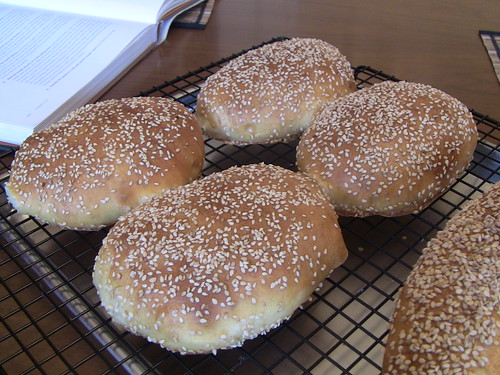
I have tried before to make buns that resemble peda bread, but not with much success.  With shish kebab on the menu, I needed to try again to replicate peda bread.  The closest bread I’d made in texture and flavor was Reinhart’s Vienna Bread from BBA.  So today I tried a variation on that Vienna Bread.   I followed his formula, but divided part of the dough into 5 ounce pieces and squashed them down fairly thin before proofing them.  When they were ready to bake, I slathered them with an egg wash and sprinkled sesame seeds on them.

These buns are both delicious and pretty darn close to peda bread. 

[

I also made a batard from this dough, also sprinkled with sesame seeds.

To  make these buns even more authentically like the bread served on the shish kebab sandwiches of my childhood memory, I split and grilled them with a bit of butter, giving them a wonderful crispiness.

By the way, this lamb is about the best I’ve ever had.  And the meal brought back fond memories.

Who knew the Viennese and the Armenians were so close?

Glenn

GSnyde's picture
GSnyde

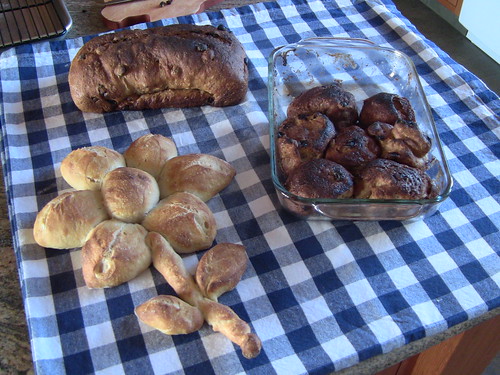
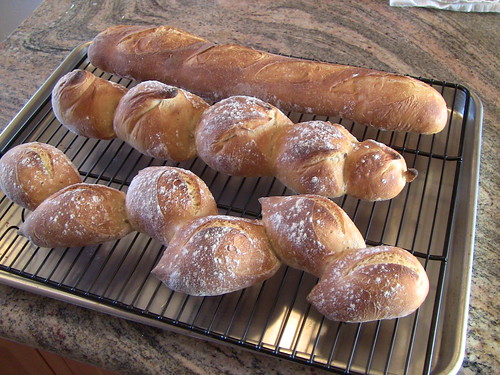
Half of the Bear-guette dough I made yesterday (http://www.thefreshloaf.com/node/23742/baguette-and-variations-junior) was refrigerated overnight.  This morning I commenced to make a couple Marguerites.  I cut one of the pieces too big and decided to trim it, and the piece I trimmed off looked so much like a leaf, that I had a rare moment of creative inspiration.  Why, I said to myself, doesn’t a Marguerite deserve a stem and leaves?   Not having a good answer, I decided to try some decorative baking (not something I expect to be good at).  Here are the results.

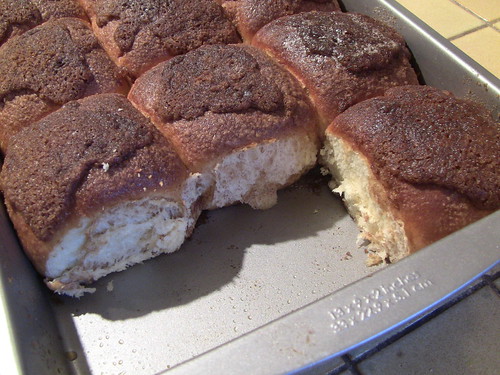
I also tried a new breakfast loaf today—Hamelman’s Oatmeal Bread with Cinnamon and Raisins.   The recipe makes more than enough for three loaves, and I discovered I only had two loaf pans. So, on the spur of the moment, I decided to make Oatmeal-Raisin-Cinnamon buns.  I dipped them in butter, rolled them in cinnamon sugar and let them grow together in a Pyrex pan, as pull-aparts.  Because I baked them with the loaves at 450F, they scorched a bit, but they are super yummy.  And because they have whole wheat and oats, they’re health food!  I will try this variation again, baked at a lower temperature.

I also baked a small loaf of the Cinnamon-Raisin-Oatmeal Bread (probably about  6 ounces) as a free form mini-batard.  It came out very nice, too.

All in all, a good day’s bake.

I did notice that one of my loaves seemed a bit grouchy.  I imagine he’s not excited about his prospects.

Or maybe he was peeved that we hadn’t taken him with us to see the wild flowers at Russian Gulch State Park.

Glenn 

GSnyde's picture
GSnyde

I didn’t want to steal Brother David’s blog post title without due credit.  Last Fall he told of his scissor-happy bake of epis and dragon tails (http://www.thefreshloaf.com/node/20226/baguette-and-variations).  And today I pursued a similar adventure.

Twenty-two years ago today, my wife, Cat, and I were married.  We scheduled the wedding for the Sunday of Memorial Day weekend because Sunday afternoon was the only time available for a private party at Green’s, a wonderful restaurant on the Bay in San Francisco, and we wanted to give our guests a Monday holiday to sober up and/or travel back to their homes.   The happy bonus was we almost always get a three-day weekend for our anniversary.

So, the goal today—of course—was to bake something to broaden the already broad smile on my beloved’s lovely face.  Her favorite is Cinnamon-Raisin-Pecan bread, and I’ll bake some of that tomorrow.  Her second favorite—always good for a swoon of pleasure—is proth5’s “bear-guette” (http://www.thefreshloaf.com/node/20831/starting-get-bear) which is now my usual baguette.

Having had success with this formula, including shaped as marguerites (http://www.thefreshloaf.com/node/22177/le-fleur-d’ours-flower-bear-and-other-goodies), I decided to work on my scissor skills and try some new shapes.

The poolish and levain were made up last night, and the dough was mixed this morning.  I let it ferment two hours, gave it one stretch and fold, and left it in a chilled cooler while we went to a fabulous lunch at Café Beaujolais (duck confit Cobb salad with warm bacon lardons has spoiled regular Cobb salad for me for the rest of my life).

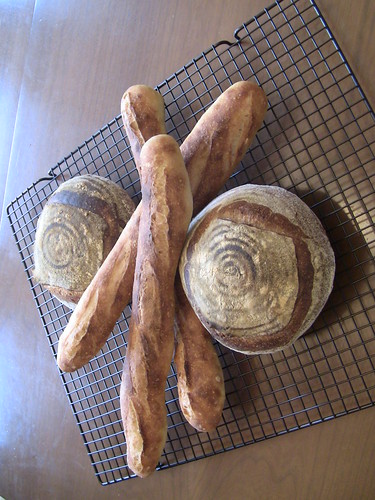
On our return three hours later, I split the dough ball into two, put half in the fridge for tomorrow, and shaped three baguettes from the rest.  I studied the excellent videos on forming epis (http://lepetitboulanger.com/videos/coupe_epi.wmv) and dragon tails (http://www.wildyeastblog.com/2010/09/12/dragon-tail-baguettes-shaping-video/).  I am pretty pleased with my first attempts, though this dragon doesn’t have a very long tail.

And, as always with the bear-guettes, the flavor is superb, the crust is crispy and the crumb is a nice balance of chewy and open.

Anniversary dinner was excellent.  You might not think meat on a stick stands up to the elegance of baguette and Champagne, but charcoal-grilled pork satay with home-made marinade and home-made spicy peanut sauce is pretty tasty

I’ve been working on Thai cuisine.   A meal of satay and baguette is my version of crust-asian. [sorry]

Glenn

GSnyde's picture
GSnyde

Since we got back from Hawaii a few weeks ago, we’ve been craving Hawaiian sweetbread.  When we were there we bought a local bakery’s cinnamon sweetbread, pull-apart buns coated with cinnamon sugar--not gooey sticky buns, just barely sinful.

When there, I tried the Hawaiian sweetbread recipe in this post (http://www.thefreshloaf.com/node/21175/hawaiian-portugese-sweet-bread#comment-148186).  It was very good, and totally true to the local sweetbread we’ve often enjoyed.  Very much like the “poor man’s brioche” in Reinhart’s BBA.

Today, I decided to go for Hawaiian-style cinnamon buns.  I used the same dough recipe.  I divided the dough into pieces of about 85 grams each.   I made seven of them into plain sweetbread buns without cinnamon sugar.

They are soft, tender, shreddable and delicious.  They will make good teriyaki chicken sandwiches tomorrow.

The other 12 buns were brushed with water, rolled in cinnamon-sugar, and placed in a buttered baking pan, each with a dollop of butter-cinnamon-sugar glaze on top.  They were baked at 375 F for about 25 minutes.  The glaze was too dry to run down the sides of the buns, but it makes a nice crispy sugary crust on top.

They are delicious!  And not as guilt-inducing as “real” cinnamon rolls.

Tasha, of course, snoozed through the whole thing.

Hope you all enjoyed the day the world didn’t end.

Glenn

GSnyde's picture
GSnyde

We had guests this weekend, and they’re bread lovers.  So the bread sort of became the centerpiece of the weekend.

Friday night I made the two very different levains, one for Tartine Basic Country Bread (50% whole wheat and 50% white at 100% hydration) and one for the SFBI Walnut-Currant Bread (95% white and 5% rye at about 55% hydration).  The Walnut-Currant bread is my variation on the Walnut-Raisin Bread Brother David posted about last December (http://www.thefreshloaf.com/node/21289/walnut-raisin-sourdough-bread-sfbi-artisan-ii).

Saturday morning I mixed both doughs fairly early.  The timing worked well, since the Walnut-Currant bread has shorter primary ferment time and shorter proofing time.  Because I knew we’d eat a lot of it, and because I wanted to continue my experiments with loaf size, I made two full size (975 gram) loaves of the BCB and retarded one in the 50 F garage to bake the two sequentially (previous experience having shown that two slack loaves of that size don’t really fit on my stone).

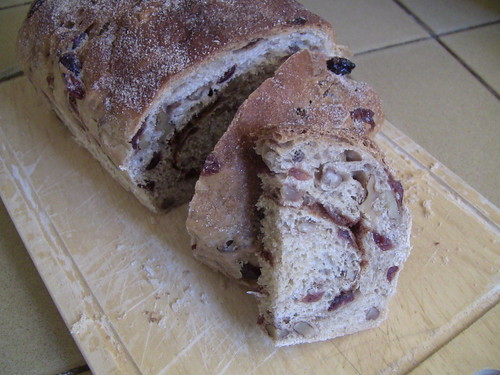
I made the Walnut-Cranberry breads—two 550 gram boules—with about 10% pumpernickel flour, which gave it a slightly deeper, richer flavor.  This bread made a very nice appetizer before dinner Saturday and was wonderful toasted for breakfast with cream cheese.

Walnut-Cranberry Bread


Walnut-Cranberry Crumb


The two Tartine loaves ended up looking quite different from each other.  The first one was browning too fast, and I covered the top with aluminum foil and reduced the temperature to around 450 F (with convection) for the second half of the bake.  Attempting to reduce the char, I baked the second one—the one proofed more slowly at lower temperature—at 475 F with steam for 20 minutes and at 450F (with convection) without steam for about 17 minutes more.  The second one had a nicer crust color and better grigne, and slightly more upward expansion.  The two loaves' crumb texture and taste are almost identical.  That is to say, delicious!

BCB Hotter Bake


BCB Cooler Bake

 BCB Crumb


For dinner Saturday, I wanted to serve something that would compliment the Basic Country Bread.  I settled on a Daube a l'Agneau (lamb stew in a Provencal style), marinated 15 hours in wine, cognac, herbs, spices and vegetables and then braised slowly for four hours.  Nothing could have made better gravy to sponge up with this wonderful bread.  Delicious with a well-aged Oregon Pinot Noir.

I continue to be very happy with the crumb texture of this Tartine bread, but I think next time I bake it I’ll go back to the Dutch Oven method.  In my four or five bakes of this bread, that method resulted in the best crust color and grigne.

Glenn

GSnyde's picture
GSnyde

Back from vacation, I needed to bake some sourdough.  Tartine’s Basic Country Bread has become my favorite.   Its crumb is my ideal texture for a hearth bread--just the right amount of chew, and airy and moist.  But, as I’ve noted before, large loaves just aren’t practical for our everyday use.   Last time I baked a batch, it was one large loaf and two small ones.  This time I made four half-kilo loaves, two batards and two boules.

IMG_2378

I mostly followed the Tartine BCB formula, using Central Milling white and whole wheat flours.  But I departed from gospel in the following ways:

·      I only made as much levain as one recipe requires

·      I did the stretch-and-folds when convenient, five of them at intervals of between 30 and 45 minutes over a 3 ½ hour bulk ferment

·      I divided the dough into four loaves of about 490 grams each

·      I baked the loaves with steam on a baking stone, in two batches an hour apart, having proofed the second two loaves in the cool basement.

My hope was that these departures would not affect the result, and I was very pleased.  The crackly crust, the tender crumb and the subtly-sour complex flavor are as good as the one kilo loaves baked in a Dutch Oven, and we can have loaves of a usable size in the freezer.

IMG_2381

IMG_2383

To prove the point, we ate most of one not-quite-fully-cooled loaf for dinner, with a medley of melted cheese for the main course, and with a mix of peanut butter and passion fruit-jalapeno jam for dessert.

It’s great to be back and baking in my own kitchen!

Glenn

GSnyde's picture
GSnyde

We’re back from our trip to the Kona Coast on the Big Island of Hawai’i.   Since we spent a lot of time in the ocean, and another large part out enjoying the sights and flavors of the islands, there were not a lot of occasions for baking.   Plus, though our friends’ house where we stayed has a well-equipped kitchen, it isn’t well equipped for baking.

The good news is that I had a chance to try baking some typical Hawaiian breads, which don’t require much specialized equipment.  I took along a thermometer, some parchment and my favorite rubber spatula, and I bought our friends a nice big glass mixing bowl and a large rolling mat.  It all worked out.

Lavosh

I’m not sure why a Middle Eastern flat bread is so ubiquitous in Hawai’I, but it is very common to see Lavosh included in bread baskets there.  And we have enjoyed it.  So I found a simple formula in Reinhart’s Bread Baker’s Apprentice, and tried it out.  The dough is somewhat like a pizza dough.  After kneading, it had a nice silky feel.

IMG_2332

The containers by the bowl are not ingredients, just indicators of the proper means  of fueling an Island baker.

To attain the proper crispiness of the Lavosh, it must be rolled very thin.  This may require letting the dough rest for periods during the rolling.  I found that a millimeter can make the difference between a cracker and a bready texture.

The results were satisfactory.  Next time I’ll use at least half whole wheat flour and maybe some wheat germ.

IMG_2333


Portuguese Sweet Bread Rolls

IMG_2371

I do know why Portuguese Sweet Bread is so common in Hawai’i.  In fact many refer to it as “Hawaiian Sweet Bread”.   The Portuguese influence in Hawaiian life is everywhere.  I found a promising formula here on The Fresh Loaf (http://www.thefreshloaf.com/node/21175/hawaiian-portugese-sweet-bread).  This is a highly enriched, buttery, yeast bread.  I have had this kind of bread many times, and had a definite idea of what I was going for.  It is soft, tender, semi-sweet, best for breakfast.  I had Txfarmer’s “shreddable” crumb texture in mind, and with extensive kneading I achieved it. 

IMG_2372

IMG_2373

I should mention that the bread had to bake almost twice as long as the recipe calls for (and the oven did have a thermometer showing the temperature was accurate).

The rolls made good sandwiches with spicy island chicken and Passion Fruit-Jalapeno jam, and the loaf was excellent toasted with jelly.  Here’s the chicken cooking (with soy, sherry, scallion, ginger, star anise, hot peppers and sesame oil).

IMG_2375

After a thoroughly relaxing trip, it’s good to be home with my baking supplies and equipment and my kitty cat.  Sea turtles may be more unusual, but they’re nowhere near as fuzzy.

IMG_2359


Aloha!

Glenn

GSnyde's picture
GSnyde


I posted a funny blog (would that be a “flog”?) earlier today about the …um, difficult texture of rye dough.  But, seriously, the bread turned out very well.  I took a first try at Greenstein’s Sour Rye, which Brother David had blogged about some years back (http://www.thefreshloaf.com/node/9316/sour-rye-bread-george-greenstein039s-“secrets-jewish-baker”).  He had recommended it as a good sandwich rye.   The flavor is, to my taste, much superior to Reinhart’s New York Deli Rye, which I made recently.  As David promised, it is quite similar to the rye bread up with which we grew.   There’s no way to take pictures of the process without either washing your hands for several minutes to get the paste off or getting your camera irreparably gummed up, but here are some pictures of the finished product.


IMG_2312


IMG_2328


I also made a batch of proth5’s incredible “Starting to Get the Bear” baguettes, aka “bear-guettes” (http://www.thefreshloaf.com/node/20831/starting-get-bear).  This has become my favorite baguette formula.  The crispy crust and creamy open crumb are just about perfect.  No pronounced ears this time, but yummy as ever.


IMG_2317


IMG_2319


We had company for dinner (roasted King Salmon marinated in teriyaki, greenbeans with garlic and slivered almonds, and cucumber salad).  And they raved about both breads.  It’s nice to get positive feedback from people besides the loyal spouse.


A productive day in the home bakery.


IMG_2325

Glenn

GSnyde's picture
GSnyde

Having just begun what could be a long adventure with rye breads, I may not be an expert yet.  But I've developed a formula that replicates the texture of 40% rye dough.


800 g warm water


750 g rye sour


150 g quick set cement


50 g Epoxy


1/2 cup Altus (optional)


1 Tbsp Caraway seeds (optional)


Once you mix the ingredients (I recommend a mason's trowel) and scrape as much as you can off the spatulas, your hands, the bowl and the work surface, you have enough for a small dinner roll.


Glenn

GSnyde's picture
GSnyde


More experiments today.  I baked a Jewish-style rye bread for the first time and I riffed on Tartine’s Basic Country Bread.


The Rye and Wherefore


IMG_2291


I have been meaning to bake a Jewish-style rye bread for quite a while.  It hadn’t made it to the top of the list largely because my wife, though a devout Carbotarian, is not a fan of rye breads.  I have very fond memories of the “corn rye” from Karsh’s Bakery in the old country (Fresno).  And, though I don’t like the dense high-percentage rye breads that some TFLers do, I do consider rye sandwich bread to be among the most important breads.


So, with promises not to include caraway seeds and—more important—promises to also bake Tartine Basic Country Bread, I managed to get the (completely unnecessary) spousal consent to bake a rye bread.


I chose the New York Deli Rye from Reinhart’s The Bread Baker’s Apprentice.  The formula includes about 35% white rye flour (I used Central Milling Organic Light Rye), half of it pre-fermented.  The formula calls for first clear, high gluten or bread flour.  I would have gone for the first clear or KAF Sir Lancelot, but I don’t have any, so I used BRM bread flour. 


The dough was nice to work with once I got it hydrated enough.  It was easy to shape into nice cylinders.  Both the primary ferment and the proofing took less time than the book specifies (I guess my kitchen is warm today).  The loaves came out looking pretty good.  I like the medium dense, medium moist texture. 


IMG_2286


IMG_2288


The flavor is good, but a bit too sweet from the brown sugar.  It made for an excellent corned beef sandwich (the real purpose of Deli Rye). 


IMG_2310


Nothing wrong with this bread, but I think I’ll try another recipe next time, maybe a Hamelman.


Tartine Demi-Loaves


IMG_2305


A couple weeks ago, I baked the Tartine Basic Country Bread for the first time, and I was delighted with it in every way, except (1) the formula calls for a levain that is twice the amount needed for the dough, and (2) the formula makes two one-kilo loaves, and that is just too big for our normal use.


I have said before, in discussions about humungous miches, that I just don’t think the texture and flavor differences of a huge loaf are as big as the inconvenience of trying to consume one.  I needed to find out if Mr. Robertson’s much ballyhooed BCB formula could be tweaked to work better for me.


So, I mostly followed the formula, but I made half the amount of levain called for (just enough for one recipe), and I divided the dough into one one-kilo boule and two small batards of about 500 grams each.


 IMG_2296


I used all Central Milling flours: Organic Artisan Baker’s Craft white flour and Organic High-Protein Fine whole wheat flour.  The fermentation time and proofing time were shorter than last time (again the warm kitchen).  I baked the small batards on the stone, and the boule in a Dutch oven. [edit: here's a photo of the boule in the DO].


IMG_2302


Because of the smaller loaf size, the batards baked 18 minutes on stone with steam at 450 F regular bake, then 18 minutes dry at 425 F convection.  The internal loaf temperature was 209 F.  The full-size boule baked in a cast iron Dutch oven at 425 F convection covered for 20 minutes, then uncovered for 17 minutes.  Internal temperature was 210 F.


The batard was just as delicious, and the crumb just as holey and moist as the previous bake of this (full-size) bread.  


IMG_2308


I have rarely achieved such a big grigne…from ear to ear (yes, I had a bit of fun with the scoring).


IMG_2299


I failed to capture a photo of the equally broad grin of my Number One Bread Taster.  I think I’ll be baking this bread a lot more often now that I know that size doesn’t matter.


Glenn


Pages

Subscribe to RSS - GSnyde's blog