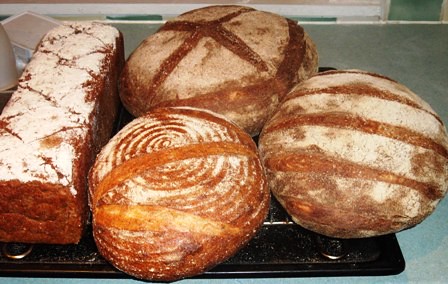
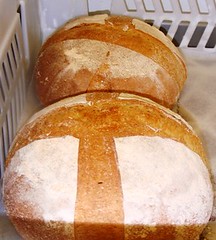
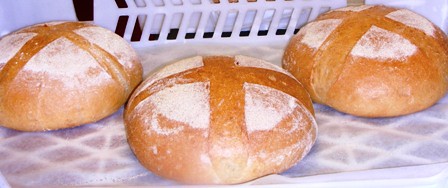
I realised that the weekend's baking only produced enough bread to see us through the first week of our Easter holiday. It is possible I could do some baking next week, up in the North West of Scotland, but I do not want to be beholden to that.
Additionally, I remembered there were a few nice ingredients lurking in the cupboard, which were ready for using up. Here's a flavour of what I made today:
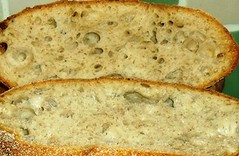
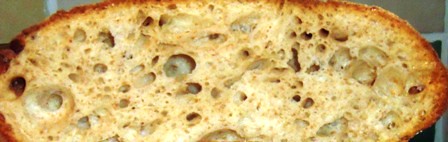
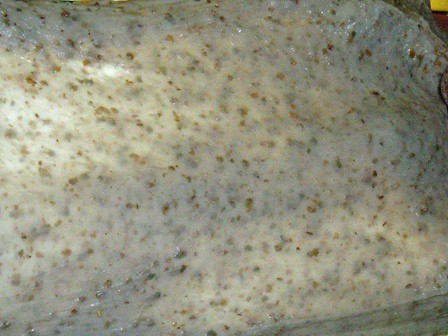
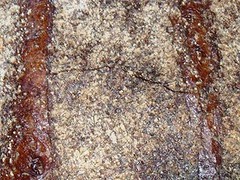
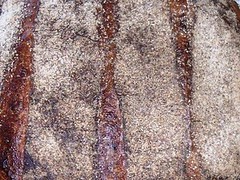
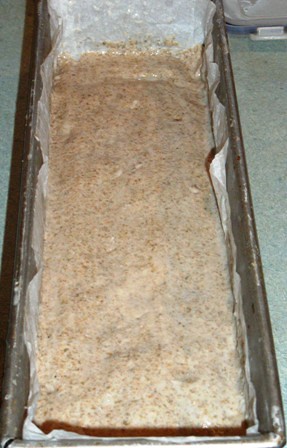
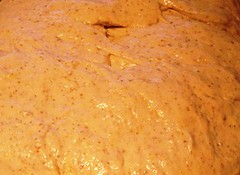
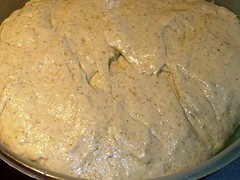
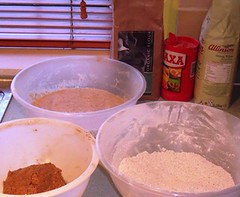
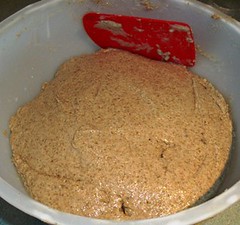
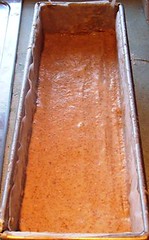
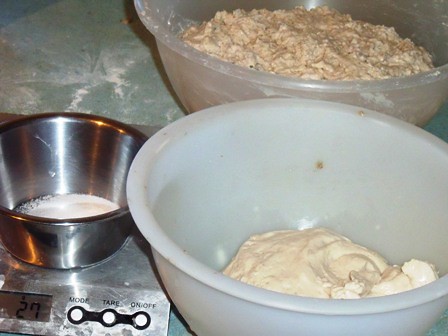
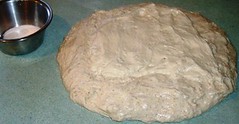
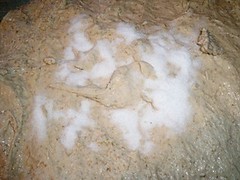
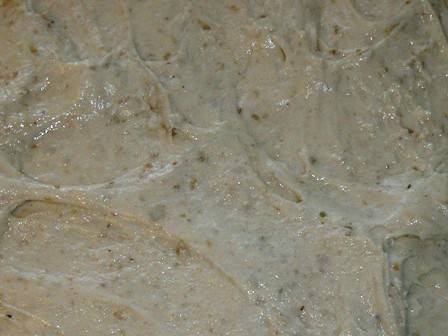
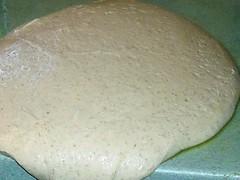
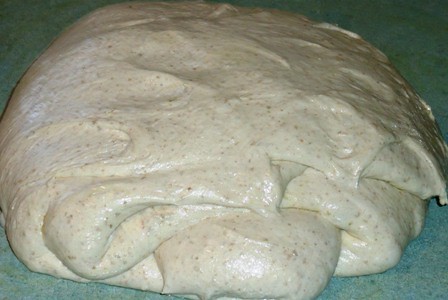
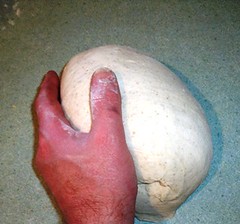
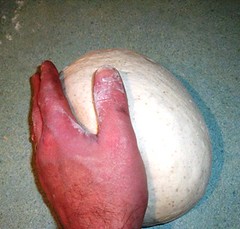
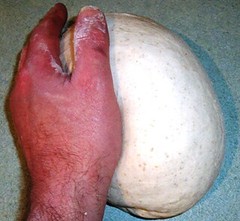
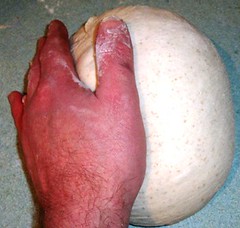
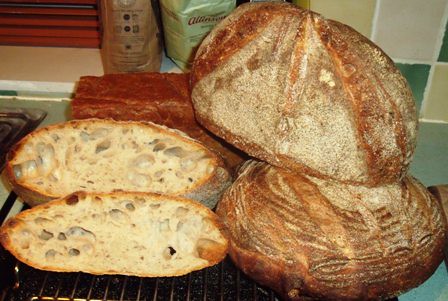
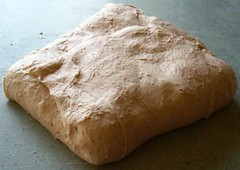
Instead of using King Arthur All Purpose flour, I used Carrs Special CC flour, but included 5% Coarse Semolina to give more bite to the loaf. I also increased the pre-fermented flour from 16 to 20%. The bulk proof time was shorter, at 2 hours, but it was hot and sunny here again today, and I put the dough out in the sunshine, covered. The dough mixed up strong, as seen in the photograph.
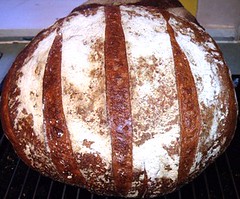
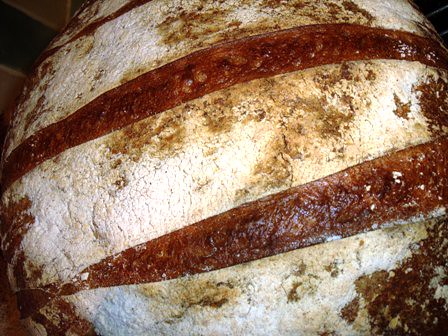
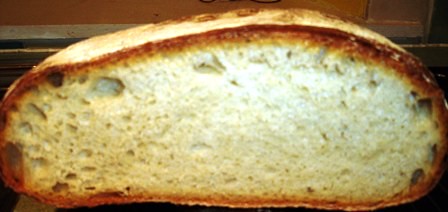
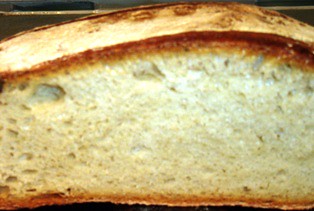
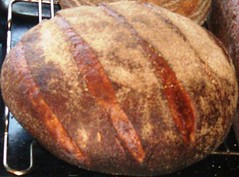
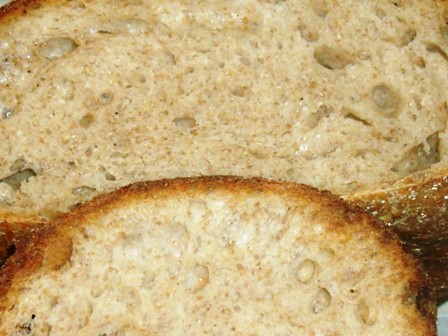
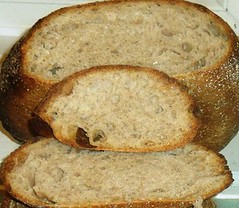
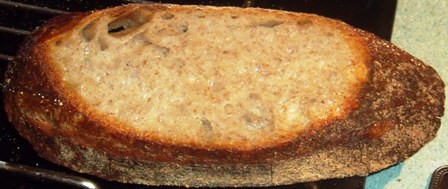
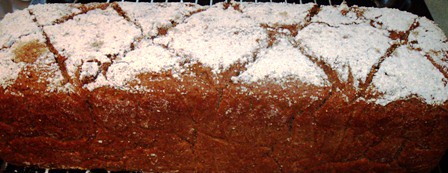
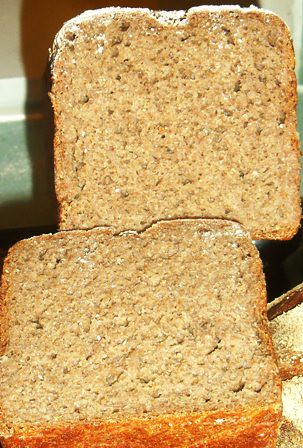
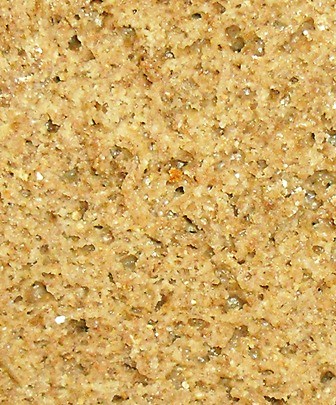
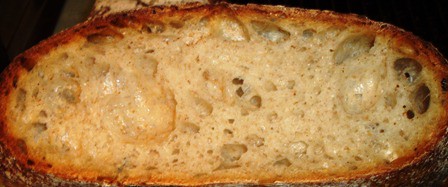
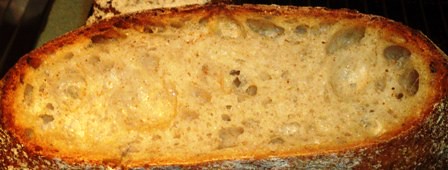
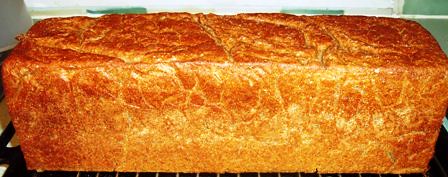
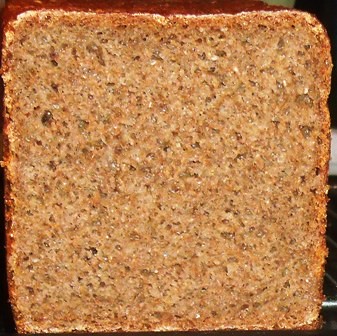
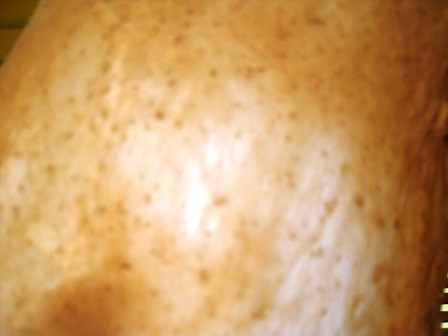
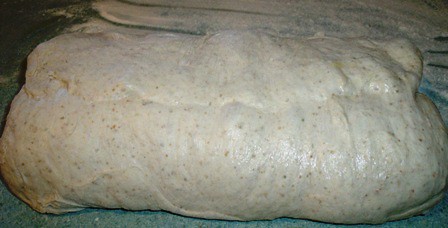
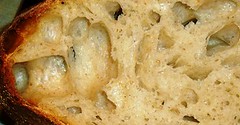
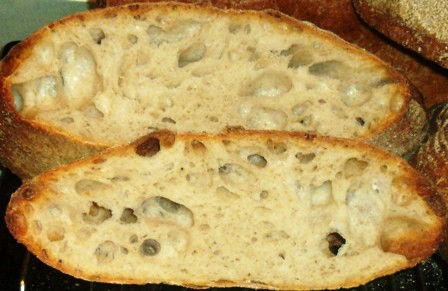
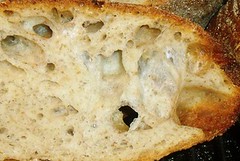
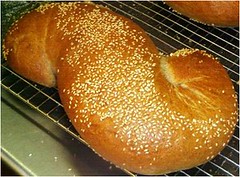
I was a little disappointed with the shaping of the final dough, and the result in the finished bread. I guess fendu shapes work best with oval brotform, and I only have a round one. Anyway, the split made in the dough piece with the dowel pin ended up completely lost. The finished dough texture was really pleasing. As regards taste, I found the bread to be very much as described in Steve's post. Thank you to both Steve and Eric for posting on this in the first place.
•2. Cheese Bread
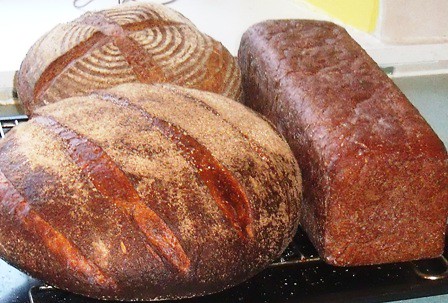
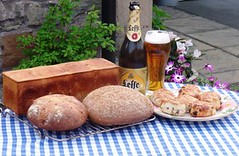
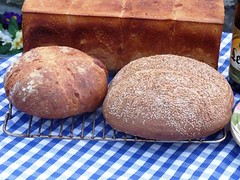
This is loosely based on Jeffrey Hamelman's formula in "Bread: A Baker's Book of Techniques and Recipes", pp. 180 - 181. I have made this previously and you can see the blogpost on it here: http://www.thefreshloaf.com/node/18164/whitsuntide-baking-and-other-antics I did make quite a few changes along the way, but kept to the methods and most of the material proportions, ending up with just over 1.5kg of dough. I increased the pre-fermented flour to just short of 30%. I used light rye flour at nearly 11% of the total flour, where Hamelman uses just white flour. I did use a small amount of dried yeast, as his formula directs, and this was very helpful in achieving the full volume in the Pullman Pan. I used Paprika @ 1.2% on flour, which was very effective in terms of dough colouration. I used a small amount of Strong Cheddar Cheese, plus Spanish Manchego Cheese, in the proportion and form Hamelman suggests. I made a small boule, and a large loaf in a Pullman Pan, using 4 piecing. A video is attached here to give more information on how this technique works. See here:
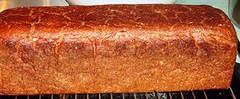
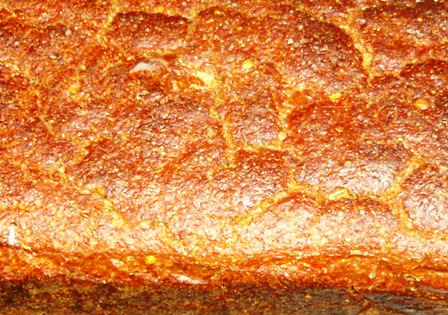
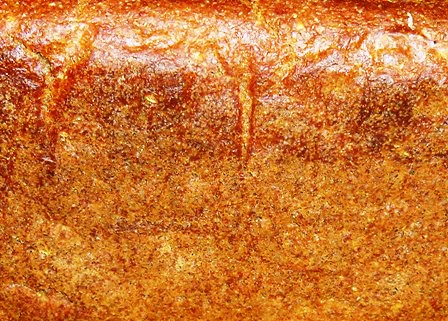
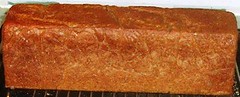
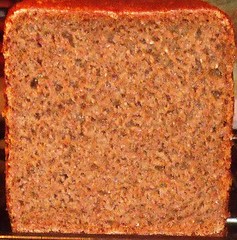
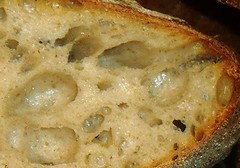
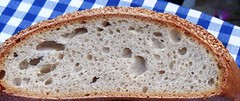
There are also some photographs below showing the finished loaves. Notice the high volume achieved in the bread, and the lovely moist crumb. This is far too open for the type of Sandwich bread sold in UK supermarkets. However, it is exactly what I had set out to achieve using a lengthy fermentation procedure, including a stiff levain, and just a tiny amount of dried yeast in the final dough.
•3. Toasted Almond, Fig and Prune Bread
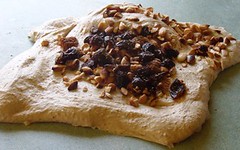
Again, this uses Hamelman's idea on pp. 185 - 186, and I have made it before; see the same post referenced above. But I used almonds instead of hazelnuts, and, added some figs as well as the prunes. The proportion of fruit and nut is accurate to the formula, but the amount of each ingredient does not fall into line with the Hamelman recipe. I had no wholewheat flour in stock. Instead, I used all white bread flour, but included wheaten bran as 2.25% of the flour content. I made just one loaf from this dough, at a whopping 1.58kg. I have attached a video of how I incorporate fruit and nuts into ready-mixed dough:
/p>
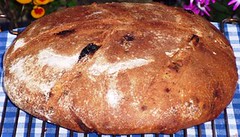
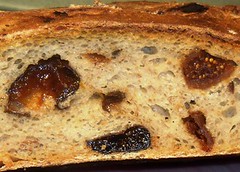
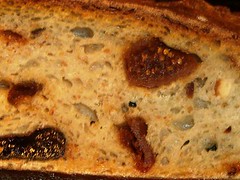
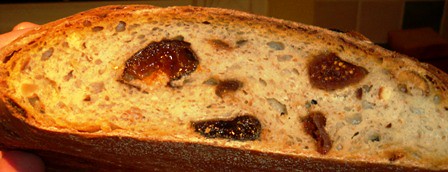
Some photographs of this very dramatic bread are also attached below. The flavours in this are just amazing.
•4. Fruit Scones
I made a really small batch of scones as an afternoon treat to have with a pot of Green Tea. This is based on the formula I tweaked recently when mentoring Kieran in the Scone entry for the NECTA Competition. We had a lovely fruit and nut mix in the house, including pistachios, pecans, almonds, brazils and cashews, as well as raisins, golden raisins, cranberries and sultanas. I added some chopped stem ginger as extra good measure. Ordinarily I mix scones using 60% soft flour, and 40% strong flour. As I only had strong flour in the house, I used a small proportion of light rye flour to reduce the gluten content. I also used the baking powder kindly supplied by my colleague Dinnie Jordan, who owns Kudos Blends, and is a specialist on chemical aerators. These scones are soooo light: many thanks Dinnie!
Formula and method below; this yields 7 scones:
Material
Formula [% of flour]
Recipe [grams]
Marriage's Organic Strong White Flour
90
180
Doves Farm Organic Light Rye Flour
10
20
Skimmed Milk Powder
7
14
Pell Baking Powder [specialist blend]
6
12
Organic Lightly Salted Butter
25
50
Golden Granulated Caster Sugar
18.75
37.5
Egg
6.25
12.5
Water
48
96
Fruit and Nut Mix with Stem Ginger
25
50
TOTAL
236
472
Method:
Crumb the butter with the flour, milk powder and baking powder
Dissolve the sugar in the water and add the egg. Then add the fruit and nuts
Add this to the crumb and combine until just clear.
Roll out on a lightly floured surface and cut out the scone shapes.
Place the scones on a baking sheet, and brush the tops with beaten egg
Rest for 15 minutes to allow the gluten to relax, and to ensure the chemical reactions take place largely in the oven
Bake in a pre-heated oven [200°C in my fan oven], for 15 - 17 minutes
A wonderfully simple and balanced formula. Yields one loaf scaled @ 680g and one scaled @ 1360g
Material
Formula [% of flour]
Recipe [grams]
1. Leaven Elaboration One
Leaven from stock
80
Special CC Flour
100
Water
60
TOTAL
240
2. Leaven Elaboration Two
Elaboration One
240
Special CC Flour
300
Water
180
TOTAL
720
53.3 [640g retained]
60g returned to stock
3. Final Dough
Leaven [from above]
53.3 [33.3 flour, 20 water]
640
Special CC Flour
50
600
Doves Farm Organic Light Rye Flour
16.7
200
Salt
1.8
21.6
Water
50
600
TOTAL
171.8
2061.6
% pre-fermented flour
33.3
% hydration
70
Method:
I built the leaven over 2 elaborations, allowing 12 hour proof time between refreshments, and prior to final dough mixing.
For the final dough, I broke the ripened leaven into pieces and deposited in the water. Then I added the flour in a large bowl and used a plastic scraper to combine sufficiently for a period of 40 minutes autolyse
I added the salt and worked up the dough for 10 minutes, then set to rest for 20 minutes. Then I worked up the dough a further 10 minutes.
I bulk proved the dough outside in the warmth and maintained a steady dough temperature of 26°C, covered for 2 hours. I used one S&F half way through bulk proof.
After 1 further S&F, then a 10 minute rest, I scaled and divided the dough as above. I moulded both pieces round, and set to final proof upside down in bannetons
Here's the rub: the small loaf had around 3 hours final proof, and I experienced "blow-out" from the bottom of the loaf; again! The larger loaf, I therefore gave 5 hours proof and it came out perfectly. I did use quite a bit of steam baking this loaf to try and avoid any further unsightliness.
After baking fully, I turned the oven off, and left the loaf inside the cooling oven with the door wedged ajar for 10 minutes. Then I set the loaves to cool on wires
Thoughts:
The longer proof time on the large boule is just right. I have utter confidence in the leavens I maintain, feed and elaborate; also in the quality of final dough produced. I've increased the proportion of pre-fermented flour in the formula, generally, now being around 33%. Also, I'm using longer proof times. Even though the weather is getting warmer, this is the proving conditions demanded by the dough, so I have responded.
The taste of this bread is superb. I tried a small piece about an hour ago, and the deep flavours from crust and crumb linger so subtly. It's not overtly sour, or, salty, yet still packs a great and complex flavour.
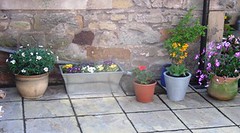
Alison was busy with our plant pot garden, and I helped out tidying the patio as the sun shone, and the dough underwent its magical transformations.
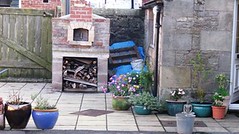
We have new daisies to brighten the patio, and I have wood chopped and prepared to fire up the oven later this week.
We want to go to Sicily in October.
We are going to the far North of Scotland on Saturday for a week's holiday. Lochinver here we come!......And it looks a little bit like this!
The North East Culinary Trades Association hold this competition in a local venue every year, and the College has always played a full part in it.
The first day is largely student-focused, with the main theatre centring on live work in "pods" by students from various colleges, cheered on enthusiastically by a large audience there to enjoy the spectacle. Additionally, a range of "static" displays are also put up, in various categories as part of the overall competition.
I mentored one student in the live class to assemble a "Decorated Gateau", and a school student who made a plate of scones which were displayed for "Afternoon Tea" as part of the static display.
For the scones, I contacted an expert in baking powders and chemical leaveners, who I first visited as a student working on a raw materials assignment for my BTEC in Baking Technology. A few tweaks to the recipe, and a decision to use dates and pecan nuts as flavour, and we were sorted. A bit of practice in the 2 weeks leading up to the Competition, and my scholar came and made his scones early on the day, so we could take them and display them absolutely fresh. First prize achieved here.
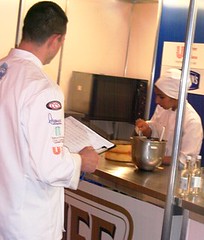
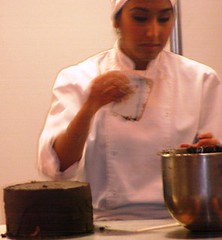
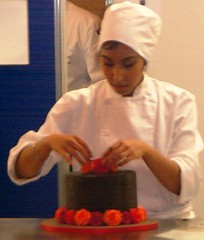
In the live class, I had selected a Level 1 student to enter this category. She actually already does her own cake decorating from home. Her business is only just getting off the ground, but clearly she just has natural talent....in spades. She did most of her work for the Competition at home, with me acting as adviser through text message and e-mail and phone. Try as I might, I could not get her to feel nervous about the whole experience. Veera is so laid back; but it finally hit her when she arrived at the venue at the Civic Centre in Newcastle upon Tyne, to find I was still back at base waiting to drive over last minute with the scones.
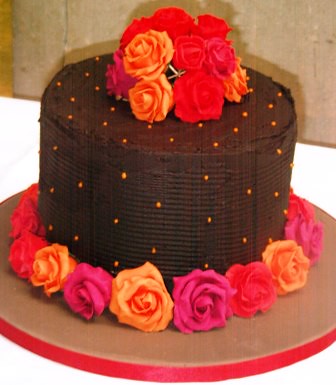
Anyway, a decorated gateau is quite different to the expert sugarcraft work Veera normally surrounds herself with. This is the design she came up with; devastatingly simple in appearance, but obvious complexity and skill in execution. She deservedly won the gold medal and took the trophy in this category.
A teaching colleague also entered the Live Easter Cake, and took a third place up against experts from the local Sugarcraft Guild.
As for our College; we took 12 first places overall. This is more than we have ever achieved. Overall, we won the Live Classes and came 2nd in the Static displays, and took top spot for the coveted "Overall Best College" prize.
In spite of all the difficulties in our professional world right now, all the lecturers were on a high for the rest of the week, and we could break up for Easter feeling really good about what we do. The main kudos, however, goes to our students. What a set of stars they are!
Pain de Campagne with Mixed Leavens and Borodinsky in a Banneton
It's been a lovely weekend in the far North Eastern corner of England. Yesterday we drove onto Holy Island and walked through the village, up to the Castle, then round the Northern Coast crossing 2 of the finest, and utterly deserted, beaches to be found...anywhere!
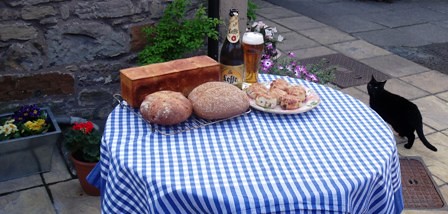
Today, we made our patio beautiful, once more, following the ravages of our harsh winter. After we had eaten our lunch sitting outside, I took some photos of the bread I was making, as it came out of the oven.
•1. Pain de Campagne.
I made 3 loaves in total. One was a gift to our neighbours who treated us to an Iced Cream whilst we chatted away the afternoon: thank you Anna and Mark! Another was just a small loaf, which I'd baked early so we could have fresh bread with some gorgeous "Berwick Edge" cheese I found yesterday, made by a local speciality cheese company, Doddingtons, just a few miles up the road from here. Awesome flavour packing a real punch!
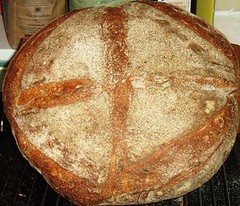
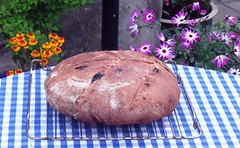
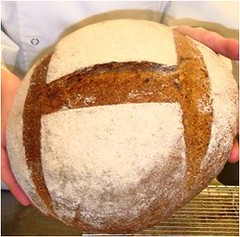
And the other is a 1.5kg Boule, showcased in the photographs here. Yes, outdoor photography in the sunshine in good ol' Blighty: things must be on the up? [I wish!]
Here's the details:
I built both the wheat leaven and rye sour using 2 feeds from stock of 80g of each leaven, on Friday evening and Saturday morning. I mixed the final dough on Saturday early evening, and retarded in the chiller overnight, before dividing, final proof and bake on Sunday morning/early afternoon. The figures in the table offer totals of flour and water only; there was a small residue of both leavens for me to put back for stock.
Material
Formula [% of flour]
Recipe [grams]
1. Wheat Levain
Special CC Flour
25.8
400
Water
15.5
240
TOTAL
41.3
640
2. Rye Sour
Bacheldre Dark Rye Flour
9.7
150
Water
16.1
250
TOTAL
25.8
400
3. Final Dough
Wheat Levain [from above]
41.3
640
Rye Sour [from above]
25.8
400
Special CC Flour
64.5
1000
Salt
1.8
28
Water
36.4
564
TOTAL
169.8
2632
% pre-fermented flour
35.5
-
Overall % hydration
68
-
Method:
Build each leaven from stock, using 2 refreshments, as outlined above
Mix rye sour, flour and water until loose dough is formed; autolyse 45 minutes.
Add salt and wheat leaven and mix gently over half an hour to form a strong dough. Use Bertinet-style techniques here, as the dough is soft and sticky to start, but will soon become obviously strong.
Use intermediate proof of up to 1 hour. Then refrigerate overnight.
Scale, divide and mould round. I made a boule at 1.5kg, one at 750g, and made a small boule with the remainder. Place upside down in bannetons and set to prove, for around 4 hours, allowing the dough pieces to come back to ambient temperature.
Bake with steam on bricks in an oven pre-heated to 250°C. Cut the tops of the loaves just prior to loading.
Turn the heat to 200°C after 15 minutes. For the large boule, bake out for up to 1 hour if necessary; minimum 50 minutes. Jar the oven door slightly open, turn off the heat source, and leave the oaf in the oven for 15 minutes.
Cool on wires
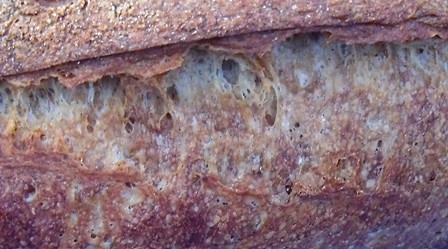
I'm really pleased with how this loaf has turned out. My experience with overnight retarding is that the breads are very prone to "blow-outs". Plenty of time is needed in the final proof in order to avoid this. I guess that my kitchen temperature hitting the dizzy heights of 24°C by lunchtime really did help me here. The dough had been very active when I set it in the chiller the night before; so I turned the fridge to work at full power. Note too, that the pre-fermented flour is way up over 35%. Great result! Here are some photos:
•2. Borodinsky
As the previous 2 occasions, I used a "scald". However, this loaf was proved in a banneton, and baked on the bricks. Also....it is 100% Rye!!! A colleague of mine who is studying for the VRQ Bakery Level 2 let me have some Doves Farm Light Rye flour she had in stock. The sour was built with 3 refreshments. The first 2 were part of the dough above, with a final refreshment made on the Saturday evening to allow me to form the final paste on Sunday morning. I made the "scald" on Saturday evening, at the same time as the final refreshment of the sourdough.
Here's the formula:
Material
Formula [% of flour]
Recipe [grams]
1. Rye Sour
Bacheldre Dark Rye Flour
29.8
186
Water
49.7
310
TOTAL
79.5
496
2. Scald
Black Strap Molasses
6.1
38
Malt Syrup
4.5
28
Coriander [ground fresh]
1
6
Salt
1
6
Doves Farm Light Rye
20
125
Water [rolling boil]
35.3
220
TOTAL
67.9
423
3. Final Paste
Rye Sour [from above]
79.5
496
Scald [from above]
67.9
423
Doves Farm Light Rye
50.2
313
TOTAL
197.6
1232
% pre-fermented flour
29.8
Overall % hydration
85
Method:
Prepare the rye sour, feeding 3 times from stock, as outlined above. Make the scald at the same time as the last refreshment. Dissolve syrups in the water and bring to a rolling boil. Grind the coriander, and combine with salt and flour. Pour on the boiling syrup solution and mix to from a stiff paste. Cover and leave to cool overnight.
Combine scald and sour and mix thoroughly. Add in the remaining flour and form a paste.
Bulk ferment, covered, for 1 hour.
Use wet hands to shape and then prove in a banneton, covered, for c. 4 hours.
Tip out onto a baking sheet. Spray the loaf top with water. Prick the top with a skewer, or, equivalent, and dust with freshly ground coriander seeds.
Bake at 250°C for 10 minutes with steam. Turn the oven straight down to 190°C and bake out for a total bake time of 1 hour
Cool on wires
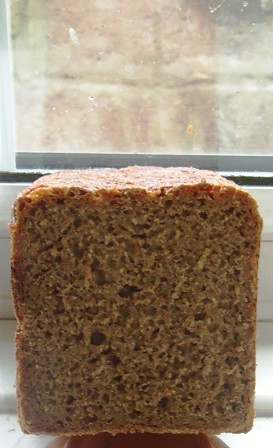
I ended up cutting into the loaf sooner than ideal, as the photographs really testify. It was such a beautiful day, and so I wanted to try and get the best photographs possible. I think I succeeded with the Pain de Campagne. The Borodinsky is not quite there. Given more paste, I prefer to make this in a Pullman Pan. But, I did not have that luxury. And, the scald was really thirsty. The final paste had 85% hydration, but was stiffer than I am normally comfortable with. The trouble is that a higher hydration can be very difficult to bake out.
There is too much flour on the top of the loaf, from the proof in the banneton. I did my best to brush it off and replace it with coriander, but with mixed success.
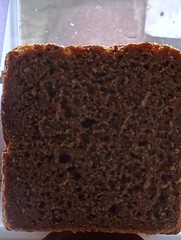
The crumb is obviously moist, and I think it will taste great. But it's a little tighter than I believe I would have achieved if I'd been able to use a Pullman Pan.
Still, photos are below, and I am certainthat the flavours will be as I want!
The sour was built using 2 elaborations, with 18 hour fermentation time in between. I started with 80g stock and ended up with 1040g of sour.
Material
Formula [% of flour]
Recipe [grams]
1. Rye Sour [see above]
Total Dark Rye Flour
30
360
Total Water
50
600
TOTAL
80
960
2. Scald
Dark Rye Flour
20
240
Malt Syrup
4.5
54
Black Strap Molasses
6
72
Coriander
1
12
Salt
1
12
Water
35
420
TOTAL
67.5
810
3. Final Paste
Rye Sour [from above]
80
960
Scald [from above]
67.5
810
Dark Rye Flour
23.5
282
Strong White Flour
26.5
318
TOTAL
197.5
2370
% pre-fermented flour
30
-
% hydration
85
-
Method:
Build the leaven as above. At the same time as preparing the final elaboration, 18 hours ahead of mixing the final paste, prepare the scald. Dissolve the malt, molasses and salt in the water, and bring to a rolling boil. Stir in the flour and coarsely ground coriander. Cover and leave to cool.
Combine scald, sour and both flours to form a paste. Bulk ferment for 1 hour.
Prepare a Pullman pan by lining with silicone paper. Scale 2kg of paste into the pan with wet hands, and smooth to shape. Make a "steamed pudding" with the remaining paste.
Proof time will be 2 - 3 hours. Bake from cold in an oven with a pan of water, raising the temperature to 160°C. Bake time of 2½ hours.
De-pan and cool on wires. Wrap in linen for 24 hours before slicing.
•2. Pain au Leaven using both Rye Sour and Wheat Levain</p>
Refreshment regime for rye sour is as above. Wheat leaven also 2 elaborations, first of 8 hours, second of 4 hours. This dough was retarded overnight and baked off the next day.
Material
Formula [% of flour]
Recipe [grams]
1. Wheat Levain
Total Strong Flour
17.9
150
Total Water
10.65
90
TOTAL
28.55
240
2. Rye Sour
Total Dark Rye Flour
7.1
60
Total Water
10.65
90
TOTAL
17.75
150
3. Final Dough
Wheat Levain [from above]
28.55
240
Rye Sour [from above]
17.75
150
Strong White Flour
75
630
Salt
1.8
15
Water
46.4
390
TOTAL
169.5
1425
% pre-fermented flour
25
-
% hydration
67.7
-
Method:
Elaborate leavens as above.
Combine all the materials to form a dough, and mix until well-developed.
Bulk proof for 2 hours, then retard overnight
Shape and final proof for 5 hours [ I gave this maximum proof]
Bake with steam as 1 large loaf, for 1 hour
Cool on wires
•3. Mixed Levains and Shoyu-Roasted Sunflower Seed Boule
Leaven cultures built as detailed above.
Material
Formula [% of flour]
Recipe [grams]
1. Wheat Levain
Total Flour
36.4
200
Total Water
21.8
120
TOTAL
58.2
320
2. Rye Sour
Total Dark Rye
8.2
45
Total Water
13.6
75
TOTAL
21.8
120
3. Final Dough
Wheat Levain [from above]
58.2
320
Rye Sour [from above]
21.8
120
Strong White Flour
45.4
250
Dark Rye Flour
10
55
Salt
1.6
9
Sunflower Seeds
16.4
90
Water
32.7
180
TOTAL
186.1
1024
% pre-fermented flour
44.6
% hydration
68.1
Method:
Build the leavens.
Roast the sunflower seeds in shoyu under the grill, turning as necessary.
Combine all ingredients except the seeds and mix to form a soft dough. Develop this, then add the seeds and complete with a sequence of 4 "stretch and folds" over a 2 hour bulk proof.
Shape and prove in a brotform for 4 hours
Bake with steam for 45 minutes.
Cool on wires
Borodinsky is for the main College Diversity Competition.
Large Boule had to be cut into prematurely, as I needed some lunch and that was the only bread available.
The Sunflower Seed bread is only just out of the oven, but straight to the freezer. With the shoyu-roasted seeds, rye flour at nearly 20% and an ambitious 44.6% pre-fermented flour, I guess this loaf will pack a full punch in flavour. Lovely crumb to it, for sure!
My Level 2 Bakery students are very competitive. Following on from Faye's Nettle Bread, and their determined, difficult yet successful adventures into Practical Exams, the group came up with a theme for their own entry into the College's Annual Competition:
"Breads of the World Arise"
See if you can name some of the breads, and where they come from?
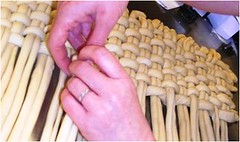
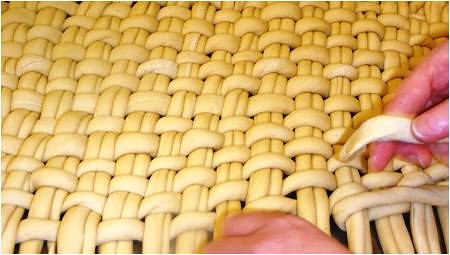
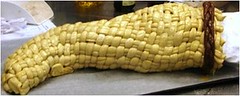
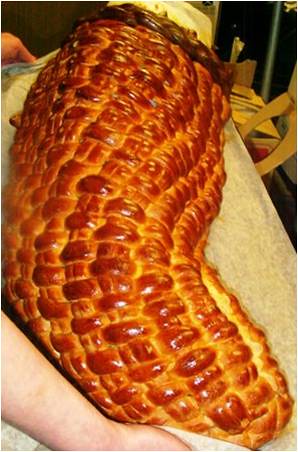
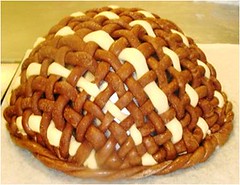
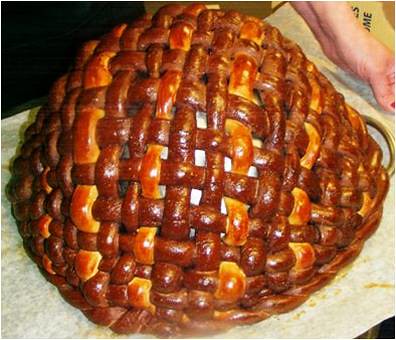
We then worked together to produce a lovely basket and Cornucopia to house the finished loaves.
This was to ensure we made it through to represent our School in the College-wide competition....which we did!! Some people in this group won the competition outright last year; they seem to be equally determined to repeat their previous success! Let's wish them well.
And, here's some recent home bread making.
1. Pain de Siègle
Material
Formula [% of flour]
Recipe [grams]
1. Rye Sour
Dark Rye
16.67
150
Water
27.78
250
TOTAL
44.45
400
2. Final Dough
Rye Sour [from above]
44.45
400
Strong White Flour
83.33
750
Salt
1.8
16
Water
40.22
362
TOTAL
169.8
1528
% pre-fermented flour
16.67
-
% overall hydration
68
-
Method:
Build the sourdough from stock over 2 refreshments and 36 hours
Combine sour with flour and water and autolyse 45 minutes
Continue the mixing cycle by developing the dough and adding the salt to form a strong dough.
Ferment in bulk for 2 hours, with 1 S&F after 1 hour
Shape and proof in a banneton for 3 hours prior to baking
Cut the loaf top and bake with steam for 50 minutes to 1 hour >
2. White Leavened Bread
Chewy and moist Sandwich bread made with a natural leaven and a retarded fermentation process
Material
Formula [% of flour]
Recipe [grams]
1. Wheat Levain
Strong White Flour
29.4
250
Water
17.6
150
TOTAL
47
400
2. Final Dough
Levain [from above]
47
400
Strong White Flour
70.6
600
Salt
1.65
14
Water
50.4
428
TOTAL
169.65
1442
% pre-fermented flour
29.4
-
% overall hydration
68
-
Method:
Build and mix as above
Bulk ferment for 2 hours, then shape loosely and retard overnight in the chiller
Shape and proceed to final fermentation and baking, as above.
Both of these are really tasty breads for our daily sandwiches whilst at work!
It's been half term holiday week here; where has it all gone I'm asking, as I go back to work tomorrow.
I s to have spent much of the week working hard to tackle all the complex issues I have to deal with ready for next year.
A brief reflection on our trip to Bolton on Friday 18th February is quite calming and re-assuring that my job is a good one. Unfortunately Faye was not in the "prize money" on this occasion, but we both had a great day out, and were very well treated by our hosts.
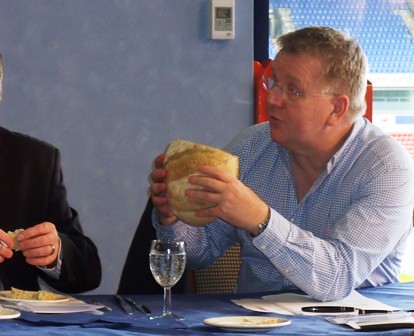
Some photographs are attached as Faye presented her Nettle Bread to a judging panel of VIPs, including Brett Warburton, the man in the open neck shirt, busily checking out her loaf, and asking very pertinent questions. How cool is that? Also on the panel was the head of Innovation for Warburtons, Darren Littler, who I met some years ago when still a student myself. Many of Warburtons R&D team were taught by the same lecturer as me, on the Baking course at Leeds.
Faye's bread was one of only 2 loaves which were genuinely artisan and made with a pre-ferment. The other 2 Baking colleges in the hunt both used bread improvers in their loaves. The other 4 entrants' loaves were from catering students, and looked like fairly ordinary homebaked bread. What matters, however, were all the students' wonderful ideas and the hardwork put in to develop their loaves. And, it cannot be an easy task to stand in front of 3 esteemed bakers from the Warburtons Company, and present your own product, and talk about it so confidently. I was really proud of Faye, especially when she stated simply that she used a leaven in her bread as she was only interested in "artisan" bread, then proceeded to explain to Darren how she had built her own leaven from scratch, and kept it going all this time. Some photographs below:
Level 2 Baking Students have an entrance into the College "Equality and Diversity" Competition tomorrow, with a theme based on breads of the world. These are to be made with our own local ingredients, primarily, and presented in a Cornucopia, made from bread dough. My contribution is the Borodinsky bread shown below. Given I had an active rye sourdough, a bag of good bread flour, and plenty of Bacheldre Dark Rye, I could not resist more baking today, with a Pain de Siegle.
Borodinsky using a "Scald"
Makes 1 "Pullman Pan"
Material
Formula [% of flour]
Recipe [grams]
1. Rye Sourdough
Dark Rye Flour
30
300
Water
50
500
TOTAL
80
800
2. "Scald"
Dark Rye Flour
20
200
Barley Malt Syrup
4.5
45
Blackstrap Molasses
6
60
Coriander Seeds-ground
1
10
Salt
1
10
Water
35
350
TOTAL
67.5
675
3. Final Paste
Rye Sourdough [from above]
80
800
Scald [from above]
67.5
675
Sifted Rye Flour
23.5
235
Strong White Flour
26.5
265
TOTAL
197.5
1975
Overall Hydration
85%
Pre-fermented Flour
30%
Method:
Build the rye sourdough over 2 to 3 refreshments from stock. Ferment fully after final refreshment through to sour
For the "Scald", dissolve the molasses and malt extract in hot water, and bring to a boil in a pan. Grind the Coriander seeds and combine these with the salt and rye flour. Pour on the boiling liquor and stir to mix. Cover tightly and cool to ambient.
Combine the sour and scald for the first stage of the final mix, then add in the remaining portions of flour to form a paste
Bulk proof for one hour
Shape into a Pullman Pan, pre-lined with silicone paper. Proof for 3 hours, approx. before baking
Place into the oven rising to 180°C, with a pan of water in the bottom of the oven. Leave for one hour. Turn the oven down to 130°C and bake a further 3 hours. Turn the oven off and leave in the cooling oven a further 3 hours
De-pan and cool on wires
Pain de Siègle
2 Boules of classic naturally leavened bread proved in Bannetons.
Material
Formula [% of flour]
Recipe [grams]
1. Rye Sourdough
Bacheldre Dark Rye Flour
24
300
Water
40
500
TOTAL
64
800
2. Final Dough
Rye Sourdough [from above]
64
800
Carrs Strong White Flour
76
950
Salt
1.8
22.5
Water
28
350
TOTAL
169.8
2122.5
Overall Hydration
68%
Pre-fermented Flour
24%
Method:
Build the rye sourdough from stock with at least 2 refreshments
Weigh the required sourdough, and add the correct amount of water to this. Blend, then carefully add the white flour. Combine, and autolyse for 1 hour.
Start to develop the dough on the bench with 5 minutes work. Rest for 10 minutes. Add the salt, and develop the dough a further 5 - 10 minutes. Rest for 10 minutes, then develop a further 5 - 10 minutes.
Line a bowl with a little oil as a container for the dough. Cover with cling film and bulk proof for 2 hours. Stretch and fold after 1 hour.
Scale and divide. Mould round and place upside down in prepared bannetons.
Final proof is approximately 3 hours.
Pre-heat the oven and masonry to 250°C. Tip out each loaf, score the top, use steam, and bake for 15 minutes. Drop the oven temperature to 220°C and bake a further 20 minutes. Drop the oven temperature to 200°C and bake each loaf out.
Cool on wires
It's proving hard to spend so much time on TFL at the moment. I wish I had more time to post, but it's a tough time in UK education right now, with lots of challenges needing full response.
I've had a heap of marking to do again this weekend now that my bakery students have successfully completed their exams for the unit in dough fermentation, and as I prepare for a visit from our External Verifier tomorrow. I hope she is suitably impressed with their wonderful work. So, I thought I'd make some bread at home to keep me on track as I wielded the red biro!
In case anybody's interested, the exam consists of a one hour written paper seeking to give credit to knowledge, and a 5 hour practical exam, in which students make a range of 3 fermented dough products. I asked them to categorise these as 1] simple bread using either bulk fermentation, or a no-time dough; 2] an enriched dough with a ferment, or, a laminated dough; 3] something using complex fermentation such as biga, poolish or levain. This tests practical skills, and understanding with 3 questions looking at dough production, temperature and fermentation. So, quite a challenge!
Anyway, I ended up challenging myself in the end, with my chosen baking schedule, as I ran short of flour....again. I live about 12 miles from a town, so this is not good!
I ran short of flour because I ended up making too much wheat leaven, and didn't want to waste it. Originally, I planned to make just short of 2kg of the Pain au Levain dough, but ended up with over 3kg. So my plan to make the 80% Rye Sourdough took a radical transformation, and became 100% Dark Rye instead!!
I have made thousands of All-Rye Sourdough breads like this, so I'm not sure why I'm using the exclamation marks?...100% Rye Sourdough with a Rye Flour Soaker
It's my formula, really, but with the inclusion of the rye flour soaker in Hamelman's recipe on pp. 213-4. There are 2 elaborations on the sour, which I maintain at 1 part flour to 1.67 parts water, done on Friday evening and Saturday afternoon ready to make the paste early Sunday morning. I made the soaker on Saturday afternoon at the same time as the second elaboration. It's just one big loaf in a Pullman Pan, weighing in around 1860g of paste, and taking nearly 3 hours to bake!
Material
Formula [% of flour]
Recipe [grams]
1. Rye Sour Build One
Stock Rye Sour
80 [30 flour; 50 water]
Dark Rye
150
Water
250
TOTAL
480
2. Rye Sour Build Two
Sourdough [from above]
480
Dark Rye
200
Water
355
TOTAL
1015
80g saved for stock
935 used in the final paste
3. Soaker
Dark Rye
200
Boiling Water
200
TOTAL
400
4. Final Paste
Rye Sourdough [from 1 & 2]
35% flour; 58.5% water
935 [350 flour; 585 water]
Soaker [from 3]
20% flour; 20% water
400
Dark Rye Flour
45%
450
Salt
1.8%
18
Water [40*C]
6.5%
65
TOTAL
186.8%
1868
Total Pre-fermented Flour
35%
Overall Hydration
85%
Bake Profile 2¾ hours @ 170°C, with constant supply of steam from a "larva pan"
Method:
Let down the soaker with the warm water, add the salt, then combine the liquid sour
Add the flour and use wet hands to mix and form a paste
Ferment in bulk for 1 hour
Line the Pullman Pan with silicone paper, and use wet hands to mould the paste for the pan. Smooth the top and set to proof, covered, for about 3 hours.
Dust the top of the loaf with Dark Rye flour and cut the top with 4 "X" shapes down the loaf. Put the lid on and set in the pre-heated oven.
Bake as profile above
Cool on wires
Pain au Levain
I aimed for 720g of levain, but ended up with 860g. The excess of final dough meant I ran out of flour, hence the wonderful All-Rye loaf above!
Material
Formula [% of flour]
Recipe [grams]
1. Build One
Carrs Special CC Flour
7.4
133
Water
4.4
107
TOTAL [nb. Stock leaven included above at 80g]
11.8
240
Build Two
Leaven [above]
11.8
240
Carrs Special CC
22.6
407
Water
13.6
217
TOTAL
48
864
3. Final Dough
Leaven [from 1 & 2]
48
864
Carrs Special CC
55.6
1000
Dark Rye Flour
14.4
260
Salt
1.8
32
Water
50
900
TOTAL
169.8
3056
Total Pre-fermented Flour
30
Overall Hydration
68
Oven Profile: Pre-heat to 250°C, and bake on the bricks using steam. Drop the heat to 225°C after 15 minutes, and to 215°C after 30 minutes. Bake each loaf out, then move to the next!
Method:
Autolyse flour and water for 1 hour
Combine autolyse with leaven, mix by hand to start development, then rest 5 minutes
Add salt and mix further 5 - 10 minutes to develop. Rest 10 minutes
Mix a further 5 - 10 minutes to achieve window pane
Bulk ferment, covered, for 2 hours in a bowl lined with olive oil; "Stretch and Fold" after 1 hour
Scale and divide [I used 1400g, 950g and 700g banneton pieces]. Mould round and set to proof upside down. Refrigerate 2 of the pieces a short while to set a working production schedule. The first loaf should be ready after 3 hours final proof; bake to profile.
Cool on wires
Nice looking breads; the house smells great; bread supply now sorted as we move to Confectionery in the student groups at College!
The weather, though wet, has turned mild, but the stove continues to blast out the heat. It's outrageously warm, and the cat has been quite disgracefully indulgent in front of the fire!!! Meanwhile, I gather you may be snowbound in parts of the US. You are hopefully better equipped to deal with it all than the authorities are capable of back here in Blighty, that's for sure!
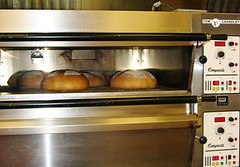
Oven Profile: Use a deck oven set at 235°C, top heat 6.5, bottom heat 5. Apply steam set at 4. Turn heat down to 225°C after 15 minutes and bake a further 10 minutes. Open the dampers, and bake out a further 5 - 8 minutes, reducing the heat to 220°C.
Method:
Prepare the "Poolish" 16 hours in advance and ferment covered at 21°C
Combine all the final dough ingredients in a small spiral mixer and mix on slow speed only for 15 minutes. Scrape down the bowl as required
Ferment in bulk for 45 minutes, covered, at 28°C.
Scale and divide into 1000g pieces, and mould round.
Place upside down in prepared banettons, and prove for 1 hour 45 minutes at 30°C, 80%rH.
Tip out onto a peel and cut the top of the loaf for coburg style with a cross. Set in the oven and apply bake profile.
Cool on wires
Large Boule with Gilchesters Farmhouse Flour and a Biga
Made in College on 26th January 2011
Material
Formula [% of flour]
Recipe [grams]
1. Biga
Special CC Flour
28
840
Water
16.8
504
Fresh Yeast
0.07
2
TOTAL
44.87
1346
2. Final Dough
Biga [from above]
44.87
1346
Special CC Flour
50
1500
Gilchesters Farmhouse
22
660
Salt
1.8
54
Yeast
1.8
54
Water
49.9
1497
TOTAL
170.37
5111
Overall Hydration
66.7%
-
Total Pre-fermented flour
28%
-
Method and Profile:
As above, except change cutting to cuts covering the whole of the loaf top; 5 parallel cuts.
>
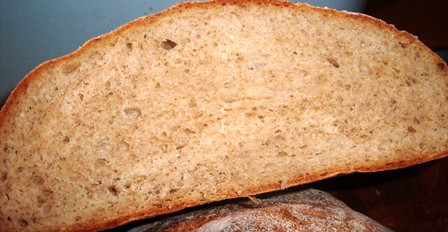
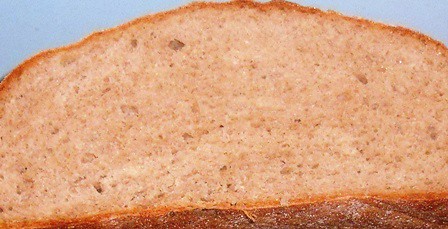
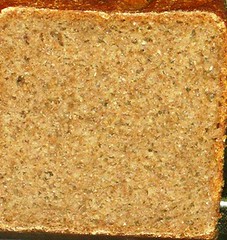
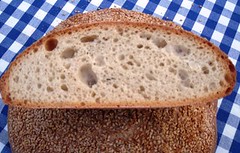
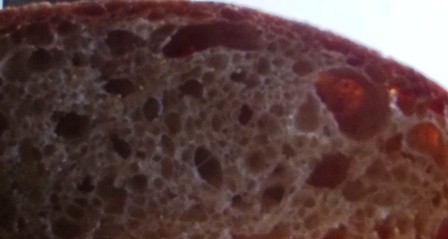
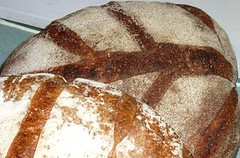
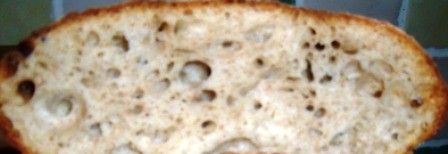
The crumbshots of the finished loaf made with biga and farmhouse flour:
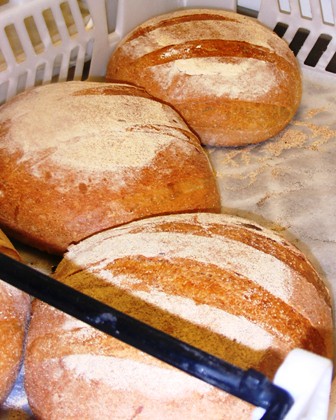
Good, honest and tasty bread. Not tried the white coburgs yet, but I have a loaf in the freezer ready to sustain us for next week.
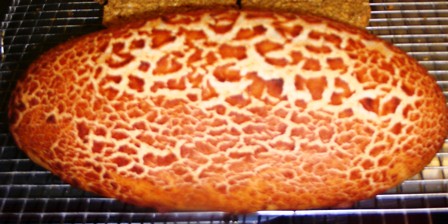
As a ps. a Level One student wanted to make Tiger Bread on Friday. This is what we came up with as a joint effort. I'm hoping he'll go far!
Pain au Levain using both a Wheat Levain and a Rye Sourdough
Hamelman (2004) has a similar concept in his book, above, but this formula is quite different in a number of ways. Full details are given below:
Material
Formula [% of flour]
Recipe [grams]
1. Wheat Levain
White Bread Flour
16.67
250
Water
10
150
TOTAL
26.67
400
2. Rye Sourdough
Dark Rye Flour
8
120
Water
13.33
200
TOTAL
21.33
320
3. Final Dough
Wheat Levain [from above]
26.67
400
Rye Sourdough [from above]
21.33
320
Strong White Flour
75.33
1130
Salt
1.8
27
Water
43.34
650
TOTAL
168.47
2527
Total Hydration
66.67%
-
Total Pre-fermented Flour
24.67%
-
Method:
Build both the rye sour and wheat levain using 2 elaborations plus stock starters, over a 30 hour period for the Rye and a 15 hour period for the Wheat.
For the final dough, first of all use autolyse, combining flour, water and rye sour. Leave for 40 minutes
Combine autolyse with wheat levain and mix for 5 minutes. Add salt and mix a further 5-10 minutes.
Ferment in bulk, covered, for 2 hours. Stretch and fold, and leave a further half hour.
Scale at 1.5kg + 1kg piece. Mould round. And place upside down in prepared Bannetons.
Proof in the fridge for 1 hour, then ambient for 2 hours prior to baking.
Pre-heat oven to 250°C, hold for 10 minutes before setting the bread onto hot bricks.
Fill a roasting pan with hot stones with boiling water for steam, and cut the top of the loaves before setting to bake. After 15 minutes drop the heat to 220°C. After another 30 minutes drop the temperature to 200°C and completely bake out each loaf.
Cool on wires
Ok, so there is evidence that my hands are not so clean; please don't make comments about this oversight on my part; the photographs are posted to be instructive and helpful. Thanks for appreciating this!
The finished dough was strong, resulting in a lovely finished flavour in the bread. How I wish domestic ovens had sufficient power to do these large loaves full justice.



















 >
>