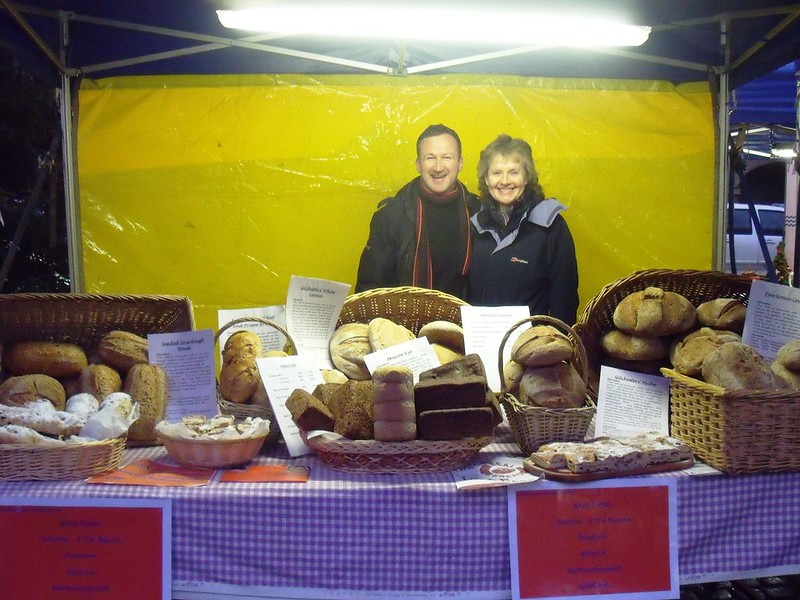
Submitted by ananda on February 6, 2012 - 2:55pm

Gilchesters Miche/Boules; Borodinsky using the Auerman Process. 6th February 2012


I made these 10 loaves using the wood-fired oven today.

The oven is now heating up well; I have moved batches of wood inside around our Inglenook fireplace for a few days and this extra drying really helps.   Burning logs is now easy, and it makes the oven "solid".

1.    “Borodinsky” using the Auerman Method

One Pullman Pan

Rye Sour build:

Day

Time

Stock Sour

Dark Rye

Water

TOTAL

Sunday

10:15

92

285

475

852


Material/Stage

Formula [% of flour]

Recipe [grams]

1a. Rye Sourdough


Bacheldre Organic Dark Rye Flour

30

300

Water

50

500

TOTAL

80

800


1b. “Scald”


Bacheldre Organic Dark Rye Flour

15

150

Red Malted Rye

5

50

Boiling Water

35

350

TOTAL

55

550


2. “Sponge”


Rye Sourdough [from 1a.]

80

800

“Scald” [from 1b.]

55

550

TOTAL

135

1350


3. Final Paste


“Sponge” [from 2]

135

1350

Bacheldre Organic Dark Rye Flour

30

300

Marriage’s Organic Strong Flour

20

200

Salt

1.5

15

Crushed Coriander Seeds

1

10

TOTAL

187.5

1875


% pre-fermented flour

30 + 20 = 50

-

% overall hydration

85

-

% wholegrain flour

80

-

FACTOR

10

-


Method:

  • Build the sour as described, make the Scald at the same time as preparing the final refreshment of the sour.   Cover and cool to room temperature overnight.   Make the Sponge first thing in the morning and ferment this for 4 hours.
  • Mix the sponge with the flours, salt and coriander using a paddle beater, on first speed for 2 minutes, and second speed for 3 minutes, scraping down the bowl as necessary.   DDT 28°C.
  • Bulk proof for 1 hour.
  • Line a Pullman Pan neatly with silicone paper and scale the paste into the pan, neatening off carefully.   Top with some freshly crushed coriander seeds.    Attach the lid.
  • Final Proof 3 hours.   Bake a minimum of 4 hours in the “dead” wood-fired oven, up to 16 hours
  • Cool on wires


 2.    Gilchesters’ Miche/Boules

Makes 9 loaves: 2 @ 1350g; 3 @ 950g; 3 @ 650g and 1 @ 350g

Levain build:

Day

Time

Stock Levain

Strong White Flour

Water

TOTAL

Sunday

12:00

40

350

210

600

Sunday

16:30

600

350

210

1160

Sunday

21:00

1160

425

255

1840

The leaven was then allowed to prove slowly overnight in the fridge

Material/Stage

Formula [% of flour]

Recipe [grams]

1. Wheat Levain


Marriage’s Organic Strong White Flour

25

1125

Water

15

675

TOTAL

40

1800


2. Final Dough


Wheat Levain [from above]

40

1800

Gilchesters’ Organic Farmhouse Flour

75

3375

Salt

1.8

81

Water

58

2610

TOTAL

174.8

7866


% pre-fermented flour

25

-

% overall hydration

73

-

% wholegrain flour [approx 85% extraction]

75

-

FACTOR

45

-


Method:

    •  Build the levain, see description above.
    • For mixing, first of all mix on first speed for 3 minutes with a hook attachment, then autolyse the Gilchesters flour with the water for 1 hour.
    • Add the levain and the salt.   Mix on first speed only for 10 minutes.   Dough Temperature Calculation worked out as follows: WT = 3[DDT – FRH] – Leaven Temp – Flour Temp.   [84 – 1] – 18 – 20 = 45.   Water temperature required at 45°C.   The gentle nature of the mixing action is evident here with just 1°C rise in temperature due to friction!
    • Bulk prove the dough maintaining DDT of 26°C for 2 hours.  
    • Scale and divide as above.   Mould round and rest for 15 minutes.   Prepare bannetons, re-mould dough pieces and set to final proof.
    • Final proof DDT maintained at 26°C, for 3 hours.
    • Tip each loaf out of the banneton onto a peel, score the top and set to bake on the sole of the wood-fired oven.   Small loaves bake in half an hour, next biggest takes 40 minutes and the biggest loaf took around 50 minutes
    • Cool on wires.

Happy Baking!

Andy

Submitted by ananda on February 4, 2012 - 10:27am

Toasted Suflower Seed Wholemeal Bread and Some Breakfast Pastries


Croissant Dough with a Sponge

My base recipe for laminated yeasted dough, with a couple of amendments.   A bit of sugar is included, although my own preference remains a croissant without sugar.   And I have adapted the formula to use a sponge where 20% of the total flour becomes pre-fermented.

Material

Formula [% of flour]

Recipe [grams]

1. Sponge


Marriage’s Strong Organic White Flour

20

200

Fresh Yeast

0.1

1

Water

12

120

TOTAL

32.1

321


2. Final Dough


Sponge [from 1 above]

32.1

321

Marriage’s Strong Organic White Flour

80

800

Salt

1.3

13

Sugar

5

50

Milk Powder

5

50

Fresh Yeast

4

40

Water

51

510

TOTAL

178.4

1784


3. Laminating Process


Final Dough above

178.4

1784

Butter – lightly salted

36

360

TOTAL

214.4

2144


% pre-fermented flour

20

-

% overall hydration

63

-

FACTOR

1 0

-


Method:

  • Make the sponge the night before and leave to ferment slowly.
  • For the dough, blend the milk powder, salt and sugar through the flour.   Weigh very cold [I pre-chill the water overnight] water into the mixing bowl, and dissolve the fresh yeast into this.   Add the sponge and the dry ingredients.   Mix with a hook attachment for 3 minutes on slow and 4 minutes on second speed, scraping down the bowl as necessary.
  • Cover the dough and store in the chiller for half an hour, and meanwhile cut the butter into slices and roll between 2 plastic bags to create a pliable sheet of butter.
  • Roll out the croissant dough so that the slab of butter fits onto two thirds of the dough slab.   Fold the butter in letter-style to create 2 layers of butter.   Rest for one hour in the chiller.
  • Turn through 90° and roll out to the same size as before.   Fold the dough in 3 for the first turn, then chill a further hour.   Repeat this 3 more times to give 4 x ½ turns in total.   Rest a further one hour
  • I then split the dough into 3 sections, and made 12 Pain Amande with one piece, 9 Pain aux Raisins with another, and 14 croissants with the last piece.
  • Glaze each finished unit with egg, dip the Pain Amande in flaked almonds and set to proof for 45 minutes.
  • I used the electric oven to bake these on convection heat setting at 210°C for approx 15 minutes each tray; there were 5 trays in total.
  • Cool on wires


Yeasted Sunflower Seed Wholemeal Bread with Mixed Pre-ferments

Both cultures given 2 refreshments prior to use:

Rye Sourdough

Day

Stock

Flour

Water

Total

Friday 09:00

40

120

200

360

Friday 17:00

360

60

100

520


Wheat Levain

Day

Stock

Flour

Water

Total

Friday 09:00

40

200

120

360

Friday 17:00

360

100

60

520

nb. The levain was allowed to ferment slowly overnight in the chiller after the last refreshment.

Material/Stage

Formula [% of flour]

Recipe [grams]

1a] Rye Sourdough


Bacheldre Organic Dark Rye Flour

9

180

Water

15

300

TOTAL

24

480


1b] Wheat Levain


Marriage’s Organic Strong White Flour

15

300

Water

9

180

TOTAL

24

480


2. Final Dough


Rye Sourdough [from 1a]

24

480

Wheat Levain [from 1b]

24

480

Marriage’s Organic Strong Wholemeal

76

1520

Shoyu-Roasted Sunflower Seeds

20

400

Salt

1.5

30

Fresh Yeast

2.5

50

Water

50

1000

TOTAL

198

3960


% pre-fermented flour

24

-

% overall hydration

74.4

-

% wholegrain

85

-

FACTOR

20

-


Method:

    • Combine wholemeal, water and rye sourdough and mix until clear with a dough hook on first speed.   Autolyse for one hour.
    • Add the wheat levain and bakers’ yeast and mix for 2 minutes on first speed and 3 minutes on second speed.   Add the salt, mix 3 more minutes on second speed.   Add the toasted seeds and mix on first speed until clear.   DDT 27°C.
    • Bulk ferment dough at 26°C for 2 hours.
    • Knock back the dough gently, and scale and divide.   I made one small panned loaf @ 500g; a large panned loaf, 3-pieced each one @ 350g; a Pullman Pan, 4-pieced each one also @ 350g.   The remaining dough, just over 1kg, was used to make one large Boule.   Mould each piece round, and rest covered for 15 minutes.   Shape each piece and dip in seeds and assemble panned loaves, and use a banneton for the boule.
    • Final proof: Boule fermented  @ 26°C for one hour; 2 panned loaves followed on, so 1¾ hours proof.   The Pullman was held back by fermenting at 15°C for 2½ hours.
    • Bake the loaves with steam…I used my electric oven for today’s bake, pre-heated to 280°C, then settling at 235°C for 10 minutes.   Then I switched to convection and baked out the breads at 210°C.
    • Cool on wires

We are about to go out for dinner at our friends' home nearby.   The bread is for them, as really valued customers; the pastries pictured are a gift.

All good wishes

Andy

Submitted by ananda on January 31, 2012 - 2:22pm

Borodinsky using the Auerman Process


Borodinsky using the Auerman Process

Late last week a package arrived for me in the post from Faith, who posts here at TFL.   She had been on a visit to Russia and brought back a tub of Red Rye Malt for both Daisy_A and one for me.

My wife, Alison went out of her way yesterday to buy some Blackstrap Molasses for me to enable me to bake a Borodinsky loaf today.

Here is the detail and formula.

Rye Sour build:

Day/Time

Stock

D Rye

Water

TOTAL

Monday 08:00

64

300

500

864


Material/Stage

Formula [% of flour]

Recipe [grams]

1a] Rye Sourdough


Bacheldre Organic Dark Rye Flour

30

300

Water

50

500

TOTAL

80

800


1b] “Scald”


Bacheldre Organic Dark Rye Flour

15

150

Red Rye Malt

5

50

Blackstrap Molasses

6

60

Crushed Coriander Seeds

1

10

Boiling Water

35

350

TOTAL

62

620


2. “Sponge”


Rye Sourdough [from 1a]

80

800

“Scald” [from 1b]

62

620

TOTAL

142

1420


3. Final Paste


“Sponge” [from 2]

142

1420

Bacheldre Organic Dark Rye Flour

25

250

Marriage’s Organic Strong White flour

25

250

Salt

1.2

12

TOTAL

193.2

1932


% pre-fermented flour

30 + 20 = 50

-

% overall hydration

85

-

% wholegrain flour

75

-

FACTOR

10

-


Method:

  • Build the sourdough as described above.   Make the “scald” as follows:   crush the coriander and add it to the red rye malt and dark rye flour.   Weigh the molasses into a pan, add water and bring to a rolling boil.   Tip this onto the flour mix, and add any extra boiling water if there is evaporation.   Stir well to ensure full gelatinisation.   Cover and cool.
  • Once sufficiently cool, add the scald to the sour to make the sponge.   Cover and leave to ferment for 6 hours.
  • For the final paste combine the sponge with remaining flour and the salt, mix with the paddle beater in an upright machine, 2 minutes on first speed and 2 minutes on second speed.   Scrape down the bowl to ensure thorough mixing.
  • Bulk proof for 1 hour with DDT at 25 - 27°C.
  • Shape into a large Pullman Pan, prepared with lining of butter and coating of rye flour.   Smooth off and top with freshly crushed Coriander seeds.
  • Final proof for just 1 hour at 27°C, then bake.
  • Pre-heat the oven to 280°C.   Load the pan, apply steam, and turn the oven down to 100°C.   Keep a supply of steam in the oven and bake for a total of 4½ hours.
  • Cool on wires; wrap in linen and leave 24 hours before cutting into the bread.

CHOCOLATE, dark chocolate!


Alison’s massage therapist left half an hour ago, and bought half of this loaf.   I’m celebrating as it means I got to capture a crumb shot, and to taste a lovely thin slice too, all on its own.   Sourness and bitterness, but also just enough sweetness too from the malt.   It’s dark, dark like chocolate, and the spicy coriander is very pronounced …Taste!

All good wishes

Andy

Submitted by ananda on January 30, 2012 - 2:17pm

Wholemeal Options; Wood-fired Baking on 30th January 2012


Wholemeal Options; Wood-fired Baking on 30th January 2012

After the success of Friday’s Farmers’ Market I had no bread in the house; none at all!   I spent a bit of time at the weekend building up my wheat levain and rye sourdough, and looked at my flour stock and decided to make a few loaves with my lovely Marriage’s Organic Strong Wholemeal at the centre of attention.

Two formulae offered below; a Pain au Levain made with Marriage’s Organic Strong White flour in a wheat levain @ 20% and Bacheldre Organic Dark Rye flour in a Rye Sourdough @ 5% on flour; the remaining 80% is the aforementioned Wholemeal.   The second offering is a yeasted dough @ 90% Wholemeal, with the other 10% being Strong White in the wheat levain which I used as a pre-ferment.   More detail below:

Refreshment Regime

a] Wheat Levain

Day/Time

Stock [g]

Flour [g]

Water [g]

Total [g]

Saturday 18:00

40

50

30

120

Sunday 09:00

120

100

60

280

Sunday 15:30

280

200

120

600

Sunday 18:30

600

500

300

1400


b] Rye Sourdough

Day/Time

Stock [g]

Flour [g]

Water [g]

Total [g]

Saturday 18:00

30

30

50

110

Sunday 09:00

40

60

100

200

Sunday 15:30

200

120

200

520


  1. 1.    Wholemeal Pain au Levain

Proved in 6 Bannetons; 3 small Boules, 1 large Boule and 2 Miches

Material/Stage

Formula [% of flour]

Recipe [grams]

1a. Wheat Levain


Marriage’s Organic Strong White Flour

20

640

Water

12

384

TOTAL

32

1024


1b. Rye Sourdough


Bacheldre Organic Dark Rye Flour

5

160

Water

8.3

266

TOTAL

13.3

426


2. Final Dough


Wheat Levain [from 1a]

32

1024

Rye Sourdough [from 1b]

13.3

426

Marriage’s Strong Organic Wholemeal

75

2400

Salt

1.4

45

Water

50.7

1622

TOTAL

172.4

5517


% pre-fermented flour

25

-

% overall hydration

71

-

% wholegrain flour

80

-

FACTOR

32

-


Method:

  • Calculate water temperature needed for DDT of 28°C.   Combine Rye Sourdough, Water and Wholemeal in the mixer, then autolyse for one hour.
  • Add the Salt and Wheat Levain and mix with the hook attachment for 6 minutes on first speed and 2 minutes on second speed.   Scrape down, rest for 10 minutes, then mix a further 2 minutes on first speed and 30 seconds on second speed.
  • Bulk proof, maintaining the dough temperature @ 25°C for 3 hours with S&F after 1 and 2 hours.
  • Scale and divide; 3 @ 500g, 1 @ 1000g and 2 @ 1500g.   Mould round and rest covered for 15 minutes while preparing bannetons.   Re-mould and place upside down in bannetons.
  • Final proof 2 hours
  • Score the tops of each loaf and set to bake in the wood-fired oven.   Small loaves baked for 30 minutes, large for 45 and miches for 1 hour.
  • Cool on wires.


  1. 2.    Panned Wholemeal Loaves

Not that long ago, if anybody had forced me to restrict myself to one type of bread only, this is the one I would have chosen.   Now, I’m not so sure; however, today’s offering from the oven is one I am really pleased with.   The leaven is there as a pre-ferment such as a biga, though yeast level in the final dough is not very high really.   No fat used!


Material/Stage

Formula [% of flour]

Recipe [grams]

1a. Wheat Levain


Marriage’s Organic Strong White Flour

10

160

Water

6

96

TOTAL

16

256


2. Final Dough


Wheat Levain [from 1a]

16

256

Marriage’s Strong Organic Wholemeal

90

1440

Fresh Yeast

2

32

Salt

1.4

22

Water

65.6

1050

TOTAL

175

2800


% pre-fermented flour

10

-

% overall hydration

71.6

-

% wholegrain flour

90

-

FACTOR

16

-


Method:

  • Calculate water temperature needed for DDT of 28°C.   Combine Water and Wholemeal in the mixer, then autolyse for one hour.
  • Add the Salt, Fresh Yeast and Wheat Levain and mix with the hook attachment for 2 minutes on first speed and 4 minutes on second speed.   Scrape down, rest for 10 minutes, then mix a further 1 minute on first speed and 2 minutes on second speed.
  • Bulk proof, maintaining the dough temperature @ 25°C for 2 hours with S&F after 1 hour.
  • Scale and divide: one small tin @ 4900g, one large @ 950g and 4 pieces @ 340g for the Pullman Pan.   Mould round and rest 15 minutes, covered.   Shape and pan the dough pieces.
  • Final proof @ 18°C for 2 hours
  • Bake in the wood-fired oven.   Small loaf for 30 minutes, large loaf for 45 minutes and Pullman Pan for 1 hour.
  • Cool on wires.


Last photo: Alison arrived with the jar this afternoon, and Faith posted me the tub around a week ago...must be Borodinsky time once more!

It’s turning cold here in the UK now, with Thursday looking rather perishing.   Hopefully I’ll be baking more bread and keeping warm…or trying to anyway!

ps. Just found these lurking on my pc.   Baking makes me smile!


Happy Baking!

Andy

Submitted by ananda on January 22, 2012 - 2:06pm

“Rauchmalz” from Germany and Gilchesters from Northumberland, UK.


“Rauchmalz” from Germany and Gilchesters from Northumberland, UK.

I made 6 loaves of Gilchesters’ Miche [2 had been sold before I could take photos], and 3 loaves of very delicious Rye Bread using the lovely Rauchmalz; sour but just balanced by the sweetness in the soaker.   I suspect this will behave like Franko’s recent loaf, and become less sour in the next few days.   The wind has been wild once more, and the wood a trifle damp.   Fires have been tricky to build!

 1.    Rye Sourdough Bread with a Dark Rye and Smoked Malt Soaker


Rye Sour build:

Day/Date

Time

Stock Sour

Dark Rye

Water

TOTAL

Friday 20.01.2012

21:45

50 [F25+W25]

275

475

800

Saturday 21.01.2012

16:30

800

300

500

1600


Material/Stage

Formula [% of flour]

Recipe [grams]

1a. Rye Sourdough


Bacheldre Organic Dark Rye Flour

30

558

Water

50

930

TOTAL

80

1488


1b. “Scald”


“Rauchmalz” Bavarian Smoked Malt

10

186

Bacheldre Organic Dark Rye Flour

10

186

Boiling Water

35

651

TOTAL

55

1023


2. “Sponge”


Rye Sourdough [from 1a.]

80

1488

“Scald” [from 1b.]

55

1023

TOTAL

135

2511


3. Final Paste


“Sponge” [from 2]

135

2511

Bacheldre Organic Dark Rye –finely sifted

20

372

Carrs Special CC Flour

30

558

Salt

1.5

28

Fresh Yeast

1

18.6

TOTAL

187.5

3487.6


% pre-fermented flour

30 + 20 = 50

-

% overall hydration

85

-

% wholegrain flour

70

-

FACTOR

18.6

-


Method:

  • Build the sour to the schedule shown above; make the Scald at the same time as preparing the final refreshment of the sour.   Cover and cool to room temperature overnight.   Make the Sponge first thing in the morning and ferment this for 4 hours.
  • Add the flours, salt and yeast [yeast is optional] to the sponge and mix with a paddle beater until thoroughly combined.
  • Bulk proof for 1 hour.
  • Line a Pullman Pan and other bread pans neatly with silicone paper and scale the paste into the pans, neatening off carefully.   Top with some crushed smoked malt and dark rye flour.    Attach the lid.   I made one panned loaf scaled @ 500g, one @ 1000g with the remainder used for one large Pullman Pan.   Dust the surface tops of the loaves with a mix of dark rye flour and rauchmalz.
  • Final Proof 4 hours.
  • These loaves can be baked in the dead wood-fired oven.   However mine were ready to bake at the same time as the Gilchesters’ Miche, so I baked them long and slow in the electric oven at 140°C with fan.
  • Cool on wires

 2.    Gilchesters’ Miche/Boules

Makes 6 loaves: 3  Boules @ 400g, 1 Boule @ 800g and 2 Miche @ 1200g.

Levain build:

Day/Date

Time

Stock Levain

Strong White Flour

Water

TOTAL

Friday 20.01.2012

22:00

40g[F25,W15]

275

165

480

Saturday 21.01.2012

16:35

480

475

285

1240


Material/Stage

Formula [% of flour]

Recipe [grams]

1. Wheat Levain


Marriage’s Organic Strong White Flour

25

750

Water

15

450

TOTAL

40

1200


2. Final Dough


Wheat Levain [from above]

40

1200

Gilchesters’ Organic Farmhouse Flour

75

2250

Salt

1.8

54

Water

56

1680

TOTAL

172.8

5184


% pre-fermented flour

25

-

% overall hydration

71

-

% wholegrain flour [approx 85% extraction]

75

-

FACTOR

30

-


Method:

  •  Build the levain, see description above.
  • For mixing, first of all mix on first speed for 3 minutes with a hook attachment, then autolyse the Gilchesters flour with the water for 1 hour.
  • Add the levain and the salt.   Mix on first speed only for 10 minutes.   Dough Temperature Calculation worked out as follows: WT = 3[DDT – FRH] – Leaven Temp – Flour Temp.   3[26 – 1] – 20 – 20 = 35.   Water temperature required at 35°C.   Retard overnight.
  • Bulk prove the dough allowing it to reach DDT of 26°C.  
  • Scale and divide as above.   Mould round and rest for 15 minutes.   Prepare bannetons, re-mould dough pieces and set to final proof.
  • Final proof DDT maintained at 26°C, for 3 hours.
  • Tip each loaf out of the banneton onto a peel, score the top and set to bake on the sole of the wood-fired oven.   Small loaves bake in half an hour, next biggest takes 40 minutes and the biggest loaf took around 50 minutes.
  • Cool on wires.

You’ve seen the Gilchester loaves a lot now.   I was amazed at the tolerance within this dough, as I managed to maintain proof at 18°C throughout a  6 hour period, following on from overnight retard and 2 hours in bulk.   Firing the oven today in the wind was a bit of a nightmare!   The rye loaves are new, and the taste is fantastic.   I bought the smoked malt some time ago; it is a brewing adjunct really, but I saw Franko’s recent post:

 http://www.thefreshloaf.com/node/26796/january-bakingpane-de-campagne-red-fife-and-rye-barley-mash-loaf and was reminded of an ingredient I had in the cupboard which needed a good use.

The formula is spiked with yeast as my rye sourdough has been struggling of late.   Some of you will know that I use Bacheldre Rye Four and it is very thirsty.   I have been experimenting with a stiffer sour, hydrated at 100% recently.   This has not been a success.   I have returned to 167% hydration, and, hey presto!   My rye sour has now returned to its full activity.

A few photos attached:

Tomorrow I have a meeting with the Press, who want to run a feature in Thursday’s local paper.   Fantastic timing as I do the first Farmer’s Market the following day.   I am now booked to deliver a talk and demonstration for our local Food Festival in September as well.

It has been a busy week and weekend, with a Consultancy project on Friday which needed writing up straight away.   Next week the MSc in Food Policy starts once more, and I have lined up laminated yeasted pastries, scones, foccacias and some more bread for the Market, along with 3 back-to-back meetings all day on Tyneside on Tuesday.   Busy Busy!

All good wishes

Andy

Submitted by ananda on January 13, 2012 - 4:46pm

“Bread and Roses” – Artisan Baking, Training and Consultancy in Northumberland


“Bread and Roses” – Artisan Baking, Training and Consultancy in Northumberland

I hadn’t baked for over a fortnight; very unusual.   I didn’t have any plans to bake either.   But, early on Thursday morning I knew I needed to bake.   Alison and I are following quite a strict diet, so we are not eating grains at the moment…quite a tough call.   I had made 4 Brazil and Hazelnut, Raisin and Apricot Scones on Tuesday as samples to celebrate the arrival of 1kg of the best commercial baking powder available in the UK today from my colleague at Kudos Blends…thank you Dinnie.   So light!   These are English Tea Scones, somewhat different to the US concept, I believe, and much-loved here in the UK.   But I wanted to bake bread, and I wanted to fire up the oven; the winds have finally subsided, and today was cold, but beautifully still and sunny.

I built both the wheat levain and rye sourdough over Thursday afternoon and night, so I could start very early this morning.   This is what I made:

1.     “Rossisky” using the Auerman Method

One Pullman Pan

Rye Sour build:

Day

Time

Stock Sour

Dark Rye

Water

TOTAL

Thursday

15:00

80g

160g

160g

400g

Thursday

20:00

400g

120g

120g

640g


Material/Stage

Formula [% of flour]

Recipe [grams]

1a. Rye Sourdough


Bacheldre Organic Dark Rye Flour

30

300

Water

30

300

TOTAL

60

600


1b. “Scald”


Sifted Bacheldre Organic Dark Rye Flour

15

150

Red Malted Barley Powder

5

50

Boiling Water

35

350

TOTAL

55

550


2. “Sponge”


Rye Sourdough [from 1a.]

60

600

“Scald” [from 1b.]

55

550

TOTAL

115

1150


3. Final Paste


“Sponge” [from 2]

115

1150

Bacheldre Organic Dark Rye

30

300

Gilchesters’ Organic Pizza/Ciabatta Flour

20

200

Water

20

200

Salt

1.5

15

TOTAL

186.5

1865


% pre-fermented flour

30 + 20 = 50

-

% overall hydration

85

-

% wholegrain flour

75

-

FACTOR

10

-


Method:

  • Build the sour as described, make the Scald at the same time as preparing the final refreshment of the sour.   Cover and cool to room temperature overnight.   Make the Sponge first thing in the morning and ferment this for 4 hours.
  • Mix the Gilchesters’ Pizza flour with the water for the final paste and autolyse for 1 hour.   Add the salt, remaining Dark Rye and the sponge to the autolyse in a mixer, and combine with the paddle beater to form a paste.
  • Bulk proof for 1 hour.
  • Line a Pullman Pan and other bread pans neatly with silicone paper and scale the paste into the pans, neatening off carefully.   Top with some freshly crushed coriander seeds.    Attach the lid.
  • Final Proof 4 hours.   Bake a minimum of 4 hours in the “dead” wood-fired oven.
  • Cool on wires

Photographs below; no crumb shot, sorry.   I took these photographs straight after the loaf emerged from the oven and Alison came downstairs mesmerised by the aroma and, frankly surprised bread was emerging from the oven so late at night.

Chocolate...Dark Chocolate!

2.    Gilchesters’ Miche/Boules

Makes 6 loaves: 2 Boules @ 400g, 1 Boule @ 800g and 2 Miche @ 1200g.

Levain build:

Day

Time

Stock Levain

Strong White Flour

Water

TOTAL

Thursday

15:00

40g

100g

60g

200g

Thursday

18:00

200g

500g

300g

1000g

Thursday

21:00

1000g

250g

150g

1400g

The leaven was then allowed to prove slowly overnight in the fridge

Material/Stage

Formula [% of flour]

Recipe [grams]

1. Wheat Levain


Marriage’s Organic Strong White Flour

25

750

Water

15

450

TOTAL

40

1200


2. Final Dough


Wheat Levain [from above]

40

1200

Gilchesters’ Organic Farmhouse Flour

75

2250

Salt

1.8

54

Water

56

1680

TOTAL

172.8

5184


% pre-fermented flour

25

-

% overall hydration

71

-

% wholegrain flour [approx 85% extraction]

75

-

FACTOR

30

-


Method:

  •  Build the levain, see description above.
  • For mixing, first of all mix on first speed for 3 minutes with a hook attachment, then autolyse the Gilchesters flour with the water for 1 hour.
  • Add the levain and the salt.   Mix on first speed only for 10 minutes.   Dough Temperature Calculation worked out as follows: WT = 3[DDT – FRH] – Leaven Temp – Flour Temp.   3[84 – 1] – 18 – 20 = 45.   Water temperature required at 45°C.   The gentle nature of the mixing action is evident here with just 1°C rise in temperature due to friction!
  • Bulk prove the dough maintaining DDT of 26°C for 2 hours.  
  • Scale and divide as above.   Mould round and rest for 15 minutes.   Prepare bannetons, re-mould dough pieces and set to final proof.
  • Final proof DDT maintained at 26°C, for 3 hours.
  • Tip each loaf out of the banneton onto a peel, score the top and set to bake on the sole of the wood-fired oven.   Small loaves bake in half an hour, next biggest takes 40 minutes and the biggest loaf took around 50 minutes.   The oven was fiercely hot!!!
  • Cool on wires.

There is stacks of flavour in this bread.   It’s not sour, but the crust is dark and well-fired, and the crumb as moist as could be, nicely gelatinised, soft and very tasty too.   Photographs below:


  1. 3.    Brazil and Hazelnut, Raisin and Apricot Scones

On Tuesday I had arranged for the local Food Safety Officer to come and visit to look over my operation and food safety systems.   She used the visit to scrutinise all my traceability systems and to go through all the baking operations thoroughly, ending up listing the visit as a full inspection…which I passed, with just some bits of advice how I can build on the work already in place.   So I made these Scones just before she arrived using the paperwork trail I had devised, in order for me to test the systems and her to verify them.   Here’s the recipe and formula:

Material

Formula [% of flour]

Recipe [grams]

Marriage’s Strong Organic White Flour

40

64

Gilchesters’ Pizza/Ciabatta Flour

60

96

Pell Opti-Scone Baking Powder

5.6

9

Organic Slightly Salted Butter

25

40

Full Fat Milk

50

80

Free Range Egg - Beaten

6.25

10

Caster Sugar

18.75

30

Chopped Brazil Nuts

6.25

10

Chopped Hazelnuts

6.25

10

California Raisins

6.25

10

Chopped Dried Apricots

6.25

10

TOTAL

230.6

369


Method:

  • Pre-heat the electric oven for ¾ hour to 210°C, then turn down to 190°C and use the ordinary fan-assist setting.
  • For such a small mix, I made these by hand.   Weigh the milk and add the required beaten egg.   Dissolve the sugar into this and set to one side.   Sieve the flours and baking powder well, then add the butter cut into cubes, and crumb carefully.   Add the prepared fruit and nuts and bring the mix together carefully by adding the liquids.
  • Roll out the scone paste and cut out 4 scones using a fluted cutter.   My scones weighed 75 – 80g, and I had a small piece leftover.
  • Place the scones on a baking sheet lined with silicone paper, and brush the tops with beaten egg.   Rest the scones for 15 minutes, then bake for 15 – 18 minutes in the pre-heated oven; I baked them on top of a baking stone for maximum lift.
  • Cool on wires

I kept the small scone, and found good homes for the other 4 on condition of getting feedback.   Very positive on 2, still waiting to hear back about the other 2.   Here are a couple of photographs:


The New Year has been all about developing the new business.   I have a website but it just has the bare essentials of a frontpage and a bit more besides.   I have a food safety system approved, but still to be completely perfected and implemented…nearly there though!   Trading Standards have confirmed my retail plans are all compliant and I have an Insurance Policy in place too!   Best of all, I’ve been accepted onto the Local Farmers’ Market at Alnwick, taking place on the last Friday in the month, every month…just 2 weeks to get ready for this now.   And, I have an up and running financial package on my pc to take care of the accounts too.   I had a meeting on Monday afternoon with a Community baking group and have some consultancy work with them commencing a week today, Friday.   I am also in negotiations with the soon-to-be ex Chief Exec at Allied Bakeries Gateshead.   We are looking at training packages to sit alongside the Management Consultancy project he is setting up.   I also have a timetable to work to of 2 days a week baking and gathering wood; 2 days for study and the remainder for training and consultancy work.   Busy and exciting too; sufficient to mean I can delay preparing the Business Plan for a few months all being well.   The plan in my head is working out sufficiently well so far.

Happy New Year to you all

Andy

Submitted by ananda on December 31, 2011 - 11:35am

Christmas Baking 2011


Finally I find time to post.   It's been a busy festive season, with a mamoth baking session on Boxing Day, and a smaller one today.   To the detail, beginning with pre-ferments for the initial large bake.


RYE SOUR DOUGH

Stock Sour 288g [D. Rye Flour 108; Water 180] Saturday 18:00

1. Rye Sourdough  288

D. Rye Flour           292 [+ 108 = 400 TOTAL]

Water                     220 [+ 180 = 400 TOTAL]

TOTAL                   800 mixed Sunday 10:00

2. Rye Sourdough 800

D. Rye Flour          330 [+ 400 = 730 TOTAL]

Water                    330 [+ 400 = 730 TOTAL]

TOTAL                1460g mixed Sunday 20:00


“SCALD”, or “ZAVARKHA”

Bacheldre Organic Dark Rye Flour

300

Red Malted Barley Powder

100

Boiling Water

700

TOTAL

1100


PÂTE FERMENTÉE

Wholemeal Bread Flour  500

Salt                                   10

Butter                               10

Fresh Yeast                     10

Water                             340

TOTAL                           870g

mixed Sunday 19:00, fermented 1 hour, then retarded overnight


WHEAT LEVAIN

1.Stock Levain  216 [Bread Flour 135; Water 81] Saturday 18:00

Bread Flour      300 [+ 135 = 435 TOTAL]

Water               180 [+  81 = 261 TOTAL]

TOTAL             696 mixed Sunday 10:00

2.Levain           696

Bread Flour     600 [+ 435 = 1035 TOTAL]

Water              360 [+ 261 =  621 TOTAL]

TOTAL          1656 mixed Sunday 14:00


FLAX SEED SOAKER

Flax Seed Blond     200

Cold Water             600

TOTAL                   800 mixed Sunday 10:00


“POOLISH”

Bread Flour    840g

Fresh Yeast   003g

Water             840g

TOTAL         1683g [use 561g for Croissant Dough and 1122g for Bloomers]

mix Sunday 20:00


BIGA

Bread Flour    400  

Water             240

Fresh Yeast   002

TOTAL           642g mixed Sunday 19:30

The first six of these were all made on Monday 26th December using a combination of both wood-fired brick oven and electric oven to complete the baking.   A Christmas Marathon, totalling 25 loaves, plus a range of laminated pastries!   Sorry, there are no photographs from this bake; I was just too busy trying to cope with the hectic schedule preparing for family visiting etc.

1.    Sourdough Seed Bread with Wheat Levain, Wholemeal Flour, Roasted Seeds and a Cold Flax Seed Soaker

For the levain build and cold soaker, see above.

Material/Stage

Formula [% of flour]

Recipe [grams]

1a. Wheat Levain


Marriage’s Organic Strong White Flour

25

1000

Water

15

600

TOTAL

40

1600


1b. Cold Soaker


Flax Seed Blond

5

200

Water

15

600

TOTAL

20

800


1c. Roasted Seeds


Pumpkin Seeds

5

200

Sunflower Seeds

5

200

Pumpkin, Sunflower, Hemp, Flax, Sesame

1.5

60

Japanese Organic Tamari Soy Sauce

To Taste


TOTAL

11.5

460


2. Final Dough


Wheat Levain [from 1a]

40

1600

Cold Soaker [from 1b]

20

800

Roasted Seeds [from 1c]

11.5

460

Marriage’s Organic Strong White Flour

35

1400

Marriage’s Organic Strong Wholemeal

40

1600

Salt

1.8

72

Water

48

1920

TOTAL

196.3

7852


% pre-fermented flour

25

-

% overall hydration

78

68.67flour+seeds

% wholegrain flour

40

-

% of seeds on flour

16.5

-

FACTOR

40

-


Method:

  • Build the levain as above, and prepare the cold soaker.
  • Roast the Seeds under the grill with tamari to taste; turn as needed.   Cool.
  • Prepare an autolyse with both flours plus water for the final dough.   Leave 1 hour to stand.
  • Add the salt, leaven and soaker and mix on first speed for 5 minutes, scraping down as needed, and adjusting the hydration if necessary.   Mix for 3 minutes on second speed, then scrape down and check development.   Add the roasted seeds and mix on first speed until cleared.
  • Retard the dough overnight.
  • Bulk proof for 1 hour to return the dough to 26°C.
  • Scale and divide.   Mould each dough piece round, and rest whilst preparing bannetons.   I made 9 various sized boules from this dough.
  • Re-mould, then prove upside down in bannetons for 3 hours
  • Turn each loaf onto a peel, score the top, then set to bake in the wood-fired oven.
  • Cool on wires.

 2.    100% Wholemeal Panned Breads made with Pâte Fermentée

For the Pâte Fermentée schedule, see above

Material/Stage

Formula [% of flour]

Recipe [grams]

1. Pâte Fermentée


Marriage’s Organic Strong Wholemeal

25

500

Salt

0.5

10

Butter

0.5

10

Fresh Yeast

0.5

10

Water

17

340

TOTAL

43.5

870


2. Final Dough


Pâte Fermentée [from 1]

43.5

870

Marriage’s Organic Strong Wholemeal

75

1500

Salt

1.3

26

Butter

1.3

26

Fresh Yeast

2

40

Water

55

1100

TOTAL

178.1

3562


% overall pre-fermented flour

25

-

% overall hydration

72

-

% wholegrain flour

100

-

FACTOR

20

-

Method:

  • As described above, for the Pâte Fermentée, combine all the ingredients in a mixer, and mix on first speed for 5 minutes, scraping down as needed.   Mix a further 2 – 4 minutes on second speed.   Bulk ferment for 2 hours, then retard overnight.
  • To mix the final dough, firstly autolyse flour and water for 1 hour.   Then add the Pâte Fermentée and the other ingredients and mix for 2 minutes on first speed.   Scrape down and mix for 7 minutes on second speed.   DDT 28°C
  • Bulk ferment 40 – 50 minutes at 28°C
  • Scale, divide and mould round.   Rest covered for 10 - 15 minutes and prepare bread pans.   Shape dough pieces and place into pans.   I made 3 different-sized panned loaves, plus 1 bloomer.
  • Final proof 2 hours at 28°C.
  • Bake in the wood-fired oven.
  • Cool on wires.

3.    Bloomers made with a “Poolish” and Rye Sourdough

For the schedules for both the “Poolish” and the Rye Sourdough, see above.

Material/Stage

Formula [% of flour]

Recipe [grams]

1a. Rye Sourdough


Bacheldre Organic Dark Rye Flour

5

100

Water

5

100

TOTAL

10

200


1b. “Poolish”


Marriage’s Organic Strong White Flour

28

560

Water

28

560

Fresh Yeast

0.1

2

TOTAL

56.1

1122


2. Final Dough


Rye Sourdough [from 1a]

10

200

“Poolish” [from 1b]

56.1

1122

Marriage’s Organic Strong White Flour

67

1340

Salt

1.8

36

Fresh Yeast

2.5

50

Water

30

600

TOTAL

167.4

3348


% pre-fermented flour

33

-

% overall hydration

63

-

% wholegrain flour

5

-

FACTOR

20

-


Method:

  • Build levain and “poolish” as above.
  • Combine both pre-ferments with all the other ingredients for the final dough in a mixer.   Mix with the hook attachment on first speed for 3 minutes, scraping down as needed and making any necessary adjustment to hydration.   Mix a further 4 – 5 minutes on second speed to develop.   DDT 26°C.
  • Bulk proof 50 minutes @ 26°C.
  • Scale and divide and mould round.   Rest covered and prepare baking sheets.   Shape for bloomers and tray up.   I made 3 large bloomers.
  • Final proof @ 28°C for 2 hours.
  • Cut the tops of the loaves with 3 diagonal slashes, spray with water, and bake on the sole of the wood-fired oven.
  • Cool on wires.

 4.    Ciabatta with a “Biga”

For the “Biga”, see schedule above

Material/Stage

Formula [% of flour]

Recipe [grams]

1. “Biga”


Marriage’s Organic Strong White Flour

40

400

Fresh Yeast

0.2

2

Water

24

240

TOTAL

64.2

642


2a. Final Dough – “Bassinage”


“Biga” [from 1]

64.2

642

Gilchesters’ Organic Ciabatta/Pizza Flour

60

600

Salt

1.8

18

Fresh Yeast

2

20

Water

44

440

TOTAL

172

1720


2b. Final Dough – Wet Stage


Final Dough – “Bassinage”

172

1720

Water

12 – 17

120 – 170

TOTAL

184 - 189

1840 - 1890


% pre-fermented flour

40

-

% overall hydration

80 – 85

-

FACTOR

10

-


Method:

  • Prepare the biga as above.
  • For the bassinage, add all ingredients to the mixer, attach a dough hook and mix on first speed for 3 minutes, scraping down as needed.   Mix a further 3 minutes on second speed.   For the final stage, change to a paddle beater and let the down down to required wet consistency on first and second speeds.   Scrape down as needed.   Final DDT 26°C
  • Line a container with some olive oil, and pour the wet dough into the container.   Cover and hold at 26°C for 2 hours, using stretch and fold after a ½, 1 and 1½ hours.
  • Move to the “dry” stage and scale and divide dough pieces using a combination of Gilchesters’ flour and Coarse Semolina.   I made 6 ciabatta breads.
  • Final proof for up to 1 hour.
  • Bake on the sole of a hot wood-fired oven.
  • Cool on wires.

 5.    “Rossisky” using the Auerman Method

See above for Rye Sourdough Build

Material/Stage

Formula [% of flour]

Recipe [grams]

1a. Rye Sourdough


Bacheldre Organic Dark Rye Flour

30

600

Water

30

600

TOTAL

60

1200


1b. “Scald”


Bacheldre Organic Dark Rye Flour

15

300

Red Malted Barley Powder

5

100

Boiling Water

35

700

TOTAL

55

1100


2. “Sponge”


Rye Sourdough [from 1a.]

60

1200

“Scald” [from 1b.]

55

1100

TOTAL

115

2300


3. Final Paste


“Sponge” [from 2]

115

2300

Bacheldre Organic Dark Rye –finely sifted

30

600

Gilchesters’ Organic Pizza/Ciabatta Flour

20

400

Water

20

400

Salt

1.5

30

TOTAL

186.5

3730


% pre-fermented flour

30 + 20 = 50

-

% overall hydration

85

-

FACTOR

20

-


Method:

  • Build the sour as described, make the Scald, then combine the 2 to make the Sponge.   Ferment this for 4 hours.
  • I sifted through the Bacheldre Organic Dark Rye flour, reserving the fine flour to use here   Add the Gilchesters’ Pizza flour to this, plus the water and autolyse for 1 hour.   Add the salt and the sponge to the autolyse in a mixer, and combine with the paddle beater to form a paste.
  • Bulk proof for 1 hour.
  • Line a Pullman Pan and other bread pans neatly with silicone paper and scale the paste into the pans, neatening off carefully.   Attach lids.
  • Final Proof 3 hours.   Bake overnight in the “dead” wood-fired oven.   Sadly, these did not work, as the oven was just too dead, so the loaves did not bake out.   I made a half batch again today and scaled the whole mixture into one large Pullman Pan.


 6.Croissant Dough with a “Poolish”   [See the “Poolish” schedule above]

Material/Stage

Formula [% of flour]

Recipe [grams]

1. “Poolish”


Marriage’s Organic Strong White Flour

28

280

Fresh Yeast

0.1

1

Water

28

280

TOTAL

56.1

561


2. “Détrempe”


“Poolish” [from 1]

56.1

561

Marriage’s Organic Strong White Flour

72

720

Chilled Water

32

320

Salt

1.2

12

Milk Powder

5

50

Fresh Yeast

5

50

Caster Sugar

8

80

TOTAL

179.3

1793


3. Lamination


Détrempe [from 2]

179.3

1793

Organic Slightly Salted Butter

41.6

416

TOTAL

220.9

2209


% pre-fermented flour

28

-

% hydration

60

-

% fat on flour

41.6

-

FACTOR

10

-

Method:

  • Mix the “poolish” as above, and leave to ferment overnight.   Chill both the flour and water for the final dough in the fridge overnight.
  • Combine all the ingredients for the final dough in the mixer.   Attach a dough hook and mix on first speed for 4 minutes, scraping down and adjusting the hydration as necessary.   Develop the dough on second speed for 3 minutes.
  • Retard the dough for 1 hour.
  • Incorporate the laminating fat using the English method.   Retard 1 hour.
  • Give 4 half turns to the dough with 1 hour rest between each turn, in the chiller.
  • Process as required.   I used the pastry dough to make a Chestnut loaf for Christmas Dinner with my family, plus a selection of croissants, pains au chocolat.   I made “Palmiers” with the scrap dough.
  • Prove finished pieces for 45 minutes and bake in the electric oven using a convection setting at 210°C.
  • Cool on wires.

 7.    Bloomers made with a “Poolish” and Rye Sourdough and Wholemeal

For the schedules for both the “Poolish” and the Rye Sourdough, see above.

Material/Stage

Formula [% of flour]

Recipe [grams]

1a. Rye Sourdough


Bacheldre Organic Dark Rye Flour

5

130

Water

5

130

TOTAL

10

260


1b. “Poolish”


Marriage’s Organic Strong White Flour

28

728

Water

28

728

Fresh Yeast

0.1

2.6

TOTAL

56.1

1458.6


2. Final Dough


Rye Sourdough [from 1a]

10

260

“Poolish” [from 1b]

56.1

1458.6

Marriage’s Organic Strong White Flour

22

572

Marriage’s Organic Strong Wholemeal

45

1170

Salt

1.8

46.8

Fresh Yeast

2.55

65

Water

34.05

885.3

TOTAL

167.4

4457.7


% pre-fermented flour

33

-

% overall hydration

67.05

-

% wholegrain flour

50

-

FACTOR

26

-


Method:

  • Build levain and “poolish” as above.
  • Combine both pre-ferments with all the other ingredients for the final dough in a mixer.   Mix with the hook attachment on first speed for 3 minutes, scraping down as needed and making any necessary adjustment to hydration.   Mix a further 4 – 5 minutes on second speed to develop.   DDT 26°C.
  • Bulk proof 50 minutes @ 26°C.
  • Scale and divide and mould round.   Rest covered and prepare baking sheets.   Shape for bloomers and tray up.
  • Final proof @ 28°C for 2 hours.
  • Cut the tops of the loaves with 3 diagonal slashes, spray with water, and bake on the sole of the wood-fired oven.
  • Cool on wires.

Photos from today’s baking shown below:


A Very Happy New Year to you all!

Andy

Submitted by ananda on December 9, 2011 - 2:50pm

Mixed Leavens, Mixed Flours; 9th December 2011.


Mixed Leavens, Mixed Flours; 9th December 2011.

These loaves come from a dough made with both a rye sourdough and a wheat levain.   The formula below illustrates the amount of pre-fermented flour in the recipe, and how much of that is rye, how much wheat.

Additionally, the formula uses some Gilchesters’ Organic local flour; the Farmhouse is a high extraction flour, with the Pizza/Ciabatta being a finely ground unbleached white, although not actually very white at all.   Strength in the dough comes from the Allinson’s white bread flour, which is a good quality industrial flour from a large UK-based multi-national milling firm.

 Leaven builds:

Rye Sourdough 2 builds from 40g stock to 840g over 14 hours

Wheat Levain 3 builds from 40g stock to 960g over 12 hours

Material/Stage

Formula [% of flour]

Recipe [grams]

1a. Wheat Levain


Carrs Special CC Flour

16.29

570

Water

9.77

342

TOTAL

26.06

912


1b. Rye Sourdough


Bacheldre Organic Rye Flour

8.57

300

Water

14.29

500

TOTAL

22.86

800


2. Final Dough


Wheat Levain [from 1a]

26.06

912

Rye Sourdough [from 1b]

22.86

800

Allinson Strong White Flour

42.86

1500

Gilchesters’ Organic Pizza/Ciabatta Flour

19.14

670

Gilchesters’ Organic Farmhouse Flour

13.14

460

Salt

1.8

63

Water

44.86

1570

TOTAL

170.72

5975


% pre-fermented flour

24.86

-

% overall hydration

68.92

-

% wholegrain flour

27.71

-

FACTOR

35

-


Method:

    • Build the leavens as described above.
    • Combine all the materials into the mixing bowl.   Attach a dough hook and mix in the Hobart mixer for 15 minutes on first speed.   Scrape down the bowl as required.   Retard overnight in the chiller.
    • Bulk ferment for 1½  hours.
    • Scale and divide.   I made boules in bannetons scaled at 1400g, 1200g and 3 @ 600g and one Pullman Pan @ c.1560g.
    • Mould each dough piece, rest for 15 minutes, then shape.   The Pullman Pan loaf should be moulded as four piece.
    • Final proof for 3 hours
    • Bake the boules in the wood-fired oven, then bake the panned loaf.
    • Cool on wires.


The dough showed exceptional tolerance in the proof.   Soon after stoking up the oven with a last batch of wood, I realised the loaves were close to ready for baking.   Now I have sourced some suitable wood, and learnt to set the most effective fire within, my oven is taking in greater quantities of solid heat, so the settling time after firing has increased.   It took about an hour from getting the fire out to being able to load the loaves to the oven!   All the while the infra red thermometer read off the scale for the top heat and side walls, and well in excess of 300°C for the bottom heat.

Still the loaves stood up beautifully bold in the oven thanks to great oven spring.   The panned loaf more than hit the lid, it actually burst through.

We then enjoyed carrots roasted in Greek extra virgin olive oil in the brick oven for our evening meal to accompany Fassolia and some feta cheese cubes.

There is now very little in the way of daylight here in the northern outposts of England.   It is getting really hard to capture photographs with enough light to do the breads justice.   Still, I’m very pleased with the way this bake has turned out and the quality in the finished loaves.   On the eating and taste front…..flavour fantastic!

Happy Baking!

Andy

Submitted by ananda on December 6, 2011 - 5:39am

Light Pain au Levain; “Rossisky”using the Auerman Three Stage Process.


Light Pain au Levain; “Rossisky”using the Auerman Three Stage Process.

Yesterday I stoked up the wood-fired oven first thing, as I had around 8.5kg of dough retarded in my fridge, and a ripe Rye “Sponge”, ready to use to make a Pullman Pan loaf of high-rye bread.

I had to get up early on Sunday to start building the wheat leaven and rye sourdough, as I had minimal stock, as usual, and had decided I wanted to make a large batch of dough using the Hobart mixer, something a bit lighter as an alternative sample for the shop I had visited the day before.

I fed the wheat leaven 3 times over the day, starting with 40g of stock, and ending up with just over 2kg.   I fed the rye sourdough twice in the same period, then made the “Sponge” last thing before going to bed.

Here are the formulae detail:

1.    Light Pain au Levain

Material/Stage

Formula [% of flour]

Recipe [grams]

1. Wheat Levain


Carrs Special CC Flour

25

1250

Water

15

750

TOTAL

40

2000


2. Final Dough


Wheat Levain [from 1.]

40

2000

Carrs Special CC Flour

45

2250

Gilchesters’ Organic Pizza/Ciabatta Flour

25

1250

Bacheldre Dark Rye coarse bran & meal

5

250

Salt

1.8

90

Water

53

2650

TOTAL

169.8

8490


% pre-fermented flour

25

-

% overall hydration

68

-

FACTOR

50

-


Method:

    • Build the leaven as described above and allow to ripen until just peaking.
    • For the rye flour, sift Bacheldre flour several times, to separate the fine particles from the coarse.   Reserve the fine flour for the Rossisky loaf, and use the coarse meal as part of the grist here.
    • Weigh the water into the mixing bowl and add the ripened leaven.   Lastly add the flours and salt.   Attach a dough hook and mix for 15 minutes on first speed to develop the dough.   Scrape down as necessaryduring mixing.   Retard overnight.
    • Leave the dough for 1½ hours to come back to room temperature, before scaling and dividing.   I made 9 loaves from this dough. One in a pan, plus a variety of different-sized boules.
    • Set to prove in the bannetons/pan, covered, for 3 – 4 hours whilst firing the oven.
    • I had to bake these loaves in 2 batches, as the oven takes 5, maybe 6 loaves only, at one time.
    • Cool on wires.

The first batch went into the oven whilst it was still a bit hot.   Four of them were fine, and I sold them to my builder mates, so they are not pictured.   The large and dark specimen is the one we are currently eating.   Alison hasn’t had any yet, and I suspect it will be too well-fired for her taste; we shall see?   However, the quality in the crumb is very pleasing indeed, a fine example of how baking hot directly on the sole can produce wonderfully gelatinised crumb.   The crust has cracked beautifully and is pleasing in every aspect, except it is a little too dark!   I took another loaf for a friend who helped me out recently with a supply of wood to fuel the fire.   I gave 2 more away as samples to the shopkeeper I visited on Saturday.   The other 2 go into the freezer.

The Samples:

 2.    “Rossisky”using the Auerman Three Stage Process.

I made the “Scald” at the same time as the final refreshment for the rye sourdough, then combined the “Scald” with the “Sour” to make the “Sponge” last thing at night.   I made the final paste first thing in the morning.

Material/Stage

Formula [% of flour]

Recipe [grams]

1a. Rye Sourdough


Bacheldre Organic Dark Rye Flour

30

300

Water

50

500

TOTAL

80

800


1b. “Scald”


Bacheldre Organic Dark Rye Flour

15

150

Red Malted Barley Powder

5

50

Boiling Water

35

350

TOTAL

55

550


2. “Sponge”


Rye Sourdough [from 1a.]

80

800

“Scald” [from 1b.]

55

550

TOTAL

135

1350


3. Final Paste


“Sponge” [from 2]

135

1350

Bacheldre Organic Dark Rye –finely sifted

30

300

Gilchesters’ Organic Pizza/Ciabatta Flour

20

200

Salt

1.5

15

TOTAL

186.5

1865


% pre-fermented flour

30 + 20 = 50

-

% overall hydration

85

-

FACTOR

10

-


Method:

    • Build the sour as described, make the Scald, then combine the two to make the Sponge.   Ferment this overnight.
    • I sifted through the Bacheldre Organic Dark Rye flour, reserving the fine flour to use here, and using the coarse meal in the Pain au Levain.   Add the remaining flour and the salt to the sponge in a mixer, and combine with the paddle beater to form a paste.   Scrape the bowl down as required.
    • Bulk proof for 1 hour.
    • Line a Pullman Pan neatly with silicone paper and place the paste into the pan, neatening off carefully.   Attach the lid.
    • Final Proof 3 hours.
    • Bake 2½ hours at 160°C in an electric oven with convection and a steady supply of steam.
    • Cool on wires.   Wrap in linen 24 hours before cutting.

For some reason my rye sourdough is not managing to raise this particular type of bread as effectively as in the past.   The loaf did not quite hit the lid of the Pullman Pan, which I have usually achieved in the past.   I kept the salt out of the Scald this time as I thought this may have been retarding activity in the Sponge.   However, what I actually believe is the most likely problem is that the final paste appears a little tight.   Rye flour is notoriously unpredictable when it comes to water absorption, however, past experience tells me to be wary of going much beyond that 85% hydration rate.   I have worked with flour in the past which was so badly damaged by the milling that it was possible to just keep adding water and yet the paste never dropped at all.   Of course, it then becomes impossible to bake the loaves as there is an excess of moisture which just cannot be driven off.   I reckon I am going to have to be much more rigorous about temperature regimes throughout the entire process.   Adding more water will be a last resort only.

I have just had a sample of this bread now, having cut off a portion to use as a sample in the shop in Wooler, and given a bit to the builders for their “elevenses”.   The taste at least, is spot-on.

More baking later in the week; I will need to be getting more wood sorted as well!

Happy Baking!

Andy

Submitted by ananda on December 2, 2011 - 2:18pm

Gilchesters’ Miche/Boules. Double-leavened Dough, made as a Sandwich Loaf and a Boule.


 Gilchesters’ Miche/Boules.

Double-leavened Dough, made as a Sandwich Loaf and a Boule.


I have been enjoying using a 3.5kg bag of both the Gilchesters’ “Organic Farmhouse Flour”, and the same size of their “Organic Pizza/Ciabatta Flour” in my breads this week.   Alison and I called into the big city [Newcastle!] on Saturday afternoon, en route to our friends’ house in County Durham, to allow me to stock up on specialist flour.   I also bought 2 bags of Bacheldre Organic Dark Rye.   This must mean a Borodinsky session is not far away!

On Monday this week, I made 4 Gilchesters’ Miche loaves using the same formula and methods as I used today, as posted below.   I also used the Pizza/Ciabatta formula with a mix of 2 leavens to make another dough.   I baked all this in the wood-fired oven.   It continues to be more difficult to build up good bottom heat, but the domed roof is producing a fantastic crust from lovely and gently radiated top heat.   I made a boule and 4 baguettines with the second dough.   The boule was lovely, but the baguettines convinced me I should not make these solely with natural leaven again.   At this stage of my journey, I am only interested in working with the natural leaven.   I have very limited capacity, much prefer to use only natural leavens anyway, and my wife has an obvious intolerance of bakers’ yeast as well; all very good reasons.   However, a friend had gifted me 2 half stick wires with 2 channels each, so I thought I would at least give them a trial.   Anyway, the baking was a success, as I sold all the loaves I made on the day, plus 3 Sourdough Seed breads specially requested by neighbours…which I just happened to have stashed in the freezer.

Since then, I have been working through all my accumulated teaching and learning resources [the paper-based ones!!!], and had a huge “throw out” of all the material I had either duplicated, or that has become out-of-date.   Alison was delighted when she got home to watch me filling our Recycling Bin with mountains of paper, previously languishing in cardboard boxes under my desk.   I’ve also acquired a website too.   More details, obviously to follow, but I have set time to one side 10th and 11th December to work with my brother to build this.   He and his wife have a website for their own small business, so I’m utilizing their expertise; how exciting!   And I have a Business Plan to write too!   These are my pre-Christmas plans, as well as circulating samples of bread to local businesses and flyers through peoples’ letter boxes in the village.   The MSc kicks off again later in January, so I need a regular income by then…although it will only be small, and things will be tight in our household.   It’s a tough time, but Alison knows how to keep me up-beat and confident this venture will be a big success for both of us.   That’s not easy when I know how much she must be worried too.

Anyway, onto the breads for today.   I built both my rye sour and wheat levain up over the course of yesterday.   The wheat leaven had 3 refreshments and the rye sour had 2.   I began with 40g of each in stock, and ended up with around 340g of rye sour and 980g of wheat leaven.   I have returned 40g of each to stock, and used up the rest in the formulae posted below.

1.    Gilchesters’ Miche/Boules

Material/Stage

Formula [% of flour]

Recipe [grams]

1. Wheat Levain


Marriage’s Organic Strong White Flour

25

500

Water

15

300

TOTAL

40

800


2. Final Dough


Wheat Levain [from above]

40

800

Gilchesters’ Organic Farmhouse Flour

75

1500

Salt

1.8

36

Water

56

1120

TOTAL

172.8

3456


% pre-fermented flour

25

-

% overall hydration

71

-

% wholegrain flour [approx 85% extraction]

75

-

FACTOR

20

-


Method:

  •  Build the levain, see description above.
  • For mixing, first of all mix on first speed for 3 minutes with a hook attachment, then autolyse the Gilchesters flour with the water for 1 hour.
  • Add the levain and the salt.   Mix on first speed for 2 minutes, then second speed for 7 minutes.
  • Bulk prove the dough maintaining DDT of 26°C for 2 hours.
  • Scale and divide as follows: 2 pieces @ 525g, one @ 1050g and the remaining piece @ c.1350g.   Mould round and rest for 15 minutes.   Prepare bannetons, re-mould dough pieces and set to final proof.
  • Final proof DDT maintained at 27°C, for 2 hours
  • Tip each loaf out of the banneton onto a peel, score the top and set to bake on the sole of the wood-fired oven.   Small loaves bake in half an hour, next biggest takes 45 minutes and the biggest loaf took around 55 minutes.
  • Cool on wires.

I set these loaves in the oven with the top heat reading in excess of 300°C and even the bottom heat was close on 280°C.   I was confident it would settle out; this is easily the best firing I have achieved with this oven; so very pleasing.

2.    Double-leavened Dough, made as a Sandwich Loaf and a Boule.

Material/Stage

Formula [% of flour]

Recipe [grams]

1a. Rye Sourdough


Bacheldre Organic Dark Rye Flour

11

110

Water

18.3

183

TOTAL

29.3

293


1b. Wheat Levain


Marriage’s Strong Organic White Flour

8.4

84

Water

5

50

TOTAL

13.4

134


2. Final Dough


Rye Sourdough [from 1a]

29.3

293

Wheat Levain [from 1b]

13.4

134

Gilchesters’ Organic Pizza/Ciabatta Flour

62

620

Marriage’s Strong Organic White Flour

13

130

Gilchesters’ Organic Farmhouse Flour

5.6

56

Salt

1.8

18

Organic Butter [slightly salted]

1.8

18

Water

43.7

437

TOTAL

170.6

1706


% pre-fermented flour

19.4

-

% overall hydration

67

-

% wholegrain flour

16.6

-

FACTOR

10

-


Method:

  • Build the leavens as described above.
  • Weigh all the ingredients into the mixing bowl.   Attach a dough hook and mix on first speed for 2 minutes.   Scrape down as needed.   Mix on second speed for 7 minutes.
  • Bulk proof for 1½ hours, DDT maintained at 27°C.
  • Scale and divide, 4 pieces @ 300g for a Sandwich loaf, leaving one piece of just over 500g for a small boule.   Mould round and rest for 15 minutes.   Prepare one banneton and one large Pullman Pan.   Re-mould the boule, and shape the four pieces ready and tin up.   Attach the pan lid and set both for final proof.
  • Final proof; the boule took 2 hours and was loaded with the Gilchester loaves.   The panned loaf stood 3 hours and was baked in the wood-fired oven straight after all the other loaves were baked.   The Sandwich loaf baked in 50 minutes.
  • Cool on wires.

Plenty of photos attached.   The wood-fired oven behaved as it has never done so far.   When I set the panned loaf in the oven the top heat was still at 250°C and the bottom heat sitting nicely at 220°C.   This is so solid compared to previous baking and is really bolstering my confidence that I will be able to bake more in it than I had originally feared might be the case.

The builders across The Square are my latest fans; they bought 3 loaves and have placed an advanced order for Monday already.   The rest is for Alison and I and, hopefully, a trip to our local town, Wooler, tomorrow see if one of the shop’s is interested in taking it as samples.   We shall see?


Happy Baking!

Andy