A while ago I bought a new baking book full with mouth watering photos of gorgeous looking loaves: "Brot", an introduction to Germany's best bakers and their signature breads. Luxurious as this book is, its principal purpose seems to be promoting culinary travels to the featured bakeries, not giving readers understandable instructions on how to make those lovely loaves at home.
The sourdough starter you simply "buy from a bakery" - no mention of hydration levels - and breads are baked "at falling temperatures". And if you obediently follow the recipes' baking temperatures and times you will end up with howling smoke alarms, crazed pets, and charred bread corpses - the instructions are probably meant for wood fired ovens. The publishers obviously printed the recipes in as they came from the bakers, never bothering with having them edited.
So I was up for a great challenge - would I be able to overcome these handicaps?
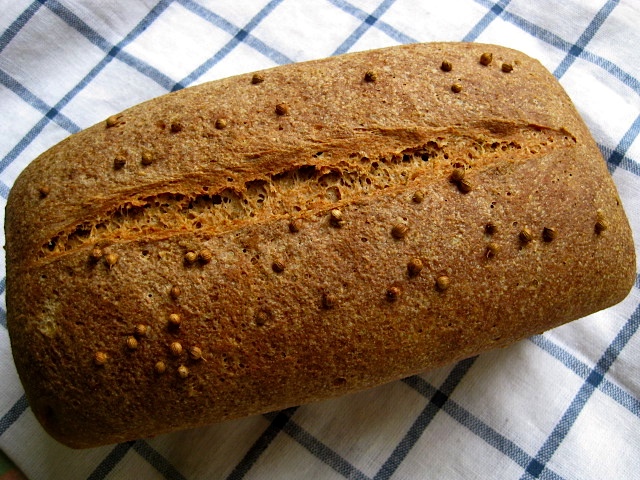
The first bread I tackled was one from my hometown Hamburg, "Hamburger Kräftiges", a hearty rye sourdough. In the book it looks like this:

"Hamburger Kräftiges" from "Brot - Deutschlands beste Bäcker"
This is the original recipe (2 breads)
520 g rye sourdough (from a bakery)
500 g rye flour type 1150
350 wheat flour type 550
540 g water (25 - 28 C)
25 g sea salt
16 g Bioreal-yeast
Knead all ingredients for 8 minutes at low speed, adding the yeast after 2 minutes. Cover and let rest for 1 hour. Shape into a round loaf, place on a baking sheet and proof for 1 - 2 hours, in a draft free location.
When surface shows distinct tears, place in 260 C/500 F preheated oven (no slashing). Pour 50 - 60 ml water on another hot baking sheet or oven floor. After 20 minutes, drop temperature to 220 C/425 F. Overall baking time: 60 - 70 minutes.
Wanting to start with one bread only, I took half of the recipe. To make the rye starter, I used the 3-step build from Martin Pöt Stoldt ("Der Sauerteig - das unbekannte Wesen) with 60 g ripe rye starter, 100 g rye flour and 100 g water and had a pleasantly sweet smelling active rye sour (100%).
A cold retardation seemed a good idea, and working with P.R.s stretch and fold technique, also. All went well, but when I took the dough out of the refrigerator I wasn't quite sure whether it had overproofed, it seemed to have grown more than I expected.
I shaped a boule and proofed it on a parchment lined baking sheet, waiting for the "distinct tears" to appear. The loaf grew, showing a little cracking, but not anything dramatic. I didn't want to wait until it overproofed, and put it in the oven. I knew that the baking temperatures and times had to be off, so I reduced the heat after 10 minutes, and checked the bread after a total baking time of 40 minutes, the internal temperatures registered already 210 F.
The bread didn't look bad, but not at all like the one in the book:

Was the photo in the book photoshopped? It looked much lighter than my loaf. And why didn't I get those pretty tears in the crust?

The bread tasted pretty good, too, but I wasn't satisfied - I wanted the one from the stupid book!
I posted those pictures, and friendly TFLers made some helpful comments, but nobody could figure out why my bread looked like a disadvantaged sibling.
Revengefully I didn't touch the book for a while and worked on other projects. But since I usually don't give up easily, and so far had managed to adapt many German bread recipes to American ingredients (and better techniques), I started pondering over the recipe again.
What made my bread look so different? Why had it almost overproofed in the fridge? And then, belatedly, I did some research in the "internets". I started with the mysterious "Bioreal" yeast. No wonder it had risen so much - this organic instant yeast contains less yeast cells than regular one, therefore 8 g was too much. For the amount of flour 6 g should be enough.
For the wheat in the recipe i had used bread flour - I know it's approximately the equivalent to German type 550. But what about the rye? Without thinking I had taken what I had: whole rye flour. And there it was! With help from Wikipedia I found out that German rye type 1150 was an "in between" white and whole rye. After some calculations I believed I could substitute type 1150 with a mix of 52% whole rye + 48% white rye. (I had some white rye from testing NYBakers recipes, but didn't use it).
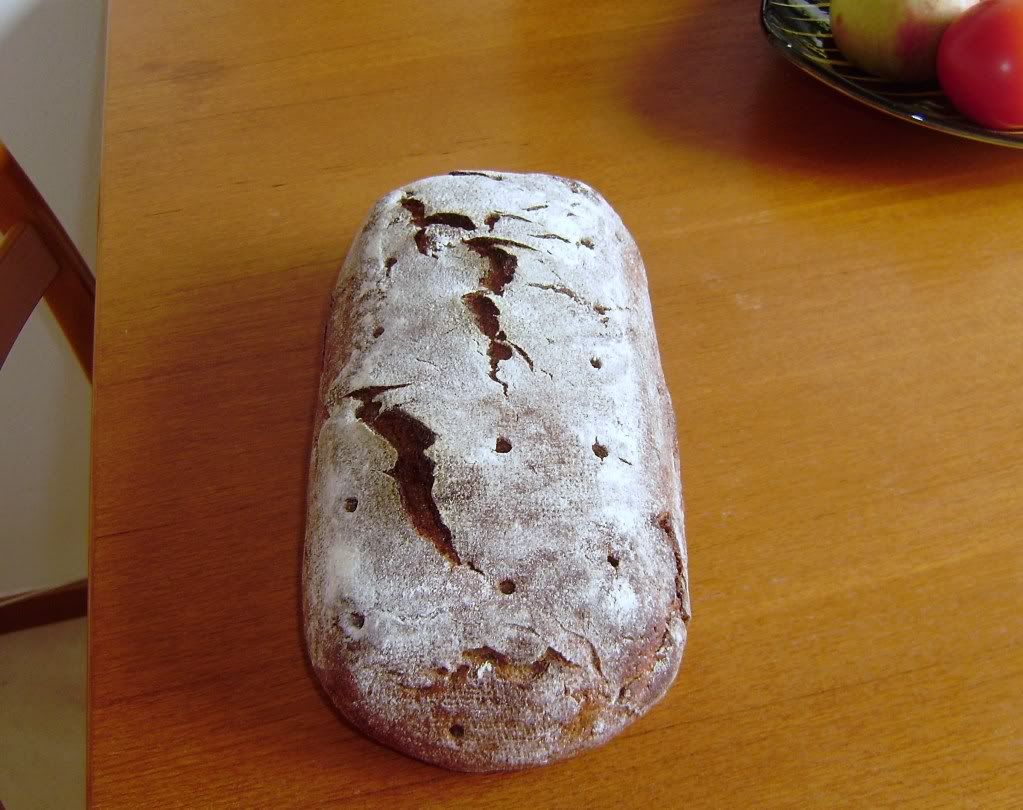
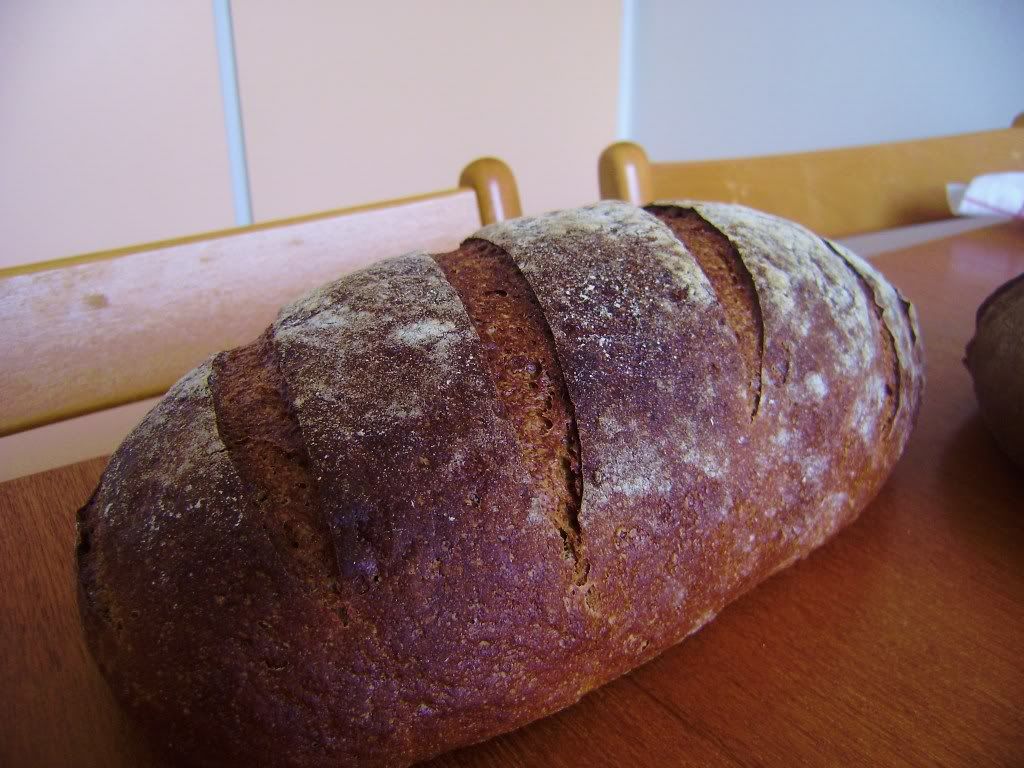
Finally, why had the bread on the photo such dramatic cracks, and mine only puny little tears? I found the answer to this question in a TFL post, about proofing a boule on a baking sheet seamside up, not down - to achieve just such a distinct pattern!
So I tried the "Hearty Rye from Hamburg" again, with these modifications. I also changed the temperatures and baking times to the ones I use for "Feinbrot" and many other lean German mixed rye wheat breads.
I liked this result much better:

It also tasted better - according to my husband this was: "the best bread you ever made"! (He is the best of all husbands - he says that every time, when he likes a new bread).

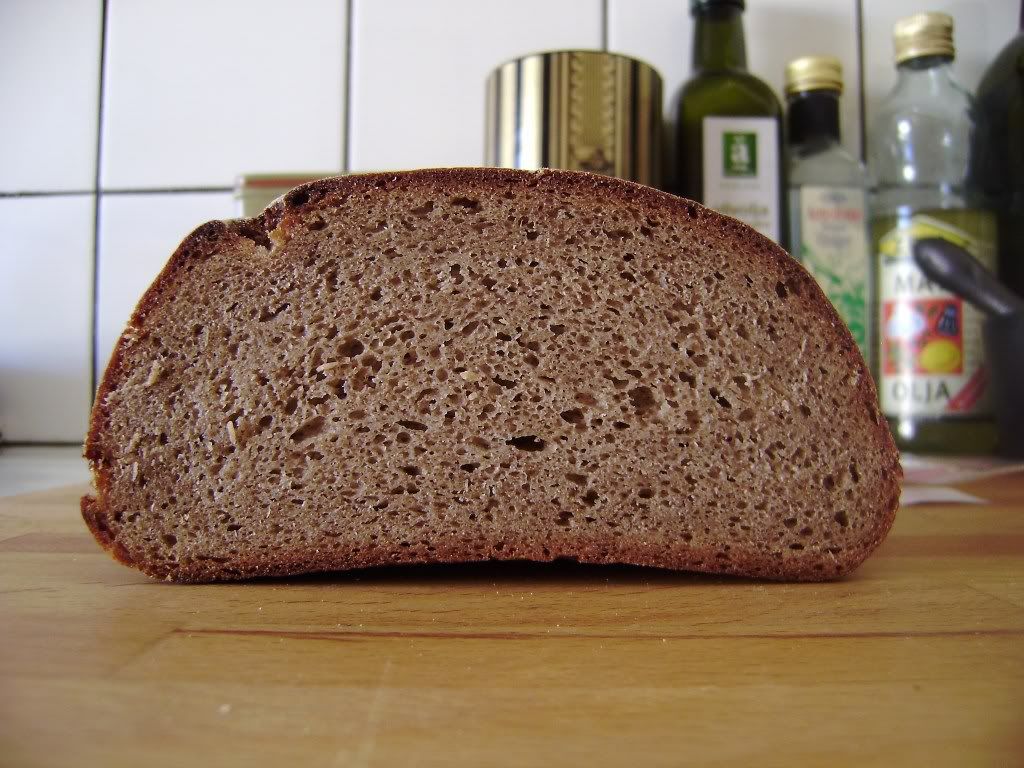
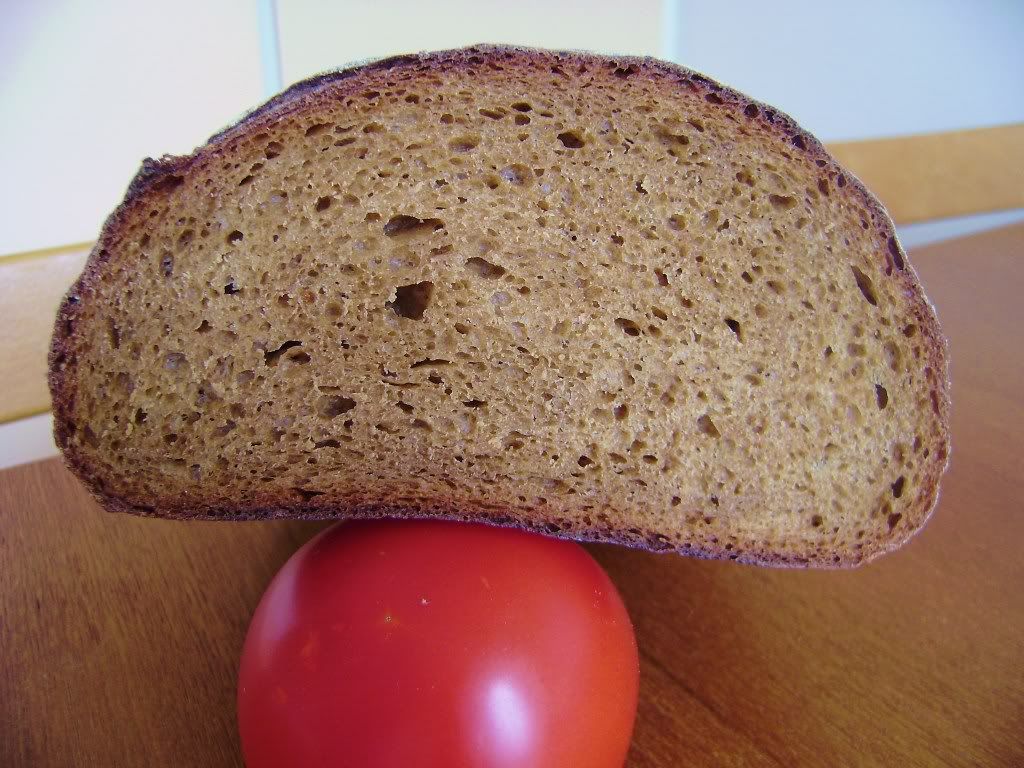
Hearty Rye from Hamburg - crumb
This is my recipe adaptation:
HEARTY RYE FROM HAMBURG
STARTER
60 g rye sourdough starter (100%)
100 g water, lukewarm
100 g whole rye flour
DOUGH
270 g water (95 F)
6 g instant yeast
all starter
110 g whole rye flour
140 g white rye flour
175 g bread flour
13 g salt
DAY 1
Prepare starter.
DAY 2
Dissolve yeast in warm water. Add to all other ingredients in mixer bowl. Mix at low speed for 1 - 2 min. until all comes together. Let rest for 5 min.
Knead at medium-low speed for 2 min., adjusting with water, if necessary. Dough should still be sticky. Resume kneading for another 4 min., the last 20 sec. at medium-high speed.
Transfer dough to lightly floured surface. Stretch and fold 4 times, with 10 min. intervals (total time 40 min.) After last S & F, refrigerate overnight.
DAY 3
Remove dough from refrigerator 2 hours before using.
Preheat oven to 500 F/260 C, including steam pan.
Shape dough into boule, place seam side UP on parchment lined sheet pan. Proof at room temperature for 45 - 60 min., or until dough has grown 1 1/2 times, and surface shows distinct cracks.
Bake 10 min. at 475 F/250 C, steaming with 1 cup boiling water, then reduce heat to 425 F/220 C and bake for another 10 min. Rotate bread and remove steam pan. Continue baking for 20 - 30 min (internal temperature 200 F/93 C).
Let cool on wire rack.
UPDATE 10/15/11: in the meantime I made a side by side comparison with American medium rye (a lighter variety, not a medium grind!) and imported (so to speak) German Typ 1150. American medium rye is a perfect substitute for German medium rye types 1150 or 1370, and my sample tasted even better: http://www.thefreshloaf.com/node/25482/who-winner-medium-rye-comparison