SearchUser loginRecommended BooksFavorite Recipes
|
Submitted by dmsnyder on July 12, 2009 - 10:04pm San Joaquin Sourdough: yet another variation
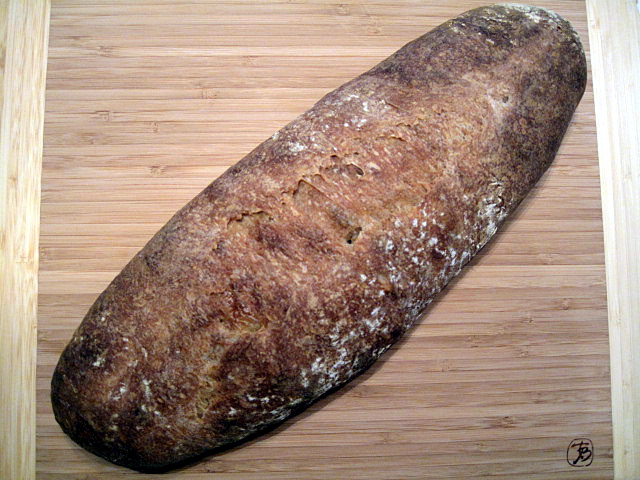
The San Joaquin Sourdough has been my wife's favorite bread for quite a while now. It's not that she doesn't like other breads. She thought Salome's Potato-Nut bread that I baked yesterday was “amazing.” But, if I had an “everyday bread,” I guess this would be it. The recipe and background on this bread are described in my blog entry for Pain de Campagne. While this loaf used the method I have described a number of times, the ingredients were a bit different. I had about 20 gms of 100% hydration starter left over from another bread, so I used it and made up the rest of the 100 gms of starter from my stock 1:3:4 mixed flour starter. I'd exhausted my stock of Giusto's whole rye flour, so I used KAF Pumpernickel, which is more coarsely milled. I figured the 100% hydration starter provided a little more water, but the pumpernickel probably absorbed a little more, so I used 10 gms less water to mix the dough. In other words, I kind of faked it. The dough tripled during cold retardation in bulk! That's probably why I didn't get much of a rise during proofing or much oven spring. The poor yeastie beasties must have been starved. <sniff> I baked under an aluminum foil roasting pan for 10 minutes at 480F/Convection, then another 20 minutes at 460F. There wasn't a lot of oven spring, and, while there was respectable bloom, no real ear formed.
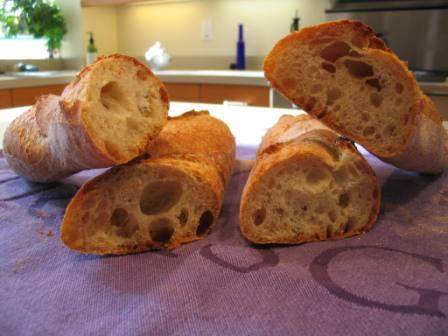
It turned out that the bread had a nice crumb structure, and the taste was as good as I've ever made, if not better. It was assertively sour, which we like. Interestingly enough, while I'd been having mild problems with the retarded dough being slacker than I wished, this dough was a bit more elastic. I can't explain it, unless it was due to the slightly lower hydration (73% vs. 75%). I think I'll bake this bread again with 10% pumpernickel flour. David
Submitted by dmsnyder on May 16, 2009 - 9:03pm Another San Joaquin SoudoughMy "San Joaquin Soudough" formula grew out of explorations of the technique used by Anis Bouabsa for his prize-winning baguettes. I have discussed this in detail in earlier blog entries on TFL. This remains one of my favorite breads, but I'm always looking for ways to improve on it. Last week, I made some straight dough baguettes that had a wonderful flavor. I used 90% Guisto's Baker's Choice and 10% KAF White Whole Wheat in that batch. I wondered how this flour mix would work in the SJ SD. I made this as before, but slightly drier than I usually do when adding whole wheat - 70% hydration. This was a very nice bread, as usual. The flavor of the flour mix used was not a noticeable improvement over the AP/Rye or AP/Rye/WW mixes I've used before. I plan to make another batch of baguettes with this flour mix tomorrow, with a few minor tweaks to the procedure. I'm eager to see if last week's flavor is reproducible. David
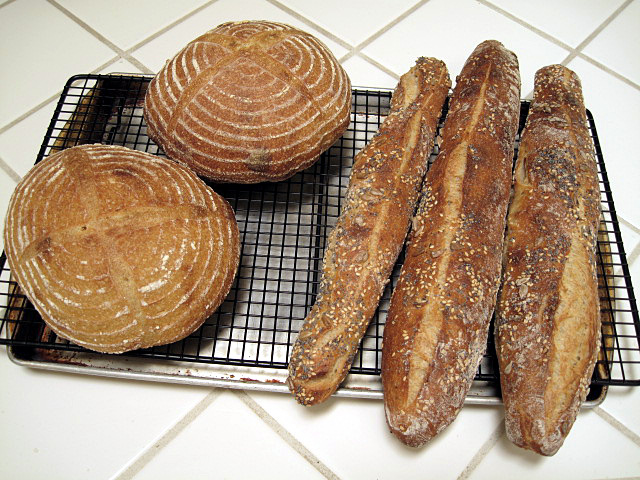
Submitted by dmsnyder on May 10, 2009 - 4:02pm Mother's day breadsToday, I baked a couple boules of Susan's "Ultimate Sourdough," a batch of Anis Bouabsa baguettes with sesame, sunflower and poppy seeds and a Polish Cottage Rye. I've blogged about Susan's sourdoughs before. What else is there to say? I love both her "Original" and "Ultimate" sourdoughs. I can't say I prefer one over the other. The one I baked today was from Susan's recipe, but I left out the olive oil ... I think. At the moment, I can't recall whether I forgot it or not. Hmmmm .... The seeded Bouabsa Baguettes were made at my wife's request. I've been making different breads with mixed-seed soakers recently. My wife has enjoyed them, but has told me she likes the seeds on the outside more than on the inside. Being it's Mother's Day, it seemed a good time to make something special for her. I followed the Bouabsa formula about which I've blogged several times before. This uses Bouabsa's technique but adds 100 gms of active sourdough starter. I also substituted 10% white whole wheat flour and 5% whole rye flour. The remaining 85% was Giusto's Baker's Choice. I mixed the seeds (30 gms sunflower, 30 gms sesame and 15 gms poppy) and rolled the shaped baguettes in the mix, spread on a sheet pan, before proofing on a linen couche. They turned out well, with a nice crunchy crust, open crumb and very tasty flavor. The Polish Cottage Rye is one of my favorite breads from Leader's "Local Breads." I have made it using First Clear flour with results like the photo in Leader's book. The last couple of times, I have followed the recipe and used bread flour for the wheat flour. The crumb has been very open and nothing like that pictured in "Local Breads." Using bread flour, it makes a very slack dough that requires extensive, intense mixing to develop the gluten sufficiently to allow one to form a boule that holds its shape. Leader's mixing instructions should be followed and yield good results. Both versions have been delicious. I made this bread today with bread flour. It just came out of the oven and "sang" at the top of its lungs.
David Submitted by dmsnyder on April 16, 2009 - 11:24pm My first Épi de BléThis was my first attempt at an "épi de blé," or "sheaf of wheat" shape. I made it with Anis Bouabsa's baguette dough. Épi de Blé
Close-up David Submitted by dmsnyder on April 11, 2009 - 5:39pm San Joaquin Sourdough: another variationI have continued to play with my formula for what I call "San Joaquin Soudough." This continuing series of experiments started with my curiosity as to whether the baguette formula of Anis Bouabsa could be applied to other types of bread than baguettes. The short answer is, of course, "yes." The basic approach I have been using is described in detail in the following blog entry: http://www.thefreshloaf.com/node/8454/pain-de-campagne The present variation used 10% KAF White Whole Wheat flour, 90% KAF Bread flour and a slightly higher hydration - 76%. The techniques for mixing, fermentation, etc. were as I have described before. So, the ingredients were: Ripe 65% hydration sourdough starter....100 gms Water........................................................380 gms KAF Bread Flour.........................................450 gms KAF White Whole Wheat Flour...................50 gms Sea Salt.........................................................10 gms Instant Yeast................................................1/4 tsp The combined effect of the different flours and the higher hydration was to yield a dramatically different bread with a much more open crumb structure - really ciabatta-like. Now, I did bake these loaves under an aluminum foil roasting pan for the first 12 minutes and then for another 18 minutes uncovered. The oven spring was massive. My scoring was obliterated. Examination of the crust coloration of the bloom revealed that the bloom occurred very early in the bake and very rapidly. (The coloration was even and not different from the rest of the crust. See my Scoring Tutorial in the TFL Handbook for further explanation.) With the higher hydration and covered baking, the crust softened quickly during cooling. The crumb was like a good ciabatta - very tender yet still chewy. The taste is very mildly sour, even on the day after baking. It made a delicious sandwich with Toscano salami, Beaver Brand Sweet Hot mustard and lettuce. (Sorry, Mini. It definitely would drip mayonnaise in your lap.) This bread presented me with a number of surprises, but I'm far from disappointed. I'm happy to have a "new" bread in my repertoire. David Submitted by DonD on April 2, 2009 - 1:25pm Gosselin vs Bouabsa Experiment
I used the folowing flour mix: 30% KA BF 58% KA APF 10% KA WWF 2% Bob's Red Mill Fava Bean Flour 2% Noirmoutier French sea salt The mixing, fermentation, shaping and baking followed David's closely for both formulations. They were baked on the same day about one hour apart. Both batches turned out great. The oven spring was about the same for both. The Gosselin crust was lighter in color than Bouabsa's which had a deep rich color. Both had good crunch and sweet caramelly flavor. The Gosselin crumb is soft and incredibly sweet with a wheaty aftertaste. The Bouabsa crumb was slightly more open, was more chewy and had a nutty flavor. I had an informal blind bread tasting with my wine tasting group and the Bouadsa baguette was unanimously the slight favourite. The top photo shows the Bouabsa baguettes. The second photo shows the crumb detais with Bouabsa's on the left and Gosselin's on the right. The third photo shows the Gosselin baguettes. The fourth photo is a close-up of the Bouabsa crumb. I want to thank David and all the TFL members for generously sharing their knowledge and experience. Happy Baking!
Submitted by dmsnyder on March 29, 2009 - 6:11pm Sir William Osler, disaster recovery and pain rustiqueIn 1904, Sir William Osler, one of the greatest physicians of his time, was asked to address the graduating class of The Johns Hopkins School of Medicine on the topic, “What is the most important personal attribute for a physician to cultivate in himself?” Sir William's address was entitled “Aequanimitas,” which roughly translates into modern American English as “Chill, dude!” I have always tried to follow Sir William's wise advice. This afternoon, I made a batch of baguettes, according to Anis Bouabsa's formula. I thought they were the most perfectly shaped and scored baguettes I've every made. As I was loading the three baguettes into my pre-heated and humidified oven, one fell off the back of the baking stone. As I tried to grab it, the other two baguettes fell off the peel onto the oven door. What a mess! Uttering a few words which my wife has asked I not speak in the presence of our grandchildren, I scooped up the twisted heaps of formerly gorgeous baguette dough. Should I scrap the bake as a lost cause or attempt a salvage operation? What could I lose by trying? Aequanimitas, aequanimitas, aequanimitas ... I was able to separate the three pitiful pieces from each other. I reshaped them quickly – one folded as one might fold a ciabatta, one coiled and one formed into a figure 8 knotted “roll.” I immediately loaded them onto the stone and baked for 10 minutes with steam at 460F and 8 more minutes dry. Anis Bouabsa Not Baguettes Anis Bouabsa Not Baguettes - Crumb Delicious! I hope you all have a great week and that all your "disasters" are really "opportunities," when you look back at them. David Submitted by dmsnyder on January 25, 2009 - 5:12pm This weekend's breadsThis weekend, I baked a couple sourdough baguettes and a bâtard using the mixing and fermentation methods described in the posts about Anis Bouabsa's baguettes. For these breads, I used 90% AP four, 5% WW and 5% rye. Interestingly enough, the flavor of the bâtard seemed much better to me.
These were nice, but the real star attraction was the Cherry Pecan Pain au Levain. I made it according to the formula and method recently posted by mountaindog. (http://www.thefreshloaf.com/node/10313/cherry-pecan-pain-au-levain) This is a spectacular bread. The flavors are wonderful and, at this point when the first batch is just cooled (well, almost just cooled), the bread dough, the cherries and the pecans each sings its own sweet tune. This bread would be good with butter, cream cheese or a fresh chevre. In fact, it is pretty darn good just by iteself. My wife's verdict is: "This is wonderful bread!" Now, she says such things fairly often, but this afternoon, she said it twice, separated by a minute or so. In Susan Speak, this indicates "I want to be certain my judgement has gotten through to you. You will make this bread for me again!" To which I say, Amen!
Happy baking! David Submitted by dmsnyder on January 17, 2009 - 12:29am Sourdough bread - 2 experimentsEver since Jane prompted me to add levain to the Bouabsa baguettes, I've wondered what this bread would be like raised by wild yeast entirely, without the small amount of baker's yeast it calls for. And, more recently, I made the best tasting ever Miche with the first clear flour Norm sent. I wondered how much of its wonderfulness was the method, and how much was the flour. So, today I explored both questions by baking a couple loaves with Norm's first clear as 100% of the flour and used Anis Bouabsa's technique of a long cold bulk fermentation. This is a 75% hydration dough, while the Hamelman Miche is 82% hydration. The result was a really nice, moderately sour bread with the distinct flavor of first clear flour. The crust was crunchy, but it needed 10 extra minutes in the turned off oven to crisp up. The crumb was quite open with a lovely cool feeling and chewy texture. I will use this technique again, but with the same AP/WW/Rye flour mix I have liked best with Bouabsa's baguettes.
David Submitted by dmsnyder on August 27, 2008 - 9:56pm Encore des baguettes
Anis_baguettes_with_SD001
Anis_baguettes_with_SD004
Anis_baguettes_with_SD009
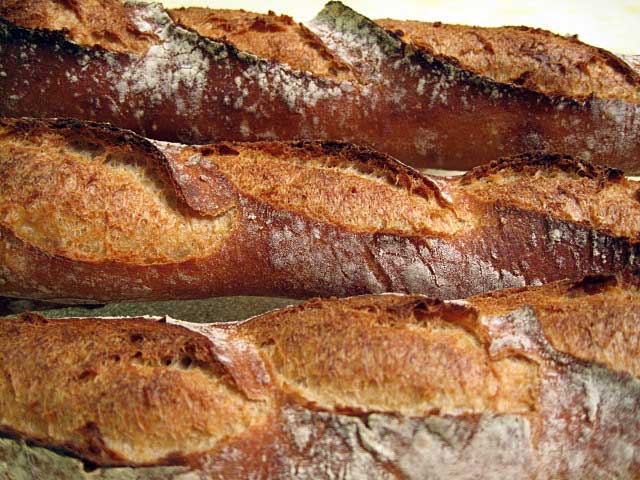
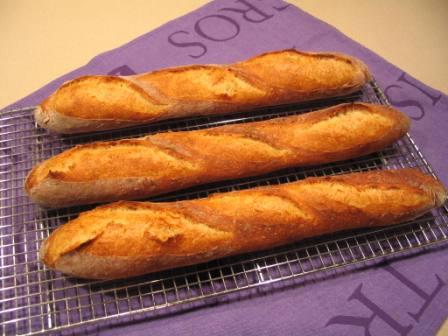
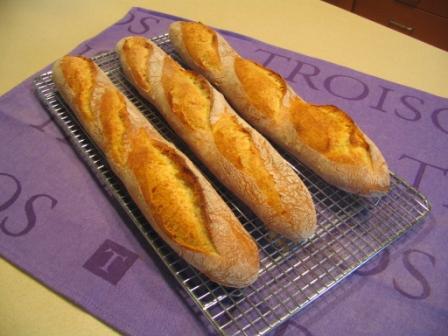
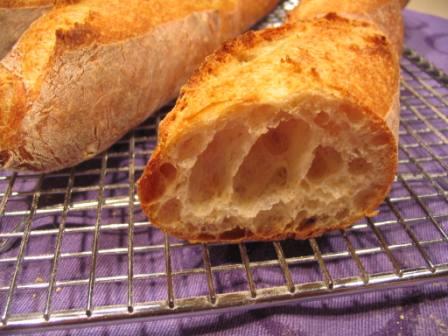
Anis_baguettes_with_SD_Crumb Thesee baguettes are based on the formula given to Janedo by Anis Bouabsa, with Jane's modification - adding 100 gms of sourdough starter to the dough. The formula and method have been described in some detail in my last blog entry: http://www.thefreshloaf.com/node/8340/more-baguettes-best-crumb-yet-me If these look substantially similar to those pictured in that entry, they are. My point is that this formula appears to be reliable and is yielding consistant and gratifying results for me. That said, this batch was superior to the last in a some respects: First, the crumb is even more open. Second, the flavor is much better. It is very mildly sour but also sweeter. Third, the crumb has a chewier texture. Fourth, the shape of the cross section is more round. Fifth, my scoring was more consistant. I did make a few modifications in ingredients and method. While these may seem trivial, I believe those of us who have participated in "The Great Baguette Quest" have found that these sorts of small differences make the difference between "good" and "great" results. So, my modifications from the previous baguette bake were:
I am not much of a baguette fan, generally speaking, but this batch was good enough to motivate further baguette adventures. David |
ALSO ON |