SearchUser loginBread BooksFavorite Recipes
|
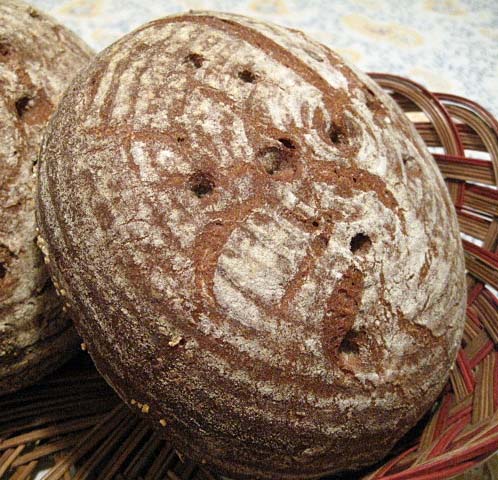
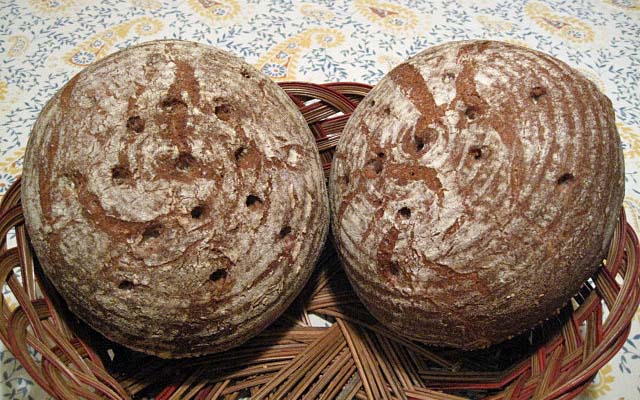
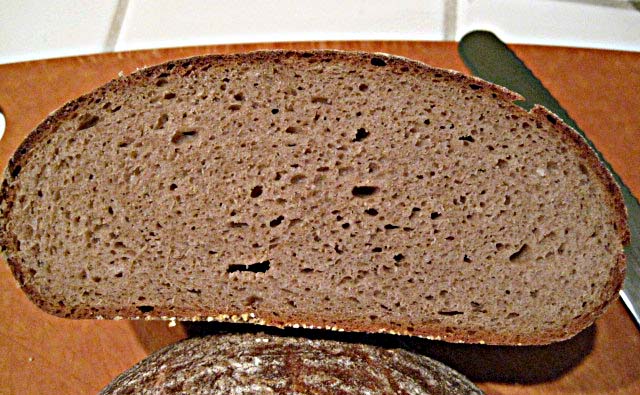
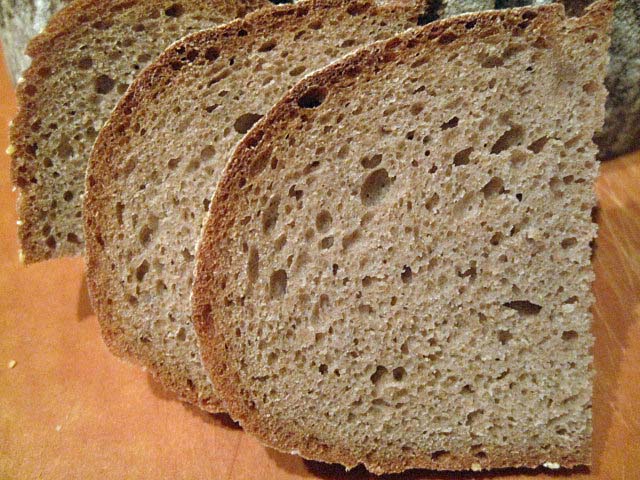
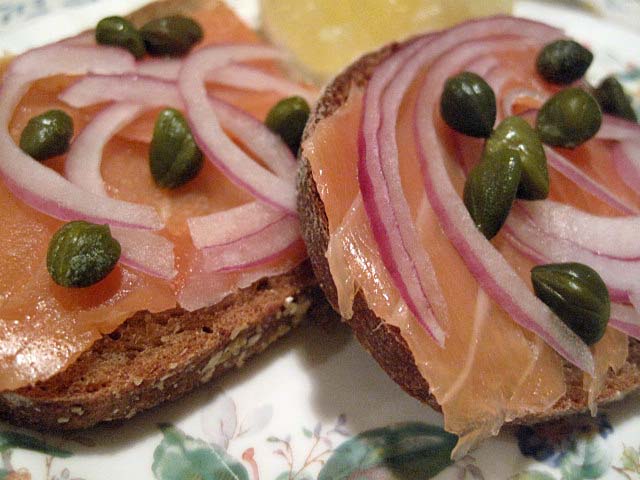
Submitted by Mebake on December 31, 2011 - 12:24am Hamleman's 80% 3-stage detmolder RyeHaving lusted over High percentage, multistage Rye breads for some time now, and being inspired by recent posts such as Phil’s and Cordruta’s, I finally took the plunge. This is one time consuming, precariously scheduled recipe, that leaves you wondering at the end, whether or not crafting this bread is worth it. Medium Rye is not available where I live, and so I improvised by sifting whole grain rye flour. The resultant flour consistency is close to a medium rye (I think). I followed Hamelman’s instructions, including 1 tsp of yeast at the end. As usual, this is a paste rather than a dough, and therefore to boost the 20% bread flour strength , I added 1 Tbl Vital wheat gluten to the final mixture. The Paste, rounded by wet hands. Bowl oiled slightly with water. The paste, divided and rounded by wet hands. Smooth top Heavily Dusted with whole Rye flour. Inverted into a 50% bread flour, 50% rice flour dusted kitchen towel. After 50 minutes of proofing. Inverted on to parchment, with corn meal at the bottom. 32 hours later. Lovely slightly moist crumb, and chewy rye-infused flavored crust. Very typical of German Rye. The verdict: worth it, only if i could afford a whole day at home. What spreads would best complement this bread? anyone? This was my last bread of 2011, happy New year everyone!
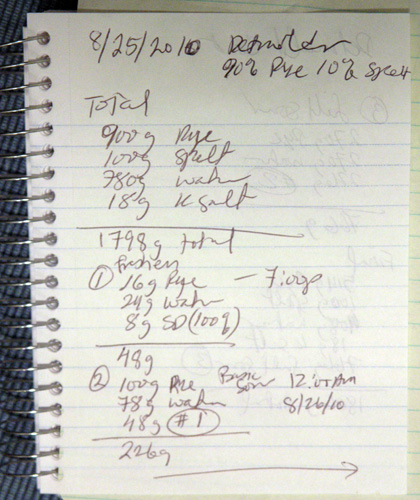
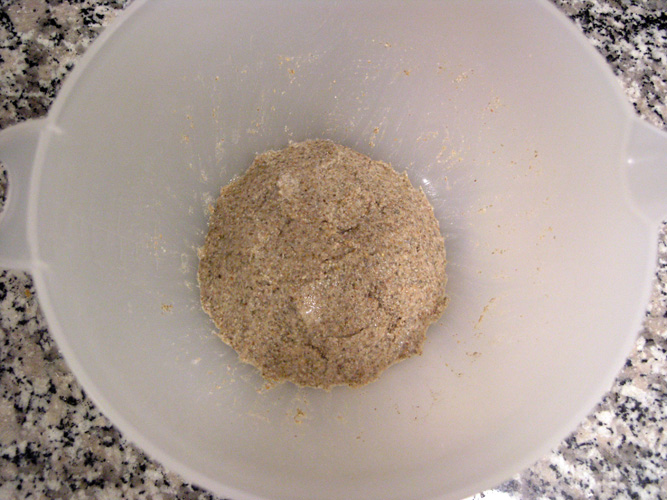
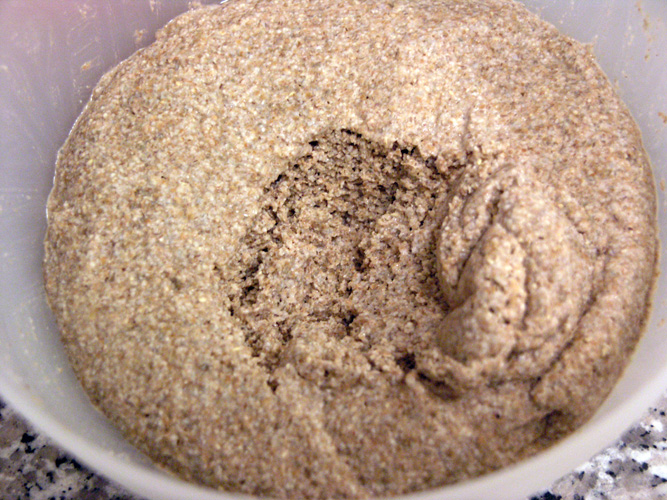
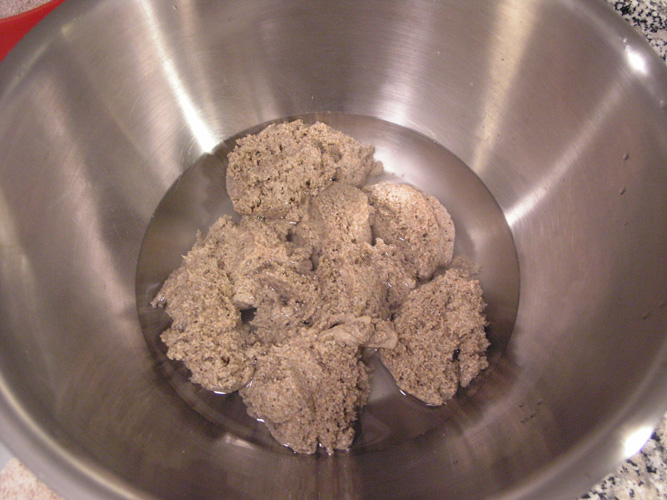
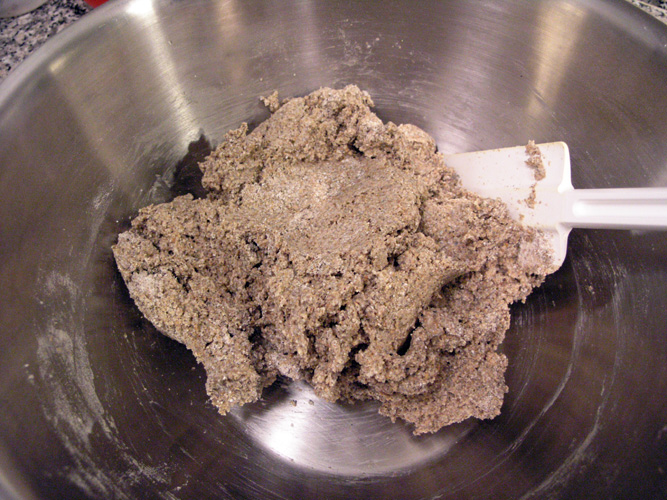
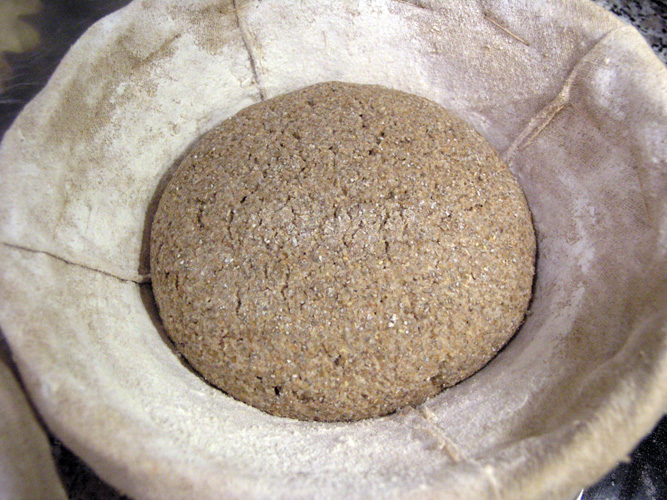
Submitted by breadbakingbass... on August 26, 2010 - 8:56pm 8/26/10 - 90/10 Roggendinkelbrot - 3-Stage Detmolder ProcessHey All, Wanted to share with you something that I have been working on for the past 2 days or so. I was poking around my local Gristede's supermarket the other day and found Hodgson Mills Stoneground Rye Flour for $5.99. I usually only go to Gristede's if I'm lazy or desperate as there are much better places to get groceries in NYC. Anyway, I was pleasantly surprised to find what I did. Also, I have some organic spelt berries that I'm trying to get rid of or use as it's not my favorite grain. So, when I got home I consulted Hamelman's Bread book along with the Hofpfisterei München website looking for some inspiration. I found the following. If you click on the links on their website as follows: Sortiment => Natursaurteigbrote => Pfister-Oko-Dinkel-Grunkern-Volkorn... It's a 92% spelt(dinkel) and 8% rye(roggen) bread... I was inspired by this, but did the complete opposite and thought it was a 92% rye bread... Anyways, my inspiration doesn't need to be correct, right? Anyways, back to the 90% rye/ 10% spelt bread that I'm making. I've tried to make a very detailed photo documentation for all of you. So here goes! This is what started it all. The Hodgson Mill Rye Flour I found at the local Gristede's around the block from me. $5.99 for 5 pounds. Not a bad find... My recipe page 1 My recipe page 2 8/25/10 - Stage 1 (Freshening) 16g Rye Flour 24g Water 8g Sourdough Starter (100% Hydration) 48g Total 7:00pm - Mix all, cover, let rest for 5 hours. 8/26/10 - Stage 2 (Basic Sour) 100g Rye Flour 78g Water 48g All of stage 1 226g Total 12:00am - Mix all, cover, let rest for approx 17 hours. Stage 2 after mixing a bit Stage 2 smoothed over with water before covering and letting rest for 17 hrs. Stage 2 after approx 17 hrs Stage 2 after approx 17 hrs - detail of what's inside 8/26/10 - Stage 3 (Full Sour) 270g Rye Flour 270g Water 226g All of stage 2 766g Total 6:45pm - Mix all, cover, let rest for approx 3-4 hours Stage 3 mixed Stage 3 smoothed over with water before covering and resting Hand grinding spelt grains for final dough with a hand crank grain mill Spelt flour close up out of the hand crank mill Stage 3 after 3 1/2 hrs Stage 3 side view - gas bubbles Stage 3 - inside texture 8/26/10 - Final Dough 514g Rye Flour 100g Spelt Flour (freshly ground) 408g Water 18g Kosher Salt 766g All of stage 2 1806g Total 9:15pm - Mix all, cover, bulk ferment for 20 minutes. Stage 3 in pieces in large mixing bowl with pre-measured amount of water All ingredients of final dough in mixing bowl Mixing with rubber spatula More mixing More mixing and mushing... Just mix well so everything is well combined... For nice ball with spatula, smooth over with water... Place in plastic bag, bulk ferment for 20 minutes... Final dough after 20 minute bulk ferment Inside texture of dough after bulk ferment 9:45pm - Divide dough into 2 equal weight pieces Form into boule, dusting lightly with rye flour to prevent sticking Place in linen lined baskets for proofing Place in baskets in plastic bag for proofing, approx 1 hr. Place baking stone on 2nd rack up from bottom, place steam tray, preheat oven to 550F with convection. Boules after proofing. Notice cracks on surface. Close up of cracks Turn out on to peel Dock loaf with chopstick 10:50pm - Turn off convection. Place loaves directly on baking stone, add 1 cup water to steam pan, close oven door. Turn oven temp to 500F and bake for 10 minutes without convection. Then remove the steam pan, turn oven down to 410F and bake for another 60 minutes or until internal temp of loaf reaches 205F or more. Sorry for the blurry shot... I'm tired... To be continued... Continuing... This is about 10 minutes into the bake right before I remove the steam pan. Notice the oven spring...
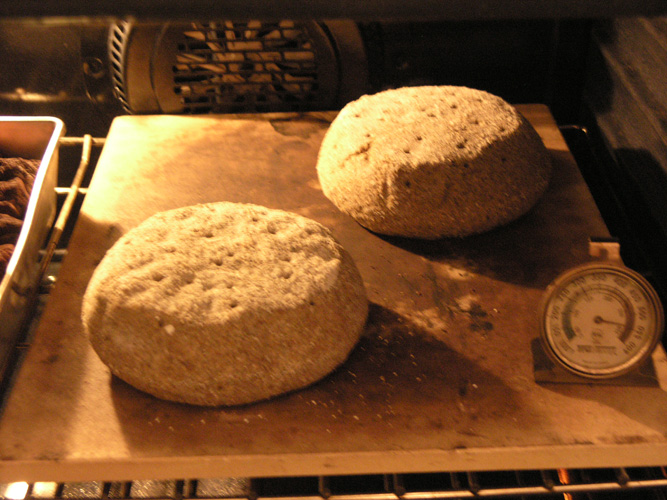
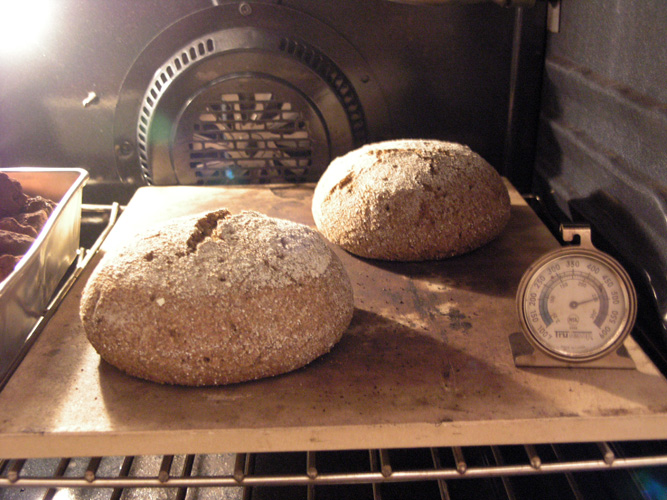
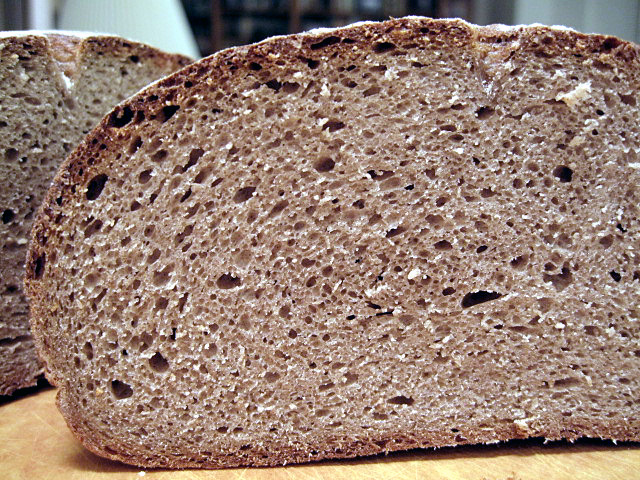
Loaves out of the oven 1 hr after removing the steam pan Crumbshot! Thanks for reading... Enjoy! Submitted by dmsnyder on July 4, 2009 - 10:19pm Hamelman's 70% 3-Stage Rye SourdoughInspired by the gorgeous rye breads hansjoakim has been showing us, I made Hamelman's 70% 3-Stage Rye Sourdough today. I've made lots of light rye breads and enjoyed them, but I had not yet tackled a rye with over 50% rye flour. I had also never made a rye using the "Detmolder 3-Stage" method. It was time. I'm glad this was not the first rye bread I attempted. My acquired comfort level with slack doughs and sticky rye dough helped immensely. Working this dough, which has so little gluten it never develops perceptibly, would have been discouraging and confusing without that experience. A 70% rye dough is a different critter from a 40% rye. The latter feels like a "normal" dough, except stickier. The former is like moulding clay. A light and quick touch is needed to successfully handle the dough, especially in shaping. I was pleased that, using this approach, almost no dough stuck to my hands. The 3-Stage Detmolder method was developed by German bread scientists to optimize flavor and, particularly, the balance of yeast, lactic acid-producers and acetic acid-producers in the dough. This requires some advance planning. I started the whole process 3 days ago by activating my rye sour with two feedings prior to starting the first "stage" of the Detmolder process. The 3 Detmolder stages are rye sour elaborations that differ in hydration, fermentation temperature and length of fermentation. The final dough adds to the rye sour some high-gluten flour (I used KAF Sir Lancelot.), more water, salt and, optionally, instant yeast. It has a very short fermentation of 10-20 minutes and proofs in bannetons until expanded somewhat less than 100%. I proofed for 1 hr, 15 minutes. In hindsight, I could have proofed for another 15 minutes. (My kitchen was around 79F.) The dough is divided into rounds which are "docked" rather than scored. Docking involves poking multiple holes in the crust before baking. There are toothed rollers that professional bakers use. I used a "Susan from San Diego Special Mixing Implement," otherwise known as "a chopstick." The 1.5 lb loaves were baked in a "falling oven temperature," starting out at 490F for 10 minutes to maximize oven spring, then at 410F for another 30 minutes. I left the loaves in the oven, with the oven off and the door ajar, for another 10 minutes to dry the crust. Steaming should be intense but brief. I poured some hot water over lava rocks in a pre-heated cast iron skillet 3 minutes or so before loading then poured some more water on the rocks just after loading. The skillet was removed after 5 minutes, and I left the oven door open for a few seconds to let some of the steam out before continuing the bake. Hamelman says to delay slicing for at least 24 hours. 70% 3-Stage Rye Sourdough, with this afternoon's crop of cherry tomatoes. 70% Rye profile 70% Rye crumb Slicing the bread, one gets the sense that this is a heavy bread. However, in the mouth it doesn't feel dense or heavy. The crumb is quite tender. The first flavor hit is earthy rye with a very mild sourness. (The sourness may well increase over the next few days.) The surprise is the long-lasting aftertaste which is decidedly sweet! I think this bread is made to eat with a hearty stew. Too bad it's way too warm for that. Smoked meats or smoked fish are more appealing. How about some Cotswold cheese? I'm off to go fishing for some smoked salmon. David Submitted to Yeast Spotting on Susan FNP's marvelous Wild Yeast blog |

ALSO ON |