SearchUser loginRecommended BooksFavorite Recipes
|
Submitted by davidg618 on July 15, 2009 - 9:30pm Today's Bake: DiMuzio's Pain au Levain (firm starter)This bread is fast becoming a favorite with us.
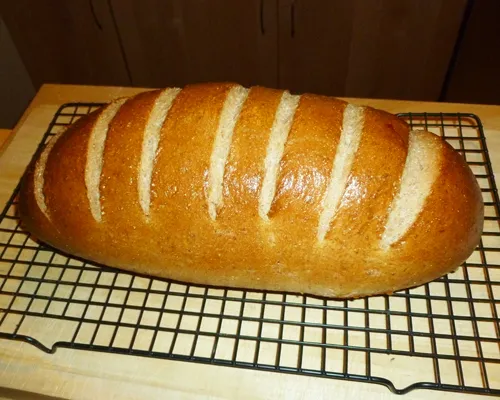
I won't have a crumb shot for these, because they are both marked for neighborhood dinner parties. Although I've not been disappointed in past bakes,I got more ovenspiring with these two loaves, baked individually, then ever before. The past three times I've baked this formula I've retarded the dough overnight. This time I scheduled the formula-ready levain to peak early in the morning, and proceeded from there to make the dough, autolyse, bulk ferment, shape, and proof. I proofed the left-hand loaf at room temperature, and retarded the final proof of the right hand loaf at 55*F. I did this only to bake the loaves individually. They are different weights (left:750g, right:1000g). I like to use a different temperature schedule for the each: 480*F for 10 mins. with steam for both; finish baking the smaller at 450*F, and the larger at 440*F. Both loaves had excellent oven spring, but the smaller, room temperature proofed loaf had the most. David G
Submitted by davidg618 on July 12, 2009 - 3:01pm 1 and 1/2 Tries at BriocheBefore today I'd never tasted nor baked Brioche. Yesterday I began by making the dough, and today I made two tries baking it. First Try
The crumb, and flavor, seem to be what I should expect, from this dough, so for a first time, ever, I'm pleased, especially after reading all the cautions--offered by the author, and elsewhere--about making high fat percentage doughs; but as you can see I have a long way to go learning to construct these rascals correctly. I've nicknamed the one in the upper left corner Nearly Headless Nick (Harry Potter fans will recognize the name.) The formula is from "Baking Artisan Bread" by Ciril Hitz, and I followed it and the author's instructions to the letter, except constructing the individual rolls. The ones shown were constructed using the little-ball-on-top-of-the-bigger ball approach. Additionally, the intructions called for 90g of dough for each mold, and I thought my molds were the same size as those shown in the author's pictures. They weren't. One head slipped off entirely. The oven spring in this dough made them look more like popovers than brioche in my forms. So I tried again. using some of the reserved dough--thus the 1 and 1/2 tries--with three changes. First I reduced the quantity for each mold to 65g, secondly, I'd baked the first four at 345°F on the oven's convection mode, as recommended by the author; the 1 and 1/2 try I used the recommended 265°F thermal mode setting, and lastly, I used the author's novel shaping. Here's an attempt to explain it in words. Starting with the dough pre-shaped into a ball, by pressing and rolling with one finger two balls--one large, one small--connected by a thin neck of dough is created. Then, the neck is stretched to three fingers width, the larger ball is turned into a doughnut shape, and the smaller ball--neck intact--is passed through the doughnut hole, and the doughnut shape is gently coaxed to collapse around the now curved neck. (I hope readers can visualize this. I couldn't have done it with out the author's pictures.) Try 1 and 1/2
Photo says it for me. Far from perfect, but OK. David G Submitted by davidg618 on July 7, 2009 - 12:33pm Building a Formula-ready levain (starter)I think one of the biggest differences between commercial artisan bakeries, that bake every day, and the amateur that bakes once or even twice a week is how each handles levain day-to-day. From my reading I've gleaned the commercial baker keeps his or her levain (starter) at room temperature, and feeds it on a periodic schedule every 8 or 12 hours. (I'm an amateur, so, experts, please correct me if I'm terribly wrong). on the other hand, most amateurs keep thier starters at refrigerator temperature (~40°F), and feed them once weekly, or less often. I am less certain how commercial bakers maintain their starters' hydration, I assume, however, that perhaps as little as one day earlier they prepare a chosen amount of their maintained starter by feeding it an amount of flour and water that adjusts its hydration to the target for a days baking. Amateurs keep their maintained starters at a fixed hydration, and, although some amateurs maintain their starters very dry (50%-60%), or very wet (~200%), the usual maintenance hydration is ~100% to ~125%. The challenge for us amteurs is, "How do I convert an alive, but nearly dormant, relatively cold starter to a formula ready starter, i.e., the correct formula specified starter weight and hydration?"; one might also add, in a reasonably short time. Some recipes intruct a single feeding, without changing the starter's hydration, followed by a fermentation period--usually 12 hours--and adjusts the dough's flour and water weights to achieve the desired dough hydration. Some amateur bakers convert their maintained starter in one feeding to the target starter weight and hydration, and then feed it an additional one to nine times over a period of one or more days. Both these approaches work, and each have subtle secondary consequences, usually effecting the final bread's flavor. It's not my intent judge the merit of those consequences, merely note they occur. What I want to do is describe the process I use, explain why I use it, and show some results. First of all, I have two primary goals for creating formula-ready starters the way I do. One is related to the final dough. I want to achieve a very active starter, strong enough to produce two strong proofs, in moderately short time, i.e., 2-3 hours each; and with sufficient reserve to provide strong oven spring. And, I want to build this formula-ready starter in no more than 24 hours. The second goal: I want to maintain only a barely necessary amount of starter, e.g., around 200g, 100% hyddration, and fed every two or three weeks. I've succeeded in reaching both goals using a 3-build approach that triples the amount of starter with each build, and adjusts the hydration by one-third of the difference between the maintained starter's hydration and the formula specified starter hydration. A couple of definitions, and a little math: seed starter: the weight of maintained starter that when tripled 3 times yields the formula-specified starter weight. Intermediate starter: the building starter, i.e. the starter at any time between the beginning of Build 1 and the end of Build 3. formula-ready starter weight = seed starter weight x (3x3x3) = seed starter weight x 27; therefore: seed starter weight = formula-ready starter weight/27. But, I always lose some--it sticks to the stirrer, and the its container's walls, so I add a little more, e.g. 20g. intermediate starter hydration = seed starter hydration +(formula-ready starter hydration - seed starter ready hydration)/3 x # of last build. An example: Formula specified starter: 480g, 60% Hydration Seed starter hydration: 100% Added to make up loss: 20g Hence: Seed starter weight = (480 + 20)/27 = 19g (rounded to nearest whole number) Intermediate starter's hydration = 100 +(60 - 100)/3 x 1 or 2 or 3 = 100 + (-40)/3 therefore: during Build 1 the Intermediate starters hydration = 86.7; during build 2 73.3%, and during build 3 60%. Intermediate starter weights are: Build 1, 55g, Build 2, 167g, and Build 3, 500. (all are rounded to nearest whole gram.) Now, I'm not going to do the Baker's math to calculate the flour and water weights added each build. I built a spreadsheet to do that for me, but it is possible by hand using Baker's math, and the intermediate starter weights and hydrations. The results: Below are a series of five photographs that visually document the example above. Why do it this way? I reasoned that adding more than twice the weight of the seed starter (or the intermediate starter weights) would dilute the density of the yeast critters beyond a "strong" density, i.e. each build should peak within eight hours or less, Yeast have little or no motility, so after a time, they are surrounded by their waste products: carbon dioxide and alcohol, not food, so production slows down or stops. Stirring , kneading dough, etc. all redistribute yeast, by-products, and food, but I don't want to be burdened with stirring. Furthermore, my goals focus on yeast production, not bacterial growth. (There are other things one can do to develop flavor contributing starters.) 1. Seed Starter: 19g of my refrigerator maintained starter.
2. Build 2. at its peak 16 hours after starting. I didn't photograph build 1, even at its peak it didn't cover the bottom of the container.
3. Build 3 at zero hour, I'd just added its flour and water additions and spread it out in its container.
4. Build three after only 3 hours (19 hours from the beginning); I consider its growth a good subjective indicator of its strength.
5. Build 3 after 7 hours (23 hours from beginning). You can see evidence it's peaked by the slight deflation around the edges. Immediately after taking this photo I made the dough...
...for this bread. This is D. DiMuzio's San Francisco Sourdough au Levain (firm starter) formula, but I used it for a Thyme-Feta Cheese-Toasted Chestnut vehicle, so it probably doesn't exhibit all the oven spring it might have in an uncluttered dough. Nonetheless, I think it stands a good example of my goal.
Crumb
Submitted by davidg618 on July 5, 2009 - 9:03am Bread Machine Sourdough Light Whole Wheat Sandwich Loaf.My wife makes three loaves of light whole wheat bread, alternating every other week with an all-white flour version of the same recipe. Two of the loaves are our "daily bread", the third routinely goes to a neighbor. She uses our bread machine, a Zo, on the "Dough" setting, and does a 2nd bulk fermentation, panning and proofing, and baking outside the machine. The machine does a one hour bulk proof; her second bulk proof is usually 2 to 2-1/2 hours depending on the dough's behavior. The long bulk proofings allow the doughs, expecially the whole wheat version, a chance to develop good flavors. Curious if I could convert the recipe to a sourdough, i scaled it to produce the same dough weight and hydration as the original recipe, but replaced some of the white flour and water with 240g of active sourdough starter at 60% hydration, built using the 3-build approach I use for all my sourdough formula.
The photo answers my curiousty with a firm yes. However, the experiement taught me the question I should have asked: "Is it worth the additional time and effort?" This bread is all one would ask for in a sandwich bread: excellent flavor; closed, but light and slightly chewy crumb; and a soft crust--even before I brushed them with butter. But I can say the same things about my wife's bread. Here's a photo of her all-white version I took a couple of weeks ago.
From my point-of-view we're going to stay with the tried and true Yvonne has baked for the last six years. Doing the sourdough was fun, and we will certainly enjoy eating the result. Sometime in the future I'm going to see if I can be successful baking a single sourdough loaf entirely in the Zo. I think it's possible, in the programmable mode, using a very active starter, and removing the paddles after the knead step. This will allow up to a four hour bulk fermentation step. But that's for another day. Submitted by davidg618 on July 1, 2009 - 12:26pm Dan DiMuzio's baguettes with liquid levainI'd planned to do yet another bake of classic baguettes ala Hitz' formula, but after seeing and reading Pamela's blog entry a week ago, and after comparing Dan's formula with what I've been doing--they are very similar except for the liquid levain--I gave into my temptation and made the DiMuzio formula. The only change I made was to scale the formula to 1000g final dough weight (four 250g small baguettes) which isn't really a change, merely a diminuation. The DiMuzio formula calls for instant yeast, in addition to the liquid levain. I considered not using it, ultimately deciding to be faithful to the formula. I prepared the liquid levain from my starter cache, using the 3-Build process I've made my own, over a nineteen hour interval. I mixed all ingredients together in my stand mixer for five minutes--bread hook, on lowest speed--then 3 minutes on second lowest speed, rested the dough 30 minutes, did a stretch & fold, and started to chill the dough for overnight retarded bulk fermation. I did two more S&F at 45 minute intervals before I was satisfied with the dough's development. Left to ferment overnight in the fridge, approximately 12 hours. Next morning, I divided the dough, and returned half to the refrigerator. I let the dough rest for thirty minutes. It didn't reach room temperature, but it had doubled in volume so I divided it again in two, preshaped, rested 20 minutes, shaped, and proofed for an hour. Baked for 10 minutes, with steam, at 480*F, cleared the steam as much as possible, dropped the temperature to 450°F and baked further to 208°F internal temperature. I had decided to do the bake in two two-loaf batches. The one time I baked four baguettes simultaneously, despite the convection oven, I experienced uneven baking among the loaves. Meanwhile, I'd removed the remaining dough from the refrigerator. I was pleased, with the first batch's oven-spring, but one of the two loaves had a minor blowout. I'm still not confident my shaping and slashing is what it should be, and the visual results of the first two loaves didn't boast my confidence even an iota. I prepared and baked the second two loaves like the first batch with two planned changes--and one mistake. Planned: I allowed the shaped loaves to proof 15 minutes longer, and I slashed approximately 1/4 of an inch deeper than the first batch. Unplanned: In a senior moment, I forgot to lower the temperature to 450°F after the first ten minutes. I think this only effected the crust thickness and color. The second two loaves are on the right in the picture below. I removed the loaves, like the first two, at 208°F internal temperature. The crumb is all I could ask for, and the flavor, in my perspective, not surprisingly, is better than the poolish initiated baguettes I've been baking. Let me hasten to add, I love their flavor as well, but the sourdough levain adds complexity absent in the classic baguettes. I especially like the crust's nutty flavor bursts, and the chewier crumb. Furthermore, the flavor is only mildly sour. So, I'll claim a conditioned success: Taste: A, Visual: C. Procedures: C+; I got a lot of them right, but not all of them. I've watched shaping and slashing video's and read shaping and slashing instructions ad nauseum, but my hands haven't yet developed the muscle memory to be able to do it rightly, without thinking about it. More practice, practice, practice. At least I've got lots of mouths that love to eat my bread, regardless of how it looks. I did, however, see one neighbor close her eyes while chewing a mouthful. I had assumed it was a gesture of ecstasy, and felt flattered, but maybe, that wasn't the real reason!
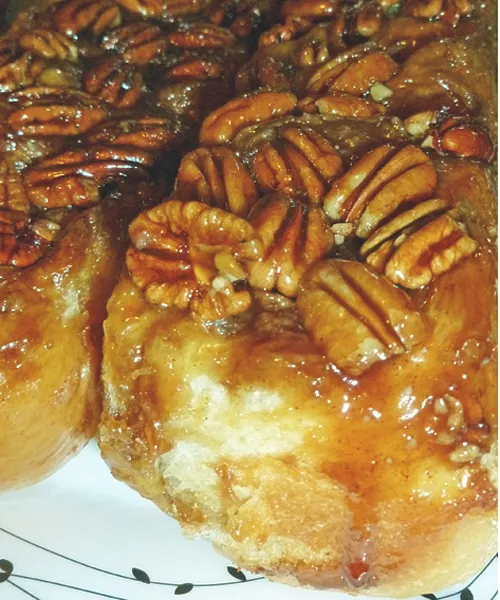
Submitted by davidg618 on June 20, 2009 - 2:28pm Old habits are hard to endWoke up this morning wanting to bake something, but also wanted a rest from building starters, poolishes, or sponges; weighing flour and water and salt and dough; and seemingly endlessly setting the timer. So I did nothing. Until, chatting with Yvonne about 11 o'clock, she mentioned sticky buns: it had been a long time since I'd made them, "distracted as you were by sourdough, and sourdough, and did I mention sourdough?" Three hours later they were...
... oven ready. and, about forty-five minutes later...
...they had cooled enough. These are from a King Arthur recipe I've been making for about ten years--a straight dough. I never turned the scale on; volume measurements all the way. Ahh-h-h-h, it was fun. Yeah, I'm learning some new habits, but they've got to be comfortable living side-by-side with old ones; they ain't gonna die. David G. Submitted by davidg618 on June 19, 2009 - 8:56am Insanity can be defined as..."doing the same thing over and over again, and expecting a different outcome." Then the counterpoint must be, "Sanity is doing the same thing over and over again, and getting the same results." If so, I'm sane! Well, maybe that's going a little too far. Nonetheless, I am delighted, so far, with my results. I repeated D. DiMuzio's pain au levain formula, and my processes, and techniques as nearly as possible on two renderings seperated by a week in time. "As nearly as possible" is the key; for example I used up all the bread flour I had on hand the first week, so the second go used a new bag, probably for a different lot, but the same brand (King Arthur).
A photo of the two bakings: The loaf in the upper left corner is week one (we ate the second, and bigger loaf). The two front loaves are this week's effort. There are slight differences in appearance--nothing significant--the biggest being the difference in crust color between the two same week loaves. After 10 minutes baking, with steam, at 480°F I turned the oven down to 450°F for the left hand loaf (the smaller one, by weight), and 440°F for the right hand loaf, which had to bake an additional 10 minutes. (I'd done the same the week before, but the crust color was more nearly the same.)
This is the crumb from the first week's loaf. We haven't cut either of this week's loaves, but by the feel of them we expect the same degree of openess. The flavor of the first week's loaves is excellent: good sour from slowly building the starter (30% of the flour weight) over 24 hours, and overnight retarded bulk proofing; the whole wheat flour lends a distinctive base note, surpirsing because it's only 10% of the flour weight; and the high initial heat, and steam, give the crust a delightful toasted nuttiness. The final test will be the taste of the second week's loaves, but we don't expect any significant difference. We entertain a lot; additionally, we live in a community that frequently comes together for potluck dinners. It's reached the point that I'm expected to serve or contribute a loaf or two of my bread, and a bottle or two of my home vinted (if that's not a verb it should be) wine. I want to be consistent, or nearly so, that's why I'm focusing, at the moment on only two formulae: DiMuzio's pain au levain, and Hitz' baguette's. Next week: Baguette's for the second time. Submitted by davidg618 on June 5, 2009 - 9:40am First Classic BaguettesHappy with my progress manipulating starters, and baking sourdough boules using D. DiMuzio's San Francisco Sourdough formula, beginning last night, and finishing this morning I let my starters rest, and tried, for the first time, to bake classic baguettes, i.e., baguettes initiated with a poolish. I was stimulated to do this by my mixed results--great flavor, ok crumb, disappointing proofing and ovenspring--baking sourdough baguettes.
For a first attempt I'm very satisfied with the results, especially the flavor. While I was setting up to photograph, I paused three times to have yet another piece with butter. The formula, and guidance came from Ciril Hitz' Baking Artisan Bread", which I followed to the letter. So I've got my baking focus, for the next couple of months centered on working with these two basic formula: DiMuzio's sourdough, and Hitz' classic baguette dough. Like the moldy, oldy directions to Carnegie Hall...practice, practice, practice. Submitted by davidg618 on June 1, 2009 - 8:30am "Adjusting" sourdough starter
Last week's result
Yesterday's result Using Daniel DiMuzio's guidance, both from his latest book "bread baking, An Artisan's Perspective", and following his posting here on TFL, I've been working with two different sourdough starters,from different sources. One contributes flavor much to our tastes for sourness, but disappointing in proofing times, and lacking in oven spring, and a second starter that has been phenomenal in yeast activity, i.e., proofing and oven spring, but dissapointing in our preferred sourness. Both starters are maintained in the refrigerator at 100% hydration. Last week, using Daniel DiMuzio's pain au levain formula with firm levain (480g ripe firm levain, 700g total flour, 68% hydration) I built my firm levain at room temperature (76°F) from the first sourdough starter with three builds, spaced approximately 8 hours apart, gradually increasing the mass three times each build, and, simutaneously, reducing its hydration by one-third each build. DiMuzio's formula calls for a pre-ferment 60% hydration, I chose to match the dough target hydration, 68%, because I wanted to keep the build as wet as possible during its ripening hopefully favoring yeast development. I visually checked its progress and fed it its scheduled builds based on observable peaks; nevertheless, the build interval was nearly eight hours each time. Expect for using all white flour, I followed Dan DiMuzio's formula exactly. I mixed the dough in my stand mixer for five minutes, allowed it to rest 30 minutes, and bulk fremented it with three stretch and folds spaced at 45 minute intervals. Doubling took approximately, three hours after the final stretch and fold. I shaped two boules (one 1-1/2 lb, one 2 lb); proofing took 2 and 1/2 hour. I baked the loave at 480°F, covered, with steam, for the first ten minutes, reduced the oven temperature to 450°F, uncovered the loaves and baked for another fifteen minutes until internal temperature was 206°-208°F. The results were very gratifying. The proof times were nominal, compared to most sourdough recipes I've read or tried, and the oven spring was adequate, attested by first photo. I didn't get a photo of the crumb; it was close but light and airy, not dense; and the flavor was delightful to our palletes. For three days immediately prior to yesterday I've been caring for a firm levain, built from the second starter (great yeast activity, disappointing sourness). Starting with 50g of seed starter, I added sufficient flour to immediately reduce its hydration to 65%, subsequently I fed it, approximately, every eight hours, maintaining its 65% hydration, ending early yeasterday morning with 480g of ripe firm levain. My goal, of course, had been to favor bacterial growth, as Dan suggests, over the extended build period. I made the dough, shaped and baked the loaves as identically as possible to the first starter test. Proof times were, as expected shorter: 2 hours, and 1 and 1/2 hours respectively. The results were equally gratifying, The levain retained its previous yeast activity, and the level of sourness we hoped for was achieved. The crumb is nearly identical (perhaps a little more open) compared to the first starter's loaves. The first two loaves are history, so I couldn't do a side by side comparison. For sourdough, I'm satisfied, for now, with the three step build (increase/decrease by thirds from seed mass and hydration) I'm using, so I don't think I'll do anything with the first starter. On the other hand, I'm considering ways to improve the second starter's bacterial contribution to flavor, but ultimately regain its maintenance hydration, and the ability to build a ripe levain in one day. I suppose the most obvious thing is repeat the three day firm levain build, and then use my twenty-four hour three-build modification back to maintenance hydration. Waiting is... Submitted by davidg618 on May 22, 2009 - 2:17pm Sourdough CiabattaMy wife and I love ciabatta, especially for soaking up soup, a handle for bruschettas, or a base for cheese. It was only natural I, obsessed with improving my bread baking skills (especially sourdoughs), would try a ciabatta.
I've been running a set of experiments trying to decide two things: 1) what hydration I should keep my SD seed starter at, and 2) is it worth the effort to do multiple builds to arrive at the formula starter I choose to use? This ciabatta was constructed with 250 gm. of 73% hydrated starter built with three intermediate stages. The initial seed starter was 10 gm. at 200% hydration. The target dough weight was 1050 gm. (three 350 gm. loaves) at 73% hydration. My tentative conclusions are: 1) the 200% Hydration favors yeast, not bacteria, development. This results in short bulk, and final proof times, and good oven spring, but nearly indiscernable sourness. (This conclusion includes the results of two previous baguette bakes.), and 2) the three build starter time is worth it. This ciabatta has a distinctive, yet still mild, sour flavor: a nice compliment to bleu cheese, or French onion soup. The crumb, is, to our needs, also near perfect. I expected an even more (undesired) dense crumb. I folded the dough more than its feel deemed necessary. However, neither I nor my wife are fans of the "more-holes-than-bread" crumb other bakers seem to strive for in ciabatta. I've developed two spreadsheets: The first helps us baker's calculate the flour and liquid for a target dough weight and target hydration, using (or not using) a SD starter, poolish, or sponge while also allowing choices re which flours ahd how much of each, as well as fluids--water isn't the only choice (i sometimes use beer). The second spread sheet calculates the required seed starter needed to create a desired starter weight and hydration, achieved with three builds--the necessary flour and water for each build is calculated also.. Each build triples the starter's beginning weight, and increases (or decreases) by one-third its hydration %. If anyone is interested, send me a message with your email address and I'll send you the spread sheets. They were built with Microsoft Excel (.xls extension.) David G. |
Advertisement |