Submitted by Floydm on November 20, 2011 - 5:24pm

Coffee with Jeff and Zoë


Jeff Hertzberg and Zoë François, the authors of Artisan Bread in Five Minutes a Day, swung through Portland a couple of weeks ago to promote their newest book, Artisan Pizza and Flatbread in Five Minutes a Day.  I was able to catch a few minutes of their time to chat about the new book.

As the title suggests, Artisan Pizza and Flatbread in Five Minutes a Day is similar to their previous books in that it centers around a high-hydration no-knead master recipe that takes only a few minutes to assemble.  Many variations of this dough are introduced, as are the appropriate sauces to accompany everything from your classic Margarita pizza to a Brussel Sprout, Pancetta, and Pecorina pizza.  Pitas, Chapati, and Turkish flatbreads are covered as well, as are gluten-free and whole wheat pizza doughs.  

Jeff and Zoë told me there are now just shy of half a million of their books in circulation and that they personally respond to around twenty emails a day from folks asking questions about their recipes.  While artisan and wood oven pizzerias have become a staple in places like Portland and San Francisco and the East Coast has a deep tradition of serious pizza, it is their impression that there are still many places where pizza as something that doesn't come out of a cardboard box is still catching on.  Particularly in these tough economic times with more folks eating at home, it is their hope that through this book they can make good pizza both affordable and accessible to as many people as possible.


Submitted by Floydm on October 23, 2011 - 12:31pm

New Releases


Many new baking books came out in late 2011.

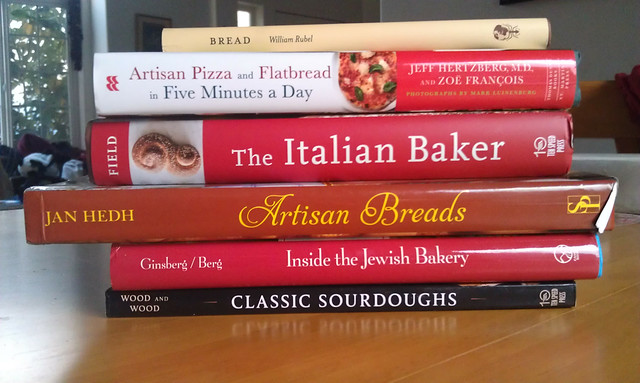
From the top:

Bread: A Global History by William Rubel

A cute 150 page history of baking, from Mesopotamia to the present. I'd put it around National Geographic magazine in terms of how entertaining and scholarly it is. Somewhere in the middle, neither too light nor total fluff. Under US there is an entry in the index for "hippie bakeries", so you know it isn't too serious.


Artisan Pizza and Flatbread in Five Minutes a Day by Jeff Hertzberg and Zoë Francois

A follow up to their previous two "in Five Minutes a Day" books which they talked about here. It includes gluten-free and whole grain recipes and is one of the top sellers on Amazon's charts already.


The Italian Baker, Revised by Carol Field.

I mentioned earlier that I heard that it was being reissued soon. Definitely a classic that deserves to be back in circulation.


Artisan Breads by Jan Hedh

Recently discussed by community members here. This looks like a quite interesting book, covering the core principles of artisan baking but also including quite a few Scandinavian recipes not as commonly found as the French and Italian bread recipes.


Inside the Jewish Bakery by Stan Ginsberg and Norm Berg.

Again, much discussion of this elsewhere on the site. The book is beautiful though, one I'm proud to have on my shelf and look forward to baking from. Congrats, Stan and Norm!


Finally, Ed and Jean Wood's Classic Sourdough was recently revised.


How to Make Bread by Emmanuel Hadjiandreou.

A lovely new book full of rich photography and a slew of information and recipes.


These should all be available in TFL Amazon Store and the   TFL Amazon.ca Store.


Submitted by raqk8 on June 23, 2011 - 9:14pm

Which book to start with??

Hi all,

I've been baking bread for a few months and am looking to get more experienced. So far I've been using the King Arthur Flour website, TFL, and various other blogs and sites for recipes and such. I bought ABin5 and tried a few recipes from there but didn't feel satisfied with the simplicity (which is nice for everyday stuff, but I like to get my hands in the dough). I feel like I'm just trying things out without starting from the beginning and building a strong knowledge base first. That being said, I do have an okay grasp on the basics and can produce some good bread, so I'm not a super-beginner.

So that brings me to my question - which bread book is the best to begin with? I am deciding between "Bread" by Hamelman or "Bread Baker's Apprentice" right now, but am open to other suggestions. As for these two, is it better to get one before the other? I would like something technical that explains why things happen as well as how, and what you can do to alter results. I want to start at the beginning of the book and bake my way through it.

Thanks so much!

Raquel


Submitted by Floydm on June 9, 2011 - 10:48pm

The Fresh Loaf Pocket Book of Bread Baking


A week ago Dorota blogged that she baked her first loaf of bread (very successfully, I might add) as a part of a yet-to-be-revealed project we're working on.  That project is an e-book for new bakers I'm putting together tentatively titled The Fresh Loaf Pocket Book of Bread Baking

Most of the content in the e-book so far is repurposed from lessons and blog entries I've posted to the site in the past, condensed and edited into a tighter format.  There is little here you can't already find on the site, but you might have to poke around and read 25 different posts and a couple of hundred comments to pull it all together. Here the posts are already filtered, sorted, and edited for you.

 I've been thinking of this as more of an e-booklet than an e-book since it is much less complete than the "real" baking books many of us already own.  Like my initial lessons on this site, I'm hoping this can provide that first successful baking gateway experience ("I really did it!  All by myself!") that leads folks to become as unhealthily obsessed with bread as most of us have become (unhealthily mentally, I mean, not physically).  At that point we can introduce them to the likes of Mr. Reinhart and Mr. Hamelman and share with them the photos of our starters (each with a name!) and all that other silly stuff only fellow bread nerds will appreciate.  

This e-book will probably not be instructive to the kinds of folks who frequent this site -- in fact, in order to not confuse new bakers like my wife I often oversimplify what we know to be quite complex processes.  Confidence building is much more the goal here than a nuanced understanding of all the factors involved in baking. 

I do intend to make more revisions, one of which is to call more attention to the TFL site at various points ("To learn more, come check out..."), but I've been trying to make it as self-contained as I possibly could without making it meandering or bloated.  That is actually quite a challenge for someone as accustomed to publishing online as I am and for whom hyperlinking is second nature.  

Some but not all of the Kindle formatting is in the manuscript currently, so if you download it be aware that there is extra white space in the PDF and the table of contents links don't all work in the Kindle file. That will come.

I would like to wrap this up and publish it to the Amazon and Barnes & Noble e-book stores in the not-too-distant future.  Price-wise, I've imagined asking no more than $5 for it, probably closer to $3.  Yes, I'd be pleased if it generated some income, but I'd be more excited to see it sell better at a lower price and make its way up the e-book charts on Amazon and thus introduce more people to bread baking (and this community) than it would at a higher price. 

 I'm interested in folks' feedback, both conceptually ("Great idea!") and in execution ("...but your writing stinks!"). If you have a chance to look at it, please email me to let me know what you think of it so far.  I'll leave these links up for the next few days then remove them some time next week when I start making further edits. 

Floyd

Download links removed 6/25/2011.

Submitted by kumitedad on January 28, 2011 - 9:52pm

How To Bake Bread: The Five Families of Bread by Michael Kalanty

Has anyone gotten this book yet?  I took a dough class from the author at the CCA and he was one of the best teacher there.  All the students loved him.  And he was always even tempered and very supportive (even when I messed up the corn breads on two straight attempts!)   Was wondering how he translated to the written page.


Submitted by Jo_Jo_ on January 16, 2011 - 2:02pm

Addicted to books....


Ok, I admit, my bookshelves are literally crammed with books, and I know that I haven't finished reading the three I got for Christmas.  Bread Baker's Apprentice, King Arthur Flour Baker's Companion, and Taste of Home Baking... all really nice books and this gives me TONS of recipes.  I am doing the BBA Challenge, so that has slowed me down from simply reading the book from cover to cover. Thing is, now that I have those books, what ones are next?  I was thinking the the whole grain one from Peter Reinhart, but I see so many other books that people are talking about that I am wondering what is the next step?  Which ones would be better for me to start with and then continue through?  For having baked bread as many years as I have, you would think that I would have a ton of them, but most of the ones I have are simply recipe books and don't even show weighing the ingredients. 

I am interested in grinding my wheat and am planning on getting a Nutrimill pretty soon, so I am trying to factor that into my choices.  Having ground some of my wheat in the past I know that it can change tried and true recipes into total disasters.  I prefer books that give me the science and explanations rather than something that simply gives me a recipe.  Don't get me wrong, recipes are good but when you have so much learning to do and nobody with the experience to teach you the art of breadmaking then reading books and forums is where you get 100% of your knowledge from. 

I have read through a lot of the reviews on TFL, and see a lot of enthusiasm for certain books, but I am still not certain what to buy next and why this one would be better than that one etc.  I am only allowing myself a few books a year now, sorta a book diet.


Submitted by Floydm on October 28, 2010 - 7:08pm

Baking books


I received a copy of Tartine Bread in the mail today and realized my baking bookshelf is now full.

(click the photo to see a higher res version on Flickr).

Um... yeah... I guess I'm going to need to start a new shelf!

Tartine Bread reminds me a lot of My Bread.  A West Coast version.  I haven't had a chance to bake from it yet but there are some interesting sounding recipes in there, like the Olive Oil Brioche that TXFarmer posted about recently.  I'm excited to check it out!

Submitted by Floydm on October 7, 2010 - 8:41pm

Biscotti


I get a lot of books from publisher, most of which I don't post about, but I received one today that I really like. 

Biscotti: Recipes from the Kitchen of The American Academy in Rome, The Rome Sustainable Food Project comes out in a week or so.  It is a little book but contains a really nice selection of cookie, biscotti, and meringhe recipes.  There are a nice range of recipes, everything from basic sugar cookies to fava bean cookies, and while a few require ingredients that I don't keep around the house (fava beans, pine nuts), none of them that I've looked at strike me as terribly complex or inaccessible.

What else.  The photography and typography are nice, the paper feels nice, it is just... a really lovely little book, one that feels more expensive than the thirteen bucks you can pick it up for right now. It'd make a nice, inexpensive gift for anyone you know who likes to cook and bake but hasn't yet caught the bread bug. 

I've not baked any of the recipes from it yet, but I shall soon.

Submitted by Elagins on September 23, 2010 - 9:35pm

NYB Bakebook Chronicles


Baker Ben suggested that since the testing is over and we had such a great group come together, that I continue to blog about the actual process we'll be going through to actually get the book into print.  I think it's a great idea, so, with thanks to Ben, here goes:

July and August were simply insane.  I was putting out a couple of dozen recipes each month, keeping track of all the testing and feedback and trying to get all of the other stuff written.  It was madness, to the point where everything else on my to-do lists (several) simply had to be pushed aside so that I could get the manuscript done by the 9/1 deadline.  

Norm and I were on the phone at least weekly -- usually more often than that -- going over recipes, fine points and all of the background stuff that needed to be included in the book we wanted to write.  If I tell you all that I got very little sleep over the last couple of weeks, it wouldn't be an exaggeration.

Those last 2-3 weeks are a blur now, writing, researching, fine-tuning, making sure all of the measurements and conversions were right, all of the steps and procedures consistent and all of the narrative smooth and where it was supposed to be.  

9/1 came around and I had about 99% done ... everything except for the Acknowledgements, Picture Credits (since we hadn't yet made final picture choices), and a couple of last-minute recipe tweaks.  Nonetheless, I assembled what we had -- about 280 pages, including somewhere around 130 recipes -- and emailed it off to our publisher and our agent.  

So of course the publisher said, "Well, no rush.  Just put everything together, print it all out, burn the files into a CD and send it off to me when you can."  When I met with him back East the beginning of July, he didn't seem like he was terribly concerned about deadlines, but I like to honor my commitments.  

So Norm and I went back at it, doing illustrations of the challah braiding, strudel dough stretching, and a couple of other recipes, including the rye flour honey cake (lekach) and revised plum cake (flomenkuchen). I figured I'd take a couple of weeks to make sure we got it all in shape. So naturally, less than a week later, I get an email from Edward (the publisher) asking, "When will we get the package?" Shift into high gear, put the final touches on it.

At that point, my laptop died.  I mean really died: motherboard, display, keypad, who knows what else?  Of course, I'd been backing up to spare hard drives, pen drives and whatever, so I had three or four backups and didn't lose a thing.  Switched to an old Dell that we had lying around ... slow as honey on a cold day ... got the manuscript all put together and start printing .... now at 260 pages, after some cuts and consolidations.  

Print, print, print.  At page 243, my printer dies <sigh>, so I load the finished file into a pen drive, take it downstairs and finish on my wife's printer.  That's Monday morning a week ago (9/12).  Then I discover that the old Dell's CD drive can only read; it doesn't burn.  Back downstairs to burn the CD on Syl's puter.  Pack it all up into a FedEx box and drive it down to the local Kinko's/FedEx office. 

A week earlier, I had asked our agent, Stephany, about typical production schedules and she said, "Be patient.  It usually takes a publisher 9-12 months to get a book into print." Nine months to a year ... feels like an eternity.

At that point, I had such mixed feelings ... so much intense work, suddenly ground to a halt, all this energy with no place to go and exhaustion suddenly setting in.  For two days, I could barely think.  But at the same time, I felt the same way I did when I took my kids to their first day of kindergarten:  proud, full of anticipation, a little bit afraid that they wouldn't do well and also sad that in an instant I was no longer as needed as I'd been the day before.  Norm and I spent a lot of time on the phone, talking about the closure of that part of the process, which he said was less real for him, since he wasn't involved in any of the writing.  

It was strange, the sense of loss finishing the book created -- first the dissolution of our tester group, which had brought together well over 100 people and created a very intimate bond of shared experience, and then the departure of my youngest child (the book). 

I waited until today (9/23) to phone Edward to find out how things were going with the book and whether he could give me more information on the production schedule, other next steps and how much more work would be needed.  Instead I got Brad, the head editor, a very kindly man who clearly loves books.  "It looks very good," he said.  "We just need to get it to copy editing and then we'll have a better idea of what else needs to be done, but I don't think it will be very much."

Then I asked the question I really wanted answered:  "Any idea of the publication date?"

"We want to get it out before summer ... probably in the March-April timeframe.  We want this book to look terrific, so we're choosing our designer carefully."

March-April! Six or seven months!  Wow!  .... Other things to think about now ... promotion and finishing up all the remaining tweaks and revisions (there are still a few), getting all of the photo permissions in place ... 

We've entered a new level of reality.

Stan Ginsberg
www.nybakers.com

(to be continued)

Submitted by HokeyPokey on July 24, 2010 - 5:39am

Peter Reinhart Whole Grain Bread Recipes - too wet and too sweet

I live in the UK, and purchased a copy of Peter Reinhart's Whole Grain recipes book as soon as it came out on sale. I was really looking forward to his book, and trying out complex, wholegrain flavour breads.

However, every recipe i have tried so far has came out too sweet, and my biga and poolish always come out too wet, much wetter than the consistency in his pictures.

Has anyone else had a similar problem with Peter's recipes? Am I doing something wrong?


HP