
George Greenstein's “Secrets of a Jewish Baker” is a wonderful source for traditional New York-style Jewish baked goods. It has been criticized for giving ingredients in volume measurements only, though. I have previously provided Greenstein's formula for Jewish Sour Rye with ingredient weights, but I realized today that I had never done this for another of my favorite Greenstein breads – Pumpernickel. So, here is Greenstein's pumpernickel formula converted to weights.
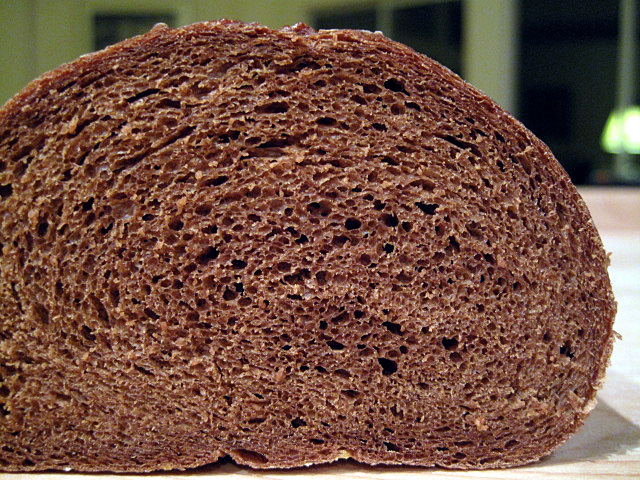
This is Jewish pumpernickel. It is moist and chewy. It is not the dry, dense German-style pumpernickel. I make it generally as long loaves, as pictured. However, you can also make it as round loaves, in which case you should "dock" the loaves by making 6-10 holes in the top with a skewer or ice pick, rather than scoring them across with 3 slashes. You can also make this bread in loaf pans, in which case I would score them with a single slash along the center of the long axis.

The recipe that follows is taken from Secrets of a Jewish Baker, by George Greenstein. The ingredient amounts are both those Greenstein specifies and the ingredient weights I actually used. The procedures are adapted from Greenstein's.
|
Ingredients |
Volume (per Greenstein) |
Amount (per dmsnyder) |
|
Warm water |
1 cup |
240 gms |
|
Yeast |
1 pkg active dry |
7.5 gms instant |
|
Rye sour |
1 cup |
250 gms |
|
Altus (optional) |
1 cup |
1 cup |
|
Pumpernickel color |
4 tablespoons |
1 tablespoon caramel color |
|
Common (First Clear) flour |
2 ½ to 3 ½ cups |
350-400 gms |
|
Pumpernickel flour |
1 cup |
115 gms |
|
Salt |
1 tablespoon |
8 gms |
|
Caraway seeds (optional) |
1 tablespoon |
Not used |
|
Cornstarch solution |
(see below) |
|
Notes on ingredients:
1. Rye sour: This is a rye sourdough starter. You can make it from scratch. You also can easily convert a wheat flour sourdough starter to a rye sour by feeding a small amount of your existing starter with rye flour and refreshing it a couple of times.
2. Altus: This is “old” rye bread cut into small pieces, soaked in water until saturated and wrung out. It was originally a way for bakers to re-use bread they hadn’t sold. "Waste not. Want not." However, it does make for a more tender and flavorful bread and has become traditional. It is optional. I keep hunks of leftover rye bread in a plastic bag in my freezer to use as altus.
3. Pumpernickel color: This is really optional but is necessary to give the "black" color expected of pumpernickel. It also gives the bread a subtle bitter undertone without which it just doesn't taste "right." You can use 1 tablespoon of powdered caramel color, instant espresso cof fee or cocoa powder. I use powdered caramel coloring from King Arthur’s Baker’s Catalogue.
4. Pumpernickel flour: This is whole grain, coarsely ground rye flour. You can use dark rye flour, but it won’t be quite the same. I get pumpernickel flour from King Arthur’s Baker’s Catalogue. Like other whole grains, it will spoil in time. I keep it in my freezer in a 1 gallon Ziploc bag.
5. Common flour: This is also known as first clear flour. Its definition gets into esoteric grain milling stuff, but it is necessary for authentic Jewish rye breads, including pumpernickel. It also makes wonderful sourdough breads as a substitute for bread flour or a mix of white and whole wheat flours. I get First Clear flour from King Arthur’s Baker’s Catalogue.
6. Cornstarch solution: Mix 1 ½ tablespoons of cornstarch in 1/4 cup cold water. Pour this into 1 cup of gently boiling water in a sauce pan, whisking constantly. Boil until slightly thickened. Set aside. It can be kept refrigerated for a few days in a sealed jar or covered bowl.
7. Caraway seeds: I don’t use them in pumpernickel, myself. You can add other things to pumpernickel, though, such as flax seeds (soaked overnight), sunflower seeds, raisins, minced onion.
Procedures
Mixing (by hand. See Note below for mixing with a stand mixer.)
In a large bowl, sprinkle the yeast over the warm water to soften; stir to dissolve. (If using instant yeast, mix it with the flour, don’t dissolve it. Add the water to the rye sour and mix.) Add the rye sour, altus (if desired), pumpernickel color, pumpernickel flour, 2 ½ cups of common flour, and salt. Mix thoroughly until the dough pulls away from the sides of the bowl.
Turn out the dough onto a floured work surface and knead, adding small amounts of flour as needed. Make the dough a bit stiffer than normal, since this dough softens as it is kneaded. Knead the dough until it feels smooth and silky (5-8 minutes).
Note: I mix in a KitchenAid mixer. I put all the ingredients in the bowl and, using the paddle, mix well at Speed 1. Scrape the dough off the paddle and replace it with the dough hook. Knead at Speed 2 for about 8-10 minutes. If you do not use altus, the dough should form a ball on the hook and clean the sides of the bowl. With altus, even when an additional 50 gms of flour is added, the dough does not clean the bowl. I then hand knead until the dough is smooth and silky.
Fermenting
Shape the dough into a ball, place in a large oiled bowl, and turn to coat. Cover and let rise until doubled in size.
Shaping & Proofing
Punch out all the air, cut in half and shape into rounds, and let rest for 10 minutes.
Shape into round loaves, long loaves or pan loaves. If baking free form, place the two loaves on a baking sheet sprinkled with coarse cornmeal. (Or on parchment paper if baking on a stone, which I prefer.) Cover and proof until doubled in size. (About 90 minutes, or more depending on room temperature). Brush with cornstarch solution. Score the loaves across if long dock them if round. If using caraway, sprinkle seeds on the top of the loaves.
Baking
Bake with steam in a preheated 375F oven until tapping the bottom of the loaf produces a hollow sound (30-45 minutes). The internal temperature should be at least 190F. If the crust seems soft, bake 5-10 minutes more. (The crust should be very firm when you take the loaves out of the oven. It will soften as the bread cools.)
Note: I use a pizza stone for baking free form loaves. I heat it at least 1 hour before baking. I produce steam by preheating a cast iron skillet filled with lava rocks in the oven along with the stone and, right after putting my loaves in, pouring 1 cup of boiling water into the skillet. Be careful you don’t scald yourself with the steam!
Cooling
After baking, place on a rack to cool and brush again with the cornstarch solution. Let cool thoroughly before slicing and eating.
This type of pumpernickel is one of the breads we always had in the house when I was a child. I usually ate it un-toasted, spread with cream cheese. My grandmother ate it spread with sourcream. I think this pumpernickel is especially good with smoked fish or herring, and it is my favorite bread to eat with scrambled eggs.
Unfortunately, my wife isn't as fond of pumpernickel as I am, so I also made one of her favorites – the Cinnamon-Raisin-Walnut Bread from BBA.


David
Submitted to Yeastspotting
- dmsnyder's Blog
- Log in or register to post comments
hmm looks yummi, david! I am especially impressed by the Raisin Cinnamon Walnut bread, the cut looks very light and nice and with a perfect swirl. my one single try wasn't very encouraging . . . ;) Because of that it's not on my to do list again.
The Pumpernickel looks very nice, but as you pointed it out, this is not a German Pumpernickel. I've never had a New York Style Pumpernickel (Germany is just somewhat closer), but your pumpernickel looks like a nice Rye bread to me.
Salome
The raisin bread is worth trying again. It is very nice. What didn't work well for you when you made it?
The pumpernickel has a relatively low proportion of rye, and the flavor is unique - not strongly rye-flavored but not like other breads I make with similar proportions of rye and wheat flours. The rye used is white rye, which probably accounts for the lack of rye flavor, and the other light ryes I make have caraway, which is a strong flavor. Certainly the crumb is like that of a 40% rye, though.
David
It was somewhat dense and dry. Probably all my fault (overbaked, substituted with some white whole wheat . . . ) but I just don't really feel like baking it again. Probably because of my bad results. I might try my Swedish hostmother's Cinnamon buns again, these "kanelbullar" were always great.
Exemplary David as always!
David
Very nice write-up! Those loaves are certainly worth the effort that went into baking them in this heat! Are you baking in your T-shirt and shorts? It's hot here and still I turn on my oven! I may try some night baking!
Sylvia
Shorts and aloha shirt, as it happens. It was still hot.
David
that beautiful pumpernickel. David, I'm curious why you recommend docking a boule, but slashing the loaf. Couldn't the boule be slashed also?
I still have BBA Cinnamon Walnut on my to do list..I can smell yours..mmmmmm!
Betty
Liverwurst! I haven't had that in years! I used to get a very mild liverwurst with pistachios in it, which I loved, at a butcher/sausage maker on SE Woodstock in Portland. Hmmm ... That was 45 years ago.
Anyway, it would have been great on this pumpernickel. I agree.
I recommended docking round loaves of pumpernickel only because that's what Greenstein says to do.
David
Would that have been Otto's? My husband took me there for the first time this summer. We sampled lots of goodies. We brought home liverwurst and some great sausages.
Betty
Hi, Betty.
Well, I don't really remember the name of the place, but it was located very close to where Otto's is now, if it's not the same place, in fact.
David
Those look excellent! Secrets of a Jewish Baker is possibly my favorite bread book. I've made a lot of the breads, and they're all great.
Greg
David
Beautiful as always, David, and thanks for both your weight conversions and excellent notes. I didn't know that that there was a word for that old bread soaker. What is the hydration of your rye sour?
I have to confess that I feed the rye sour by volume. I mix about a cup of sour with 1/2 cup of water and 1 cup of rye flour. Then I sprinkle another 1/4 cup or so of rye flour over the paste to keep it from drying out. I generally go through a couple more feedings of the entire sour, adding those quantities of water and flour each time, to build it up to the quantity I need.
This is basically Greenstein's method. I blogged on this a year or more ago. See:
http://www.thefreshloaf.com/node/4796/greenstein039s-sourdough-rye-rye-sour-care-and-feeding-illustrated
David
Hi David,
I would like to make this pumpernickel bread that I ate in my childhood as well as later in Israel.
Here in Sydney I can found only a very dark and moist pumpernickel made in Holland, and it it is not a real bread as the crumb is wet.
To use your recipe I have 2 major problems : the pumpernickel flour ! where can I fin that here !!! I will try organic shops and health shops, but if I cannot put my hand on it can it be replace by something else ? I can find the Dark rye flour ( which I usually don't use ) but I never saw any coarsly ground rye flour, the second problem is the common flour ! again if I cannot find that is it possible to use something else ? I know the risk to sustitue can change the final result but it might be worth to try ?
In hope ! Bee
Hi, Bee.
If you have a grain mill and access to rye berries, you could try grinding your own pumpernickel flour. Otherwise, I would just use dark rye. You will loose something in texture, but the flavor should be the same.
If you cannot get first clear/common flour, I would substitute a strong ("bread") flour. You might try adding a bit of coarsely ground whole meal flour, as an experiment.
What is essential, really, is the use of a rye sour. Although some are snooty about adding coloring, I find that using caramel color adds a subtle bitter flavor that makes this identical in flavor to the Jewish pumpernickel I ate as a child.
Good luck with your pumpernickel! Let us know what you do and how it turns out.
David
Me again..
I found on the web an australian organic kibbled rye which not seem to be a flour but cracked rye, and a rye coarse meal flour that might be between this and that. It's difficult to see on the photo... as for commomn flour the result is : white or wholemeal flour....
I might be able to use the kibbled rye and transform it to a flour by grinding it, but I still stay with the common flour question.
You seem to have a greater choice of flours in the US, and I envy you with this King Arthur company which seems to answer to any of your desire.... If I was in France I suppose that I would have been even more lucky than you there, but here I found difficult to find the right products.
Bee
Hi Bee,
The kibbled grain should work as chops, or cracked grain...just about; it's nearer to a wholegrain if I'm not wrong. The rye meal should be an equivalent of what you are looking for. I've never used pumpernickel flour, but I'm sure David can provide a little more information on that.
Best wishes
Andy
Thank David and Andy,
The organic site I found earlier sell all the possibilities, berries kibbled and coarse meal. I will use the last one as it will simplify my work. as for the common bread I'll use the strong bread flour David advices.
Hope to be able to do it in a couple of weeks after I'll get the Rye flour, and let you know the results. Unfortunately I don't know to use TFL to up load photos that I have in my Picassa file or in My Pictures file (from my documents and setting) and I also don't know how to use TFL other than reply to articles. But if you can give me an email address I can send the photos to you.
Anyway I will probably make the pumpernickel bread before the challah. Do you have the recipe David618 used for the challah ?
Bee
Hi, Bee.
Read the Posting Photos FAQ
If you have more questions about this, ask them.
If you want Challah recipes, most bread books have at least one. For the "ultimate" challah recipe collection, see Maggie Glezer's "A Blessing of Bread." It has some 40 recipes from many countries.
I don't have the book from which David618 got his recipe, but he sure made a gorgeous challah.
David
Hi Bee,
Best way to post photos is to use flickr.
If you send me an e-mail through TFL I'll give you some help on that.
It's very easy.
Regarding Chollah; please check out my post here: http://www.thefreshloaf.com/node/15230/ananda039s-blog
It's a great recipe, and very easy; deserves more traffic than it has had.
Best wishes
Andy
Hi David,
I had some difficulties to get the kibbled rye but I found it in grain and ground it by myself... It's now a a very coarse ingredient/flour. I'm refreshing my Rye SD and tomorrow morning I want to make it. But I can wait and do it in the evening depend of your reply.
I found an advice from the Milling Co. to soak one cup of KB.Rye in one cup of hot water for the night with molasse, before mixing it with the other ingredients. Is it really necessary ? It will change the quantity of water to use.
Can I use molasse or malted barley extract in form of syrop, which I have in my pantry, instead of the caramel color or the pumpernickel color that I didn't find here.
Bea
Hi Bea,
Soaking would be beneficial for sure. This is how to avoid changing your formula:
Weigh the kibbled wheat and molasses prior to soaking. Then when you pour off the water from the soaker, weigh the grains. The difference between the 2 figures is the amount of water the kibbled wheat has taken up. If you subtract that figure from the water addition in your final dough, your formula will once again balance! Magic hey!
Best wishes
Andy
Thanks Andy,
Your reply arrived just in time for me to go on, before I'm going to bed !
I weighted the kibbled and the molasse and added the same weight of water.
It seems that I should put more water as it look like a wet mash, otherwise tomorrow morning I will not have any water to retry from the bowl....
Thank again for your help. I hope my first pumpernickel try will be ok.I will use only half of the proportions given in the recipe. I weight everything, the cup system is not precise. I weight each ingredient to the exact grm included water and salt. In the recipe David said that if the dough is too sticky you should add flour, but he don't say which one : the common or the pumpernickel. It is a bit confusing.
As my oven is not very good I bake only in a cast iron covered pot . Usually I don't warm the oven before I put the pot with my Rye bread, in this case do you think I should ?
I still have time until the baking, but I like to know what I'm doing from a to z.
Bea
Hi Bea,
Go with the soaker as it is.
You've done everything right if you have weighed water, grain and molasses.
just be sure to calculate how much liquid your grain has taken up when you come to use it.
I would imagine David would encourage you to use as little flour as possible, given he is very careful putting his formulae together...but perhaps that's one for the original author?
Regarding baking, maybe you could post back with some more detail. As most of my baking experience comes from dealing with heat retaining monsters of the brick and wood-fired variety, or the lovely deck ovens with steam, I'm not sure I'm the best person to help you here. Mini oven will doubtless be able to offer wisdom; maybe David or Eric? Just a thought. But I'll try later if you give me some more info.
I'm sure you'll be fine, but good luck anyway
Andy
Hi, Bea.
If I have to add flour, I generally add the common flour. Most of the rye is in the sour, and there are advantages to using mostly pre-fermented rye for flavor and texture.
But note that the amount of flour I add, if any, is very small - 1-2 tablespoons. We're talking about very fine tuning. The dough should remain sticky. Don't try to make a dry dough.
Also note that, even though I mix the dough by machine, I usually give it a stretch and fold on the board with a light sprinkling of flour before putting the dough in the bowl for bulk fermentation. This really helps gluten development and reduces stickiness.
I don't bake pumpernickel covered. I'm interested in the results you get.
David
Hi David, and Andy
The bad news was that I get up sick this morning, I could feel it coming the last days but today was the day! The kibbled rye was ready (triple it size with the soaking) and the starter Rye SD was also ready. My partner Egon didn't want me to do anything and sent me back to bed!
He took the recipe and put everything in his bread machine, as I had wrote the 1/2 quantities needed he had no problem to go through. He just added 25gr of flour.
The bread a small rectangle of a dark gold honey color is on the table cooling.
For me it's a flop that I could not do it by myself. But I will as soon as I will feel better. I don't know how it is inside but from the hole that left the "knife" of the machine I can see that it look like bread... it's not a block of concret...
I have already adobe photo, picasa and microsoft photos.. on my computer to add flicker which is not a free download seem to me exaggurated. so my photos will stayed with me. it's not a big loss for you because there is nothing as beautiful as you are doing. And the last one really don't deserve a photo ! it's a normal square little block of bread!
I use the dutch oven method because the old electric oven I have in this kitchen burn everything on the back and no matter how I put the bread it's always happening. So it's now 6 months that I use the dutch oven method. Until now I don't complain. No more burned bread. It's make the baking of baguettes or normal bread straight on the brick or on the shelf very difficult.
Thank you for all your tips. I will bake another one next week with the whole quantities of the recipe. It look more difficult on the paper than it is when you do it. In the bread book of the Bread Machine it's called Russian dark bread... and the recipe is very close to yours, but no Rye SD there, and cocoa and molasses to get the color.
Bea
David
Hope you get well soon. You don't need flicker to post pictures here. You use the little picture on the toolbar when you are posting a message. It looks like a tree. I think there is an FAQ that you can find if you search for it. Send a message to FloydDM and he will help you.
Hope you're feeling better soo. I wouldn't recommend a rye bread without the sourdough starter. It's pretty important to the whole process.
Using the dutch oven is a great way to deal with a less then perfect oven! Also, try adding a big brick to your oven. I'm using an RV oven and have a giant stepping stone on the bottom of it to get it to cook evenly. You'll find lots of tips on this forum to help you with your cooking.
Get well soon!
Hi Doc Tracy,
thanks for your advice. I'm about to try and post photos as you advice me, I also found the way to reach Flickr through the link Anada sent to me. I was just on the wrong link all the time...
I can put the bricks back in my oven but it takes a long pre heated time which cost a lot of electricity... My cast iron pot is very heavy and I put it with a cold oven hoping that the bread will get a better raise while baking this way. As my bread are never very high, this way or the other I don't know what is the reason; is it my way to prepare it or the quantities of Rye flour or my SD (which is really looking good bubbling right and smelling the acidic smell I expect) As I have nobody close to me to be able to compare I'm still going my own way. The result is not big bread but very tasty. My partner eat this bread as it was instead a piece of cake. So what can I hope more than such a compliment !
Hope you will soon see sopme of my photos!
Bea
Thanks David for your health greetings. Hope it won't take too long, also it's not a one day cold and the Dr. was a bit pessimistic which I hate to say.
Anyway Egon is taking care of me and let me sleep few hours this afternoon. Then he teased me about the bread telling that the machine had beaten me... the bread is really good although very small due to the quantities I had preview, and it's because of the machine... I should stop to mess around and dirty my hand up to my elbows obstructing the fridge for the night with the dough.... etc.... I could not said a word until I have a piece of it! it was really good. Better than my usual rye bread. Never the less I don't think I will use the machine as the making of the bread is a kind of therapy. It take my mind to other territories and keep me alert and interesting in reading TFL and participating to this wonderful social circle.
Bea
Hi Bea,
Hope you get well soon.
I've just set 2 x 75% Rye sourdough loaves for final proof.
They are both in tins; although not the odd-shaped things you get with a bread-maker. I'll try and post on them next week, as I'm making the Miche Pointe a Calliere tomorrow. Both these are part of the JH Bread Challenge.
I like to make the rye breads in tins; we like using it for sandwiches. That said, this was a beautiful recipe, and I reckon it would have proved even in a banneton. Another time.
This is the link to the flickr page: http://www.flickr.com/
If you click on "create an account" and follow the steps, there really should be no charge. I am just wondering if you may need a Yahoo account to register? I have one of these as my Internet provider gives that as part of the service. But, if you do, surely you can sign up to a free Yahoo account, then create a flickr account. I'm only thinking, if you do want to post photos on your blog, it couldn't be easier once you have created a flickr account, then learnt how to upload photos there. Just to clarify, flickr is a site which hosts photos and videos, allowing you to upload directly to sites like TFL. This is not the same as the Adobe, etc software you are talking about, which is editing tools if I'm not wrong.
A cautionary word about the Black Bread you want to make Bea. You may be aware of this, I don't know? The reasons why rye breads are associated with sourdough are numerous. Two fundamental ones concern:
a] a high acidity in the dough is a useful preservative to combat the dangers of rapid mould growth in a loaf with such a high moisture content.
b] the structure of rye paste is knitted together by the pentosans, which is the fiberous matter knitting the starch together. This is one reason why rye needs so much water. Towards the end of proof, these pentosans become very unstable, and this can easily lead to collapse in the oven. High acid content from the sourdough again helps to maintain the strength of the structure from the pentosans.
Just a little something you may want to think about before you try a non sourdough rye.
Best wishes
Andy
ps.The offer of support on photo uploading still stands.
Hi Andy,
Thank you so much for your help with the photos. I got the link all right and yes it is linked to yahoo where I have an account. But I think I find the way to up load straight from my files thanks to Doc. and I will try later. I need to try this way or the other! it might turn a bit funny and I don't care if you laugh, on the opposite.
I have absolutely no intention to do any bread without SD! I was just curious to see a pumpernickel recipe in the Machine Book to ensure that Egon could use the machine with my recipe and when I could not find it in the index I went recipe by recipe until I found this dark russian bread, which after all had nothing to do with the Pumpernickel I was after. It is make with no SD, Rye flour, cocoa, molasses coffee instant grains, dry yeast wholemeal and water. This not at all the way I want to do my bread.
Anyway the bread made in the machine with my instructions and the soaked kibbled rye turn absolutely delicious ! but was very small and it took no time at all to disappear into our mouths! I think that I will, from now on, stick to this recipe instead of my usual Rye Bread ! I will also put again the bricks into the oven even using the dutch oven way to bake and see if there is a difference. What stop me to do it is the long warming before the baking which cost a lot of electricity.
The interesting thing here for me, is that Egon is baking every 48 hours a Rye bread in his machine, bread which he enrich with all sort of pepitas and other grains but he use the ready mix flour which containt some dry sourdough. He is doing that to have a bread that give him a good size sandwiches, and eat my bread as a treat like you would eat a piece of cake ... For me it's very rewarding that my bread is considered as a piece of cake!
I now will try to transfer photos on TFL.
Bea
To andy or/and Doc tracy,
I managed to upload few photos on flicker -somehow it could not upload in once all the photos I ask it to do-but from there I'm swimming in the dark. After I clicked on the green tree I went nowhere until I type the number of 4 photos in the window saying URL photos.......and this has nothing to do with flickr, it come straight from my documents and settings/mypictures!
That is what I managed to do I don't know if the pictures will appear!!!
if you can see the photos they are from the last 6 months, the batards were my last try before I began to bake in the Dutch oven way.
It all based on SD Rye. I never got a very high oven spring but I reckon it's because rye flour is not one give the bread to rise strongly. If I want a bigger loaf I just increase the quantity I put in my bowl...
I don't take any photo the last 3 months... I gave up. I bake the bread an we eat it ! But if the photos can appear on the tfl I might come back to my camera...
I wait to know if you can see the photos.
I feel better, but I'm not out of this bloody virus... Bea
Hi Bea,
Try this. Select the photo on your flickr site to upload.
The photo will come up on screen with a no. of icons above it. Select "All sizes"
Then the photo will come up again with the size options above it. Choose "Small size". Then when the small size comes up, scroll down the page a little. Look for Option 2. Grab the photo's URL. Highlight this and right click on it.
Then go back to the blog entry you are creating and the point where you want to insert the photo. Click on the tree icon. Right click on the box next to "Image URL" and select the "paste" option. The URL file path will then come up. Then simply select "Insert" in the bottom left hand corner. You photo should then appear as you want it to. Good luck, and shout me back if you need to
Andy
Thanks Andy I got it but I can transfer only one by one. so this is the first one
bake in a cast iron pot it's a simple rye bread, the next one will be the crumb
this is also a rye bread one of the last I baked uncovered, as you can see the burned edges...I find the baking into a pot keeping my bread from burning accidents... and I'm sticking to this method
I have many more photos but I thought that those were desmontrating enough. It's not the professional looking of David, Eric or yours but it's not too bad.
Again thank you so much to have dimystified for me the use of the photo system !
Bea
Hey, great stuff Bea!
Yes, you can only upload one photo at a time.
I look forward to you posting your own blogs with photos of your products in the future.
Well done for working through the uploading methods
Best wishes
Andy
Now it's not only talking about baking my own bread, there is the proof!
Thanks again for your patience andy. yes now that I know how to insert a photo I will attack the new challenge for me : not only to mail a reply or a comment but to blog my own stuff if there is anything to show off...
I have keep in mind your remark about baking pumpernickel in tin. I suppose it's because it's a sticky dough and it will get loose without a form. But David posted the photos of his pumpernickel and it's looked like his dough was stiff enough... As my oven is not that good, I will try in tin and in the pot. A new oven is not on the agenda and I will have to restrain myself to try and bake baguettes !
Bea
If you follow Greenstein's recipe, the loaves are easy to form. I generally proof this bread on parchment paper used as a couche. The side of the loaves are supported with rolled up kitchen towels outside the parchment.
The parchement is transferred to a peedl and, from there, to a pre-heated baking stone.
Note that this is not "German-style" pumpernickel, but a very different bread.
David
If you bulk fermented the dough for 10 hours at 72 dF, I would expect it to be over-fermented. It should feel very gassy if you pat it or poke it gently. That's assuming everything else is as it should be.
Regarding your sour: So you fed it Tuesday. I assume you let it fully ripen before using it for the pumpernickel. If you used it immediately after feeding it, that might be your problem.
I can't answer "is there any way to fix it" without knowing what the problem is. I suppose the surest "fix" would be to start over, feeding your rye starter. Have you seen my blog on "the care and feeding" of a rye sour?"
David
Hi David,
I'm a newbie here on TFL - though I've been baking sweets forever, I've only started baking breads in the past 3-4 months. I live in NYC, within walking distance of Zabar's, Orwasher's and a slew of other great sources for fabulous bread, but I get a real kick out of keeping my sourdough starter healthy and trying some of the gorgeous breads on this site. I've found a successful way to make the Jewish Heavy Sour Rye using your post, but with the advice from Norm about using 100% rye sour and proofing in a wooden box. It's fantastic.
I have 2 questions for you - I want to make this pumpernickel bread with raisins added. When should I add in the raisins? After the bulk fermentation, just before dividing? Or at the end of the mix? I don't have a mixer - I mix/knead by hand. My other question is: I don't have pumpernickel flour, so should I use dark rye flour? Or I have some rye berries which I could grind in a food processor to a coarse meal.
Many thanks,
Cherie
Hi, Cherie.
Welcome to TFL!
Solid ingredients like raisins and nuts are usually added to the dough at the end of a machine mix. So, for example, you might mix a dough on Speed 2 for 5 minutes, then stop the mixer, add the solids and mix at Speed 1 (Not faster!) for a couple minutes to distribute the solids.
Another method for hand mixed dough, is to knead the dough until gluten is developed, then stretch it into a rectangle, spread the solids over the dough and fold it over. Then knead a bit more or do some stretch and folds to distribute the solids.
Regarding Pumpernickel substitutes: You could use "dark rye," as long as it is really whole grain and not first clear rye. I don't know about using a food processor. This would probably produce "rye chops," rather than a coarse meal. I would also worry about over-heating the grain, but I have no experience with this. Maybe if you post the question as a new topic, some one who has used a food processor to make rye meal will share his/her experience.
David
for your quick response! I'll try using the whole grain dark rye flour from Arrowhead Mills as that's what I have on hand.
Thanks for your instructions regarding hand-kneading the raisins into the dough.
I have learned so much from TFL!!! What a wonderful discovery. Thanks for all your great recipe posts and easy-to-follow directions. My "to bake"list is a mile long and my family is really enjoying the results.
cheers!
Cherie
David
Cheers,
Cherie
Your loaves look good. From your description of them sagging when scored and not having any oven spring, I would say they were over-proofed a little. Watching the dough not the clock is the right approach. You just need to recalibrate your poke test finger. ;-)
I use caramel powder to give the dark color. I don't think the coarseness of the rye grind makes a bit of difference in the color.
So, did your pumpernickel taste right to you?
David
I'd say close, but no cigar (my family would disagree, they loved it and finished off one of the loaves with dinner). Next time, besides poking sooner, I'd like to try for a more assertive rye flavor. I'm hoping the pumpernickel grind will help with that, plus building up the rye sour with dark rye for one build. And I will have to try the caramel color, as I am wishing for a dark, almost ebony look and a bitter note would be good with the sweetness from the raisins I think. Thanks for your help and for posting the recipe.
cheers,
Cherie
PS - Your hazelnut cherry loaves are inspirational!
I have been looking for a delicious pumpernickel raisin bread recipe. The closest bakery that makes it near me is from Rockland Bakery.
Any suggestions on where to get the pumpernickel flour? I only know of ordering it from King Arthur flour. Are there any other suppliers?
Besides KAF, the only source I know of is nybakers.com. I have never seen it in a grocery store. I'd bet there are other mills that produce it, and there may be some in your locale. I would ask at a local bakery to see their wholesaler's product list and ask if the bakery could order some pumpernickel flour for you. You did want a pallet of 50 lb sacks, didn't you? ;-)
David
Hi David! I've made your Jewish Sour Rye recipe with great results (although I admit I made a tweak or two because I can't help myself). I thought I'd try this recipe. using the sour...I have some KA pumpernickel flour on the way today but I don't have caramel color so thought a couple tablespoons of molasses might do the trick. Thoughts?
TIA,
Wendy
Hi, Wendy.
Caramel Coloring produces the black color. It gives a subtle bitter flavor. Molasses would give sweetness. I wouldn't do it. If you have some instant espresso, that would be a better alternative. There is a third option that I can't recall at the moment.
Two more options are 1) Just leave out the Caramel Coloring. The color would be different, but the difference in flavor would be minimal, I think. 2) You can make your own Caramel Coloring. It's just almost burned sugar. You can find recipes. If you can't, I have one somewhere.
David
I hear what you're saying and I'm going to experiment and report back. I'm hoping that the sour might balance the sweetness in the molasses....and that's the black strap kind I'm thinking of using...I can't help myself..I have to tinker. The worst that can happen is I have more food for the birds!! They love my mistakes.
I tinkered with the Jewish Rye recipe you provided and it came out as one of the best ryes I made so far but your recipe was the guide. The sour smells like a brewery and is very lively. I added in some WW and potato flour and virtually eliminated the first clear mainly because I ran out and used KA bread flour but the flavor from the sour is exactly what I wanted. I'm searching for a specific texture and will increase both of those slightly and report on my results and the opinions of my panel of independent taste testers...LOL We certainly can't eat all the bread I produce so the panel usually does not go home empty handed.
Wendy
Let us know how your tweaks work out, Wendy.
Malasses is used in German-style pumpernickel, BTW.
Re. Texture: If you have rye bread you can rescue from the birds, you might think about using some as "altus" in the pumpernickel. It has an effect on texture that may be similar to that of potato flour. I describe it as smooth and custardy.
David
Hi,
many thanks for the recipe conversion and all the tips.
I'm planning on baking this this weekend but after two days of research have not been able to come up with a source of First Clear. In fact for the most part people just stare at me blankly when I ask.
First as I am probably not going to resolve this in time for this batch what is my best bet as a substitute this time around?
Next any ideas on where to source this on this side of the pond would be fantastic.
All the best,
joel
I'm sorry, but I have no idea if anything like First Clear flour is produced in the UK. It does make a subtle difference in the bread's flavor but is not critical. There are many UK members on TFL, so you might post a new topic with your question.
In the meantime, a strong bread flour would be an acceptable substitute for First Clear. I would say one with 12.5-14% protein.
Let us know how it turns out for you!
Happy baking!
David
I made this the other day. Used the rye sour, Altus and KAF flours. I did the cornstarch solution. Bread taste fine but the crust leaves a bitter taste
Any reason for this? is it the cornstarch solution?
Also made Jewish rye bread from KAF recipe which came out wonderful. but no cornstarch solution. used same flours, and Altus, and rye sour on both breads
The bitter flavor is typical, but it should be subtle. It comes from the caramel coloring, not the cornstarch glaze. If you don't like it, skip it. It is mostly there for aesthetic reasons, I believe.
David
David,
I didn't use any coloring. hmm
Must do this again see what happens
Joann
So, I don't know. Let us know if you figure it out.
David
his David!
could you share the walnut bread recipe? looks so good reminds me of a walnut bread from this place in LA jane bakery! thank youuu
You posted this request in a topic on another bread. Please repost on the topic for which you want the recipe.
David