
Hi!
This is my first ever attempt at a blog. I have been a member of the Fresh Loaf just over a couple of weeks; that's all.
By way of introduction, I am from the UK, and I lecture in Bakery in Newcastle upon Tyne, in the North of England. I have industrial experience as a craft and artisan baker going back to 1987. I gained distinction in my bakery qualifications in 2005, and then went on to gain full teaching qualifications as well. Currently I am studying for a Masters Degree in Food Policy.
I planned to post a series of blogs using content and materials I share with my students in college. I have tried to pick recipes which will be of interest; if anyone has a particular request, please let me know.
First Product is......
CHOLLAH
[Plaited Festive Bread]
Method: FERMENT AND DOUGH
MATERIAL | % OF FLOUR | GRAMS | GRAMS |
1. FERMENT |
|
|
|
Strong White Bread Flour | 20 | 100 | 400 |
Water @ 38°C | 32 | 160 | 640 |
Fresh Yeast | 8 | 40 | 160 |
Sugar | 5 | 25 | 100 |
TOTAL | 65 | 325 | 1300 |
2.FINAL DOUGH |
|
|
|
Ferment | 65 | 325 | 1300 |
Strong White Bread Flour | 80 | 400 | 1600 |
Milk Powder | 5 | 25 | 100 |
Salt | 1 | 5 | 20 |
Sugar | 5 | 25 | 100 |
Butter | 10 | 50 | 200 |
Eggs | 28 | 140 | 560 |
TOTAL | 194 | 970 | 3880 |
Oven profile: bake in the deck oven at 175°C, top heat 6, bottom heat 5 for 28 minutes. No steam, draw the damper for the last 5 minutes
Method:
- Whisk all the ingredients for the ferment together in a steel bowl.
- Cover with cling film and set in a warm place for half an hour.
- Mix all the ingredients, together with the ferment, in an upright machine with a hook; 2 minutes on first speed, then scrape down; 6 minutes on 3rd speed. A spiral mixer is a good alternative.
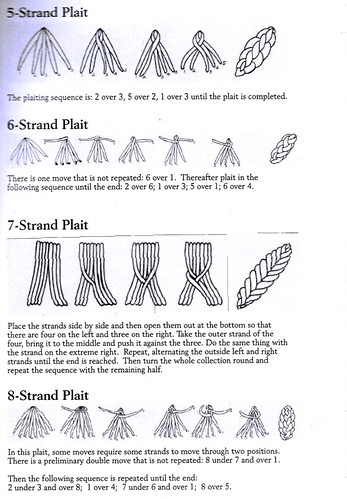
- Rest, covered, for 15 minutes, then scale into 970g pieces and divide each into 2, 3, 4, 5, 6, 7, or 8 equal sized pieces, depending on the number of strands in your plait. Try to avoid using any flour on the bench during this and subsequent stages.
- Mould round, cover and rest 5 minutes.
- Line trays with silicone paper. Roll out strands to 9" and plait according to instructions.
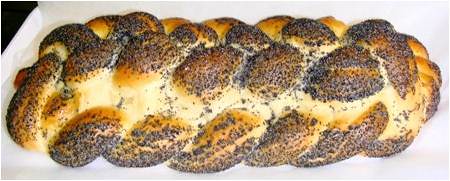
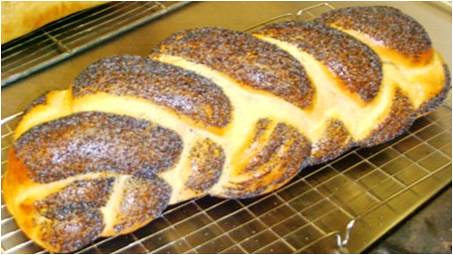
- Double brush with beaten egg. Top with poppy seeds. Set to prove.
- Prove 50 - 60 minutes at 35 - 40°C, 85%rH.
- Bake as oven profile.
- Cool on wires.

This is a video demonstration I used with my students to assemble an 8 strand plait:
- ananda's Blog
- Log in or register to post comments
Since you've been so kind as to include "home size" quantities for the formula, would you also provide mixing and baking instructions that are geared to the home baker's equipment?
Thanks,
Paul
Hi Paul,
Thanks for your reply.
With regard to mixing at home, I would still recommend using an electric mixer. I have never found a wholly satisfactory version, but in the UK the best Kenwood mixers are ok, and there are Kitchen Aid mixers, which are expensive and over-rated, but they do work to give an acceptable dough; eventually. It is possible to mix this dough by hand, although it would be sticky in the handling to start with.
The recipe calls for strong flour, and relies on the protein in this, plus the protein in the albumen for success. This means the dough needs sufficient hydration, otherwise the strands will consistently spring back as you try to roll them out. If you use an "All Purpose" [we call it "Plain"] flour, then you would need to cut back on liquid, as the weaker flour would not hold the higher moisture content. The result would definitely be an inferior loaf.
You can bake this loaf in an ordinary domestic oven; electric or gas. Our fan ovens tend to be fierce, so if you have one of these you should reduce the dial temperature to 160*C in the first instance. Pre-heat the oven, and bake as the profile. I have 3 bricks in my home oven to use for some heat solidity. I also have an old roasting pot in the bottom with some pebbles in it. I throw boiling water on to these to give a steam source. This works well for what you call "hearth bread"; however this is not needed for the Chollah. An Aga type oven would be wonderful, but you may need to lower the normal running temperature, as this recipe has plentiful sugar and egg content, so it coloursd up pretty quickly.
Is this any help for you?
Best wishes and Happy New Year
Andy
I am looking forward to what you have to share with us. Al
thanks for sharing. i have a soft spot for braided breads so i'm glad you've joined the TFL. looking forward to reading your blogs and to learning from your experience as an artisan baker. :)
What a great theme for your blog, Andy. I especially like the inclusion of diagrams to illustrate the braiding patterns. Looking forward to seeing more, and I would love a lesson on whole wheat/grain English muffins---only 'English' to us(we?) American's, of course ;-) Are those in your repertoire, by any chance?
Welcome to TFL : )
-dw
Hi Debra, thank you for your welcome.
Your contribution on bacteriology is a major reason for me being so enthused with this site, so it is good to be hearing from you.
English Muffins I can do in the New Year; wholegrain no problem.
We know them over here as English Muffins. American Muffins are now ubiquitous at Coffee shops [chains]; unfortunately most of these are factory monstrosities too, as you might expect. Do you have decent griddling facilities, as the key to a good muffin is a soft fermented dough finished on a hotplate!
Happy New Year
Andy
Yes, I do have a griddle, and I don't use it nearly often enough. No rush though---I have some other breads to work on this month.
Thanks, and Happy New Year!
-dw
I would like to take on your offer and suggest that rye sourdough would be an area of interest for many home bakers here; the higher the percentage of rye flour the better.
Looking forward to your future posts at your convience, and thank you for joining TFL.
Shiao-Ping
Hello there and thank you for your kind words about this formula.
Personally I like the flavours derived from the use of butter and milk powder to enrich the dough, together with sugar. The whole purpose of the flying ferment used in this formula is to generate rapid yeast activity in spite of the high levels of enriching ingredients. What you want to do is fine, but the changes you make mean you are making a completely different formula. And I would therefore recommend you look to incorporate a different type of pre-ferment such as a biga, rather than seeking to work cold with my formula using a flying ferment.
Best wishes
Andy