
Eagleswings' struggles with a rye starter and the current interest in Jewish sour rye and corn bread have prompted me to re-post my response regarding the care and feeding of rye sour. After making sour rye breads last weekend, I took some photos of my rye sour refreshment which might be helpful to those undertaking rye bread baking for the first time.
The photos that follow illustrate the progression of each stage's ripening. The volume of the sour is, of course, increased with each stage.
DMSnyder's adaptation of Greenstein's Rye Sour:
There are 3 "stages" to make a sour ready to use in a rye bread recipe. You can refrigerate overnight after any of the stages. If you do refrigerate it, use warm water in the next build. The mature sour will probaby be okay to use for a couple of days, but I try to time it to spend no longer that 12 hours since the last feeding. If you have kept it longer under refrigeration, it should be refreshed.
Stage 1:

50 gms of Rye sour refreshed with 100 gms water and 75 gms rye flour, mixed into a paste, scraped down and smoothed over.

Refreshed rye sour with 25 gms (1/4 cup) rye flour sprinkled over the surface. This prevents drying out. Cover airtight (more or less) to ripen.

Ripening refreshed rye sour after 3 hours or so, starting to rise and form a dome, spreading the dry rye flour. Keep covered. Be patient.

Ripening refreshed rye sour after 4-5 hours. Expanded further with more pronounced spreading of dry flour.
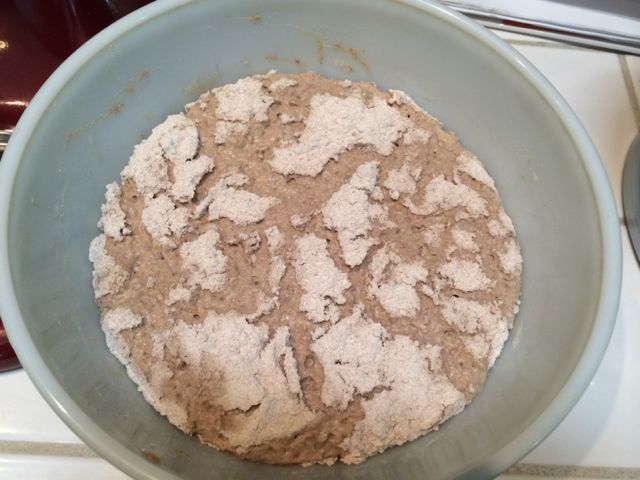
Fully ripe rye sour. This should be used immediately. If you are not ready for it, I have refrigerated it overnight. What you don't want is for fermentation to continue until the sour collapses.
Stage 2:
All of the Stage 1 starter
1/2 cup water
3/4 cup rye flour
Mix thoroughly into a thick paste. Scrape down and smooth the surface.
Sprinkle 1/4 cup of rye flour all over the surface. Cover the bowl and let rise for 4-8 hours or untile the dry rye on the surface has spread into "continents" and the surface has domed. Don't wait until it collapses.
Stage 3:
All of the Stage 1 starter
1/2 cup of water
1 cup of rye flour.
You may have to transfer this to a larger bowl. Mix thoroughly into a thicker paste - It should pull away from the sides of the bowl as you mix it. If it is too thin, you can add more rye flour until it is more "dough-like." Cover the starter and let it rise 4-8 hours. It should nearly double in volume and be bubbly.
It's now ready to use to make rye bread.
Greenstein advises to keep the starter refrigerated and stir the starter every 3-4 days and refresh it every 10-12 days by throwing out half of it and mixing in "equal amounts of flour and water."
Greenstein says, if you are going to refrigerate the sour for any length of time, keep it in a covered container in the refrigerator and float a layer of water over it. (I don't generally do the water cover trick.)
I hope this helps some one.
David
Hi David: Jim again here.
You seem to have a good knowledge foundation on the rye starters. Maybe you can help me (and the rest of us at AgroEast Baking & Milling Co.) with the following:
We are searching for variations to the 3-Stage Detmolder technique for our sourdough rye with caraway seeds. We've seen the odd reference to a 2-Stage Detmolder but can not seem to get any details. This issue at this end is to find a variation that will fit with our production and logistics schedule; we need about 8-10 hrs between the final build and mixing the dough. The 3-Stage allows (if my memory doesn't fail me...) 5-6 hrs.
Will the 2-Stage help us? If you have some ideas on this please don't hesitate to share them with me (us!)
Cheers
Jim Haas, Kyiv Ukraine
David
What is the purpose? I know I've read the details about the rigid Detmolder schedule but really, what is the purpose of the three stage build. Will a two stage build give adequate results or will three stages make a great deal more difference?
Do you use commercial yeast with your rye breads or rely only on your starter? I've noticed most rye recipes seem to include commercial yeast. I've omitted it on a few occasions and liked it both ways. Just more sour without the yeast.
Tracy
From what I've read, Tracy, it's all about superb and complex flavor in a rye sourdough. If you have Mr. Hamelman's book, he details the Detmolder method at page 200.
The process involves three builds of a rye sourdough, each at a different (and very controlled) temperature and a different hydration, so that each build will reflect its particular taste characteristic.
The description of the final rye is mouth watering, but it's a process I could never attempt because of the strict temperature control needed.....not to mention immaculate technique. The Mt. Everest of bread baking.
Lindy gave a very good summary, and I second her suggestion to read what Hamelman has to say about it.
It does look formidable, but it's not that hard to achieve at home with a little effort. I made one of the Detmolder 3-stage ryes from Hamelman on one occasion. I controlled the temperature of fermentation by using my microwave oven, heating a mug of water in it to get the environment to the correct temperature.
My usual rye baking routine is to go through 3 or more builds of my rye sour before mixing the final dough anyway, so the Detmolder procedure really wasn't significantly more work.
The resulting bread was outstanding. However, I can't say it was very much better than "Hansjoakim's Favorite 70% Rye," at least to my taste.
David
It's often said that breads made from the three-step method is less sour than equivalent one-step breads. This sounds pretty reasonable if you compare the different processes, their timings and temperature specifications. I can't say I'm able to distinguish the two however ;)
I usually bake my rye breads using a one-step sourdough build, but I always make sure that the starter is plenty active before I mix the full build. I usually don't use any commercial yeast in the final doughs, and I'm very pleased with the leavening capacity I get from my one-step sourdough builds.
If anyone's interested in technical details re: Detmolder builds, and understand a little German, make sure you check out the following .pdfs:
One-step method
Two-step method
Three-step method
As you can see from the temperatures and ripening times presented in section 1 of the three-step document, they're not that rigid.
Just ask if anything's unclear, and I'll see what I can do with my rusty German :)
PS: Teigausbeute (TA) is the same as baker's percentage total dough yield. E.g.: TA 250 = 100% flour + 150% water. Anstellgut or Anstellsauer translates to sourdough starter.
Enjoying the read and comparisons. Using warm water in the mix can really bring out flavors. I've noticed that when speeding up a ferment to be able to bake at a reasonable time. Some of my rushed (8 hours) final ferments have been the tastiest.
Interesting the first small innoculations. I've got a rye starter with 10g starter to 100g water and 120g flour. Ater reading the paper, I can easily let it sit out until tomorrow (18hrs) or whenever I want to throw a loaf together. I could also refrigerate it for even later... or easily turn it into a 3 step. When it gets ripe, give it equal amounts of flour and make a soup. Then after a few hours, mix up the rest of the flour. Interesting how the added yeast is also used to compete with the sd for food and reduce the acid in the end dough... or did I read that wrong.
Did you ever happen to run across anything on retarding ryes? Warnings even?
Mini
Yes, I think aiming for proofing temps. right in the zone where the lactobacilli are most active result in tasty, aromatic loaves.
And yes, the wide time interval for using the one-step sourdough is really neat. No need to get up in the wee hours every saturday morning... ;)
I'm left wondering why Hamelman preferments so much of the rye flour in his formulas - check out the figure at the end of the one-step doc. I've found that my rye doughs are easier to handle (less sticky), exhibit a more aerated crumb and taste better when I follow the guidelines for amount of prefermented flour from the Merkblatt. Leaving out commercial yeast from the final dough doesn't prolong proofing times that much either (by roughly... 50% perhaps?), and I think the overall oven spring is better for pure sourdough ryes (i.e. without added commercial yeast).
I've never retarded my ryes... I've read warnings in Suas' book at least, not sure about what Hamelman says about it, but I'm sure Suas warns about retarding ryes. I bet it'd be alright to retard loaves with only modest rye amounts (at least if you're using high-gluten bread flours), but I'd be very cautious to retard loaves with a majority of rye flour. I would say that the high enzymatic activity, lots of available foodstuffs for yeast/bacteria and an overall low proofing tolerance of the dough would make the loaves overproof easily. It could work for firmer doughs, perhaps? What do you think?
Edit: Here are two more Merkblatts you might find interesting, Mini:
Berliner Kurzsauer
Monheimer Salzsauer
read something wrong.
Hmm... I'm not sure if the starter should be included in the total dough yield (since you often assume that some ripe sourdough is removed to perpetuate the culture). Either way, the SD starter also contributes to the net hydration, so, assuming the same hydration for the starter as for the sourdough you're preparing, the total hydration is 100% for TA 200.
I think I only skimmed that page because I had no way of doing this without a controlled proofing environment. I've actually read about it a couple of times. The strict temperature control developing different parts of the sourdough bacterias at different times.
Anyone who's done side by side comparisions, I'd love to know their reviews!
Someday, I'll get my engineer husband to rig me up a proofing box with thermostat and maybe I'll give the three stage process a try to see what it gives me.
If I remember correctly the description of the 2-stage Detmolder process was on sourdough.com.
I implemented it even more often than the 3-stage because for my maintainance habits it makes much more sense.
The first stage (150% hydratation) is simply skipped -it makes sense because the yeasts are always soooo happy and lively in my rye starter. The second stage (66% hydratation) is unchanged, but it lasts 18 hours rather than 24 according to that page. The third stage (90% hudratation) is identical, too, but lasts 3-4 hours.
EDIT. The description I found is here:
http://sourdough.com/forum/re-rye-flour-and-starter
I don't know if and how it's reliable, but it works, at least for a home baker (of course removing every single mention to wheat in the final dough...).
I didn't feel nor see any difference between a 2-stage and a 3-stage.
I made this bread per David's weights and it came out great. Thanks David for going the extra mile on this one.
Rick
David
If you use your wheat starter in Stage 1, by time you are at Stage 3, your will have accomplished the conversion.
Happy Baking!
David
With rye sours and liquid levains, for that matter, doubling of volume as a measure of full fermentation is worthless. Lose it! Please re-read my initial post in this topic. Sprinkle the surface of your just-mixed sour with dry rye flour. Use spreading of the dry flour into "islands" as the measure of fermentation. From your description, your sour is probably ripe, if not over-fermented. Your rye flour sounds great.
I often refrigerate the stage 3 rye sour, but I do it after it has matured. In theory, what you did should be better. Once a sour/levain has been cooled to 40 dF, it may take 2 to 3 hours to get really active once it has been moved to a 70+ dF environment. If I have refrigerated the sour, I use warm (80-90 dF) water to mix the final dough.
David
Well that's stage 1 ready and resting... :-)
ok.... I put Stage 1 on the counter overnight - this is Ireland so the temperature would not have exceeded 20 degrees Celsius during that period. I'm working from home today so this is a good day to do this....
When I got up this morning, my Stage 1 looked a lot like the picture you posted with the caption "Ripening refreshed rye sour after 4-5 hours." - but mine had stood there overnight, which would have been closer to 8 hours. I left it another couple of hours, but it didn't change much in that time. It was still domed and it hadn't collapsed, so I proceeded to Stage 2.
That was about 1 1/2 hours ago and satisfyingly impressive "cracks" have appeared already. Happy days.
Just a quick question. After posting "Ripening refreshed rye sour after 4-5 hours." you stated "I'd give it another hour or two to achieve maximum expansion" - How do you decide that "NOW" is the time to proceed to the next step? How do you know "maximum expansion" has been reached other than waiting for the start of collapse? In what way would the sour look different to the picture you posted labeled "Ripening refreshed rye sour after 4-5 hours."?
Cheers
P
Looks like this:
Remember: All the components in sourdough starter metabolism are very temperature sensitive. Times are just approximations and, generally, assume an ambient temperature of around 70dF. If your environment is a lot cooler, the sour will ripen much more slowly.
David
Great! My "Stage 2" sour isn't a million miles off that, though the cracks aren't quite as wide as that, yet.
Here's my "Stage 2" this very minute ....
As they say, "A picture's worth 1000 words."
That sour is just short of "fully ripe." Based on your convenience, you could mix Stage 3 right now or let the sour ripen a bit further. A sour that looks that healthy is generally pretty forgiving.
David
Excellent. Stage 3 it is
So does this look OK for a Stage 3? I mixed it as per your instructions and after taking the picture I covered it with cling film... Should I dust it with some rye?
If it forms a ball like that, it is on the dry side. I'm with you regarding volume measurements. Note the age of this topic. These days, I go by weight entirely. However, I wouldn't make adjustments at this point; I think your stage 3 will be fine. I would dust with rye. I trust you have the sour in a bowl covered with plasti-crap, rather than wrapping the ball in it.
The purpose of the rye dusting is to keep the sour from drying out, primarily. Its spreading is incidentally a convenient measure of expansion. In the times when these techniques were developed, they <gasp> didn't have plasti-crap!
BTW, what bread do you plan on making with your sour?
David
I've dusted it with a bit of rye.
Yes, the sheet it's on is actually a baking sheet, so once it's ready I plan to just lift it gently out of the bowl it's in and place it, sheet and all, straight on to a baking stone. Or do I need to do something else with it after "Stage 3" is complete?
You are not going to just bake the ripe sour, are you?
If that's your plan, I would strongly encourage you to find a good rye bread recipe and follow it, using your sour for leavening.
If you search TFL, you will find many rye recipes.
David
I knew I was getting the wrong end of the stick. So when the 3rd stage is ripe, that's only the point at which it is ready to leaven an actual bread? Boy I can be dense sometimes ... LOL
Ok... with this being my first rye bread, I would like to start as simple as possible rather than going for a specific recipe. How about I use equal amounts (w/w) of the rye sour at Stage 3, once it's ripe, and Italian tipo 00, and add enough water to create a nice sloppy dough? Or perhaps equal amounts of the rye sour and a 50/50 mix of Italian tipo 00 and more wholemeal rye?
Two suggestions:
1) Start out with an easy one with 50% or less rye. And for the wheat flour, use a strong bread flour. Most Italian 00 flour doesn't have enough gluten. Remember, rye has none.
2) If you are going to be making rye breads, do yourself a favor. Read up on rye breads. It's way different from wheat in many ways. I think the best treatment of rye baking principles is in Jeffrey Hamelman's Bread. I'm assuming you can buy or borrow a copy (local library?). The TFL Handbook (See the menu at the top of this page.) has a section on rye under "ingredients," as I recall. It's a start.
David
I'll be checking out those publications, thanks David. - In the meantime, of course, I had to use what I had, so I stuck to the original plan and I'm not altogether dissatisfied with the end result. Plenty - PLENTY - of room for improvement, of course, but not bad for a first attempt.
http://www.thefreshloaf.com/node/39640/yay-rye-sour
I don't quite know what sort of bread I'll be making, by the way.... just a "generic rye bread", I guess? Once I'm happy that I got the basic technique for that right I can start thinking about doing something a bit more specific. I can be a slow learner sometimes [blush]
BTW .... You made Stage 1 with 50g of rye sour, 75g of rye, 100g of water, and 25g of rye to cover. At that point you state that 25g of rye = 1/4 cup, so I have worked on the basis that all your cup measurements are 1cup = 100g, 1/2cup = 50g, 1/4 cup = 25g and 3/4 cup = 75g
Which is grand for the rye... But I just realised that I may have messed it up with the water, as that is much denser than rye? What does 1cup of water equate to in grams/ml ?
The definition of a gram was originally the weight of one ml of water. There are by, convention, 30 g in one liquid oz. It's really about 28 g for water.
David
Indeed. I always find recipes with "cups", "table spoons", "tea spoons" and so on extremely frustrating. I'm a good little European, me. Grams and milliliters. I wouldn't have it any other way :-)
I don't think I made a complete mess of it then; I've used 25 grams (=ml) of water for each "1/4" cup you mentioned, but the difference isn't huge and the sour still looks ok.
My Stage 2 cracked into beautiful "continents" within 3 hours. I've put it in the fridge as I don't want it to peak before tonight (about 5/6 hours from now), and I'd like to put my Stage 3 in a cool place overnight for a bake tomorrow morning. I read your recommendation to use warm water at that point, and I will do so.