
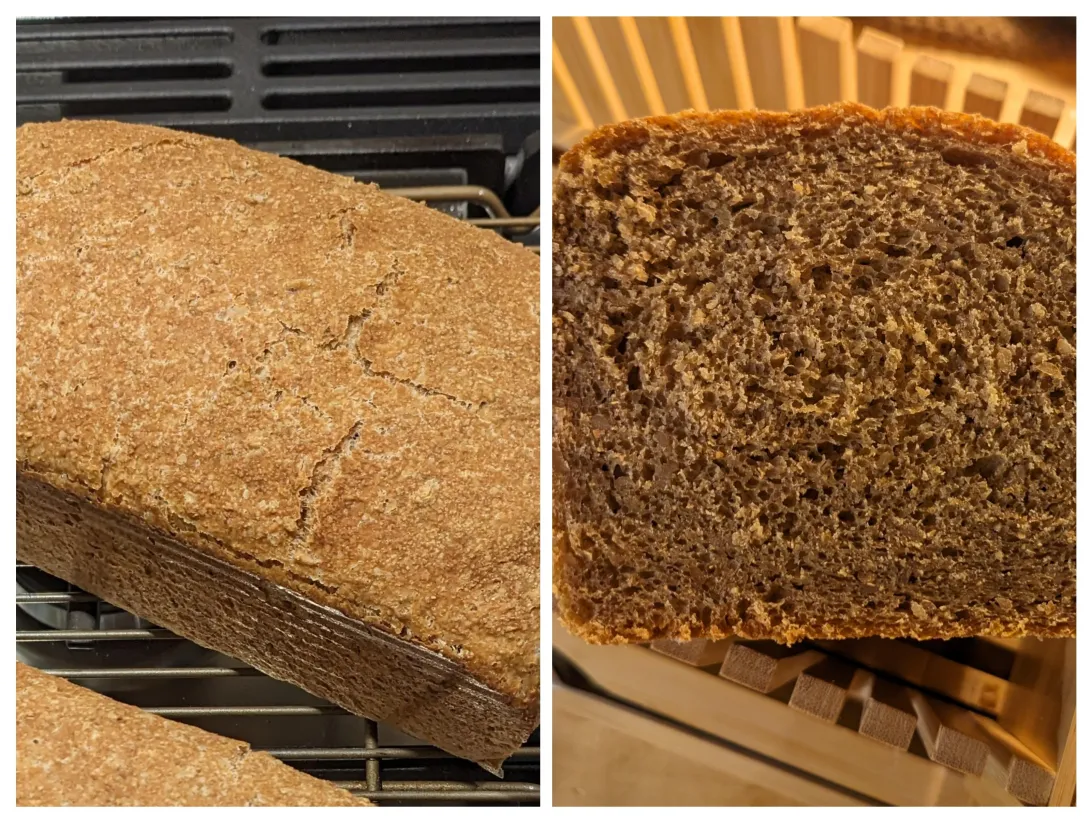
TLDR; How do I fix my crumbly crumb?
I'm looking for some ideas on how to improve my 100% whole grain bread. All flour is home milled with a Nutimill Harvest Grain Mill. I have adapted my recipe from Rose Levy Beranbaum's "Cracked Wheat Loaf" in her "Bread Bible" book.
All of the grain (except the 136g of Red Fife)was ground as fine as my mill would allow (stones definitely touching) and sieved through a #40 sieve. Then extracted bran was reground at the same mill setting and re-sieved. The resulting extract (124g total) was mixed with 87g of hot water and set aside overnight. My recipe follows:
Cracked Grain
- 136 g Red Fife Very, very coarse grind (cracked)
- 200g boiling water, set aside overnight
Starter:
- 240g Red Fife
- 250g Fredrick
- 3.8g Instant Dry Yeast
- 10g Sugar
- 13g Powdered Milk
- 34g Honey
- 400g Water
Combine, set on counter for 3 hours, refrigerate overnight.
Additional Flour Mixture:
- 249g Glenn
- 10g sugar
- 1.3 Instant Dry Yeast
- 18.4 Salt
- 10.2 Lecithin
- 33g Olive Oil
Combine cracked grain, starter and additional flour mixture in bowl of Ankarsrum mixer set up with roller and scraper. Mix on medium low for about 8 minutes. Add soaked bran and mix another 4 minutes. Dough passed window pane test (barely) but seemed smooth and extensible.
Bulk rise about 2.5 hours with three stretch and folds along the way. (In the oven with light on, about 77F.) Divided and shaped into two loaves and put in loaf pans for final rise.
Preheated oven and Challenger pan to 410F. I couldn't fit both into my Challenger pan at the same time so loaded the first and reduced temp to 385F. Baked covered for 15 minutes the went to 205F internal. I forgot to retard the second one so it over proofed and collapsed during baking. The photos are from the first loaf.
In general, I'm pretty pleased with this. Of course I would like a bit more rise, but I think I understand some of the limitations of 100% whole grain. My biggest complaint is that the crumb crumbles when I slice it. Previous attempts used un-sifted flour and 22g of oil. This loaf is an improvement but still falls short. If I calculated correctly, I'm at 79% hydration, which seems about right?
Constructive criticism and helpful hints welcome.
Tom
In a nutshell - too much water. Enjoy!
"Soaked bran" appears in your comments but not in the recipe. What is it?
I'd skip the powdered milk and don't add the olive oil until the last 4 minutes, for a more cohesive crumb..
I'm new to home milling, but the first thing I'd try based on my experience is much more time kneading. One of the main steps in moving from a crumbly, dense bread to something that's getting close to a sandwich loaf was very, very extensive kneading. "Barely passes the windowpane but seems smooth and extensible" got me results similar to yours.
These posts by txfarmer were the biggest help:
https://www.thefreshloaf.com/node/21575/sourdough-100-whole-wheat-oatmeal-sandwich-bread-whole-grain-breads-can-be-soft-too
https://www.thefreshloaf.com/node/23061/extremely-sourdough-soft-sandwich-bread-most-shreddble-soft-velvety-ever
I don't know how red fife or your other flours will handle with that, though.
The "soaked bran" is what got sieved out, soaked and added back at the end of mixing/kneading.
Thanks everyone for the ideas. I will be working through these suggestions over the next few weeks.
Tom
Anytime you have a bread cracking and crumbling after baking, it is a moisture issue. Either there needs to be more water overall or there needs to be more time to allow the rough bits to absorb the moisture into itself. Otherwise, as it bakes (and afterwards), the branny bits continue to rob the moisture from the gel-like network of the crumb. Then, when you take a bite of the delicious sandwich you just made, the gel-crumb shatters from dryness in your hands.
If I'm doing my math correctly, isn't this recipe at 68%? I am including the coarse ground Red Fife additive. That is very low for a whole grain loaf, and especially using a freshly milled which is particularly thirsty. You gave the rough bits a good soak, you kneaded to windowpane and you had a long (almost 3 hr) bulk rise. Now you have to give the dough more water and the time to absorb it. For a dough that is so hardy, I would even say, why not an overnight cold retard? I have, in years past, made a whole grain loaf that I would mix, rise about halfway and then put in an oiled container overnight and bake the next day. It would go into the bowl quite sticky and next am come out soft and tacky. Perfect. The crumb after baking would be as soft as you can get with WW with bits. I loved adding dates,nuts and bread spice for a really hearty, delicious breakfast bread.
Add more water to bring it to 85% and try a long retard.
PLEASE POST YOUR RESULTS. It is very disheartening when people ask for help and then disappear. It is really helpful to everyone if you post whether you had success or failure. This community loves to help and you will find a solution if you stick with it.
Try increasing the dough hydration as you develop it. Both hydration and proper dough development are key when making a 100% whole-grain loaf. I bake 100% whole-grain bread all the time using home-milled flour—feel free to check out my blog if you’re interested.
Here’s one of my simple recipes that shows a few techniques that can make a big difference.
https://www.thefreshloaf.com/node/71297/20221020-simple-100-wholewheat-bread-clas
Yippee
I see where my hydration calculation might get confusing. I'm actually a bit confused my self on how I should have done it.
I included the 136g of cracked Red Fife in my total flours number, was this wrong?
The 124g of extracted bran was part of the total flours listed in the recipe. Again, might be incorrect.
So for flour I had 136+240+250+249=875
For water I had 87 (soaking the bran but not listed in the recipe) +200+400=687
687/875=.785 hydration.
I suppose I should have come here before I baked the bread, but I do enjoy the process and a challenge. I guess I underestimated the impact going from 70% home milled to 100% home milled would have. I'll add water and do the cold retard the next time I bake it. And I will report back, with good news or bad.
Thanks,
Tom