Submitted by Mini Oven on July 5, 2009 - 11:19pm

Seoulful German Farmhouse Rye


Yes I did it.  I found rye flour in Seoul, South Korea, in the Bangsan Market between wall paper shops and packaging tucked into the alleyways kept cool in the winding shadows from the burning sun.  I found two different ryes, that with my third, and my unending curiosity can only lead to one thing.... a comparison.  I have already gathered that there might be some flavor differences evidenced by the interesting additives in North American recipes...

So I decided to use Daniel Leader's Soulful German Farmhouse Rye in Local Breads combining all the ingredients except for added yeast (don't want it) and final 70% rye flour.  That way the only difference in flavor will be the flours.  All three doughs will be handled alike. 

The Rye:

  • Bob's Red Mill Organic Dark Rye flour @ 4000 won a kilo

  • German, Demeter Organic Rye type 1150 flour @ 7900 won a kilo

  • Austrian, Haberfellner Rye type 960 which is quickly running out


I mixed up the recipe and divided the liquid into thirds, added 117g rye flour to each bowl moistening the flour and covering for one hour.  I had already started noticing differences...

Bob's is a slightly coarser flour, has more speckles, is darker (but not by much) and not as sticky as the other two

German 1150 has two mosts: lighter color, and stickiness

Austrian 950 has dough color between the two but in the picture they look all look alike.

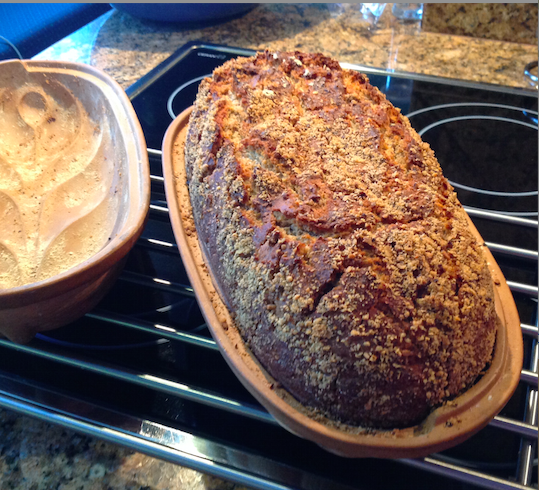
All mixed well, all sticky (typical rye) so I use a wet silicone spatula to fold the doughs twice.   After 3 hours the loaves were gently shaped with wet hands patted with oatmeal flakes and set over cutout bread letters to mark the bottoms.  (4 o'clock is Bob's, 12 o'clock is German)  They were rising nicely (not a whole lot) when they went into the oven.  (tip, it is very hard to judge rising in a flat round bowl shape)

As you can see, I'm having a little trouble lining everything up here...(someone please send me a note on how to do this!)    The picture below of the top shows Bob's Red Mill at 10 o'clock, Austrian 950 at 2  o'clock, German 1150 at 6 o'clock.


The doughs seem to rise in relationship to fineness of the flour.  Bob's is the heavier and coarser so it rose slightly lower than than the other two.  1150 and 950 were pretty close in height but the 950 rose just a tad more.  The darker color of Bob's is even darker after baking.  Now to squeeze in another picture, the crumbs.  Austrian is on left, German right, Bob's is the darker of the three, first on the bottom then on the top.

All have a moist heavy crumb (We like it that way) but the differences are slight but mostly in color and texture of crumb in the mouth. 

1150 feels smoother in chewing, 950 is more stick to your teeth smooth, Bob's tend to be more stick in between the teeth which gives it a longer taste in your mouth. 

After two days the sour is growing but I still can't tell one from the other as far as taste goes.  The Austrians at the office yesterday could also not tell any flavour differences.  They just wanted more.  So I've been baking and playing.  I keep in mind that Bob's won't rise as high as the 950 (or peaks sooner having more whole grain).  I made a loaf yesterday with Bob's and gave it a longer steam in the oven, 10 min instead of the 6 minutes in the above bread.  It came out lovely rose higher and being consumed as I write.   It also went into a banneton, tall and narrow.  I also use more spices than the recipe but far from overpowering the rye.

So.  I Guess I blew the top off that urban legend if there ever was one.  They all taste pretty much the same.  Thanks for waiting patiently for the results.

Mini Oven


Submitted by Mini Oven on May 4, 2009 - 10:26am

Labs and Baby Mammoths


Did anyone find the latest issue of National Geographic interesting?  How about Dan Fisher a paleontologist who plays with his food by preserving it with Lactobacteria? 

http://ngm.nationalgeographic.com/2009/05/mammoths/latreille-photography

Mini

Submitted by Mini Oven on April 20, 2009 - 6:10am

Cooked Kamut berries, now what?


Ongoing Kamut experiment... a short one.

Monday Morning:

I have 600g Kamut berries.  Dirctions say how to cook, 2 cups water for 1 cup berries washed in sieve.  I decided to use the rice cooker for my good 4 cups of grain.  By washing, it was clear that the grain was better washed in a large bowl and water poured off the top to remove parts of hulls and dust.  The berries are large enough to drain in a colander.   I then let the rice cooker do the work with 1 tsp of salt.  All the water was absorbed and the grain took on a caramel color with a nutty fragrance. 

Now what?  I was hoping to put this grain into a rye bread but I had to eat some first.  Very chewy.  Very chewy indeed!  Now I'm not so sure I want it whole in my bread.  I was eating chili for lunch so I combined some cooked grain into it.  Uh, ok, not the best idea, but I did get a glimpse of the texture with other food.  The tough chewy berries stood out.  "Roughage" kept going through my head.  I guess the blender is the next step, make the grains smaller.  Will I come out with a pudding like substance?   I have to think about this....  any ideas?  (Meanwhile, starter is being refreshed.)  I need some coffee.


Submitted by Mini Oven on July 6, 2008 - 5:27am

Apricot Dumplings, Marillenknödel


 pitted and stuffed with a sugar cube before wrapping tightly with potato dough, a true Austrian delight!

Apricot dumplings: A true Austrian delight!  Just in time for Apricot season (northern hemisphere)

A few things to remember before getting started: The dough is 2/3 cooked potatoes combined with 1/3 other ingredients by weight. Potatoes should be the flaky type or bake type potatoes and boil one or two extra to make sure there are enough. Apricots can be fresh, frozen and even slightly on the firm side. One can carefully remove the pits and place a sugar cube inside larger fruits, this works esp. well for freezing. Apricots, peaches or cherries are all posible. Crumbs may include grated nuts as well.

You will need:

potatoes 700g, AP flour, one egg, salt, butter, a large fry pan, a large pot for boiling, work surface, & about 750g fruit or 12 apricots, a slotted spoon, sugar.

APRICOT DUMPLINGS      makes 12

Potato Dough:

  • 500g potato; boiled, hot or one day old, peeled and put through ricer, grated or fork mashed very fine.
  • 165g flour
  • 5g salt
  • 1 egg
  • 15g unsalted butter

Crumbs:

  • 100g unsalted butter
  • 70g bread crumbs


Grate fine or put potatoes thru a ricer. Combine loosely and evenly with flour and salt and make a hole in the middle. Add egg and bits of butter. Now pinch and quickly knead into a nice firm dough, no added flour, remove or squish any lumps. Roll out into a log and divide into 60g lumps for apricots and 40g for cherries.

Set a large pot of salt water to boil, you will want to cover the dumplings and they should just swim and not touch the bottom, about 1/3 to 1/2 full of water with about a teaspoon of salt.

Roll each lump into a ball and then into a disk with the middle slightly thinner than edges. Now you can use just a little flour in the palm of one hand to help shape lump and keep it from sticking while you place each fruit into dough. Press & stretch the dough tightly around each fruit trying to prevent any air pockets. Seal opening and roll slightly in hands to make round. Set aside and repeat for next fruit until all are prepared. (They can be frozen or refrigerated at this point. If using frozen fruit, it is recommended to boil right away to retain shape.)

When water is boiling, give it a good stir so it is moving and slip dumplings in on a wet spoon. Set timer for 15 minutes. Turn or jar pot often to prevent sticking. After water has returned to boiling reduce heat to softly roll the dumplings as they boil. Meanwhile, heat up a large fry pan and brown crumbs in melting butter. The trick here is not to let them burn so stir often and turn off heat before they're done, the heat in the pan will continue to brown them. Set the pan aside or nearby.

When the dumplings have boiled 15 min, gently transfer with a slotted spoon into the crumbly pan. Pick up the pan and with a rotating motion rolling the balls into the crumbs coating them as you play. Remove onto a serving plate or smaller plates and serve warm with fine sugar. Variations may include serving with Vanilla sauce or Vanilla ice cream. Three make a meal, one a dessert. I made 8 Apricot and 8 cherry.


 it's antique but works great!

Put potatoes thru a ricer... or whatever and fluff in flour & salt

 potato is all crumbly like

Add egg and butter...and start squishing and kneading

 really a nice dough to work with

knead: ..and take a picture at the same time ...until uniform  

 thinner in the middle

Shape a disk

 yes, it's frozen

shape and fill

 until it's wrapped around evenly

...and press around until closed up and sealed

boil and brown

boil and brown at the same time

 throw 'em in wet and naked!

rock and roll until coated ... then serve up piping hot!

Apricots and Cherries!

Apricots and Cherries! Yum yum!


Enjoy!


Submitted by Mini Oven on March 2, 2008 - 11:33am

It's Bärlauch zeit


Spring has sprung and so has the Allium ursinum or Bear garlic, known in my woods as Bärlauch.

German: http://www.uni-graz.at/~katzer/germ/Alli_urs.html

English: http://www.uni-graz.at/~katzer/engl/Alli_urs.html

I have two containers of freshly plucked leaves gathered from the forest floor (before the storm hit us) and don't quite know where to start.....

Submitted by Mini Oven on February 16, 2008 - 1:39pm

Pizzies Pierre-nuries 9 story


How I went about it...

I made Leader's Pierre-nury rustic rye dough. I like the dough so much, I'm experimenting again, well....

After following all the directions, carefully laid out the dough before me. I had just prepared all my ingredients:

Submitted by Mini Oven on October 6, 2007 - 12:56pm

Walnut flour


Hello! Just wanted to show the machine I use to grate nut meats into flour. Same can be used for sunflower seeds, hard bread (crumbs) hard cheese, etc. The nuts are cut and not mashed or pressed so they remain fluffy and dry.

Submitted by Mini Oven on September 21, 2007 - 10:50am

Mini's Oven in China


Here is what got me into The Fresh Loaf, dealing with this and a similar oven.

 Stainless Steel salad bar bin used for toast bread form


Submitted by Mini Oven on August 31, 2007 - 1:43am

Sourdough moving experiment.


Many many months ago, in Austria far away, a sourdough starter was supplied from a baker, good and qualified. The Austrian starter was dried and traveled to China where part of it mixed and grew nurtured in the presence of Chinese all purpose flour and later with Austrian Rye flour. Sometimes it sat out to grow, sometimes it sat in a refrigerator, one time even froze but it lived long and prospered and provided many a loaf of bread. Then it was dried. This happened at various times in the last few months.

Submitted by Mini Oven on July 27, 2006 - 8:00pm

Buckwheat berries


July 28, 2006 Found Buckwheat berries in the market.
They are hulled, meaning I can crush them between a finger and fingernail. This ought to be fun, one more whole grain without gluten to experiment with. The locals mix and cook them with rice to enrich it. I will first wash and soak them and add to my Poolish. They are shaped like little hearts with three sides reminding me of Austrian Löffel Kraut, a sort of nutty herb that grows everywhere there, picked for salads and high in vit C.
Having heard of Buckwheat flour for pancakes, I made a dough ball of fine buckwheat flour, water, salt, com. yeast and kneaded it. More like "play dough." It rose minutely for gas escaped in tiny little cracks all over the surface. I tweaked it and practiced my kaiser roll folds with it and left it in a little ball to rise. When I had had enough, I painted it with milk to seal the cracks and baked it. I managed to trap some bubbles and I like the taste but the dense grey puck cannot stand on its own. I cut it up and dried it.