

We baked a miche the last day of the SFBI Artisan II (sourdough baking) workshop. This was one of the breads we mixed entirely by hand. The students' miches were scaled to 1 kg, as I recall, but our instructor baked a couple larger ones, using the same dough.
These miches were among the favorites of all the students for the wonderful texture of their crust and crumb and their flavor. I gave one of mine to brother Glenn, who has stopped reminding me in the past few days that I promised him the formula.
This formula is substantially different from the miche formula in Advanced Bread and Pastry. I blogged about the background of that miche last month. This one is more similar to contemporary versions such as that of James McGuire, Hamelman's adaptation of which is found in Bread.
The formula we used at the SFBI calls for mostly white flour, with a little whole wheat in the levain refreshment and a little toasted wheat germ in the final dough. From my reading, a high-extraction flour is preferred for miches. I had some of Central Milling's “Organic Type 85” high-extraction flour on hand, so that is what I used.
|
Total formula |
|
|
|
Ingredients |
Wt (g) |
Baker's % |
|
High-extraction flour |
702 |
100 |
|
Water |
515 |
73.33 |
|
Wheat germ (toasted) |
18 |
2.5 |
|
Salt |
15 |
2.08 |
|
Total |
1250 |
177.91 |
Notes
-
The SFBI formula used 96.67% “Bread flour” and 3.33% Whole wheat flour. All the whole wheat flour is used in the levain. I used Central Milling's “Organic Type 85 Flour” for both the levain and the final dough
-
I did not use wheat germ since I was using high-extraction flour, but this ingredient did contribute to the great flavor of this bread as we made it in Artisan II.
|
Levain |
|
|
|
Ingredients |
Wt (g) |
Baker's % |
|
High-extraction flour |
93.7 |
100 |
|
Water |
93.7 |
100 |
|
Liquid starter |
50 |
46.8 |
|
Total |
237.4 |
246.8 |
-
Dissolve the starter in the water and mix in the flour. Desired Dough Temperature: 78ºF.
-
Ferment for 8-12 hours.
|
Final Dough |
|
|
|
Ingredients |
Wt (g) |
Baker's % |
|
High-extraction flour |
586 |
100 |
|
Water |
398 |
68 |
|
Wheat germ (toasted) |
18 |
3 |
|
Salt |
15 |
2.5 |
|
Levain |
234 |
40 |
|
Total |
1251 |
213.5 |
Procedure
-
Dissolve the levain in the water. Add the other ingredients and mix thoroughly by hand. DDT: 75-78ºF.
-
Transfer the dough to a clean, lightly oiled bowl.
-
Ferment for 3-4 hours with 4 folds at 50 minute intervals. (I did this by the “stretch and fold in the bowl” technique.)
-
Transfer the dough to a lightly floured board. Pre-shape as a tight boule.
-
Cover and let rest for 20-30 minutes to relax the gluten.
-
Shape as a tight boule and place, seam side up, in a floured banneton.
-
Cover with plastic and retard overnight in refrigerator.
-
Remove the boule from the refrigerator and allow to warm and complete proofing for 1-3 hours. (Watch the dough, not the clock!)
-
45-60 minutes before baking, pre-heat the over to 500ºF with baking stone and steaming apparatus in place.
-
When the loaf is proofed, transfer the boule to a peel. Slash the boule as desired, and transfer it to the baking stone. Steam the oven and reduce the temperature to 450ºF.
-
Bake for 20 minutes, then remove any water remaining in your steaming apparatus.
-
Continue baking for another 40-50 minutes. (If you have a convection oven, switch to “Convection Bake” and reduce the oven temperature to 430ºF at this point. But see my tasting notes.)
-
Remove the boule to a cooling rack, and cool thoroughly before slicing.
Notes on procedure
-
Traditionally, we were told, this bread is scored in a diamond pattern, but any scoring pattern that pleases you is fine. Just be aware that the diamond pattern tends to yield a flatter profile loaf than a simple square or cross.
-
This bread benefits from a very bold bake. The crust should be quite dark. It may look almost burned, but the flavor and crunchiness that is desired requires this.
-
This type of bread often improves in flavor very substantially 24 hours after baking.

Crust

Crumb
Crumb close-up
Tasting notes
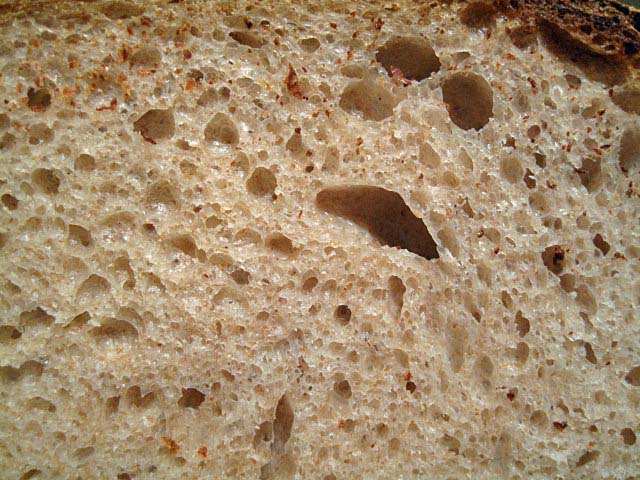
I sliced and tasted the bread about 4 hours after removing it from the oven. The crust had crackled nicely and was very thick and crunchy – the kind that results in crust flying everywhere when you slice it. The crumb was well-aerated, but without any really large holes. The crumb structure is similar to that I got with the miche from BBA made with this flour, but a bit more open. The crumb is chewy-tender.
The flavor of the crust is very dark – caramelized-sweet but with a bitter overtone where it is almost black. The crumb is sweet, wheaty, nutty and absolutely delicious. My note above notwithstanding, it's hard to imagine the flavor getting any better in another day.
I am enormously impressed with the flavor of the breads I have baked with Central Milling's “Organic Type 85” flour. I want more of it, and I want to try some of their other specialty flours, including those they mill for baguettes.
I will definitely be baking this bread again. I would like to make it as a larger miche, say 2 kg. Next time, I will lower the oven temperature to 420 or 425ºF when I switch to convection bake for the crust to be slightly less dark.
David
Submitted to YeastSpotting
- dmsnyder's Blog
- Log in or register to post comments
Hello David, Thank you for posting the SFBI Miche formula.
I look forward to trying this. Your miche is beautiful - I love the diamond scoring!
Regards, breadsong
This one will definitely sing your song!
David
I really am grateful you've posted another SFBI Miche formula.
I was thrilled with how my first SFBI Miche turned out and it will be fun to try this one next.
Thanks again, from breadsong
This is the one I've been waiting for - thanks David! Love the look of that crumb!
Too bloody hot to bake here at the moment, but as soon as we get some respite, I'm going directly to this one without passing Go!
Cheers!
Ross
I know you will enjoy it! Let us know how yours turns out.
David
Very pleased with how it turned out, although mine is a far more modest version that doesn't quite qualify as a miche - too small. So I've called it a boule! I made a few mods for reasons I've outlined in my post here.
Thanks again, David. A lovely bread!
Ross
Do you think 'atta' (or Indian/Pakistani whole-wheat chapatti flour) is a fair substitute for 'high-extraction flour'? I know the gluten content of the 'atta' I can buy is about 12% or a bit over...I'd be inclined to add the toasted wheat-germ to guarantee that the flavour is what it should be...
I'd love to give this formula a try. Am I on the right track?
Thanks for your valuable time!
copyu
Hi, copyu.
My understanding is that atta is generally made from wheat that is more like (identical to?) durum wheat than hard red winter wheat. I would think atta would give a different flavor and performance, but it might be to your liking.
David
We have a lot of flours available here in Japan...but even after consulting Hamelman's "Bread" I'm none the wiser...I now understand what "High Extraction Flour" means, but I wouldn't know what to ask for in Japanese!
The atta flour that I can buy is a sort of "white wholemeal"...it's white in the package, but only reveals its 'whole-wheat' properties after hydration
I might gve it a try and, if successful, will report back
Thanks again,
copyu
Hmmm, what a beauty David.
Absolutely perfect crumb for my taste, and nicely gelatinized to boot. No wonder it's a hit, just from appearances alone, but I can also tell there's a lot of flavour going on as well from the way the crust gradually colours into the actual crumb. That's good baking IMO, and a great loaf. Thanks for sharing the recipe and your notes.
Franko
David
Mmmm, when I return back home this week this loaf is on the agenda!
By the way, do you special order your flour directly from Central Milling? Since I have heard you mention Central Milling and this type 85 flour a few times, I think this morning when my rep arrives at the bakery I will ask what he has to offer when it comes to Central Milling and see what goodies I can get my hands on!
It is Snyder approved afterall!
Hi, Arlo.
My brother picked up the flour at the CM warehouse for me. Since he drives by Petaluma pretty often on the way from SF to his north coast get-away, I hope I can use him as my "distributor" in the future.
Their web site lists a vast array of flours and grains. Unfortunately, they don't describe their specialty flours or provide specs online. Hmmmm ... I may have to plan a visit myself.
Nicky Guisto recommended their Type 85 flour as closest to the flour that Lionel Poilâne used for his Miche. Frankly, I like the one I made better than how I recall Poilâne's bread from the taste I had of it in Paris. That was quite a while back though, and I'm planning to do a bakery tour of Paris this Spring. In all fairness, Poilâne deserves a second chance, don't you agree?
David
Hey David!
Great miche! This has to be the formula to test the high extraction flour with that I found after turning this city upside down (Amsterdam).
Usually it's very difficult here to find out what sort of flour you're dealing with; they just don't put any info on the label other than "flour".... yeah, I knew THAT...
Every disadvantage has it's advantage though; after trying all sorts of flour, I found that the one on the lowest shelf in my supermarket around the corner yields the most reliable results at.... 69 cents per 2 kilograms :-)
But this one is a no brainer; 85% "bise-flour", and from what I read on the net and on this site, it must be the "strong stuff" I was looking for.
Can't wait to get started on this miche with the high extraction flour! I succesfully revived a rye sourdough starter after a long sleep in the fridge.
One question I hope you can help me with: I usually make stiff starters, and this formula asks for a liquid starter. How much of the stiff starter would I use in this formula?
Greetz from Amsterdam!
Freerk
P.S. Whilst managing my profile and bookmarks, I realized that about 50% of my "favorites" come straight from your pages and comments. I guess a big THANK YOU! is appropriate! And, just out of curiosity; your last name suggests a Dutch heritage, is that the case?
It sounds like your flour is just perfect Let us know how it turns out for you.
To convert a firm starter to liquid, just feed it a couple times like this:
Flour 100%
Water 100%
Starter 40%
Percents are baker's %.
The family name is of German origin linguistically, although my grandfather immigrated to the US from Russia. We don't have any Dutch connections, to my knowledge.
David
The Dutch miche :-)
So here it is: I haven't tasted it yet (still cooling) but once again too impatient to wait, so here is an impression of the crust;
Not as dark a crust as yours... but I still think it looks pretty. Can't wait to taste it...
I'll post some crumb pics later :-)
Thanks for this formula! I literally had my miche "oven-springing" into the grill in the top of my oven. Usually the second to the top slide has my preference, but for this high riser, I need to put it in the middle... I LIKE THAT :-))))
Freerk
From the photo, I'd say I'd prefer the crust somewhere between yours and mine.
Looking forward to seeing your crumb and hearing how you like the flavor of your bread.
David
Great taste! I love the thickness of the crust. "Juicy" bite. Decent crumb, but a bit uneven, due to a work schedule interfering with my bread baking ;-)
Freerk
Perfect in every way David! The scoring shows a well trained hand. The luster of the crumb speaks flavor as Franko suggests above. Well done!
I've been searching for a local source for Central Milling products since I started looking at Tartine. Nicky says he will ship me 50# bags but the freight is $50 so I'm still looking.
Would you make a suggestion on how we can approximate the high extraction flour? I have seen combination's of WW and AP that seem to get in the ball park. Perhaps sifting the WW to remove the rough component? Getting the flour right has a lot to do with a successful miche.
Eric
I've seen so many different AP:WW ratios for approximating high-extraction flours, I just don't know what to recommend.
I provided information regarding the original SFBI formula, and will clarify if needed. I can say (and Glenn can substantiate) that the SFBI formula produces a spectacular bread. They just used some WW flour to feed the levain, but then added toasted wheat germ to the final dough. I may try this bread again with added toasted wheat germ, even using the Type 85 flour.
My best suggestion is for you to visit Petaluma with an empty suitcase. The nearest airport is Santa Rosa. Plan B might be to call Nicky Giusto and find out if they have a distributor in the mid-west. My local market that carries bulk flours says they will order me a bag (50#) of whatever their distributor carries. Since this is just added to their own order, there is no shipping charge to me. It's still a lot of flour, and, if it has wheat germ in it, it should be frozen or refrigerated if not consumed within a reasonable time.
Good luck!
David
Very nice loaf. And thanks for posting this formula (finally!). Now I can thaw and eat the last piece of your SFBI miche.
One question, though. If the formula calls for bread flour plus a bit of germ, how similar is your version with 100% Type 85? I'd think your version would have a lot more germ and bran.
I have had great success with Central Milling's flours. I like the Organic Type 85, and the Organic Artisan Baker's Craft (the flour Acme uses for baguettes, as I understand it).
As to sources for Central Milling Flour out of the Bay Area, I have not heard of any. I did hear that Nicky will now sell 5 pound bags of most things if you call ahead and pick up (I know that doesn't help much for people who are distant).
Glenn
Comparing the SFBI miche with the one I made with Type 85 flour: The flavor is very similar. My loaf had a less open crumb. This is probably due to the increased bran in the high-extraction flour. I could offset this somewhat by increasing hydration a bit.
Either way, the bread is going to be wonderful. Both Susan and I really love the flavor of the breads I've made with CM Type 85 flour though.
We need to figure out just how I'm going to get my next delivery, and I'd like to try that other CM flour you're recommending.
David
Hi,
I live in Idaho & was able to order CM flour direct from the company. I ordered 4 5#bags, but could've ordered more, or less. They are very nice & helpful.
Margie
If Whole Foods Stores 365 Organic Flour is from Central Milling maybe Whole Foods sells a high extraction flour too or could order it. WF is about an hour from us in Ohio which is a lot closer than CA.
Has anyone used the 365 Organic that I think sells for $3.50/5lb.
Also, what about KAF's First Clear Flour, isn't that a high extraction and can it be used in this recipe?
Your loaf is gorgeous David!
weavershouse
Yes. My understanding is that WFM 365 AP and Organic AP flours are from Central Milling, at least in CA. However, I don't know which of their several AP flours is sold by WFM under their 365 brand.
KAF First Clear is milled by a different process than high-extraction flours. It has a distinctive flavor. I like it, but it's not the same. I have used in many times to make miches, and liked them. So, "You pays your money, and you takes your choice."
David
the whole thing looks perfect, David! I think you've nailed this very traditional bread. I'd be interested in the results of a really large loaf - I understand they can stay fresh for quite a long time.
Larry
I wonder how Heartland Mill's Golden Buffalo would work out with your formula.
I bought a 10 lb bag of GB 2 or 3 years ago. I baked several miches with it and did not especially like the flavor. I much prefer CM's Type 85. Others who baked with GB liked it though, so you have to judge for yourself.
David
We have a whole foods not to far from here...I will have to check out their flours!
The crumb looks so delicious! Thanks for sharing the nicely written formula!
Sylvia
Beautiful, David! Lovely miche!Do you think it may use some extra final fermentation time? The crumb could be more open i presume. I've seen Giovanni, a TFL member, bake miches to perfection, and i believe you aremore than capable of doing so. It may be the final tightening of the boule that squeezed the larger bubbles out?
Excellent questions!
Giovanni's miches are magnificent, indeed! I really should attempt one of his formulas.
I bulk fermented longer than the formula specified, because my kitchen was cool. Maybe I could have gone a bit longer. On the other hand, the complete aeration seen in the crumb suggests adequate fermentation to me. Do you think otherwise? I think mine was proofed about right. It had very good oven spring. I would have like a bit more bloom. Your point about the "final tightening of the boule. Is interesting. The instructions were to shape a "tight boule," and I did so. However, I shaped gently, too, so I don't think I changed the crumb structure too much. I think it is more a reflection of the flour used and the hydration level. I'm not unhappy with it, but I am curious about how it would turn out with slightly higher hydration - say 75%.
David
Hi David,
there are aspects of this bread that your post justifiably mark out at the highest quality.
I agree with your assessment of the crumb. The close-up says it all; a more open crumb is not the goal here for me.
The dark crust with cracks, must surely yield tremendous flavour.
Gorgeous bread from clearly supreme flour.
To me, the most difficult aspect of fermentation of these types of breads, especially the very large loaves, is the lower core of the loaf. So long as that is well leavened and not tight or "doughy", then the fermentation is good.
Great bread
Andy
For your kind words and your helpful pointers,
When I first started baking sourdough breads, my crumb was typically "tight or doughy." At the time, I was following PR's instructions for timing of both mixing and fermentation religiously. At first, I was sure the problem was under-mixing, and I started really going for the window pane, even if it required mixing twice as long as Reinhart specified. That helped somewhat, but, of course, I was also learning how to "read" the dough at each stage.
In hindsight, I now believe my early problems were much more with fermentation than with mixing.
So, I especially appreciate your confirmation that my crumb is telling me about my judgement regarding fermentation. I have been thinking that a denser crumb near the bottom of the loaf was caused by shaping issues. I understand you to be saying that this also results from underfermentation. Would you like to share more thoughts about that particular defect? (Roles played by fermentation, shaping, proofing, other?)
David
That is True, Andy! I think that this Miche is fermented all the way to the end, and the crumb structure, is that of a typical European style miche.
And yes, David, more hydration would be the key to a Giovanni-style Miche.
Hi David and Khalid,
The core at the base of the middle of the loaf is the most difficult part to reach in terms of oven spring.
You can see from my post of late that the dough was very well fermented, and the shaping was tight and smooth.
A wet dough will enable more spring, so I guess that is one reason why a lot of people have found success with this method.
However, I actually like some small amount of activity in the dough when I set it in the oven. This will induce the right amount of spring required. The dough should not be fermented to the limit of its life and beyond; over fermentation results in flavours in bread which I find unpleasant, and the keeping qualities are diabolical.
So, for the homebaker making miches, to me, the difficulties to overcome relate to using an oven which is lacking in power, cannot retain heat, and so will not manage to penetrate that difficult core and induce lift in a difficult to reach place.
If I'd baked the 2 leaven bread in my deck oven in College, with steam, the result would have been a more even crumb throughout the whole loaf. By that, I mean big holes and random texture throughout, as seen in the photos. As it was, the closer to the middle, the tighter the structure. It was still pretty good, and a lovely loaf of bread, but a dough piece in excess of 1.5kg baked in a domestic oven does present certain challenges.
David, I'm sure you will have picked up on this from your time at SFBI: there really is no comparison between a domestic oven and the types used commercially. No matter what measures are taken regarding use of masonry to store heat. The difference in power is enormous!
I do hope that makes sense to you both, but I can clarify if you have further questions. Khalid, if you want a reference point for my post, it's here: http://www.thefreshloaf.com/node/21684/rye-and-wheat-breads-january-2011-not-changing
Best wishes
Andy
Overall, I've been quite happy with my home oven, but, as you say, it can't match the performance of the gas deck ovens we used at SFBI. We can only keep tweaking and do our best with what we have to work with.
I will be making this miche again and scaling it to 2 kg or 2.5 kg - especially now that you've thrown down the gauntlet! :-)
David
Remember to use the velvet gauntlet.
I will try this formula soon. I also plan to get more of CM's Type 85, and ask Nicky about its possible distribution beyond the Bay Area.
Glenn
Thank you Andy.
David, Can you comment about taste differences between the one you made here and at school? It seems that you prefer this one but I'm wondering what are the major differences. Thanks. -Varda
David, Can you comment about taste differences between the one you made here and at school? It seems that you prefer this one but I'm wondering what are the major differences. Thanks. -Varda
I really can't comment on the flavor differences. They are subtle. Also, it's been a while since I tasted the original formula, and I haven't made it at home yet.
I don't think you can go wrong either way.
David
I will try it. Thanks for sharing the formula. -Varda
This miche is AMAZING! David, thank you SO MUCH for sharing this formula and your notes.
I just baked this bread today. After 3 1/2 hours of waiting, I couldn't wait longer. I did a 360 degree evaluation before I cut it open, and guess what I saw? Crack marks all around the bread! When I sliced it, the lovely sound of crunchiness is loud and crisp. You are right, the colour of the crust is very dark, and I was very worried when I took it out from the oven. However, after one bite, I was in heaven, and I went on and ate a few more slices (more than I should have).
David, do you think I can obtain the same quality of the bread but the dark crust if I bake this bread using the dutch oven method? Will I compromise some of the good qualities of this miche?
Michelle
I'm so glad you enjoyed this bread. I think it is one of my all-time favorites.
I would imagine you would get wonderful results baking in a dutch oven, if you have one big enough. I am convinced that the large dough mass does contribute to the great flavor of this bread.
If you do bake it again in a Dutch oven, please share your results.
David
I'll surely share the result...I have a big enough but oval shape dutch oven..
If I do it in a dutch oven I guess steaming isn't necessary. However, how about the changes of oven temperature and timing? I did follow your advice by pre-heating the oven to 500F, then 450F for 20 mins, then 430F in convection mode for 40 mins.
Should I remove the lid after 20 mins in 450F, and followed by the same procedures?
Thanks in advance,
Michelle
Hi, Michelle.
I don't have any standard method for adjusting procedures when adapting a bake to a Dutch oven.
Based on my current state of ignorance on the subject, I would leave the timing and temperature unchanged. My biggest concern would be burning the bottom crust. I've found that a generous dusting of the bottom of the loaf with semolina seems to help prevent this, based on a single trial.I dust the bottom of the loaf while it's still in the banneton, before flipping it onto the peel for loading.
Please do share. We will all learn from your experience.
David
Hi David,
Thanks for the tip re: burned bottom crust. I have this problem every time I use the dutch oven for baking bread. Will let you know the result!
Michelle
Instead of the High Extraction Flour? I guess this might be a dumb question..i have limited space so i have limited flours to bake with...could i do whole wheat with all purpose and yield a similar bread (i have the wheat germ)...it looks SOOO good...thanks!
Yes, KAP AP and WW can be used. In fact, that's what the original formula calls for. See this post: http://www.thefreshloaf.com/node/21875/miche-sfbi-artisan-ii-2-kg
David
I cannot wait to try this..i don't know how i missed the other post because i follow what you do pretty close. Thanks so much for sharing this!!!
David this miche looks amazing!
I would make it as soon as my new starter will be ready (sadly I had to throw away my last one because of mold).
Tell me, Is the dough with 96% bread flour and 73% hydration is a bit too slack? More like Ciabatta? I cant get my hands on High Extraction Flour here, so what flour combination you think will yield the best results?
Thanks, and again- this miche looks so delicious!
Jonathan.
The dough was very easy to handle, once the gluten was well-developed through the stretch and folds.
Please see this topic, if you don't have high-extraction flour:
http://www.thefreshloaf.com/node/21875/miche-sfbi-artisan-ii-2-kg
David
David,
I made this miche and I'm very satisfied. I used "tipo 2" flour (0.95% ashes) that should be very similar to first clear flour, at least in theory. There's no visible bran in it (or at least not to my sight) but there are particles of germ. To say the truth I should have used "tipo 1" (0.80% ashes), but since I had this bag hidden since forever it was big time to use it.
I used my rye starter rather than the wheat one because I feel much more confortable with it.
The loaf came out like an old-timer, something that I could never reproduce with other flours.
Thanks for the recipe!
It looks great!
David
Beautiful Miche, Nico!
Hi David,
I am so glad to try your Miche! The taste of bread is outstanding like I never forget the texture and taste. I used KA AP for levain, and KA bread flour for the final dough. I baked this early morning after I proofed it at room temperature for 1.5 hours after retarding for 12 hours in a refrigerator. I started to make this Miche with 3g raisin yeast water +23g water / 26g KA AP.
I don't know why my Miche looks very shiny, and I burnt the bread. I forgot to reduce the oven temeprature from 470F to 450F. I cooked the dough with steam at 470F for 5 minutes by my mistake. After I took the steaming towel out of the oven, I reduced the temperature to 420F from 450F.
I sliced it 12 hours after I baked. I really like this bread crumb, very moist and chewy but soft as you described. I was little afraid to retard it overnight, the bread would be really sour. Fortunetely, My miche is not sour. I tasted a little bit of sour that is good for me. I like to eat this bread without toasting. When I toasted a slice of the bread, I tasted sourer. Your miche is one of my favorite breads already.
Thank you for posting your wonderful Miche,
Akiko
I am glad you enjoyed the miche. It is a delicious bread. Your crumb looks wonderful!
The miche does not look burned to me. This bread should have a very dark crust. A shiny crust is usually from too much steam, yet you say you only steamed for 5 minutes. You must have made a lot of steam!
Did you use any whole wheat flour? Toasted wheat germ? These really improve the flavor.
David
I am very sorry to describe how I made your miche. It was mixed up with Hasjoakim's 70% rye bread that I was baking in the same day.
How I baked your miche:
I used 2 pans like this: I baked it with steam for 20 minutes as I followed your method.
I did use the toasted wheat germ in the dough. It still looks fairy white, doesn't it? I better use some whole wheat flour when I make it again. I ate another slices of this miche with homemade straweberry presereves after dinner. It is a truely tasty bread.
Thank you again David!!
Akiko
I have a question, David.
Why do you proof at room temperature after retarding the dough in a refrigerator for overnight? If it is fully proofed in a refrigerator (Example:A longer time in refrigerator :around 14 hours or so - Does it damage the dough structure and flavor?) Do you think that we don't need to proof the dough at room temperature? What is the purpose of proofing at room temperature after retarding?
I am sorry if you answered the same question already on your blog. I couldn't find it when I searched using the search box here.
P.S Updating of the taste of my miche after 24 hours: It became difinitely sourer and I still tasted great sweetness in the bread, too. When I bit off the piece of my miche, I felt nicely cold moist in the crumb on my lips that was a amazing moment to see how moist the miche is. I am making your miche now :) This time, I will retard it at 50F for several hours to get slightly sour bread that My family and I like. Thank you so much.
Best wishes,
Akiko
When the bread is fully proofed, it's ready to bake. I retard at 40ºF, so, once the dough cools down to that temperature, most fermentation stops. The dough is not ready to bake without some additional proofing at room temperature.
This may not be true, if you retard at 50ºF, or if you proof for a couple hours before retarding the loaves at 40ºF. This should be judged by the condition of the dough, not by the clock.
When I retard dough in bulk, I often find it is much more extensible and less elastic. I believe this is due to protease activity degrading the gluten. This is more an issue with high-hydration doughs, in my experience. It is less an issue when I retard shaped loaves.
I hope this answers your questions, Akiko.
David
Thank you for taking the time to answer my questions, David. I still have questions.
The dough which you mentioned is final dough ? If it is a final dough, I understand because I have the same experience. I haven't retarded the final dough in bulk ( first proof) since I found it out, however, I like to retard levain in bulk as soon as I refresh ( feed) because that strength the dough, also develop the taste in the dough from my experience.
I thought if I retard the shaped dough at 50F before baking, The bread will be sweeter bread .( not sourer bread) Although I understand the taste will be vary depends on how we make the bread.( from mixing to final proof)
What if we retard the final dough before baking for overnight ? It stops fermenting slowly when we put the dough in a refrigerator taking a long time. But it still fermentes in the cold place. It will be fully fermented if we retard the dough for more than 12 -14 hours or so (not 24 hours) so that we might not need the time to proof at room temperature?: I understand that the time will be changed depends on the dough's condition.
Best wishes,
Akiko
When I talk about "bulk retardation" I mean storing the complete (final) dough before it is divided and shaped into loaves.
If the dough is at 50ºF, the metabolic processes that produces acetic acid will be relatively more active than at 70ºF. A dough fermented at the cooler temperature will be more sour. To maximize sourness, you want a low-hydration, cool environment. This is usually achieved through the levain's fermentation, but cold retarding the dough in bulk or the shaped loaves will also generate more acetic acid.
Retarding at 40ºF will result in more sourness, as the dough cools down. But, once it is at 49ºF, all the fermentation and bacterial metabolism and enzyme actions are really slowed down.
If you want less sourness, use a liquid levain and don't use cold retardation.
I have achieved pretty sour bread by using a liquid levain (100% hydration) but cold retarding the dough in bulk for 36 hours. So, hydration of the levain, hydration of the dough, percentage of levain in the final dough, temperature of fermentation and length of fermentation all influence the balance of lactic versus acetic acid and the total amount of acid production.
When I retard either the dough in bulk or formed loaves at 40ºF, I see the dough expand for about an hour before it just stops. So, if I want to bake loaves right out of the refrigerator, I would proof them almost completely before retarding them.
I hope this answers your questions.
David
Thank you for taking more time to explain to me as always.
I think what you wrote above is based on sourdough that is started with whole wheat or rye flour and water. Fruit yeast water, and Flour yeast which is started with white flour and water are very different from sourdough in my opinion. You can read Ron ( Ronray)'s yeast water processes and you can understand how he made non sour bread with his yeast water even he retarded it.
http://www.thefreshloaf.com/node/20693/culturing-growing-and-baking-range-wild-yeasts#comment-143857
You might be interested in this thread, too.
http://www.thefreshloaf.com/node/20460/banana-saga-%E9%95%B7%E7%AF%87%E6%95%85%E4%BA%8B#comment-167080
Very best wishes,
Akiko
I have been meaning to make this since you posted but was stymied by High Extraction flour. Finally I just sifted Whole Foods Whole Wheat which I think you said was Central Milling. I think you can see from crumb color that I didn't get quite to 85%. Better sifting tools required. But quite different than what this would have looked like (tasted like) without the sifting.
How was the flavor, with the sifted WW flour?
David
David, This tastes almost like it would if it were 100% whole wheat, but with completely different texture, i.e. no cakiness - which then again impacts the taste. If I were going to do this again with the same tools for sifting I would add more water, as it seems a little dry. When I mixed in all the ingredients, I was then able to handmix with no stickiness at all which surprised me because the hydration is pretty high. Between each stretch and fold it seemed to soften and smell, but then with the stretch and fold, it perked back up. I probably could have proofed for longer as I see quite a difference between your picture and mine with the ridges along my score lines around a centimeter high. In the oven it sprung straight up which also surprised me because I thought it would spread out with the diamond scoring and have a flatter profile. -Varda
Hmmmm .... Rather than using sifted WW, I would use a mix of AP (or Bread) flour and WW - maybe 75:25.
If you've followed the Further Adventures of this miche, you may recall that, currently, I am using a 50:50 mix of AP and High-extraction (CM Organic Type-85). Personally, I think any of these options would be preferable to home-sifted WW. And 100% high-extraction flour is excellent also.
The hydration level that is best will vary significantly, depending on flour choice. The dough should be pretty slack and sticky until after the first S&F.
I did take note of the great bloom you got. It's amazing how big a difference 15 minutes proofing, more or less, can make.
David
David, I think the right thing for me in future would be to mix AP and sifted whole wheat. The sifting does remove the large bran flakes and so changes the character of the flour in a way that using even a small quantity of whole wheat would not. I weighed before and after, and really couldn't get below around 90% extraction. I had not realized you had moved to half and half AP and 85%. The reason I would go to partial AP/BF would be to cut the taste of the whole wheat which doesn't seem to go away by removing the large bran. Not that I don't like it but it is very strong. And then try to make it sticky by adjusting the hydration. Thanks for your comments. That helps a lot. -Varda
Is your oven so small that you burn bread at higher temperatures, kakuzookakura? Did you measure whether the temperatures in your oven are correct? In a lot of ovens the temperatures are off.
I'm asking because I bake all my lean breads at temperatures between 475 and 425 F, with the oven preheated even higher.
Karin
Hi and thanks, David. I just baked my first miche--feels like some kind of achievement! I followed Hamelman's Mixed-flour miche to the letter, only I baked it in my round cloche. When I lifted the lid after 45 minutes of baking, the crust was a deep golden, honey-colored briwn. Still had 15 minutes to go, but by 54 minutes, the crust looked pretty blackened, so out it came. It's VERY flat, weighs 24.6 oz., so I think I over baked it. I even took the time to sieve KA whole wheat flour, too! I'll wrap it in linen when it cools, and we'll eat it tomorrow. I really appreciated seeing your photo of the somewhat blackened crust! We now live in Rossmoor, Walnut Creek, so I don't have easy access to the good flour Keith Giusto sells in Petaluma. Oh well, we're much closer to the 3 grandkids ( I saw your sweet posting with your granddaughter).
Happy New Year,
Joy
How nice to hear from you! A happy and healthy New Year to you and your family!
I don't believe I've baked Hamelman's mixed flour miche, but I may have forgotten. It happens.
The miche from SFBI, described in this blog entry is my favorite, and you can make it with any mix of flours. The crust is best dark - short of charred.
You are farther from Petaluma, but still a lot closer than I am! "Closer to grandkids" is certainly worth it. And Keith is now shipping to retail customers, you know.
We'll be with our grandchildren for Thanksgiving (in Henderson, NV). Something else for which we are grateful. One of my daughters-in-law is apparently gluten-sensitive. She cannot eat wheat bread, even sourdough. However, Stan Ginsberg's "Berliner Landbrot," which is 90% rye, doesn't bother her, and she loves it. So, in addition to mixed grain sourdoughs for Thanksgiving dressing, I will be taking a kilo loaf of rye to Henderson.
David
What a lovely reply, David. Life is full as the family grows. We ate the miche today--dense, chewy, somewhat thick crust, divine flavor! I think baking it in the cloche increases the heat, so a little less time than Hamelman's 60 minutes is best. I will try other formulae and post results. I'll look for your SFBI miche posting as well and thonk about the Pointe-a-Callie re as well. I do like the rye in the mixed-flour miche, and I regularly bake Hamelman's levain with mixed starters, which took a blue ribbon in the Sonoma County Harvest Fair in 2012. I up the whole wheat slightly both in the levain and dough and top it with a seed mix.
I read that Stan Ginsberg will be in S.F. and Berkeley promoting the new rye book: this Friday in Berkeley, Saturday afternoon at Omnivore Books, S.F., Sunday afternoon S.F. again at a Litquake event. It's all on his website. Perhaps I'll get over to one of those events. I haven't baked the over-50% rye breads--yet. How great that you could accommodate your daughter-in-law's gluten sensitivity with his formula.
By the way, a friend here in Rossmoor, Dr. Sydne Weiner, a retired radiologist who lived in Fresno some time ago, says she knows you (or of you). Small world isn't it?
All the best,
Joy
Of course! Susan and I remember her. That was a few years back, too! Please give her our regards.
If you do see Stan, please convey my regards to him, too. I wish I could go to one of his book signings, but it's not likely to happen.
David
Of course I'll give your best to Sydne. I don't know if I'll make it to SF this weekend, but if I do, I'll give your regards to Stan. The traffic over the Bay Bridge has become outrageous, and we have to deal with it going to our son's house for Yom Kippur a couple days later.
My very best, Joy
I just got some type 85 & type 110 from central milling. Looking forward to making this. Beautiful, beautiful bread there!
I know this is an old blog entry, but I tried it over the weekend, and it was fantastic! I wanted to post to say thank you, and provide my notes.
It tastes wonderful, and I think it's the best looking loaf I'm made. It's also the first time I've baked bread in a clay pot. I don't have a crumb photo, but I'm happy with it. Not too dense, and pretty similar to yours.
I loved the texture of the dough. Came together easily. I think this is going to be my go-to.
I know your Jan 2011 post "miche is a hit ! " is 9 years old by now,
but in the middle of COVID I bought an 50lb bag of Central Milling 80.
Your recipe of using type 85 seemed close enough for me to try.
the levain mix reads like this
*********************
1 dissolve starter in water and mix in flour. DDT 78 F
2. Ferment for 8-12 hrs.
********************
Is the ferment at 78 F?
For my starter a 1:2:2 ratio the starter rise exhausts at about 6 hrs at 80 F
Do you retard this in the refrigerator to get 8-12 hrs ferment without exhausting the Levain?
or 4 hrs at 80 F and 8 in the frig.
What do you do, or what are you watching for?
Thanks for all your good posts,
I have baked this bread at least a dozen times, with these mods, based on resources available to me in Anchorage: 1:3 parts KA white whole wheat to Central Milling AP; baked in a pre-heated Lodge 5 qt dutch oven (corn grits in the bottom) after slashing a checkerboard pattern, spritzing with water, and replacing cover; 450 for 20 mins, cracking cover, then convection bake at 425 for 42 mins. The bottom never burns, the overnight rise in the fridge results in fabulous flavor, and the crust is crispy, but not too dark. This is so good, I rarely venture to make any other. Thank you Mr Snyder!