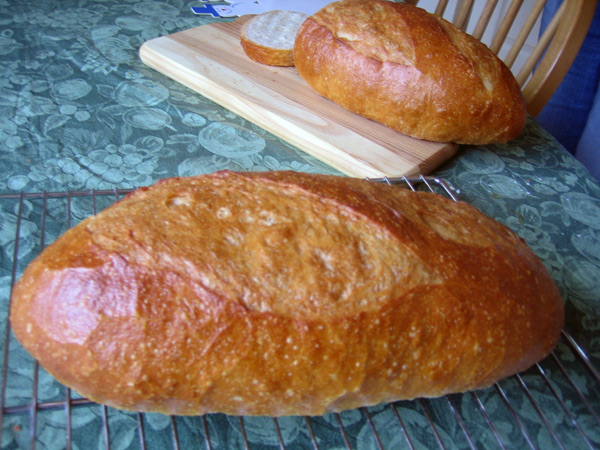
Aside from the fact that I mumble quite a bit, it didn't turn out too bad, did it?
I dunno... what do people think: would more multimedia content on the site be useful? I tried to do a vid of me scoring these loaves too, but I ran out of room on the memory card. Still learning how to do this.
Based on watching this one, I would say yes. It is helpful to see a real person doing this task rather than a breadbaking demigod from the King Arthur Education Center. The former is more likely to be closer to the technique that a learner would use. Sorta like younger siblings: they learn to walk by watching their older sib, not adults.
sPh
PS You might want to dub over the adjective you used to describe your kids' activity; perhaps "wild ones" might be better!
It is helpful to see a real person doing this task rather than a breadbaking demigod from the King Arthur Education Center.
Ha ha... baking demigod I am not.
You might want to dub over the adjective you used to describe your kids' activity;
Are you in the UK? I remember the brouhaha in the UK when Tiger Woods used that term on TV. In the States it is about as innocuous a term as you can use. I've heard teachers use it when telling students to settle down. I hear it (or use it) all the time at playgrounds and in kids' playgroups and I've never heard anyone take offence to it. I will try to avoid using it on camera next time though.
And to think I almost called this thread "Let's Get Batarded" after the politically incorrect Black Eyed Peas song with a similar title.
This video was great. I absolutely think more content like this would be helpful. I'm still very much a novice and devour every bit of information I can glean from this site.
What kind of equipment did you use to create the video? Maybe other experienced users would be able to create videos to share with everybody on this site?
He just used a regular camera - My camera has a video option in it (Canon A610) so he mounted it on a tripod since I was busy trying to keep the kids out of his way :)
If other folks could make and post videos I would be estatic. I'll do what I can, but I'm certainly not the best baker on this site.
If people include the YouTube links to their videos I can edit their posts to embed the videos. I fear opening up the ability to embed object into the site because who knows what kind of.. umm... "interesting" videos might begin showing up. Not posted by any of the actual site users, but I get a lot of spambots trying to post content here, much of it is NSFW.
I could also grant individual users the ability to embed videos, I think, so if anyone is interested in doing that regularly, just let me know.
Hey there. I put together an OK video on making Portuguese Sweet Bread and I'm having a heck of time trying to get it to look decent on YouTube. How'd you get yours to look so good? If you wouldn't mind saying, what were the settings you used when you uploaded? Anyways, once I get it up there, I'll be asking you to check it out to see if you think it would be good for here. Thanks, and I enjoy this site of yours.
I think I uploaded it at a pretty high resolution and file size. YouTube recompresses whatever you send them, so the higher the better.
Certainly, if you put together a video, post it here. I currently don't allow embeds by default... I feared spammers could use that to include something extremely inappropriate... but if you post a link to your video I will edit the post to include the embed (assuming that is what you'd like me to do).
That was great video. Reading about shaping a batard would not be near as much help as your video. And that bread is so beautiful may I ask what recipe you used? weavershouse
A simplified rustic bread.... basically my daily bread with about 10% whole wheat flour. I totally winged it on the measurements, so I have no idea what the final hydration was.
I think the video is great and more videos on the site would be even better. Sometimes it's so hard to accurately describe so many things about dough, I believe this stems from the fact that it is a living thing. Anyway, these sort of information is awesome not to mention the inspiration it gives me to makes come batards.
Great video Floyd. I have pain au levain near the finish of the first fermentation so I will so be doing the preshaping and then the shaping. I will be using the video as a reminder of the correct way to shape the batard.
I took a class with Hamelmann a few months ago and will be doing it again next month. Your technique is almost identical to what he showed us. BTW, he was very open and willing to share information and answer any questions we had.
I too would love to see a video on slashing as that is a challenge for me. I will try to post pictures of my bread after it is done.
I took a class with Hamelmann a few months ago and will be doing it again next month. Your technique is almost identical to what he showed us.
Heh... because just off camera I had his book open to the shaping diagrams, which are incredibly helpful. 8^)
I'm sure Hamelman can crank 'em out in a quarter of the time that I can and make them a heck of a lot nicer, but, once again, that is part of what I try to do on the site: show people that you don't have to be a super baker to make good bread.
I think I feel a new site motto coming on: The Fresh Loaf: Lowering the Bar Since 2005
Well I shaped my batards and it was much easier after seeing the video. And indeed I did hear some of the air bubbles popping when I was sealing the seams. I had to go searching in the house for 2 clean garbage bags big enough to cover the baking tins. The usual grbage bags I use have an odor neutralizer and I did not think that it would be good to use with the dough.
I really think that the hydration on this batch seems much wetter though I have not done any different with the scaling. I ended up doing 3 folds with the dough to try to add more strength. The only change I made with the autolyse is that I scaled the water first and then added the flours. I used the paddle attachment on my mixer to do the first mix and switched to the dough hook after I added the salt and lastly the sourdough build. Maybe the order that I add things make a difference. That is a question for Jeffery next month.
I would love to see this video Floydm. How do I see it? I am having trouble with the hydration of dough to get an open crumb and am thinking your video may show the correct texture of the dough.
Thank you for making this video! I havent actually had a chance to read much about shaping loaves in my new BBA, but YOur vidoe has made me a little more mindful of reading them and trying them out. I will be referring to it and BBA next time I make bread :)
It was great to see someone do it live - it's so hard to visualize what people mean reading it in a book. Would love to see more. Slashing definitely. I always squish my bread way too much when slashing. I like the title "Let's Get Batarded," that's funny. And my kids are spazzy, too. =)
I, like so many others, want to see a slasher flick next. One thing your video has made really clear to me is that many of my batards have been way too dry.
Thanks for such great instruction and for the invitation to share what we're doing.
Floyd or anyone - I made some sourdough batards today copying your technique here and it seemed to work great, but my question is: is it always good practice to degas the dough before folding into a batard? I know it is supposed to even out the crumb, but when I did mine today, even though I let them proof enough, the crumb was even but the holes were smaller than I typically like to get. Previous to using this technique I used to GENTLY fold the dough 3 or 4 times during first fermentation but then handled it very little when shaping so as not to degas it, and I got nice big holes. Is this just personal preference, or dependent on the type of bread, or are large uneven holes not actually desireable (I always thought they were for rustic artisan bread?). Opinions?
I'm in agreement with you that uneven holes are good in artisan bread and that you typically shouldn't degas the dough much when shaping. I certainly didn't mean to suggest that you should completely degas the dough when shaping a batard because, you are right, you'll end up with a very even, dull crumb. Good for sandwich bread, not good for artisan bread.
But I've also found that if you have a fully developed dough and don't degas it some while shaping you don't get much of a final rise. If anything, when I've been too gentle shaping I've ended up with an underfermented dough that doesn't even brown much in the oven. So... I guess it depends on the state of your dough going into the shaping. If it is fully developed, I believe you should degas it some (not completely) to break down some of the bonds to give the yeast something new to feed on. If you dough isn't yet fully developed, folding and not degassing at all is the way to go.
I certainly would say that if you have a technique that delivers a result you like, stick with it. And if you are adventurous, take some video of it and share it with us!
Floyd,Sorry if this is a silly questions but why is it that we want our bread to be full of holes? Does the bread taste better or do we love the olive oil running down our chin? I always try for lots of holes in my bread but I guess I don't really know why. There have been times when I've given good bread full of holes away to someone and I can see when they cut open the loaf they are wondering about the holes. Like maybe I can't get it right. Some are only used to store bought dead bread. They do love it when they taste it though. weavershouse
Um... good question, and I'm not sure I can answer adequately.
My hypothesis is that we may be confusing cause and effect. Slow, long fermentation leads to better tasting bread and also creates an uneven crumb. So I think bakers tend to see an uneven crumb as a visual cue that their bread is good. But, yes, then people tend to strive for uneven crumb without knowing why it is good or see uneven holes as an end unto themselves. And you are certainly right that there are times when an uneven crumb is highly inconvenient: good bread comes in many shapes and sizes, and not all breads are well suited for all uses.
Thanks for the quick reply. I think you're right...I'm looking for an uneven crumb without thinking about what I'm doing to get it. What I'm doing is what's making a tasty loaf...the holes are just the proof. weavershouse
Floyd - you're batard video was great and I just got confused, I was also reading Emily Buehler's book yesterday where her shaping technigues are very similar and I misunderstood about the level of de-gassing that should occur. Anyhow, the breads still taste great and are still pretty hole-y. (I like the Buehler book, by the way, great details on starter creation and influence of slashing on final shape).
For the WHY of big holes: I pulled out BBA last night and re-read a few sections -amazing how many things you can forget in such a short time! According to BBA, the desireability of large holes is for more intense flavor, which I do detect in my hole-ier breads:
"Much of how a bread's flavor develops through the three oven reactions is determined by the quality of the final rise. As noted throughout, crusty lean breads are improved by retaining a large, irregular hole structure, or crumb. The larger the holes, the easier it is to evaporate the moisture out of the loaf while it is baking, thus intensifying flavor by deeper roasting of the proteins and the fullest possible gelatinization of the starches." BBA, p. 101.
So much of what I have learned in my quest to become a baker have been from watching videos. They say a picture is worth a thousand words but a video really shows the subtle quality's of the dough and procedures. I remember when I first saw the French fold video how I instantly understood how the gluten was being affected. I think it's very hard to describe the nature of a dough in static words. The "tacky but not to sticky" is hard to get a handle on until you see it in motion. The video clips cooky mentions below are excellent references also. I liked your Battard video and especially liked seeing the finished loaf to see how the spring worked out.
I was going to say that it's hard to find video clips but I just searched for "Video" and see there is a nice selection of video's to choose from. Nice job Floyd!
Floyd, the videos are terrific, both this and the slasher flick. I drive myself nuts trying to shape and slash loaves properly, so actually seeing someone else do it is an education worth staying up late for.
I also liked the shaping/slashing videos at http://lepetitboulanger.com as well as the Danielle Forestier videos at the Julia Child Master Chefs series (http://www.pbs.org/juliachild/video.html). Each shows somewhat different techniques than Floyd demonstrated, altough the basic concepts seem to be the same.
One thing was notably different; the French didn't seem much concerned about knocking the gas out of the dough. Both started with dough flattened to the thickness of maybe a pizza crust. Danielle Forestier actually demonstrates how she smacks the dough flat with her open hand before shaping. That did seem to make the multiple fold-and-seal steps a little easier - and did not seem to sacrifice open crumb structure at all. That surprised me, because I had been operating under the notion that open crumb could only be had with minimal handling during the shaping process.
I have tried to reproduce the Forestier technique, with pretty pathetic results. But it was a first try, so I 'll keep at it. And if I ever manage to get past the accidental-comedy stage, I might even make a video!
Anyway, thanks again, Floyd, for the videos and, you know, everything. You are the rock star of bread people!
Re: shaping a batard video
> I dunno... what do people think: would more
> multimedia content on the site be useful?
Based on watching this one, I would say yes. It is helpful to see a real person doing this task rather than a breadbaking demigod from the King Arthur Education Center. The former is more likely to be closer to the technique that a learner would use. Sorta like younger siblings: they learn to walk by watching their older sib, not adults.
sPh
PS You might want to dub over the adjective you used to describe your kids' activity; perhaps "wild ones" might be better!
Vid and term
It is helpful to see a real person doing this task rather than a breadbaking demigod from the King Arthur Education Center.
Ha ha... baking demigod I am not.
You might want to dub over the adjective you used to describe your kids' activity;
Are you in the UK? I remember the brouhaha in the UK when Tiger Woods used that term on TV. In the States it is about as innocuous a term as you can use. I've heard teachers use it when telling students to settle down. I hear it (or use it) all the time at playgrounds and in kids' playgroups and I've never heard anyone take offence to it. I will try to avoid using it on camera next time though.
And to think I almost called this thread "Let's Get Batarded" after the politically incorrect Black Eyed Peas song with a similar title.
Shaping a Batard Video Helpful
This video was great. I absolutely think more content like this would be helpful. I'm still very much a novice and devour every bit of information I can glean from this site.
What kind of equipment did you use to create the video? Maybe other experienced users would be able to create videos to share with everybody on this site?
He just used a regular
He just used a regular camera - My camera has a video option in it (Canon A610) so he mounted it on a tripod since I was busy trying to keep the kids out of his way :)
Other people posting vids
If other folks could make and post videos I would be estatic. I'll do what I can, but I'm certainly not the best baker on this site.
If people include the YouTube links to their videos I can edit their posts to embed the videos. I fear opening up the ability to embed object into the site because who knows what kind of.. umm... "interesting" videos might begin showing up. Not posted by any of the actual site users, but I get a lot of spambots trying to post content here, much of it is NSFW.
I could also grant individual users the ability to embed videos, I think, so if anyone is interested in doing that regularly, just let me know.
looking to post a video, Floyd
Floyd,
Hey there. I put together an OK video on making Portuguese Sweet Bread and I'm having a heck of time trying to get it to look decent on YouTube. How'd you get yours to look so good? If you wouldn't mind saying, what were the settings you used when you uploaded? Anyways, once I get it up there, I'll be asking you to check it out to see if you think it would be good for here. Thanks, and I enjoy this site of yours.
-Mark
http://thebackhomebakery.com
Posting vids
I think I uploaded it at a pretty high resolution and file size. YouTube recompresses whatever you send them, so the higher the better.
Certainly, if you put together a video, post it here. I currently don't allow embeds by default... I feared spammers could use that to include something extremely inappropriate... but if you post a link to your video I will edit the post to include the embed (assuming that is what you'd like me to do).
not yet video
Floyd,
Thanks, I'll let you know when it's ready, then that'd be great if you could embed it.
-Mark
http://thebackhomebakery.com
yes more video
yes more video please!!!!!
that was wonderful. And that bread looks so totally yummy.
So yes, more video please!
April
great video
That was great video. Reading about shaping a batard would not be near as much help as your video. And that bread is so beautiful may I ask what recipe you used? weavershouse
A simplified rustic bread
A simplified rustic bread.... basically my daily bread with about 10% whole wheat flour. I totally winged it on the measurements, so I have no idea what the final hydration was.
agree-video was great
Floyd the video was great, and would love to see a slashing lesson done by a home baker next!
I love videos
I think the video is great and more videos on the site would be even better. Sometimes it's so hard to accurately describe so many things about dough, I believe this stems from the fact that it is a living thing. Anyway, these sort of information is awesome not to mention the inspiration it gives me to makes come batards.
demegrad
http://www.demegrad.blogspot.com
Video
Great video Floyd. I have pain au levain near the finish of the first fermentation so I will so be doing the preshaping and then the shaping. I will be using the video as a reminder of the correct way to shape the batard.
I took a class with Hamelmann a few months ago and will be doing it again next month. Your technique is almost identical to what he showed us. BTW, he was very open and willing to share information and answer any questions we had.
I too would love to see a video on slashing as that is a challenge for me. I will try to post pictures of my bread after it is done.
Rena in Delaware
Hamelman's technique
Great video Floyd.
Thank you.
I took a class with Hamelmann a few months ago and will be doing it again next month. Your technique is almost identical to what he showed us.
Heh... because just off camera I had his book open to the shaping diagrams, which are incredibly helpful. 8^)
I'm sure Hamelman can crank 'em out in a quarter of the time that I can and make them a heck of a lot nicer, but, once again, that is part of what I try to do on the site: show people that you don't have to be a super baker to make good bread.
I think I feel a new site motto coming on: The Fresh Loaf: Lowering the Bar Since 2005
Batards
Well I shaped my batards and it was much easier after seeing the video. And indeed I did hear some of the air bubbles popping when I was sealing the seams. I had to go searching in the house for 2 clean garbage bags big enough to cover the baking tins. The usual grbage bags I use have an odor neutralizer and I did not think that it would be good to use with the dough.
I really think that the hydration on this batch seems much wetter though I have not done any different with the scaling. I ended up doing 3 folds with the dough to try to add more strength. The only change I made with the autolyse is that I scaled the water first and then added the flours. I used the paddle attachment on my mixer to do the first mix and switched to the dough hook after I added the salt and lastly the sourdough build. Maybe the order that I add things make a difference. That is a question for Jeffery next month.
Rena in Delaware
video by floydm
Where is this video by floydm?
I would love to see this video Floydm. How do I see it? I am having trouble with the hydration of dough to get an open crumb and am thinking your video may show the correct texture of the dough.
Finding the video
The video is embedded in this page, at the top. Click on the big play button.
You can also watch it over at YouTube.
FLoyd thats wonderful! Thank
FLoyd thats wonderful!
Thank you for making this video! I havent actually had a chance to read much about shaping loaves in my new BBA, but YOur vidoe has made me a little more mindful of reading them and trying them out. I will be referring to it and BBA next time I make bread :)
Thanks again Floydm!
Neat Floyd. I'm anxious to
Neat Floyd. I'm anxious to see your slashing video when you get it.
gt
loved it!
It was great to see someone do it live - it's so hard to visualize what people mean reading it in a book. Would love to see more. Slashing definitely. I always squish my bread way too much when slashing. I like the title "Let's Get Batarded," that's funny. And my kids are spazzy, too. =)
Kate
More video, pleas
Great video, Floyd.
I, like so many others, want to see a slasher flick next. One thing your video has made really clear to me is that many of my batards have been way too dry.
Thanks for such great instruction and for the invitation to share what we're doing.
Sylviambt
In search of the perfect crust & crumb
batard degassing question
Floyd or anyone - I made some sourdough batards today copying your technique here and it seemed to work great, but my question is: is it always good practice to degas the dough before folding into a batard? I know it is supposed to even out the crumb, but when I did mine today, even though I let them proof enough, the crumb was even but the holes were smaller than I typically like to get. Previous to using this technique I used to GENTLY fold the dough 3 or 4 times during first fermentation but then handled it very little when shaping so as not to degas it, and I got nice big holes. Is this just personal preference, or dependent on the type of bread, or are large uneven holes not actually desireable (I always thought they were for rustic artisan bread?). Opinions?
Degassing
I'm in agreement with you that uneven holes are good in artisan bread and that you typically shouldn't degas the dough much when shaping. I certainly didn't mean to suggest that you should completely degas the dough when shaping a batard because, you are right, you'll end up with a very even, dull crumb. Good for sandwich bread, not good for artisan bread.
But I've also found that if you have a fully developed dough and don't degas it some while shaping you don't get much of a final rise. If anything, when I've been too gentle shaping I've ended up with an underfermented dough that doesn't even brown much in the oven. So... I guess it depends on the state of your dough going into the shaping. If it is fully developed, I believe you should degas it some (not completely) to break down some of the bonds to give the yeast something new to feed on. If you dough isn't yet fully developed, folding and not degassing at all is the way to go.
I certainly would say that if you have a technique that delivers a result you like, stick with it. And if you are adventurous, take some video of it and share it with us!
Why are holes in bread good?
Floyd,Sorry if this is a silly questions but why is it that we want our bread to be full of holes? Does the bread taste better or do we love the olive oil running down our chin? I always try for lots of holes in my bread but I guess I don't really know why. There have been times when I've given good bread full of holes away to someone and I can see when they cut open the loaf they are wondering about the holes. Like maybe I can't get it right. Some are only used to store bought dead bread. They do love it when they taste it though. weavershouse
Why big holes
Um... good question, and I'm not sure I can answer adequately.
My hypothesis is that we may be confusing cause and effect. Slow, long fermentation leads to better tasting bread and also creates an uneven crumb. So I think bakers tend to see an uneven crumb as a visual cue that their bread is good. But, yes, then people tend to strive for uneven crumb without knowing why it is good or see uneven holes as an end unto themselves. And you are certainly right that there are times when an uneven crumb is highly inconvenient: good bread comes in many shapes and sizes, and not all breads are well suited for all uses.
That's my take. Anyone else have an opinion?
Ahh, good answer.
Thanks for the quick reply. I think you're right...I'm looking for an uneven crumb without thinking about what I'm doing to get it. What I'm doing is what's making a tasty loaf...the holes are just the proof. weavershouse
Why big holes according to BBA
Floyd - you're batard video was great and I just got confused, I was also reading Emily Buehler's book yesterday where her shaping technigues are very similar and I misunderstood about the level of de-gassing that should occur. Anyhow, the breads still taste great and are still pretty hole-y. (I like the Buehler book, by the way, great details on starter creation and influence of slashing on final shape).
For the WHY of big holes: I pulled out BBA last night and re-read a few sections -amazing how many things you can forget in such a short time! According to BBA, the desireability of large holes is for more intense flavor, which I do detect in my hole-ier breads:
"Much of how a bread's flavor develops through the three oven reactions is determined by the quality of the final rise. As noted throughout, crusty lean breads are improved by retaining a large, irregular hole structure, or crumb. The larger the holes, the easier it is to evaporate the moisture out of the loaf while it is baking, thus intensifying flavor by deeper roasting of the proteins and the fullest possible gelatinization of the starches." BBA, p. 101.
Love the slasher video too, thanks!
Video tutor
Floyd,
So much of what I have learned in my quest to become a baker have been from watching videos. They say a picture is worth a thousand words but a video really shows the subtle quality's of the dough and procedures. I remember when I first saw the French fold video how I instantly understood how the gluten was being affected. I think it's very hard to describe the nature of a dough in static words. The "tacky but not to sticky" is hard to get a handle on until you see it in motion. The video clips cooky mentions below are excellent references also. I liked your Battard video and especially liked seeing the finished loaf to see how the spring worked out.
I was going to say that it's hard to find video clips but I just searched for "Video" and see there is a nice selection of video's to choose from. Nice job Floyd!
Degassing, shaping, slashing -- and videos!
Floyd, the videos are terrific, both this and the slasher flick. I drive myself nuts trying to shape and slash loaves properly, so actually seeing someone else do it is an education worth staying up late for.
I also liked the shaping/slashing videos at http://lepetitboulanger.com as well as the Danielle Forestier videos at the Julia Child Master Chefs series (http://www.pbs.org/juliachild/video.html). Each shows somewhat different techniques than Floyd demonstrated, altough the basic concepts seem to be the same.
One thing was notably different; the French didn't seem much concerned about knocking the gas out of the dough. Both started with dough flattened to the thickness of maybe a pizza crust. Danielle Forestier actually demonstrates how she smacks the dough flat with her open hand before shaping. That did seem to make the multiple fold-and-seal steps a little easier - and did not seem to sacrifice open crumb structure at all. That surprised me, because I had been operating under the notion that open crumb could only be had with minimal handling during the shaping process.
I have tried to reproduce the Forestier technique, with pretty pathetic results. But it was a first try, so I 'll keep at it. And if I ever manage to get past the accidental-comedy stage, I might even make a video!
Anyway, thanks again, Floyd, for the videos and, you know, everything. You are the rock star of bread people!