
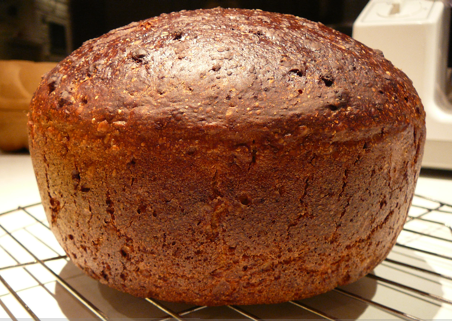
I've been playing with rye loaf ratios (starter/water/flour) and I came up with one using any amount of rye starter that when refreshed is a paste (100% hydration) and as it ferments loostens to a thick batter. I was looking for basic numbers (like 1/2/3) and I found them they're 1/ 3.5/ 4.16. It makes Rye so much easier! The starter should be generously refreshed 8-12 hours before and mixed into the dough just before peaking and in a 22°c room (72°F) the dough ferments 7-8 hours before baking. Dough should not be folded or shaped 4 hours before going into the oven.
Basic Ratio> 1 part starter: 3.5 parts cold water: 4.16 parts rye flour
4 tablespoons bread spice for 500g flour Salt 1.8 to 2% of flour weight
Hydration of dough aprox 84%. Handle dough with wet hands and a wet spatula. Combine starter and water then the flour, stir well and let rest covered. Add salt about one hour after mixing and any other ingredients. If room is warmer add salt earlier. Three hours into the ferment lightly fold with wet hands and shape into a smooth ball. Place into a well floured brotform or oiled baking pan. Cover and let rise. Don't let it quite Double for it will if conditions are right. Before placing in the oven, use a wet toothpick and dock the loaf all over to release any large bubbles. Bake in covered dark dish in cold oven Convection 200°C or 390°F (oven can reach 220°C easy with the fan on.) Remove cover after 20 to 25 minutes and rotate loaf. Reduce heat by simply turning off convection and use top & bottom heat at 200°C. Remove when dough center reaches 93°C or 200° F.
All kinds of combinations are possible including addition of soaked & drained seeds and or cooked berries or moist altus and whole or cracked walnuts or a little spoon of honey.
How it works: I have 150g rye starter at 100% hydration. I figure for water: 150 x 3.5 gives the water amount or 525g. I figure the flour: 150 x 4.16 gives 624 g Rye flour. For salt: 2% of 700g (624g + aprox. 75g in the starter) makes salt 14g or one level tablespoon of table salt.
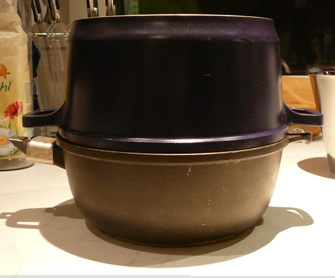
This amount of dough took 1 1/2 hours to bake and included moist rye altus. It was baked in two non-stick cast aluminum sauce pans (20cm diameter) one inverted over the other . The rounder of the two on the bottom. No steam other than what was trapped inside. Top removed after 25 minutes. It has a beautiful dark crust with a light shine. Aroma is heavenly.
- Mini Oven's Blog
- Log in or register to post comments
Mini-if I'm reading this correctly-this is a 100% rye bread made with a rye starter? Or, is the flour that you add white or another flour and you use a rye starter with it?
I'd like to try it, just trying to make sure I understand it first.
Tracy
All the flour in the recipe is rye flour. I used 960 in our Austrian/German flour system. I hope you do try it. I've been playing around with hydration and there seems to be a magical amount where the rye structure stretches. The dough rises so nicely, slowly but lovely. I need to make a crumb shot and I'm waiting for better light.
When working with the dough, have the faucet just dribbling so you can get your hands wet as soon as they start to stick. A little stickiness is good or the dough will separate into globs. Then time to back off the water if that starts to happen. You should be able to fold the dough gently in the air. Folding is a little overstated, it's more like just tucking and sealing the tuck or two. I just love to get my hands into it. To loosen the dough from the bowl, sprinkle just a teaspoon of water around the edges between the dough and the bowl. Then run a wet spatula down the sides and eventually the bottom. A little water makes it all so slippery to flip out into your wet hand. Wet the other hand (the one finished using the spatula) and then play a little. It is such a mass of goo! If it runs thru your fingers and you can't hold it, then it is too thin and needs more flour. That's better done in a bowl with a sturdy spoon. I tend to start out with a firmer dough as time will soften it, that and wet hands.
If you want to substitute some of the rye flour for wheat or spelt, mix the substitution into the starter & water first for a few minutes before adding the rye to get the gluten going. Salt plays a major roll in the timing. If you go no salt, the dough will ferment faster and surely be ready for the oven under 5 hours. I prefer not to rush it. Salt free dough should then be retarded in the refrigerator after one hour of room temp. I have not ventured yet in this direction but I had forgotten the salt... once. Always a learning experience. Now I set a timer.
The altus I used was about 4 thick slices of whole Rye broken and bashed up in the blades of a food processor. (Yes it was fun!) Added a tablespoon of water to make them moister. You can actually see darker crust bits in the crumb shot.
Mini
I wonder if I can use a little deli rye for the altus? I'm not sure I've ever even tasted whole rye bread? Maybe those little tiny loaves they sell for appetizers in the deli? I've been wanting to try a 100%, getting back to my Finn roots, this looks like a good one to start with.
Even if nobody eats it but me, it's still fun to experiment with. What the heck. Dog classes start next week. If nothing else, my dog can eat 100% whole rye, she's on a non-wheat diet!
What spices do you use? Fennel, honey?
of roasted and crushed Fennel, Coriander, and Caraway. I think Coriander makes up the bulk of the mixture. If you use ground spices it would be better to use less as it is more compact.
I didn't add honey directly, there was a tiny bit in the altus loaf. Any tasty old bread works as long as it's not questionable or moldy or has off tastes. Once I baked a loaf that came out salt free... forgot the salt. After a few Tuscan meals, it got crumbled and dried for altus. I do prefer some rye in the altus but I wouldn't go out of my way to purchase bread just to crumble up into this loaf. With this recipe, I have also removed about 100g of rye and replaced with bread flour then adding about a Tablespoon of water. Works well! The grain alone is naturally sweet for my tastes and I don't see any need to add sweetener.
Oven Temp. I also just noticed I forgot to write I turned down the oven temp after removing the cover while baking by simply turning the dial from convection to upper&lower heat. I will have to sneak that into the main recipe.
I have also much success using this ratio and switching the flours around. Today is 150g sourdough, 525g water, 690g flour (200g Wheat Bread Flour +500g Rye) 12.5g Salt and 150g broken roasted walnuts. From mixing up the starter/water/flour together (same routine as above) to placing into the oven took 7.5 hours. I guess this is close to a 70% Rye loaf. It sure is looking beautiful in the oven. Rising nicely at 210°C or 410°F Steamed the first 10 minutes then vented the oven. (I am now using a Korean Steam Mini-Oven for this loaf.) Baked for an hour or until inside temp is 96°C or 205°F. This is a larger 24cm pan and therefore a flatter loaf is the result. Wish you could smell this, you will have to settle with crumb shots. Bottoms up!
You can see why I never knew for the longest time that walnuts turned the dough purple...
Mini
Would be tasty with cheese and not only... wonderful loaf Mini.... ;-)
I went to bake today, doubled the recipe. I figured out the ratio first on paper, then I was looking at notes tacked on the cupboard door. (The quick notes to save time. I have the ratio and it has the grams for 120g starter 150g, 170g and so on....) Something is wrong with my math. Then I looked at the ratio at the top... I had written the wrong numbers. I kept wondering why I was adding more water when I used the cupboard notes... (thought it was the bread flour in substitutes and that was constantly changing) when mixing in the salt and couldn't keep the salt amount constant. I had written 4.6 flour instead of 4.16 flour. Gee wizz! At least I wrote it in the reports what I did even if it wasn't the right ratio. The original ratio works best.
The error is in the recipe above. I have 690g of flour instead of 624g. And nobody noticed! My cheat sheet in the cupboard is being revamped! I'm looking down this Blog for more errors. No worry. Haven't found any more.
Mini
I hate it when I do that! But it proves (no pun intended) that even with casual measurements, the dough still becomes bread.
-Elizabeth
"Salt free dough should then be retarded in the refrigerator after one hour of room temp."
My quote and I have to say, I now question retarding in the refrigerator may not work with 100% rye dough. Although this was mentioned in context with substituted flours which may work. Until I have investigated it more, I was attributing more wheat characteristics onto rye. See threads with same dates way down the thread. Rye doughs of 100% seem to have difficulty rising after retardation in a refrigerator.
Mini
I figured a pullman pan might work well for this recipe since it's covered. Plus, it will fit well in the RV oven. Let me know if you think that's a bad idea. I'm going to try it next week when I get the pan. If it's a good bread I'll bake a second one to send to my friend in TX. He lived in Denmark and Germany for 13 years and misses his dense rye breads. He hates US pumpernickel from the store.
I'll be mixing up your bread spices for the bread too. Got to make it authentic! Plus, will save some altus from my eric's fav.
Hi Mini,
I'm not sure what you mean by the following:
The starter should be generously refreshed 8-12 hours before and mixed into the dough just before peaking and in a 22°c room (72°F) the dough ferments 7-8 hours before baking. Dough should not be folded or shaped 4 hours before going into the oven.
Is that before the dough peaks or the starter?
When combined it then has to sit for 7-8 hours, correct?
Do you wait until the 7-8 hour rising to complete before shaping/folding or halfway through the raising process and then let it finish raising?
Also have a question about the starter, are you refreshing it everyday until you have enough for the recipe?
Thanks, I'm hoping the second loaf is successful as my first was an epic fail.
Tammy
Hi Tammy,
Maybe it should read:
The starter should be generously refreshed 8-12 hours before and mixed into the dough just before peaking. In a 22°c room (72°F) my dough ferments 7-8 hours before baking. Dough should not be folded or shaped 4 hours before going into the oven. This would mean the dough should be shaped while there is strength in the matrix. These times are based on the starter speed, should your rye starter normally peak sooner, adjust your dough times so that your loaf is proofed before it would rise too much. Dough should be handled before it reaches half way to peaked volume.
When combined it then has to sit for 7-8 hours, correct?
No. That would be way too long. What rye flour are you using? What details do you have of the last refresh or feeding, when and how high was the last peak?
Do you wait until the 7-8 hour rising to complete before shaping/folding or halfway through the raising process and then let it finish raising?
No, My dough will be shaped around the three hour mark. After it has bulk risen and increased volume by about one third.
Also have a question about the starter, are you refreshing it everyday until you have enough for the recipe?
No. I keep my starter stored in the fridge. I inoculate the amount of flour I need for the recipe the night before. I refresh the mother starter when I run out or it is getting old or it looses ooomph. Then it gets a complete cycle of feeding and rising to peak to check on its health, aroma etc before another feeding, partial rise , to store back into the fridge.
Thanks, I'm hoping the second loaf is successful as my first was an epic fail. What exactly do you mean by fail? Perhaps more detail could help find the problem before the next bake.
do with other enzyme activities going on. The dough breaks down faster without salt. It gives a longer window of workability if introduced at the correct time.
I just bought more of the same wholemeal rye flour and it's not 960, looks like it has a higher ash content, closer to 1060. I was just looking for my reference chart but I think it's here at this link. Scroll to the bottom of the page. How interesting, looks like a light rye but it is whole rye. It is ground very fine like powder. No coarseness. But Rye with a little grit ought to work too. The higher the number, the darker it is, the more protein it contains along with roughage and minerals. I don't think I've seen it here at less than 960 -- seems to be the average in Austria.
Mini
Sounds wonderful Mini,
Can't wait to see the images. Can you give us an approximation of the spices you used? I think that is one area that has a huge impact on the aroma and flavor and yet outside of Austria and Germany are virtually unknown. Maybe now would be a good time to try and work out a formula for that spice mix.
Eric
Eric,
Mini talks about the spice mix in this posting from a few years ago.
http://tfl.thefreshloaf.com/node/1012/spices-bread
Start with 2% like salt and go up to 3%. That is what I can gather. I looked at 15g of spice and would say, yes, that's about what I threw in maybe a little bit more. Here's a blown up photo of the open jar, as you can see it is lightly crushed, enough to pop open some seed pods but certainly not a powder...
:) Mini o spices
"I've been playing around with hydration and there seems to be a magical amount where the rye structure stretches."
Mini,
I bake a lot of rye bread of all types and your sentence about a magical amount reminded me of a perfect rye loaf I made early in my rye career. This was before I was familar with ratios and precentages and I was just blindly experimenting. One of those undocumented experiments came out perfectly. It was a 100% rye with the crumb like a beautifully baked airy whole wheat loaf. I was quite excited about my achievement but regrettably unable to duplicate it. Before perfecting my rye technique I moved on to whole grain wheat.
Your post has reminded me of that perfect rye loaf and I will use your information as a starting point to see if I can recreate that loaf from rye heaven.
Thanks for the inspiration and yet another great post,
Jeff
I seem to be having troubles with my pics so I'll try here...
The loaf measures 12cm high and 19cm across. Not Bad! This is not fluffy but moist and yummy!
And maybe on the 16th try, I'll get another crumb shot in by golly!
yes! I wish the sun had come out but can't control everything...
Wow, all the 100% whole ryes I've seen are dense, like bricks! Yours looks just like the deli rye I just baked yesterday! I'm ready to give this a try. I just love the taste of rye. I hope my flour is not too coarse. It's a pretty coarse stone ground flour.
Amazing bread, mini! Now, if I only had room for two pots in my camper oven I'd be in business.
Remove the handle from a small frying pan if it fits rim to rim. It's not so deep. My lower pan had a removable handle and the top one was more like a little dutch oven with stubby grips. The idea was to block the blowing action of the oven fan and trap in steam so I wouldn't have to physically add steam to the oven. It worked nicely.
I can put a disposable aluminum roaster on top. I can put the dough in a round cake pan. That should all fit in the oven, despite having only a few inches to work with. Might be close but I bet I can do it! I'll give it a try in the next few days, let you know how it works. I have a tiny bit of the heel from my Eric's fav rye and I think maybe another in the freezer from a while ago that I can use as altus.
Today though, I need to use my white starter which was feeling neglected. I think I'm going to do the mixed sourdough or something along those lines from Hamelman's book. We'll see.
From Rainy AZ where we survived our one and only Tornado Warning last night!
Tracy
is this loaf 100% rye?
cut with an electric bread cutting machine.
It's amazing the rise and gas pockets you get with 100% rye.. I so want to make bread like this. Is this due to the high hydration? 84% .. Hamelman's recipe is 76% hydration for 80% rye. I used his recipe and my loaves are more dense.
Even if a 100% rye bread dough doubles in volume during baking, it will still be a firm bread. Dense when compared to many other grains. "Fluff" is not in high rye vocabulary. The trick is to trap the gas and steam in the loaf matrix and get it baked before the integrity is lost. (I actually get more gas pockets with a 80% rye.) And yes, hydration is the key. Knowing your starter is very important. Adding altus helps too.
The whole reason for this formula was to make a high rye loaf simple and flavourful and reasonably as airy as rye can be without the time and envolvement of a 3 or 4 step process. I consider the elaboration of the starter one step and the mixing of the dough the second step. I tend to loose interest if the recipe gets too complicated where there are so many variables to consider. I want at least 6-8 hours of wet time on all the flour in my dough and I want the bread to taste good. The finished bread should be able to stand on its own without any toppings.
Certainly I could turn this into a multi step rye, but why when I can do it successfully this way? This is my window to the world of rye for many intimidated home bakers. If I consider using altus as a step (it is an already baked bread) then it gets more complicated but many of us have some frozen bread or a brick somewhere we want to rework. Crushing that brick and feeding it to the starter is a great way to increase flavour, economize and improve on the next loaf. The downside is making a rye bread so good that there are no left-overs for altus.
I believe Hamelman's recipe is also a free standing loaf. So hydration is lower and with 20% wheat in the recipe, it can maintain a shape without a bread pan. Which recipe (page #) and book are we talking about?
Yeah I know it will be a firm bread, I just like the way your's looks with the holes in it. Looks like it got a really nice rise. I didn't have as much rise making Hamelman's three stage 80% sourdough rye loaf. (I took a picture of it yesterday and uploaded to a forum thread here so you can see.) His loaf is 76% hydration and was wondering if I used higher hydration dough if I would get a better rise. Btw, I wasn't suggesting you turn it into a multi step rye.
to make up the total flour amount helps a great deal in getting a softer more airy crumb. Even with the lower hydration. Get the spelt wet first and let it soak up water for the first 20 minutes before adding the rye flour. Spelt and rye work well together, don't know why, someone with more tech.- know. can probably explain. They seem to me like opposites that attract each other and work well for bread if you're careful to keep control over the spelt. I haven't investigated the parameters yet, too little or too much, but it has led to many surprises in shortening fermentation time and "fluffing"crumb texture. I just don't experiment enough anymore. If you proof with spelt in the dough, don't proof too long, better under-proofed, slash and wait for lots of action in the oven with steam.
Mini, you remind me that several weeks ago I made a preferment with altus alone. The aroma was incredible, extremely intense! (much more than with rye flour alone) and somewhat beery. Something totally new for me. I'll try to use it as starter for the next Mini's bread.
A perfect loaf, and at 100% it must be delicious.
Eric
Mini:
I love you loaf. Thank you for sharing.
Yippee
That is one of the prettiest ryes I have ever seen!
I noticed that you did not give a specific hydration for starters. I imagine that is because of the variety of flours available and the varying consistencies of each. Can you share the general range of starter hydrations that seemed to satisfy your requirements?
I mix my starter using my eyes, feel and ambient surroundings and what I want and expect from a starter. The amounts tend to vary they are not scratched in stone.
I keep a firm starter as basic and back-up. It is mixed very thick, like peanut butter or thicker. It's allowed a few hours at room temp and then put into the refrigerator in a jar with screw on lid, not tightly. After 3 or more days, I can remove spoonfuls from the middle of this starter to refresh/feed and let ferment (8-12hrs) overnight to be used in the morning for mixing into bread dough. It keeps several weeks. (It is not discarded until it has been replaced.)
At the same time... and it happens often I'm playing with several starters at the same time...
If you haven't a firm rye starter, and want one, make one. It doesn't take long, 12 hour feeding schedule... a few days. Take a mature peaking 100% hydration starter, don't thin it with water, and add flour to make a thick paste. Flatten out and let it stand at room temp (between 72°F and 75°F or 21°c and 24°c) covered until it peaks and smells wonderfully sour (it smells like wet flour when just mixed). It will progressively get thinner, stir gently a few times while fermenting, to re-distribute the food and to get to know your goop as it ferments. It will get thick foamy as it rises close to peaking and can hold its own while you slowly stir. Enjoy the aroma and don't forget to sniff it as it ripens. (Caution, addictive! This is how you pleasently get dough on your nose.) A half hour later it starts collapsing as you stir, and that is past the peak, the bubbles go flat and it's high time to feed.
Then take a heaping teaspoon of this, blend with about 30g to 40g of water and enough flour to make another thick peanut butter like paste. This one will be somewhat faster fermenting meaning the yeasts numbers are getting stronger. Repeat every 12 hours.
When the rising process is getting to under 12 hours you can now refresh one more time. Depending on how often you bake, use about one heaping teaspoon for each 100g starter you want to store. Make the paste let it stand room temp for 1-2 hours and refrigerate. Cover loose enough for gasses to escape and tight enough to prevent drying out. Leave it alone for a few days before using.
Preparation for baking. I take a heaping teaspoon (10g) of firm starter for every 100g of starter I want to make (or keep a spoonful (10g) and the dirty jar of a newly refreshed just before peaking starter.) I tend to mix it like a firm starter but just a little bit thinner. If I want it sooner (under 8hrs) I add a little more water. The wetter it is, the faster it goes off or peaks but the harder it is to "read" when it is ready. I decide if it's ready more from smell and bubble activity than from height. If I'm going early to bed, I mix it a little thicker to give it more food, slowing it down so it makes the 12 hours easily. (There is no point in making a faster starter, if I want to have a good nights sleep and enjoy my breakfast and enjoy my bread. My starters work for me, not the other way around. A bakery on the other hand may want a faster starter, then by all means push it to an 8 hour schedule, that's seems to be the limit without suffering too much loss of Lacto beastie activity.)
If you figure out the hydration, please contribute. I don't have any more rye flour to experiment with because I'm busy using up stocks as I'm packing to travel again. The last of my rye went to put my starter into deep sleep for a 3 month nap. A starter awaits me in Korea. It's been asleep since November.
BTW, I found these steam ovens just for you :)
http://www.twenga.de/dir-Haushaltsgeraete,Backoefen-und-Zubehoer,Dampfbackofen
They sure are a pricey bunch!
I got quite a deal in Korea, dispite the fact that I can't read the instruction book and all the buttons are written in Korean. Everytime I go back to it, it takes me a few days to remember the basics. My husband doesn't even use the oven when I'm gone. He wanted me to buy the one with the mirowave built in as well but I was worried I would zap a loaf instead of baking it. It is tricky enough trying to figure out if I have steam or not, convection or not, and I don't know if I can turn on just lower or upper heat. I can look at the pictures of food and take a wild guess. I found the dough proofing setting by accident. And strange enough, a few typos!
In Austria, I have, believe it or not, an Amana Oven under the "Perfekt" line. When I purchased it, the sales lady said it was a "no name" brand. "Oh really?" I matter of factly replied, trying not to show the twinkle in my eyes. I took it off their hands, morbidly discounted. It is a wall model, convection, all the oven combos and simple nobs and timer, comparable with a Miele. Only draw back is that it takes a long time to pre-heat for its size and a Miele is better insulated. I do better with convection and a bread capsule. It is more economical too.
Yesterday I was baking spelt buns and decided to pour a little water between the parchment and the baking tray, sort of "floating the buns" to try a different steaming approach. Well I rotated the pan and let the steam out of the oven, did get a good rise, but when I checked to see if the buns were brown on the bottom, the little buns stuck to the parchment. Got flat bottoms that way. They browned nicely for I left them in for another 5 min. because of the sticking. The buns did come off but not as easily as they should have. One bun tore in half as I pulled on it with the oven mitt. Oops! I then slid the whole sheet of parchment to the cooling rack and pulled them easily off later. Chalk that up to parchment peculiarities!
I am still enjoying the last of this Rye in the toppy top most photo. It was a big loaf! The photo shows it lighter in colour than it really is. The flavour is so nutty rich and the crumb has not dried out yet. Lovely with just a scrape of butter. No signs of invading anything on any surface. It wouldn't surprise me if my overnight starter was also 84% hydration. I will check on that after Ground Hog's day.
Mini
I started out with a liquid starter, most of us do when we start out, demanding little starter... always hungry and easy to spill and slop around!
I converted to a firm starter after seeing JMonkey's articles on firm starters. That first firm starter seemed much more stable and seemed to take care of itself. I could break the chains that demanded so much attention. I fell in love and haven't looked back.
I think of water as a mode of beastie transportation. I use it the way I want to but water does create empty spaces between the food and the beasts (the yeasts are very capable of reaching the food, but the LABs tend to let the food come to them.) It's the amount of flour that feeds the beasts not the amount of water. A big jar of water that contains one cup of flour and 1 million beasts is equal to a small jar of water that contains a cup of flour and 1 million beasts. More liquid does not mean more yeast. Increasing the flour provides more food and the numbers increase as a natural reaction to an abundant food supply. More flour and activity (the starter matures within a 8-12 hour time frame) means more yeasts.
If the starter uses less water, it does have a direct relationship to dough formation... more water or liquid must be added to a dough recipe just to have enough water to make the flour come together. In using a more liquid starter, little or no water is added in the dough recipe. ...Always something more to think about...
Mini
do you mean this article? http://www.thefreshloaf.com/node/1040/lesson-squeeze-more-sour-your-sourdough
I don't see all the pictures that used to be in there. There might be an older article on firm starters as well. I am always amazed by all the wonderful contributions from so many people.
comes second to bread spice sniffing... LOL (wickedly)
I appreciate your rich description of your starter process. You are so much more of an intuitive baker than I am at this point that I learn a lot from your approach. I have been using a "George Greenstein" derived 100% rye sour for most of my rye baking, and it will be an interesting challenge to try your methodology.
Jessica
Mini, would a cast iron dutch oven work for this bread? They get so hot, I just didn't know.
Syb
Cast iron tends to burn stuff when it's pre-heated. Two cast iron frying pans would also work if they fit together well. I used a cold oven, most pans or casserole will work. As the iron heats up, the dough rises and the iron transfers heat to the dough to bake it. It may take an extra 30 minutes or so, just add it to the baking time (and subtract from the final proofing time to prevent over-proofing.)
That is why the cover is so important, it not only traps in steam but also prevents the top of the dough from drying and baking before the rest of the dough. If left open (with convection or upper heat element on) a hard crust would develop and it would brown or burn before the bottom finished baking, resulting in a stunted loaf with a light raw bottom.
Mini
Thanks, Mini. I'm trying to work up the self confidence to try your 100% Rye. I've done only one rye formula before, and it turned out a dismal mess. Of course, I had no idea you treated rye any differently than regular bread flour. You make it sound so easy. Soon.
Syb
That first experience with rye must have driven you crazy. It acts more like it doesn't want to be confused with wheat at all. But with wet hands this sticks stuff can be tamed.
And it would make a magnificant birthday rye!
That's one amazing bread, Mini. Hat's off to you.
Am going to have to study your formula and technique. I can envision a slice filled with toasted tasty seeds.
Roll it in seeds too and let me know how it comes out! I hope you try this. It really is quite simple.
I could pack this full of fruit too... figs, dried cranberries, cherries, dates and nuts... a wonderful fruit cake it would make... soaking the fruit first in rum... lower the oven temp... brushing the fresh baked loaf with orange marmelade. Maybe in the fall...
Mini
Truly a super surprise and Thank You Floyd! Oh my! Oh my! Oh my! My beasties thank you too!
Mini
Mini,
So happy to see you on the front page. You are one of our most skilled contributors and this thread in particular is loaded with great information. You have spoken eloquently about how to accomplish a complicated bread. Thank you.
Eric
Hi Mini
That is one of the best 100% pure rye bread this century! I shall study all the comments and replies with keen interest. Thank you so much for sharing. Your formula would make a great classic to last to eternity!
Shiao-Ping
That's interesting, I study your loaves as well. Time will pass before we see some feed back on the recipe. Not too many out there baking pure ryes.
That's truly a loaf for the history books! I'm amazed by the apparent lightness and moistness of your crumb. Obviously you've stumbled upon numbers and ratios that are inextricably linked to the very essence of Nature (and rye).
It reminds me of a quote from the movie Pi:
My assumptions:
1. Mathematics is the language of nature.
2. Everything around us can be represented and understood through numbers.
3. If you graph these numbers, patterns emerge. Therefore: There are patterns everywhere in nature.
I'm wondering if that 1/3.5/4.16 sequence appears in the decimals to Pi... ***off to find a flashlight, dusty old math books, pencil and paper***
one is 3.1416 the other 1.618
We all know that a recipe or ratio is not definitive, no golden rule. Most of us tweak recipes. Forget squared pies and just try the ratio. Then you can throw your brick at me if it doesn't turn out! I suppose there could be some formula taking in ash content, moisture, weight, grind of flour, but... my kitchen elves can't read formulas and I see multi-colored graphs in my head. What a combination! They insist the golden rule has something to do with being rewarded for helping me dump ingredients into my dough.
I'm mixing up a spelt dough, did a 1-2-3 and it is a little dry. Half the flour was #700 bread flour. Spelt starter too plus half a cube of fresh yeast. It's rising like crazy, going to have to cool it down. We just got dumped with a foot fresh snow, was shoveling out my car and drive and it keeps coming down. I cleared a path for the postman to reach my neighbor. Would have made a path to the WFO if I had one. Anyway, a good time to take in fresh air and bake bread.
The trick to a spelt loaf it getting it to come out heavy is to add some yeast, keep it cool for a long fermentation, knocking it down a few times before shaping and a short rise. I've been working on a spelt loaf as a mock rye. I know an Austrian allergic to rye, almost every dark sourdough contains rye here. I found that by using the bread spice and spelt sourdough, soaked rolled spelt and yeast, I come pretty close.
Mini
Got started on my first loaf in Korea and am using a German Rye #1150 (higher ash content than the original recipe using #960 or #1060.) I had to make an adjustment to 89% hydration (less flour) to get the right consistency. I switched from a spatula to a sturdy wooden spoon for fear of breaking the handle. Turned out to be very wet for handling as time and fermentation progressed. I did find some altus in cleaning out the freezer but that got snatched up before I could hide it. The shredded, crumbed altus does give the dough some body making it easier to handle and I'm sure helping it maintain a nice shape. (The next loaf will also not have altus, my loaf just walked out the door in an office oriented direction. Drat! No picture!)
I didn' have two pans that fit well together and used aluminum foil loosely on top. Not so ideal, the top seemed to bake too soon in my small Korean oven. I like the tighter fit creating a cooler chamber on top for the dough to stretch as it rises. (The secret behind the magic bowl?)
I plan to correct that today. I like the smaller diameter pans for more height. Something around 20cm. The right size pan makes all the difference. I am limited in height so will be searching with my trusty tape measure tho I'd envisioned myself with a callipers. I did think of using the glass lid covered with foil, but it proved too awkward for removal with mitts.
Ratio: 1 (starter): 3.5 (water): 3.93 (rye flour)
I gotta get cracking if I want to get a loaf into the oven today before I sleep. I have to build my starter... it's 8am... warm water and more starter to flour, lets see in 6 hours, two tablespoons to make 200ml starter. Where are those elves? I think they must have jet lag too! Last night I managed to sleep the whole night without waking up at 3am!
Mini
http://www.thefreshloaf.com/node/4245/minis-oven-china#comments
I wish I still had mine. So fun to watch the dough!
I was curious about removing the lid from your bread after 25 minutes starting in a cold oven but I saw a comment about how quickly your oven heats up. do you have any idea how hot your oven is when you remove the top? Maybe in an oven that takes longer to come to full heat the top shoul be removed later. I really like the flavor of rye bread but have a lot of trouble with bread of over 40% rye flour.
Your loaf and crumb look fabulous. I would so like to make it with your spice mix. Thanks for all your input to the web site. Herb
As the oven was on convection, it heated faster than it would with just upper & lower heat. It was set to 200°c but might have reached 220°c (428°F.) After removing the top, and rotating the form, I turned off the convection which tends to let the oven temperature drop a little. I'm guessing that with the door opening and all, it was around 200°c. The thick cast aluminum pan would be a little warmer and gradually cool down as the crust is browing.
"Maybe in an oven that takes longer to come to full heat the top should be removed later."
That would make sense. You may have to play around with it a little bit. Adding another ten minutes to the cover time, and browning time is within reason.
If you find the loaf near done, but the color too light, simply remove from the pan and set it on the hot rack to bake for 5 to 10 minutes or until nicely browned. After the loaf is cooled down completely, it can be wrapped into a plastic bag allowing the moisture to move from the crumb to the crust (overnight) softening it somewhat before slicing.
"I really like the flavor of rye bread but have a lot of trouble with bread of over 40% rye flour."
Rye breads over 45% start to take on the dough characteristics of rye which is quite different to wheat. Sticky and not so stretchy. Once over the 50% amount, it is just as easy to go to 60% or 70% treating the dough more like a rye dough and letting the rye work with a sourdough starter thus letting the wheat flour be the added ingredient. It becomes very important not to overknead the dough as the rye amount increases. I like to add the wheat flour right after I add the starter and water when mixing a final dough spending a little time just stirring and letting it sit for the gluten to form before adding the bulk of the rye flour -- sometimes up to 30 minutes later.
Mini
Thanks Mini, I will try it adding 10 minutes and using the convection mode which I never did. Maybe I did years ago when I used a preheated cloche ( Is that the right term?). It is so great that you answer all these queries in so much detail. It can't help but do so much for evertbody. Thanks again. Herb
Just noticed your post, hansjoakim. I LOVED the movie Pi, although I struggle to remember much of it now - quite some years ago when I saw it! It was very much an arthouse release here, and didn't show for long before it disappeared without trace. The few folk I have discussed it with didn't like it much. So, good to see you quoting from the screenplay. Evidently it made an impression on you.
Mini, what a crumb! I've steered clear of baking pure rye breads, but this one of yours is irresistible!
And to continue on with the application of mathematics to dough mix ratios, this thread reminds me - I've been thinking for a while about how to incorporate Fibonacci numbers into baking. Any ideas?
Cheers
Ross
How about applying them to the beasties?
That is probably the best place to start.
That's 100% rye?! I can't believe the loft. You're brilliant, MiniO!
-Elizabeth
As for the Amanda, wow, great deal !! I am sure they were very relieved to unload it to an unsuspecting foreigner, grin....
On a sadder note, day before yesterday I received my new Romertopf and I immediately tried it out with your Rye loaf. In my excitement I did not read the instructions to grease down the Topf and everything stuck like mad. The biggest disappointment - the Topf wound up with a hairline crack on the bottom, despite handling that aspect acc to instructions, i.e. soak first, insert into cold oven, pull out and set on something warmish or a folded towel which I did.
I can still use the deep top and perhaps use parchment to line it because I feel the soaking properties will be diminished by lathering it with oil.
anna
Is there a possibility to get the bottom replaced?
I would oil it, I found myself oiling the inside with every second bake. The oil didn't seem to soak into the pot but more staying on the surface. Soaking with water helps distribute the heat in the pot itself.
Other than sticking, how did the loaf turn out?
Mini
Mini,
I spread your word and a friend of mine implemented your bread, but with white rye flour:
http://www.cookaround.com/yabbse1/showthread.php?t=155571
You have a new team of fans just the other side of the Alps;)
Thank you for the link. I'm honored and so happy to see it working in Italian in Italy! Bravo!
The alps are not so high after all!
Mini
I come from a long lineage of bakers, Prussia to be exact, I have a dear love of baking that hs come on stronger since I entered my 40's. I am great at Science, and was an assistant Chef, I am experimenting with Rye, and have thrown 6 bricks away, have 2 loaves of molasses Rye that rose to the heavens, and 2 loaves of light rye that are short but delicious. Now! I have a starter, starting, and it is not rye, it's just AP and filtered water, already bubbling, what that says for my atmosphere I don't know, like I don't know what to do with this once it does whatever it's going to do. I am a serious learner and baker, I have no problem with white breads, and quick breads. I love the doing this, I have one rye rising now, crossing my fingers. I need help on several different levels of several different things, like starters for example, how do you use them with just plain white bread, of the Amish variety, or yeast rolls, or what is the difference between a sourdough starter, what is a rye starter and How do you use a starter, I love the concept and I know it is the bible of baking, will someone please help, there is so much information and as a cook, I am shocked I can't wrap my head around it!! 45 Born in America, Texas to be exact.
http://en.wikipedia.org/wiki/Sourdough
Love your enthusiasm and I hear you! Welcome to the Fresh Loaf!
Starters are not the Bible of baking by no means! They are a tool, or more a pool, of growing and dying yeasts and bacteria varieties that we use to raise bread. By introducing them to our dough, the dough starts to decompose and ferment flavoring it as time goes by. We try to control the process and it is slower than just adding packaged yeast but can be worth your time. Sourdoughs, because they tend to break down the gluten structure of the flour as time progresses, have to be handled more gently, no punching of dough, and the use of folding the dough to build surface strength. Sourdoughs generally are heavier than yeasted doughs so I rarely take the "brick" remarks seriously. I just wish I would have seen them. High % Rye is a whole different dimention in mixing & baking, not anywhere near the fluffy cotton candy loaves many of us grew up on. My brother would eat 4-5 slices at a time!
You might find our search/index box useful. Type anything that comes to mind and see where it leads you. (avoid single words like flour, starter, suggestion, water or recipe) If you wish to speed up your learning curve, try checking out any of the mentioned books from your local library.
If you find interesting threads and want to find them again (sometimes a real challenge) click on the "add to favorites" at the bottom of each introduction article and it will be listed at "My Account" under your name.
On the suggested link, here is a well written paragraph under "History" that goes into detail as to why sourdough and rye are ment for each other.
Mini
Mini, looks fabulous and tasty! If I were to grind the rye myself from rye berries, how would I best approximate this flour? how fine to grind, and do I sift off some bran, or should it be the whole berry.
I love 100% ryes! this one looks exceptional.
It does and is what I am trying to achieve! I am using Hodges Mill and am tearing my hair out at this point.
I know hair is protein but I wouldn't use it. :)
What's the problem? How fine a flour is Hodges Mill? Sometimes only a little hydration adjustment is needed. Show me a picture of that hair raising loaf! The more detail the better...
Okay,
it is probably one of the best I have tasted, won't rise above the bread pan but absolutley delicious, I am not using a starter, don't know how to, have started one though and it smells sour, like sourdough but prefer rye. I feel so lost and I have been baking and cooking all my life. I'll try and post a picture, my profile picture is my molasses rye, that rises to the heavens. The flour is grainy, ash colored, not like the first flour I used which was finer, probably my problem. I want to use starters though and don't know how to, even though there is one sitting on my counter, do I sound panicked, I am. If this were anyone else I would be laughing so you may if you like.
Thank you, and I'm smiling, I'm enjoying it only because I've been there. Nothing to get paniked about. Pour youself a cocktail or a beer and let's play with that starter. If it is at least 4 days old and bubbling away (which may be hard for me to believe) reduce it to... wait a minute. Do you know why you want to use a starter with rye?
I know my rye flour is very fine, I would increase the water a little bit if you include the bran. If you check the Flour table listed way up on the 960 talk, you might get a better idea.
I don't see any reason not to include the bran.
If you sift off bran, do you use it to feed the starter?
Okay no i am using ap flour to feed the starter, I want to start from the very beginning and do this right, I have uploaded pictures, do I need to make a rye starter? And if so, do I leave the bran in it? And where do I find the recipe for a rye starter and bread?
to someone else.
Putting the bran in the starter is a good idea, as it'll have more organisms on it. Good idea.
Usually I've just been putting it in my next loaf, or if it's a coarser ground and the siftings have small crumbs of grain I put it on my back deck and the little songbirds on the ground like it.
But more for the older ones because it's food!
You do not need to make another starter from scratch, you can simply add half AP and rye to this one at the next feeding. The rye is perfect food for a starter, in fact many starters start with rye. It will be no trouble at all. How old is the starter and when did you feed it last?
Mini
I just dumped it, I want to start fresh, and it was really only 3 days old, and it was bubbling like you wouldn't believe, and smelled to high heaven. So what do I do, and yes I want to make a nice rye, light in color preferred.
now go get yourself some unsweetened pineapple juice and make one using rye flour. It is a better way to go.
The pineapple lowers the pH in the flour so the stinky stuff you just had is less likely to happen. Mix equal weights rye and juice, cover and let stand. Stir every few hours. I suggest using a cover of plastic wrap and a rubber band for easy access.
Mini
Read: http://www.thefreshloaf.com/node/10901/pineapple-juice-solution-part-2
Don't forget to read some of her other blogs!
Question, should I do 1 or 2 cups of each and what will that mean for the finished result. And do I sift the rye first? It has alot of stuff in it.
A lot of crushed and whole rye flour is used to feed rye starters. The more unsifted it is, the better your chances of growing a starter. Leave the stuff in. I took the liberty to have your dumped starter picture removed. Hope you don't mind! I'm glad you started anew.
Mini
It is very pasty, though not dried up, feeding this morning 2T to 2T, very thick, is this okay or do you have more suggestions, I am using the pineapple recipe, it wants my to dump half tomorrow, and boy there isn't much there to dump.
I read that and wow, starts with just 2 T of each, I can do that, I want to do it step by step, I will ad-lib when I know the dance floor a little better, you are a doll and I love you already, thank you so much, I will keep you posted.
The TFL elves turned your pictures into thumbnails, a much better idea. I was feeling funny about that.
Is there a lot of rye in those loves?
Mini
I went to feed my little pet, named JOBA, and and he is growing fuzz on the side of the jar, it is white fuzz bu it is fuzz, I have a cut zip lock bag over the top with a ponytail holder wrapped around it for the top, it is in a pint mason jar, so is this okay? Beings this is not a chia pet, I didn't think I should have "hair" growing, thoughts? Am I to throw this out> I was getting attached.
Was the jar clean? 75°F temp is just fine for room temp, too warm might get fuzzy. Try adding a spoon more of pineapple juice. Maybe, flour that didn't get mixed in? Sorry I was gone a few days... What's it doing now?
Mini
I have 2 rye flours one real grainy and one very soft, so can I mix the 2 they are both whole grain. This is a container issue.
You might want to add a note to the bag that you added the other to it. As far as feeding starters go they are pretty much equal. I don't normally mix my flours, I'm always looking at the bags for some odd reason. Up to you.
Oh and can I make 2 starters out of the one I am doing, today I have to discard all but 1/4 cup and feed it any flour I want, and I though to do one wheat and one rye, so as not to throw out any of Joba
Then split it. The few tablespoons you throw away will save you waiting & worry later. This mixture is rather unbalanced in the beginning and better not being saved.
Mini
Hi Mini,
I´m Linda, Nico´s friend, and I´m going to do for the second time this wonderful bread.
Which is your advice for altus in this bread? I´ve some in the freezer.
Is it possible in your opinion to work?
And, if I put altus, I´ve to put less flower and water then, to have the same final weight? And in which step I´ve to do this? In the very beginning?
Excuse me for the language. I´ll use few words and I hope to understand your replies.
Linda
Here is a link to a post on using Altus
http://www.thefreshloaf.com/node/13369/altus-amp-formula#comment-81363
I do not figure it into the dough formula for home baking. Weigh the normal frozen bread and use up to 33% of the total weight of the dough. So if you add up all the ingedients and it comes to say 1kg, don't use more than 333g of altus in the recipe. I use less.
The altus can be added in a number of ways:
You can do that, but reduce the sourdough starter too. I suggest to start out with a smaller amount of starter for the formula for a small form. Think of adding altus like adding nuts or raisins. Altus from rye bread is preferred.
Mini