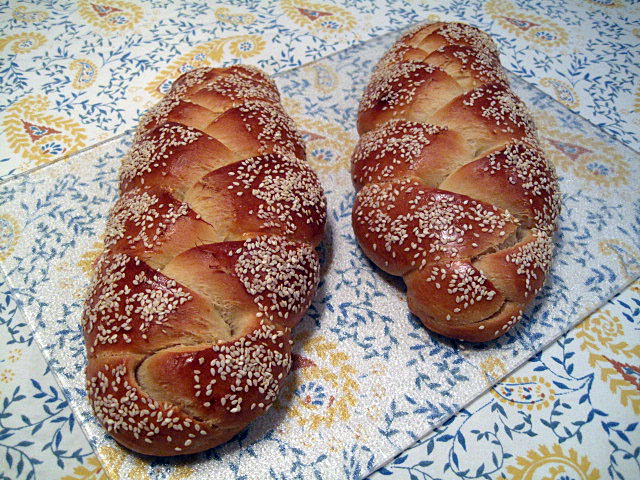
I'm rather fond of challah, but my wife isn't. Most challah is too rich and too sweet for her taste. The closer to brioche it tastes, the less she likes it. So, when I made “My Sourdough Challah” from Maggie Glezer's “A Blessing of Bread,” and both my wife and I loved it, I was delighted.
Of course, all challah was made with sourdough before the introduction of commercial yeast. Since then, according to Glezer, challah has tended to be made sweeter and richer. Sourdough challah has a “moister, creamier texture” and stays fresh longer that the yeasted variety. Glezer's version has a delightful sourdough tang which lends it an almost “sweet and sour” flavor. It is wonderful plain, as toast and as French toast.
|
Ingredients |
|
|
The starter |
Amount (gms) |
|
Active firm sourdough starter |
35 |
|
Warm water |
80 |
|
Bread flour |
135 |
|
|
|
|
The final dough |
|
|
Warm water |
60 |
|
Large Eggs |
3 eggs + 1 egg for glazing the loaves. |
|
Salt |
8 |
|
Vegetable oil |
55 |
|
Mild honey |
65 |
|
Or Granulated sugar |
60 |
|
Bread flour |
400* |
|
Sourdough starter |
All of the above+ |
* I added an additional 3 tablespoons or so of flour during mixing, because the dough seemed too wet. This may have been needed due to my using more starter than Glezer specifies. See below.
+ Glezer says to use only 200 gms of starter, but I used all of it (250 gms)
Procedures
-
The night before baking, mix the starter and ferment it at room temperature for 8-12 hours.
-
In the morning, in a large bowl or the bowl of a stand mixer, dissolve the starter in the water, then mix in the 3 eggs, salt, honey and oil until completely combined.
-
Mix in all the bread flour until it forms a shaggy mass.
- Knead the dough on the bench or in a stand mixer until it is smooth and there is moderate gluten development. Add small amounts of water or flour to achieve the desired consistency. The dough should be quite firm.
-
Transfer the dough to a lightly oiled bowl and cover it tightly. Ferment for about 2 hours. It may not rise much.
-
To make two 1 pound loaves, divide the dough into two equal portions, and divide each portion into the number of pieces needed for the type of braiding you plan to do. (I did 3-strand braids.)
-
Form each piece into a ball and allow them to rest, covered, for 10-20 minutes to relax the gluten.
-
Form each piece into a strand about 14” long. (I like Glezer's technique for this. On an un-floured board, flatten each piece with the palm of your hand. Using a rolling pin, roll out each piece to about ¼ inch thickness. Then roll up each piece into a tight tube. Using the palms of your hands, lengthen each piece by rolling each tube back and forth on the bench with light pressure. Start with your hands together in the middle of the tube and, as you roll it, move your hands gradually outward. Taper the ends of the tube by rotating your wrists slightly so that the thumb side of your hand is slightly elevated, as you near the ends of the tube.)
-
Braid the loaves.
-
Place each loaf on parchment paper in half-sheet pans (I used a quarter-sheet pan for each loaf.) Cover well with plasti-crap or place the pans in a food grade plastic bag, and proof at room temperature until the loaves have tripled in volume. (Glezer says this will take “about 5 hours.” My kitchen was rather cool. I proofed for 6 hours.)
-
Pre-heat the oven to 350ºF with the rack in the upper third of the oven.
-
Brush each loaf with an egg lightly beaten with a pinch of salt.
-
Optionally, sprinkle the loaves with sesame seeds and/or poppy seeds.
-
Bake until done – 25-35 minutes for 1 pound loaves.
-
Cool completely before slicing.
David
Submitted to YeastSpotting on SusanFNP's Wildyeastblog.
- dmsnyder's Blog
- Log in or register to post comments
Lovely breads, David. They literally glow with goodness. I've never tasted Challah; yours look very inviting!
Challah was one of the breads I grew up on ... grew out on, also. Like most breads these days for most of us, the challah you can make at home is better than anything you can buy.
Glezer's book has something like 40 different challah recipes. It's amazing.
David
get such distinct definition in the creases of your braids. The rise in the highest parts, and the clean junctions at the crossing points of the braids is exceptionally clear. I'd wager that the crumb is every bit as tender and moist as it looks too. I have Challah on my holiday baking list, but I had not thought of trying it as sourdough. Thanks for the inspiration.
OldWoodenSpoon
I'm still learning how to braid and how long to proof challot (the Hebrew plural of "challah") to get the best definition of the braiding in the baked loaf. I was pleased with this result. One definite necessity is braiding somewhat loosely.
I bet some of the real challah experts like Janknitz could add some tips based on their greater experience.
I do recommend this version. It's delicious.
David
I haven't tried Maggie Glezer's version (just got the book for my birthday), but I've been making RLB's version from her website, for which she credits Maggie as the inspiration.
It is delicious challah, not too sweet (my kids complain, but eat it just the same), and with a lovely texture. I'll have to try this one to compare, though I really don't want any of the sourdough flavor to come through.
Anyway, beautiful job, David!
You are one of my challah baking inspirations!
Is the RLB version to which you refer sourdough?
This one is sweet enough to my taste. If it were sweeter, my wife wouldn't like it. In fact, one of her comments when we tasted it just cooled was "It's almost like cake." BTW, the sourdough flavor does come through, but it doesn't dominate. Try it. You might like it.
David
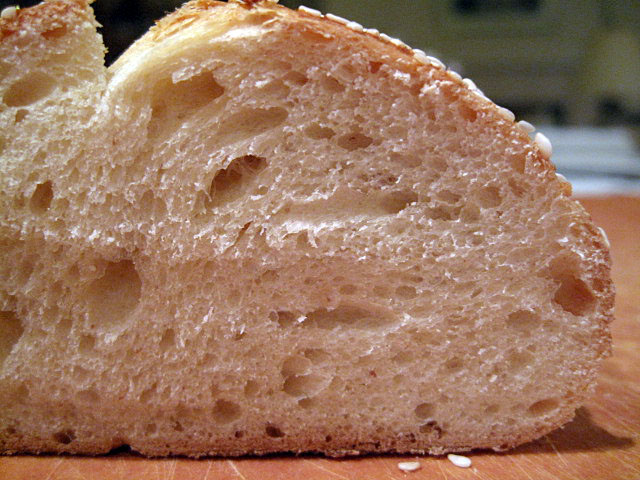
I love making and eating challah but I have not tried a sourdough one and yours looks delicious. Lovely crumb and braiding, David!
Sylvia
Soudough challah is definitely different in flavor and, some, in texture, as well as proofing time, compared to yeasted versions. It also stays fresh tasting longer, as you would expect.
It seems to me that yeasted challot depend on the enrichments for their flavor. The sourdough version adds the complexity of flavor we expect from longer fermentations.
Do try it, and let us know how you like it.
David
Beautiful, David. Mind if I feature it for a bit?
If you want to feature it, I'd be honored.
David
I am loving this book since I like the taste of challah, and LOVE all those fun shapes. Have been wanting to try this recipe, now I definitely will!
What can I say? They're beautiful!
Betty
David
Beautiful as usual David. I've not made a sourdough version of this bread but the family I usually gift these to is now watching sugar intake due to medical concerns. This might be a welcome change. I'm guessing some of that honey is consumed during the longer ferment.
Eric
Glezer points out that, because of the effect of high sugar on yeast action, her sourdough challah has less sugar than the yeasted versions. I'm sure some of the sugar does get fermented, but the bread still has a sweet flavor.
David
I have never heard of any challah or challot bread recipes using sourdough. But I have always wanted to make sourdough bread, as though it seems to be a hard bread to make, I have always been fascinated by it. We have our Shabbat/sabbath meal every Friday evening, and I make the challah for it. I'm trying to find the perfect recipe for making it.
I will be checking out more on this subject, as it intrigues me.
Hi, Rachel.
I'm a pretty inexperienced challah baker compared to you, but if you are looking for new recipes, do check out Glezer's "A Blessing of Bread." Actually, you should read it for the historical and cultural content, even if you never bake from it.
I would encourage you to try sourdough baking. It is not "harder" than baking with commercial yeast, once you have understood a few of the differences. Almost all the breads I bake are made with natural leavening. (I'm resisting a "hard sell," but if you have questions about sourdough baking, there is a wealth of information available here on TFL and elsewhere online, as well as in any number of excellent cook books.)
David
I'll have to look about the book. I am finding so much out about bread. I've never really been able to bake my own bread - there's always a hole, or it goes flat, too gooey, burnt... I'm a disaster at bread baking. the only one I can really do is the challah, and sometimes that is a fop too.
I've been wanting to get the Bread Baker's Apprentice, but I've not been able to. I've always been fascinated by rustic breads as you don't see them all too often in the stores, and I've never really been to a bakery. Not to mention I love history and when I think of making rustic breads, I feel as if I've gone back in time. (if you know what I mean.) Its a piece of history right on the table.
The book looks interesting, but I probably won't be able to get it, due to certain circumstances. Unfortunately, as I would love to have it. I love Jewish things, and since learning all about Torah and the Jewish way of life, I'd be very happy to have this book. I'm assuming the author is Jewish? :)
Thanks again for your help. I'll be looking into doing sourdough breads.
I just read that you said "I'm a pretty inexperienced challah baker compared to you," I thought you said you were more experienced! I'm sorry. No really I'm not. I still fop at it sometimes. But I am learning every time I make it, and I enjoy it. :) I hope you will make it more often, as I find braided bread is not only pretty, but rewarding. Glad you wife liked the one you made. :)
looks stellar David!
David
Beautiful loaves David. You have the touch!
Bix
David
David in step 4. Step 2 and 3 the starter has already been added to the flour mixture?
Sylvia
Hmmm ... Step 4. is redundant, isn't it? I'll have to check the book, but I know I added the starter as described in Step 2.
David
Thank you so very much for the inspiration and write-up, David!
Sylvia
Yours are so beautiful!
David
I used Reinhart's recipe for transitional whole wheat Challah, which I found on one of my favorite cooking blogs: 101 Cookbooks
I had never made Challah before and this one came out nicely, making two good sized loaves. I also have not done a whole lot of braiding, but tried both a three-strand and a six-strand braid. They come out not too shabby in my humble opinion.
I would love to give this type of bread another try, but using sourdough someday.
Callie
Very impressive for your first time braiding!
David
I also grew up on challah...your looks amazing....
I wanted to make a challah for a dinner x-mas day...perfect timing cause i have a stiff starter ready to go...I was going to make a celebration loaf...ala BBA...have you added raisins to this loaf? what do you think would be the max i could add...?I guess i have to start it tonight...thanks
Judd
I've not added raisins to challah, but I know there are those who like it that way. I would guess you could add somewhere around 20% of the flour weight in raisins, but maybe some one who makes it with raisins has personal experience to contribute.
David
Many thanks for sharing! I started with an almost 100% hydration starter and used about 120 gms of white whole wheat flour (KAF). I made a loaf and four snails. Its a hot, humid day in NYC, and I only let it rise 3 hours. Not a fan of the egg glaze so I skipped it.
I am super pleased with the results - many thanks for sharing! The instructions were very helpful.
Hi dmsnyder, I just wanted to thank you for this recipe, as my family loves Challah and I love sourdough baking, I decided to give this recipe a try. I used a mixer to do my kneading and platted it in a 3 strand single loaf. I let it prove for over 6 hours and baked in the oven for 50 mins with a turn and put upside down for the last 10 min.
This is a fantastic challah loaf and i will defiantly make this again, my only problem is with the plat definition, after the prove, it had merged into a long loaf with only a slight sign that it was platted, have you any suggestion on how to make the plates stand out more?
Again, thanks for the posting the recipe.
Richard
Hi, Richard.
I haven't made challah in quite some time and am certainly no expert. I believe a couple things that help to keep the braids well-defined is to braid loosely and to avoid over-proofing.
I hope others with more expertise add their advice.
David
Could I use my Rye Starter?
The Rye Starter is a 100% hydration but firm.
Or should I get my wheat starter out of the fridge and take some out to make a firm starter from it?
LOVE the look of your bread.
Hi, Petra.
I don't see why you couldn't use your rye starter for the challah starter. The total percentage of rye would be small in the final dough. Let us know how it turns out.
David
Oh wonderful David:)
I shall go on a quest.
Hello!
I was wondering how warm should be the water when you make the main dough? I've made this recipe once already but came out with a stiff dry Challah, so I was thinking maybe my room temperature was too low and the water that I put into the main dough was too cool... Could you please provide mor info on this subjects? TIA!!!
I don't recall the exact water temperature. When I say "warm water," I usually mean 85-90ºF.
Within limits, a warmer or cooler ambient environment just means your bulk fermentation needs to be shorter or longer. Watch the dough, not the clock. These days, I use a proofing box with a thermostat to control fermentation temperature. I usually set it to 76-80ºF.
Challah dough is a stiff, dry dough compared to most. Without handling your dough, I can't say whether the consistency was appropriate.
I hope this helps.
David
Thank you very much, David!!
your reply has been really helpful! i will give this a new try as soon as I get a strong starter! i did liked the recipe very much, only I watched the colock and not the dough, conctrary to what you advise!! I don't have a proofing box or any of the sort, but I believe I can make it either way!
Thanks again and will update if I succeed!!! otherwise, I'll keep practising!!
Ramiro
This is the Challa i did the other day with your recipe!!!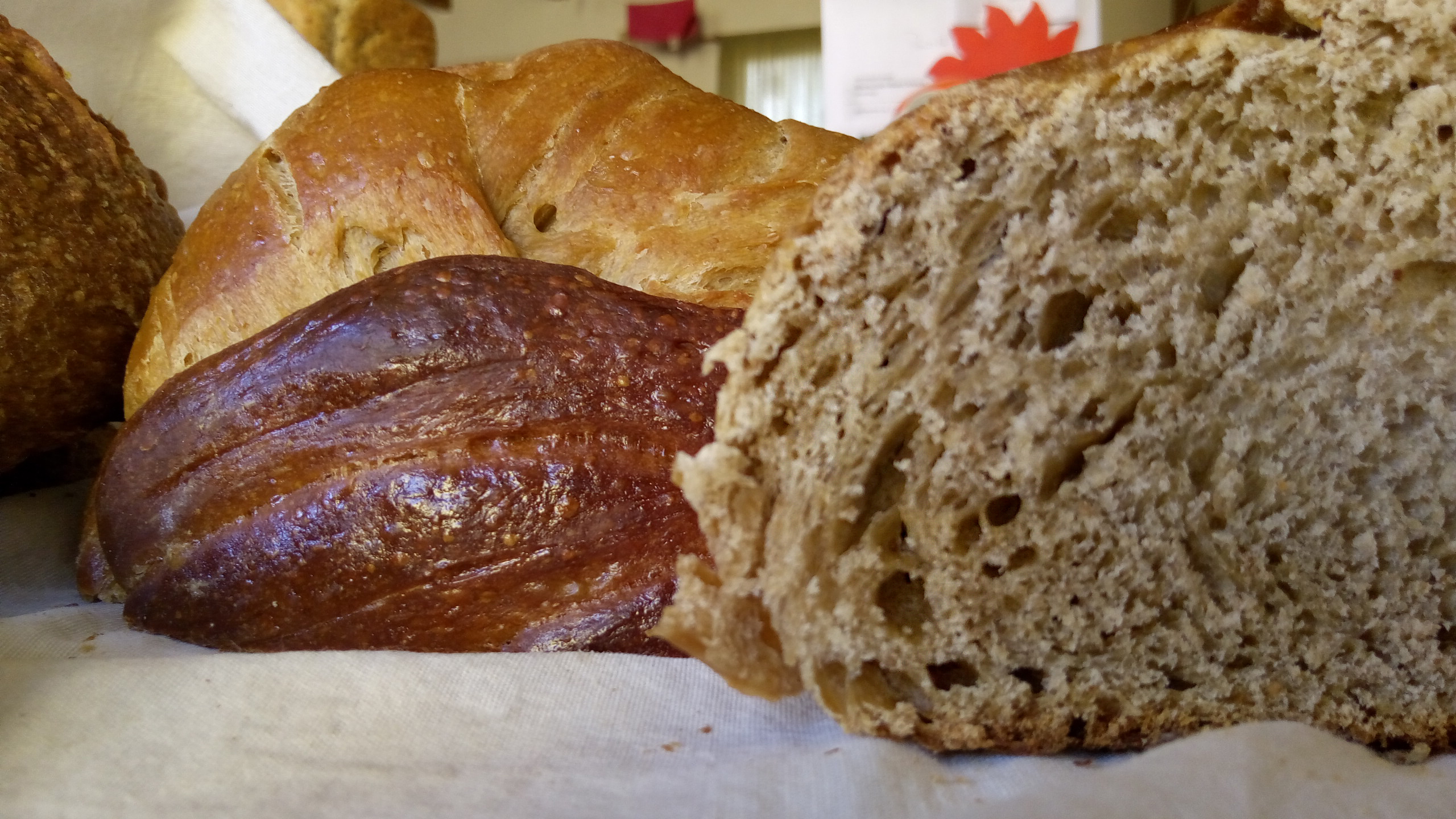
awesome bread indeed!! I wanted to bake it with yeast water but it failed, so I used sourdough instead! I don't love the tangyness of SD in this particular bread but it had a LOT of acceptance between my friends!! First big success with Challah!! Thank you!!!!!
I am glad you achieved success.
Your crumb looks like you used whole grain flour. Is it just the lighting, or did you make a sourdough whole wheat challah?
The flavor of this bread is very different from non-sourdough challot - sweet and sour. I rather liked it. My wife didn't. That's probably why it has been so long since I made it.
David
It was a big satisfaction indeed! Thank you <3
I have an issue with whether to call my flour whole wheat or not! It's a flour from a friend's mill and it says "harina 000 entera" Whole bread flour I think would be the translation to English... but it's supposed to be white flour. It has little bran in it but the color of the flour is a bit greyish... So... Could say it's a kinda-whole-wheat Challah!
I never tried non-sourdough challah! I remember in my first attempt i did it with yeast water and the flavor was a lot nicer to my palate! I am looking forwards to having a good YW so I can repeat this recipe! <3
Ramiro
I don't know if you read these messages often enough, but in case you do:
I always wanted to make a challah, but didn't like all those commercial yeast recipes. This year I was determined to find a good sourdough recipe, and browsing through the TFL site I found this recipe TWICE - from you, and from Zolablue, so I decided to give it a try. I was going to make it tomorrow, but I just realized that even if I start at 8am, it won't be ready to be cut until around 7pm, which is a bit too late for Rosh Hashanah dinner (1 hr min mixing/resting/braiding, 2 hrs bulk proof, 5 hrs final proof, 30+ min baking, 2 hrs cooling = ~11 hrs).
Have you attempted a variation of this recipe when it can be started the evening before and then finished the following day? I wonder if, for instance, instead of warm water for the initial mix I could use regular cool water, and then let it bulk-proof in a fridge overnight, instead of for 2 hrs on the counter. I have no idea how to "translate" 2 hrs on the counter @ 70F into X hrs @ 40F.
Anyway, if you have any thoughts on this, I'd love to hear them, and L'Shanah Tovah!
This recipe calls for a pretty low hydration starter (looks like around 60% vs "regular" 100% hydration starter). What is the reason for this? Anyone knows why can't 100% hydration starter be used, with appropriate decrease in the amount of water in the recipe?
L'shanah tovah!
I will address the questions in both of your replies here. First, I often ferment my levain the day before mixing the final dough and refrigerate it overnight, or even for 2 days. The main effect is that your bread may be a little more sour.
There is not an immense difference in the final outcome using a liquid versus a firm levain - a bit more extensibility with the liquid levain. Slight differences in flavor profile.
I have never retarded a braided challah. My gut feeling is that it wouldn't be a great idea.
Happy baking! Happy New Year!
David
Not sure why I missed your response earlier; perhaps the notification e-mail never came... Anyway - yes, you are right, overnight cold-retarding was not a good idea. :) The challah was edible, but not very fluffy, and tasted just like some sweet white bread, not a challah.
I made this recipe once again a week ago, following the process as designed, but this time around my dough was too tacky, even though I added some extra flour during kneading, trying to compensate. It rose better during final ferment, but the braids almost joined together - probably once again because the dough was too wet. The baked challah also had a bit strange taste, which I could not put my finger on, until it hit me - honey! I used honey instead of sugar, and I thought it would make it better, but it appears that all that extra wetness and stickiness affects the dough consistency, as well as taste. Well, hopefully lesson learned, and the next one will be with sugar. Too bad my wife and I enjoy the bread I usually bake with various white and whole grain flours and various seeds etc. too much, so there isn't often a chance for me to bake something else as well.
Thanks again for taking the time to respond!
I've tried making sourdough challah before with little success. This recipe worked for me. It was more dense and the braids weren't as well defined as the loaves made with commercial yeast, but the flavor was more complex. We ate it warm and couldn't stop slicing off chunks. I tried to attach pictures, but couldn't quite figure out how. Anyway, will be blogging about it soon and will definitely make it again.
Not sure if it's due to a different type of yeast, or something else in the overall process. They do make wonderful French toasts though, as they don't fall apart as easily as fluffy store-bought challas!
I made French toast for lunch today and it worked perfectly. I also think the bread stays fresher longer.
David, your formula calls for bread flour. I am fairly new to braided breads. Which flour is your preferred choice? The more I bake, the more important proper flour becomes.
This bake was posted long ago. Have you adapted another formula as your SD favorite version since then?
Thanks for posting such a beautiful bake.
Danny
I haven't made this bread in ages, although I have been thinking about it the past few weeks.
Challah is often made with a relatively high-protein flour, but an AP like King Arthur or CM ABC would work fine. I may have used King Arthur Bread Flour (12.5-12.7% protein). I can't recall. Note that CM ABC flour, which was formulated originally for baguettes, has the same protein percentage as KA AP, but makes a dough that is much more extensible. That might be a good thing for rolling out the strands for braiding. I ought to try it, but another bread has priority for this week.
David
If the flours have the same protein content, could one produce longer (or perhaps stronger) gluten strands than the other? Otherwise, why would it make a dough that's much more extensible?
Gluten is a molecule that forms when two other proteins in wheat combine in the presence of water. Those proteins are not all exactly the same in all varieties of wheat, and their differences effect the physical properties of the gluten they form.
Glutenin proteins are long chains. It is responsible for the elasticity of dough. Gliadin proteins are short and globular. It is responsible for dough's extensibility -- the ability to stretch without tearing. (from Bread Science)
So, there are many tweaks the bread scientist and knowledgeable miller than do to provide a flour that meets the exact needs of a particular bakery.
Central Milling's ABC flour was formulated originally for Acme Bakery for their baguettes. But I like it a lot for Pain au Levain type breads too.
David
Thanks a lot for the education!
Hi David, I’m making this challah, my first challah and I do have a question about final proof. You indicate to shoot for triple volume, would you say the finger poke test at that volume would pass and indicate the usual amount of proof? Would the finger poke be accurate as far as when to bake?
I’m doing this as one larger loaf so six strand, the braiding was super fun.
Benny
I tried several times, and I was never able to achieve such a nice looking braid. I also do 6 strands, and I found it to be fairly easy once you remember the pattern of what goes where. I also used honey in my dough every time, instead of sugar, and I think it messes up the way the dough feels and behaves, as well as adding a strange taste to the final loaf (even though I love honey by itself).
Please post pictures of a final loaf, when done!
OH I will definitely post them here and in my blog Cooper, good or bad I post. The post mortem is the way to learn.
I also grabbed olive oil by accident since it is what I usually cook with so I used about 60% olive oil and 40% canola oil. Hopefully that doesn’t negatively affect the flavor. I also used honey, interesting that you didn’t like the flavor it imparts despite liking honey. I guess we’ll see how this turns out, if I don’t like the flavor at least I know what to adjust for next time.
I really enjoyed the plaiting, it was fun. I watched this video a few times. I guess my practice shaping baguettes was super helpful in getting the strands shaped. I added sesame seeds after the egg wash. The bread is in the oven now.
All baked up and smelling awesome. I’ll have to wait a while to slice it, probably have some at dinner time, I can’t wait.
This looks marvelous! Well done!!!
Thanks Cooper, I’m surprised it went so well.
Benny
I'm too late to help you with your proofing question, but whatever you did sure turned out well.
Anyway, Glezer says to let the loaf triple in size, but I don't shoot for that. What I do is use the poke test and my gut feeling. I shoot for what the old-fashioned Jewish bakers regarded as a "full proof." The criterion was, when you poke the dough, it doesn't completely fill back in. I would say the challah in the OP may have been somewhat under-proofed. Yours looks perfect to my eye.
Have you tasted it yet?
David
Thank you David firstly for your kind comments on my first challah, but also for all the effort you always put into your posts sharing these amazing recipes with the rest of us. I truly appreciate what you’ve done over the years.
I did go with my gut and kept poking at the dough, as it started to spring back less and less I preheated the oven. By the time the oven was at temperature, the dough didn’t spring back very much at all and in it went.
I’m going to have some of this soon for dinner and I cannot wait, as I’ve said I love challah so I’m really hoping to enjoy this, I just hope the olive oil I used doesn’t detract from it for me. Anyhow, it will give me an excuse to make it again minus the olive oil.
Benny
Super delicious challah David, I can’t thank you enough for sharing this recipe, it will not be the last time I bake this. It is excellent even with the olive oil which I really cannot taste. Wonderful crumb which is tender and moist. The crust is great with the sesame seeds.
In all respects, your Challah looks excellent. Great Job.
Thank you Dan, not up to your amazingly more complex plaiting but I’m pleased as punch with how this baked up and tastes.
Hi David, your challah looks beautiful! I want to share some information I just came across that you and others might find useful. I just bought "Breaking Breads" by Uri Scheft and he perfectly describes the texture of challah that I grew up eating and hope to some day achieve in my own baking: "When you break into a loaf of challah, it should pull apart almost like cotton candy coming off the paper cone. There is a soft and tender threadlike quality to the crumb of a well-kneaded challah. It is layered with sheets of tender gluten, so it can be almost unraveled rather than broken apart like a loaf of sandwich bread. There are three ways to achieve this: 1. Underknead.... with most dough, you want to be able to stretch a small corner to a thin sheet without it tearing (this is called the windowpane test). With challah, you don't want the gluten to get that strong--so knead only as instructed. 2. Underproof. Slightly underproof the challah, meaning that when you press a finger into the rising dough, the depression that's left fills in about halfway... 3. Use high heat to seal in moisture... You don't want challah to have a hearty, thick, and crisp crust--you just want the crust to be substantial enough to lock in the moisture during baking but soft enough to easily rip by hand when eating."
I agree with Scheft's description of the desired crumb. The term generally used for this texture these days is "shredable." I don't agree with his procedural recommendations at all, however. I think the texture is as much a result of the oil and sugar as the factors he describes.
You don't want to overknead, but you do want good gluten development. Underproofing will increase oven spring and cause the ropes to separate. In fact, Glezer says to let these loaves triple in size before baking. I have found that to work well. I don't know what he regards as high heat, but I bake lean sourdough loaves at 460-480ºF, depending on size and shape. An enriched dough like challot will burn at those temperatures. I bake at 350-375ºF.
David
David, thanks for the info! Shredable. Good to know about that. I had no way to describe it before reading Scheft, and now I have another term!
BTW, do you really get the loaves to triple in size after shaping? Mine do not nearly approach that.
Well, I don't have a precise way of measuring the volume, but they do more than double ... I think.
David
Could you please provide a Baker's Percentage for Glazer's Challah; I normally calculate this myself but the Starter stumps me.
thank you
I posted this bake almost 13 years ago! I would like to think my baking has improved since then, as well as my documentation of recipes. For your interest, although almost all of my bread baking is of sourdough, I do prefer the yeasted versions of challah. That's probably just because that's what I grew up on.
In response to Ibor's request, I am posting a complete re-write of this recipe's ingredients. Here it is:
Sourdough Challah
from A Blessing of Bread by Maggie Glezer
Rendered in Baker’s Percentages by David Snyder
August, 2022
Total Dough
Ingredient
Wt (g)
Baker’s %
Bread Flour
526
100
Warm water
134
25
3 Large eggs
165
31
Salt
8
1.5
Vegetable oil
55
10
Mild honey
65
12
Or baker’s sugar
60
Total
953
179.5
Notes: Both the flour and the water in the Total Dough include the water and flour in the “Active firm starter and that used in feeding it to make the Firm Starter. Also note that the formula calls for making 250g of Firm Starter, but only 200g of it is used in the final dough.
The effective hydration in this dough is not due only to the water. The eggs, and honey add to it.
I prefer honey to sugar in challah, and I calculated weights based on that. If you use sugar, decrease the weight of sweetener as specified above.
In this formula, 24% of the total flour is pre-fermented.
The Total dough does not include the additional egg used to glaze the loaves before baking or the (optional) seeds used to garnish the loaves.
Firm Starter
Ingredient
Wt. (g)
Baker’s %
Active firm starter
35
26
Warm water
80
59
Bread flour
135
100
Total
250
185
Final Dough
Ingredient
Wt (g)
Bread flour
400
Warm water
60
3 Large eggs
165
Vegetable oil
55
Mild Honey
65
Salt
8
Firm starter
200
Total
953
Procedures
1. The night before baking, mix the starter and ferment it at room temperature for 8-12 hours.
2. In the morning, in a large bowl or the bowl of a stand mixer, dissolve the starter in the water, then mix in the 3 eggs, salt, honey and oil until completely combined.
3. Mix in all the bread flour until it forms a shaggy mass.
4. Knead the dough on the bench or in a stand mixer until it is smooth and there is moderate gluten development. Add small amounts of water or flour to achieve the desired consistency. The dough should be quite firm.
5. Transfer the dough to a lightly oiled bowl and cover it tightly. Ferment for about 2 hours. It may not rise much.
6. To make two 1 pound loaves, divide the dough into two equal portions, and divide each portion into the number of pieces needed for the type of braiding you plan to do. (I did 3-strand braids.)
7. Form each piece into a ball and allow them to rest, covered, for 10-20 minutes to relax the gluten.
8. Form each piece into a strand about 14” long. (I like Glezer's technique for this. On an un-floured board, flatten each piece with the palm of your hand. Using a rolling pin, roll out each piece to about ¼ inch thickness. Then roll up each piece into a tight tube. Using the palms of your hands, lengthen each piece by rolling each tube back and forth on the bench with light pressure. Start with your hands together in the middle of the tube and, as you roll it, move your hands gradually outward. Taper the ends of the tube by rotating your wrists slightly so that the thumb side of your hand is slightly elevated, as you near the ends of the tube.)
9. Braid the loaves.
10. Place each loaf on parchment paper in half-sheet pans (I used a quarter-sheet pan for each loaf.) Cover well with a towel or place the pans in a food grade plastic bag, and proof at room temperature until the loaves have tripled in volume.
11. Pre-heat the oven to 350ºF with the rack in the upper third of the oven.
12. Brush each loaf with an egg lightly beaten with a pinch of salt.
13. Optionally, sprinkle the loaves with sesame seeds and/or poppy seeds.
14. Bake until done – 25-35 minutes for 1 pound loaves.
14. Cool completely before slicing.
Enjoy!
David
Thank you very much Dr. Snyder.
When a formula is good, it is good 13 years later too.
best wishes
for taking the time to document everything! One day I'll be able to make a challah the family will like. ;) Like you, we are all used to the taste and texture of yeasted challah, and I keep telling everyone that this is a more modern invention, and for centuries all bread, including challah, was SD, so this is how it's supposed to taste! :)
My regular challah bake is the yeasted version of this one. It is the one Maggie Glezer says she bakes for her family, and I really like it. However, which challah you probably regard as proper depends on where you grew up. Glezer's book documents about 40 different versions from all over the globe. The recipes were collected from women who learned from their own mothers, mostly "in the old country." I am stuck on the one I make, but I really should try some of the other recipes.
So many breads; so little time!
Happy baking!
David