SearchUser loginRecommended BooksFavorite Recipes
|
Submitted by txfarmer on November 20, 2009 - 10:09am Rolled Oats and Apple BreadAnother winner from Dan Lepard's book "The handmade loaf".
The dough was very sticky and wet from soaked oats and grated apples (I used Fuji), but I like wet dough. I used Sir Lancelot high gluten flour because I ran out of bread flour at home (17 different kinds of flour, yet that's the one I ran out), the end result was a beautiful bread with open, moist, and chewy crumb. Intentionally left a few bigger chunks of apple in the dough, which made the apple taste stronger.
The book called for 3/4 tsb of fresh yeast, I used less than 1/2tsb of instant yeast. Even though Dan suggested that the amount of instant yeast should be half of fresh yeast IN WEIGHT, which is equal amount in VOLUME, I found that I only need half of the yeast IN WEIGHT if I use instant, otherwise it fermentate and proof way too fast. Even with barely 1/2 tsb, my proofing time was only 45 minutes, not 1.5 hour suggested in the book. (My kitchen was pretty warm that day though)
I really like the subtle warm/tart/sweet taste of this bread, thanks to the oats and apple, it goes well with jam/butter, great as a sandwich with some ham and veggies too.
Submitted by txfarmer on November 9, 2009 - 8:07pm Pumpkin Challah
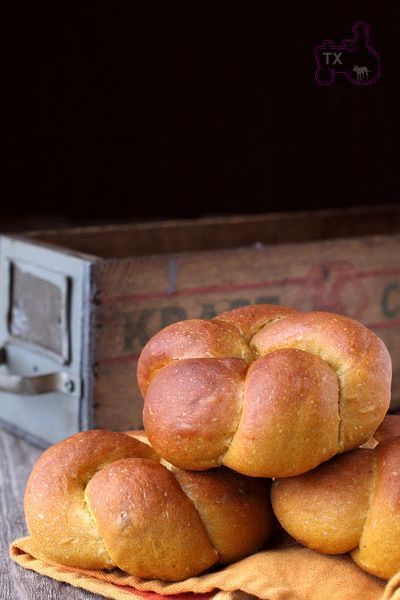
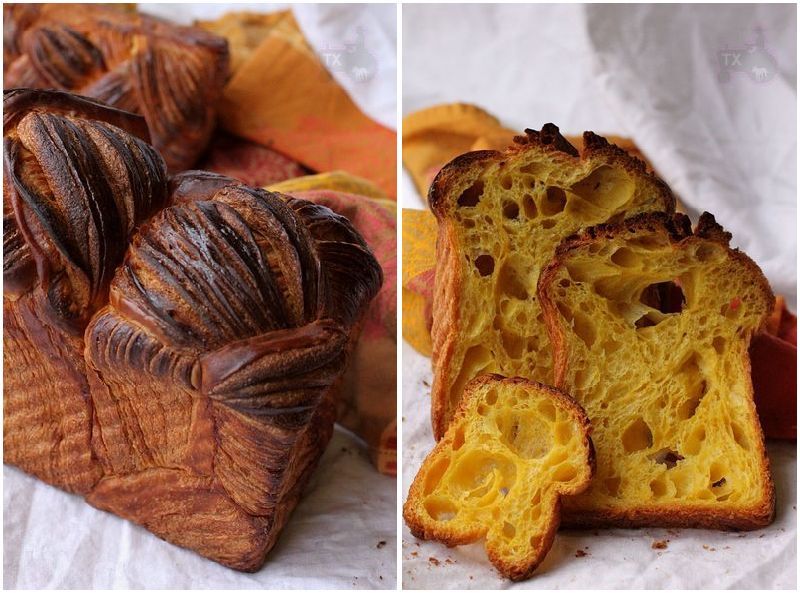
The recipe is from Maggie Glezer's " A Blessing of Bread: The Many Rich Traditions of Jewish Bread Baking from Around the World" I got the book from the library and just love it! So much fascinating history and background information, along with many recipes, I had no idea challah breads have so many variations. This time of the year, I am in a pumpkin kick, so I immediately made pumpkin challah. Even though there are many interesting braiding techniques in the book, my shaping/braiding was from Hamleman's "Bread", which consists of 20 strands, 6 sets of six strand braids, and one 2 strand braid in the middle. I have been wanting to try this massive braiding project for a while now, so glad it turned out well!
The pumpkin flavor is quite subtle, I would probably increase the amount of pumpkin puree next time, but the spice combo was on the mark, crumb was soft, and crust was slightly hard from the egg brush.
I love the golden color, combined with the star shape, I think it's quite a looker! And I think I will buy the book, a worthy addition to my already huge bread book collection.
Submitted by txfarmer on November 3, 2009 - 4:48pm Horst Bandel’s Black Pumpernickel - Finally!
The picture above shows the 5th Horst Bandel Pumpernickel I made, and the last 4 were made within the span of a month, yes, I am just a tad "obsessive". :P
I've posted twicehere before asking about this recipe. Other than the first time, where I over-corrected the "too wet" problem and made the dough too dry, the other times the bread actually tasted fine. When I posted pictures last time, the kind people here even said it looked perfect for an authentic German pumpernickel. There's only ONE problem, the bread did not rise to the top to fill the pullman pan. No matter how much water I put in, how much I knead/not knead, how long/short I let it rise, the finish loaf was ALWAYS 0.5inch below the lid. Even though it tasted great, the smell was heavenly, and the crumb was just the right moisture, I just couldn't rest until it rose to the top! Finally, I noticed that my pan was 4X4X13, while Hamelman's was 3.75X3.75X13, it's such a tiny difference, I never thought it was a big deal. Then I got desperate and calculated the volume difference, wow, it's exactly 1/2inch below my pan!!! So for this last time, I adjusted all the ingredients, and made 110% of the recipe, guess what?! It filled the top and came out perfectly square!
After 36 hours of resting, sliced thin:
Yummy with smoked salmon
Phew, finally I can stop baking this bread every Sunday, which taks up the oven space for the whole day (17 hours)! I love eating it, but I think I am just a tad relieved that I can take a break from it for a bit. :P
For those who like heavy dark rye breads, this one is a must try, it's in the "Bread" book by Hamelman. Super yummy, and really not THAT difficult to make, as long as you add enoug water, my dough was plenty wet, so wet that I couldn't really lift the column into the pan, I had to dump it in. I was pretty stingy with the soaking water for the old bread, and used probably 95% of the water in the final dough. Oh yeah, it helps to make sure that your pan size is correct if you are obsessed about the shape like me.BTW, I didn't have blackstrap molasses so I skipped it as instructed in the recipe, that's why the bread is not that dark.
Submitted by txfarmer on November 1, 2009 - 8:23am BBA Poolish Baguette - with much modification
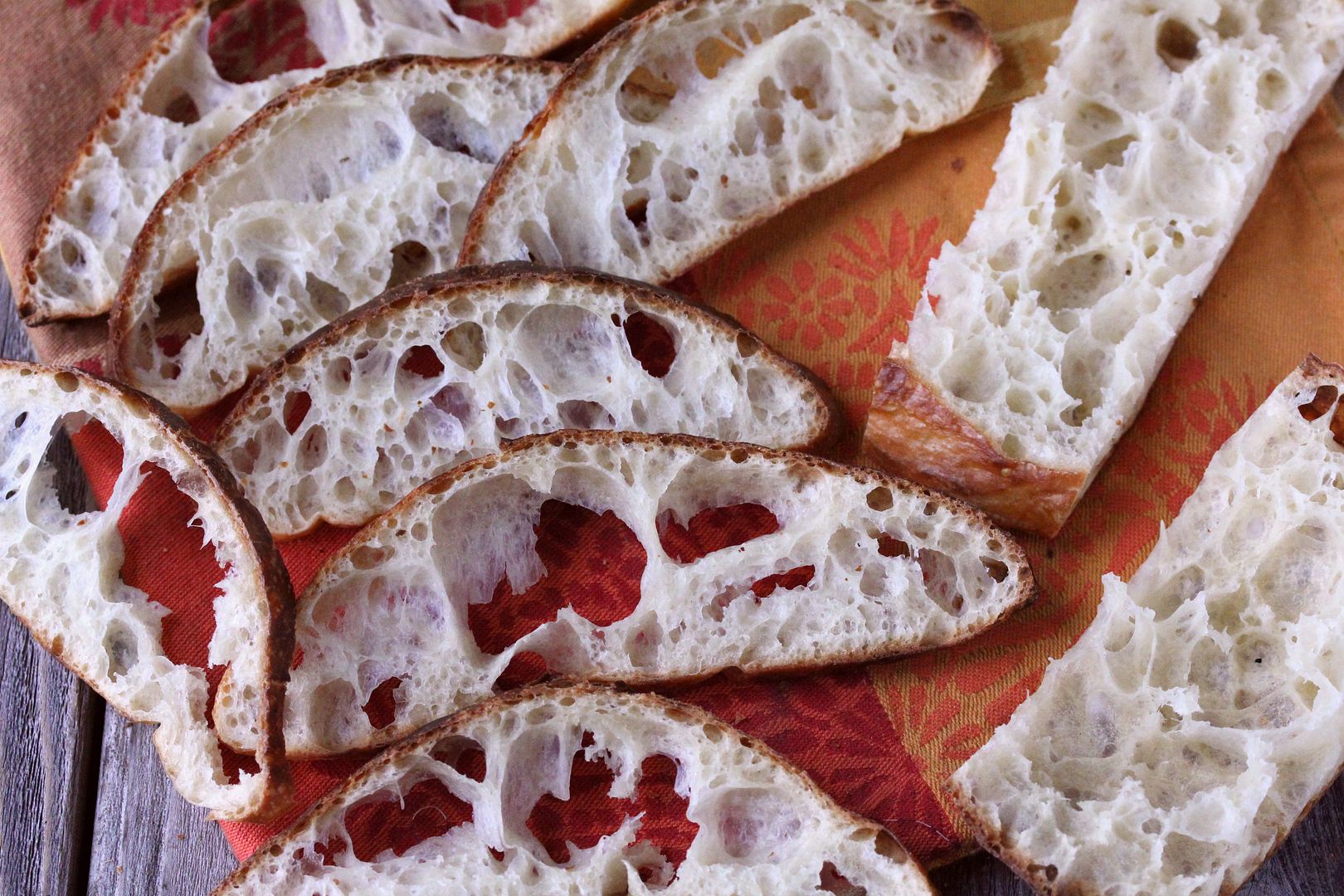
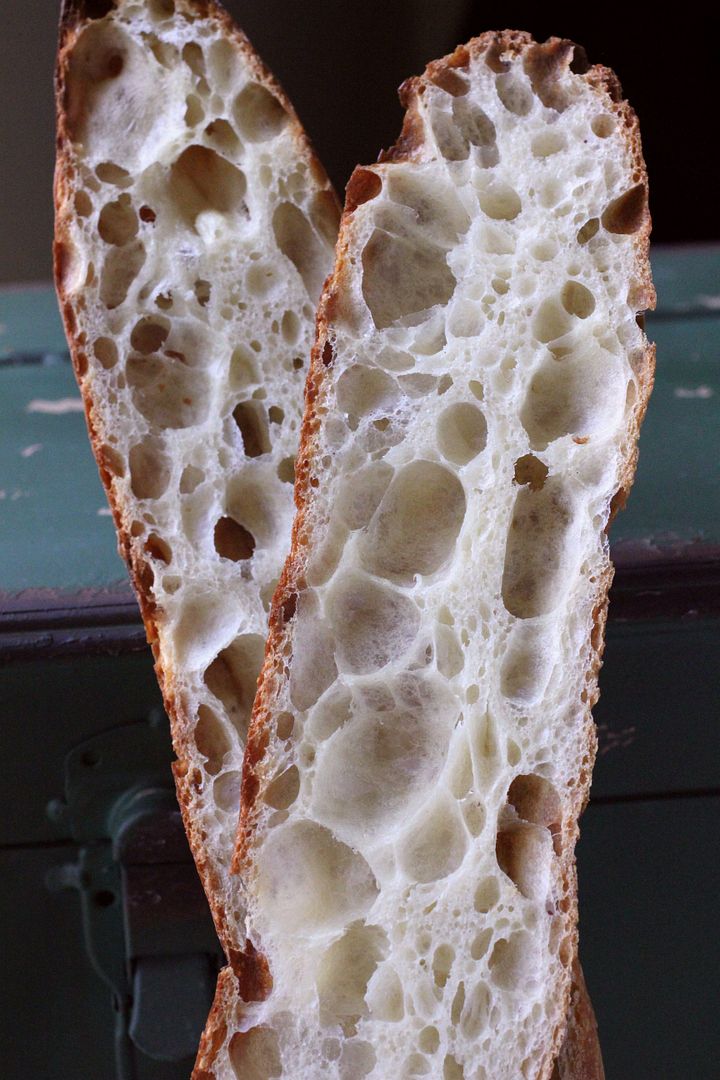
I make baguettes often, including the Anis recipe from this forum, and some other recipes from other books. I found BBA tends to overknead for lean breads such as baguette, ciabatta, etc. For this poolish recipe, he instructs to knead until pass the windowpane test, sure way to get ride of holes and taste! I changed kneading procedure to: autolyse for 20 minues, knead in my KA for 2 minutes just to kick off the gluten developement, S&F 3 times during the first of 2 bulk fermentations. I am happy with the open crumb in the final breads. The Interesting thing about this recipe is that there are 2 bulk fermentations, each 2 hours. I've been doing the BBA challenge, other than overkneading, I notice BBA tends to over fermentate/proof too. For this recipe, the first fermentation for me was indeed 2 hours, but that's only because I didn't knead much and did S&F, for a well kneaded dough, I don't think 2 hours would be necessary. For the 2nd fermentation (after punching down, which I translated to "gently pat down"), it was only 90 minutes for me, even that was a bit too long IMO. The extra fermentation helps with the volume of the bread, but not much else.
I am not too happy with my scoring on this one, I think I overproofed a bit. Again the recipe says to proof for 50 to 60 minutes, I did 45, 30 to 40 would've been enough, and the scoring would have opened up more with better blooming.
Now, here's the biggest "modification" I made to this recipe: I used my 100% sourdough starter in place of the poolish. With my understanding, wild yeast starter fermentates a little slower than his poolish, which means if I had used the poolish, the fermentation/proofing should have been even shorter! I love BBA, but for some lean breads, it's tendency of too much yeast, too long of fermentation/proof, too much kneading must be adjusted for me. I like sourdough breads, so I like my starter baguette better than the usual light straight baguette. The flavor is more complex (my white starter is not that sour though), and the crust is a bit more substantial.
A delicious bread, and I am always happy to practice making baguettes, I do recommend Hamelman's poolish baguette formula over this one though. Submitted by txfarmer on October 31, 2009 - 10:31pm Dan Lepard's Walnut Bread - and my impression of the book
This is the first recipe I made from the new book "The art of handmade bread". I followed the instruction closely, only swapping out fresh yeast for instant. I consulted Dan's informative website and forum, it turns out that the amount of instant yeast should be half of the fresh yeast by weight, but fresh yeast is denser than instant yeast, in the end, their volume usage amount are the same, so that's how I made mine. The minimal kneading techinque worked well, but next time I will leave yeast and salt out until after autolyse. The dough was dryer than what I am used to (which is pretty wet), but that was mentioned on his forum so I forged ahead. Since the recipe uses both rye starter and instant yeast, the fermentation time was short - bulk fermentation for one hour, with final proofing between 2 and 2.5 hours. That's where I was confused - usually proofing time should be shorter than fermentation, I did't undersatnd why this recipe has such a long proofing time. I went ahead and followed the instruction and that's why my first loaf failed. At the end of first hour, my loaf was already ready to be baked, yet my oven was still off! Massive overproof, I got a flat pancake. I tried again the next evening, same procedure bu only proofing for one hour this time, and oola, I got a nice looking high loaf with incredible smell.
Next time I will reduce, or even leave out entirely, instant yeast. The taste of the bread was fantanstic, the walnut paste really added to the flavor, that's the extra kick of this recipe.
All in all, it's a great recipe, a tasty bread, and a very useful book with lots of interesting new recipes and techniques, can't wait to make more breads out of it. I am eyeing the oatmeal apple one next.
Submitted by txfarmer on October 10, 2009 - 7:54pm Hamelman Cheese Bread, sort of
I think it worked out well despite all my changes to the recipe: - I didn't make a preferment, simply used the same porportion of starter directly, adjusted for my 100% starter so the same percentage of flour came from the starter. - my starter is whole wheat, so the final product has some WW flavor in it. - I added <1oz of extra water, due to the WW flour I think - I eliminated the instant yeast, relied on the starter only. Dallas went from summer to fall in one day, so my kitchen went from 80F to barely 70F, fermentation took nearly 5 hours to expand to a little less than double, with a lot of visible bubbles in the dough. Last weekend when I made the seeded sourdough with similar formula, the fermentation was less than 3 hours at 80F, temperature makes such a huge difference for sourdough dough. - I retarted the dough during proofing, at <40F, for 13 hours. It took 1 hour and 45 minutes to finish proofing, while last weekend the seeded sourdough only took 1 hour, again, I think it's the lower temperature in my kitchen. Got very good oven spring, and cheese on the surface made lovely blisters
Pretty open crumb, there are melted cheese in those big holes!
It's a very fragrant bread, crust is pretty thick, love the chewy and tasty crumb
Submitted by txfarmer on October 7, 2009 - 8:18pm Kicking off my blog here with my first self-created formula
Hi all, I have been lurking, occasionally posting here for a while now, finally decide to bite the bullet and start my blog to make here "home". I was born in China, moved to North America after high school, now working and living in Dallas TX with my husband and our dog. About a year ago I picked up baking, at first just to recreate some of my favorite Asian style desserts, pretty quickly though I started making bread, and it's been an "obsession" ever since. My favorite baking book is Hameman's "Bread", love BBA too which is why I am a part of the BBA challenge. Until now I have been mostly following recipes, with some minor changes here and there. Recently I made several five grain breads and loved their taste. Also made Anis baguette and loved how easy that schedule fit into my busy work week - 2 to 3 hours a night is the most I have on a weekday night. I then decide to combine the two to make a "5 grain weekday bread" so we can have fresh bread for after work! Here's the formula, which is basically Anis's yeast percentage and timing, with everything else modified: 5 Grain Weekday Bread Bread flour: 80% Whole wheat/whole rye/or a combo of the two: 20% 5 grain mix (I used flaxseeds, sunflower seeds, buckwheat, wheat bran, and steel cut oats this time): 20% salt: 2.2% (higher than Anis formula due to the grain mix) water: 80% (since bread flour, WW flour, and grain mix all absorb more water than the AP flour in Anis formula, I increased the water. It didn't feel wet at all, I think I could've added even more water.) First night 1.Mix everything, autolyse for 30 minutes, mix in my KA at first speed for 1 minute then 2nd speed for 2 minute for some basic gluten developement, put in bowl to fermentate. 2.fermentate for 1.5 hours total, at every 30 minutes stretch and fold. I didn't have to do the S&F in the bowl, I could S&F on the counter totally fine. 3.Put back into the bowl and put in the fridge (slightly lower than 40F) for 22 hours. 4.Soak the grain in equal amount of water from the total formula. Second night 5.Take the dough out, it has rised a little, and full of bubbles. Cut into 2 parts, each about 1lb. Preshape and relax for 45 minutes. 6.Shape into boules and put in proofing baskets for 40 minutes. 7.Score and put into 550F oven with usual steaming method (I use a cast iron pan with lava rocks, and pour water into it). Lower the oven temperature to 460, bake for 30 minutes. At 15 minutes, take out the cast iron pan.
As you can see, there's massive oven spring. I got a bit "creative" with the scoring, which is why one of the little boule is wearing a "hat".
Pretty happy with the taste too, crunch crust with chewy crumb, I can taste the grains:
I may add some of my 100% starter to the mix next time just to get that sourdough flavor I love, but I will still keep the yeast since it's a "weekday bread" and I need it to fermentate and proof reliably on schedule. I am pretty happy with my first attempt to create my own formula, this really opens up a lot of possibilities - I can throw in a lot of flavor combos that I like. One thing I am curious about is whether the relatively closed crumb is due to the grains, or my handling, or maybe it needs more water?
|
ALSO ON |