
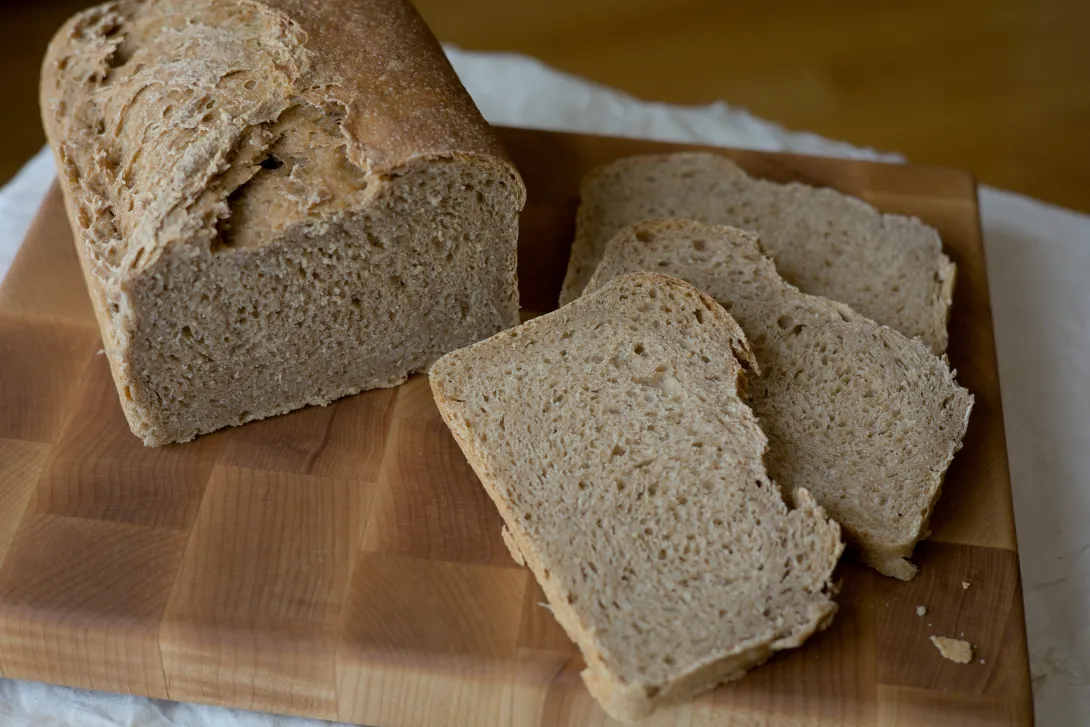
Turns out I've been causing unnecessary problems for myself the whole time I've been milling wheat.
On my previous post, I was asked for my opinions on Yecora Rojo's gluten and I found I didn't have a good answer. Looking back on the times I've worked with it sans VWG, there have been so many little oddities and contradictions with how it behaves that weren't significant enough to sink in at the time, and in retrospect I wasn't sure what to make of them. But between that pizza and two loaves I've made since which were all done quite differently, I had enough to at least start articulating my questions.
Most of which were, perhaps predictably, at least in part from the TFL archives. I kept reading and found one poster directing someone to Bread Science for a solid science-based resource. Suspecting excess protease activity from the freshly milled wheat over the course of my usual 12+ hour autolyze/bulk fermentation was the culprit, I picked up the book and went right to the sections on protease and gluten. The contents made me even more certain that I'd identified my issue (or at least the major component of it.)
Of course the sensible thing to do at that point would of course have been to make a simple bread from a tested recipe, sans the long soak. Without doing anything new-to-me or making needless alterations. Limiting the number of potential complications is important while troubleshooting, after all.
So anyway, this loaf is based on the mash bread recipe in Reinhart's Whole Grain Breads. Mashes are a completely new technique to me! I switched the wheat in the mash to barley, added lemon juice because I have too many lemons, then both increased the yeast and omitted the biga (which is itself suggested as an alternative to base recipe's sourdough starter). I used no preferment and only a very minimal autolyze -- which does rather contradict the methods the book is based on, yes -- because the goal of this whole thing is just to determine if protease is the cause of the problems I've had with my wheat. Thus limiting the wheat's contact time with water is the point.
Perfectly sensible.
THE MASH
Much thanks to Benny for finding and posting about a method for the Instant Pot. Mine has a custom setting for the Keep Warm function, but it ran ~2.5F hot per Thermapen throughout the time I had it running, so 146F seems the safe spot.
I learned two bonus lessons while setting up the mash. Firstly, mixing boiling water with flour in a stainless steel bowl at these ratios cools down much faster than I'd anticipated. If I'd had absolutely everything else ready to go, it might still have been a bit too fast to get the jar in the IP at the right temp. Secondly, getting the mash up from 115 to 145+ by placing it in a water bath and stirring every 10 min is vexing. But I got it to safe holding temp in under and hour and discovered more ways not to do things, so I won't complain.
The mash did darken considerably in the ~4-5 hours it spent at 145F+ and in the end had a sweet and rather interesting taste, so I look forward to trying this more in the future. There may have been more going on flavor-wise, but I was too congested from a cold to discern anything.
THE DOUGH
I neglected to calculate the hydration before starting because every other recipe I've made from this book has been too dry. I could probably have gotten up to the ~78% via bassinage, but it was too much on initial mixing, I felt. Rather than pulling out my impact mill and brushing it down again for 20g of flour, I just used KA BF. I don't expect the performance would be enormously different if I'd reduced the water in the first place. It's possible that part of the discrepancy is due to me cooking the mash in a covered water bath vs the oven method described in the book; also, I've never worked with sourdough and am not familiar with handling doughs at that hydration.
Mash:
300g water
120g barley flour
1g diastatic malt powder
Dough:
all mash
481g spring Yecora Rojo
20g KA bread flour (as a correction)
43g lemon juice (this was too much; replace some with water)
130g water
14g honey
14g light olive oil
9g salt
9g yeast (will reduce in future)
Mixed everything but the BF. Autolyzed ~15 minutes. Kneaded 4 minutes, felt the dough was too wet at this point, did the math on hydration, added the BF. Mixed that in, rested another ~10 minutes. Kneaded another 5 minutes or so.
Extracted to another bowl. Bulk fermentation for 40 minutes in the oven at 160F with folds at 10 minutes and 20. The dough looked good after the second, an unbroken surface smooth but for the bits of bran and barley.
Portioned 850g for the loaf, degassed thoroughly and pre-shaped. The rest of the dough became rolls (an excellent technique for reducing the risk of cutting a loaf too early). Proofed ~32 minutes and that was too much. Less yeast next time on account of my strong tendency to overproof dough.
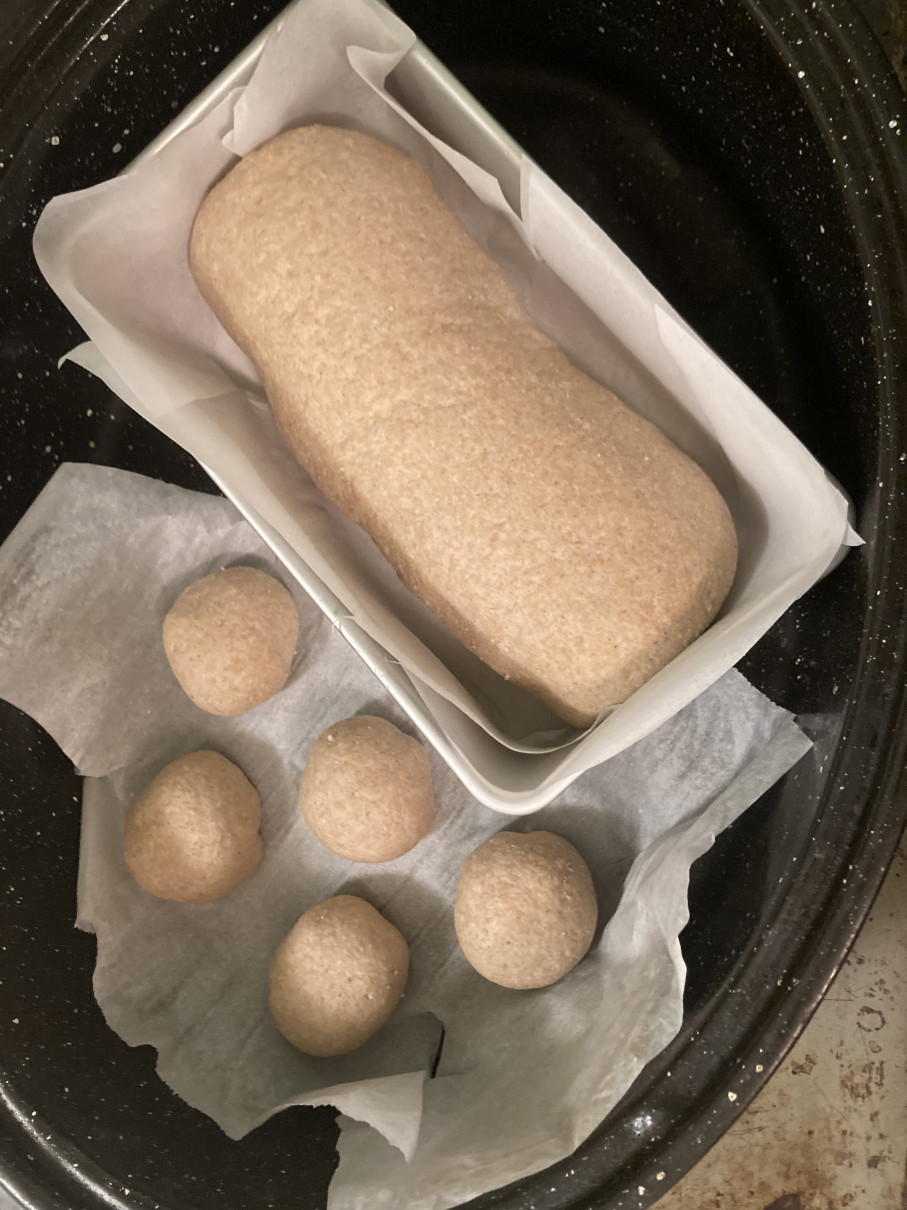
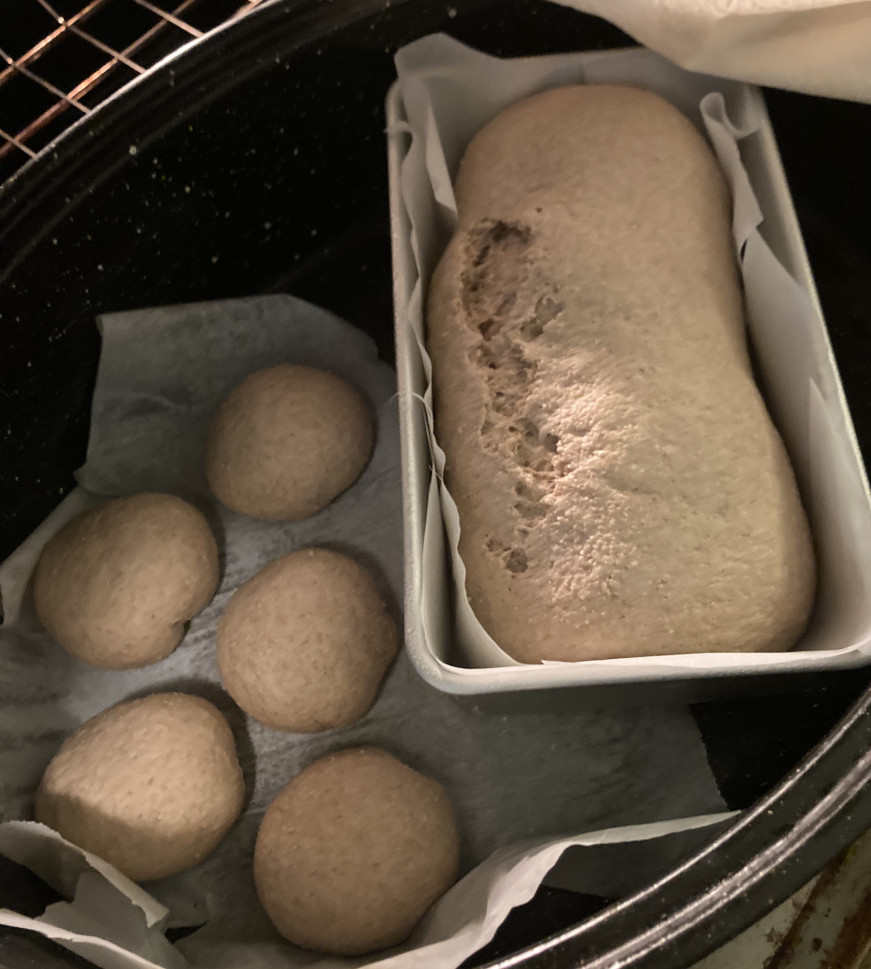
Baked at 330F in an anodized aluminum pan within a graniteware roaster, interior misted, on a baking sheet (thanks to various TFLers for that tip!) About 30 minutes covered then an unknown amount of time, perhaps 40+ minutes, uncovered at 340F because I got caught up in work.
I only gave the loaf about 8 minutes of rest after pre-shaping and it did seem to need a bit longer, so this may have contributed to the split. But the dough handled enormously differently than it does after an overnight autolyze, or even the overnight BF that my pizzas got. It was quite "normal," as in it had both extensibility and elasticity (more of the former but not too much), released from the bowl easily, and generally behaved about like you'd expect whole wheat to handle in a dough like this.
So, it turns out that freshly milled wheat is, in fact, different. If only somebody had warned me.
THE BREAD
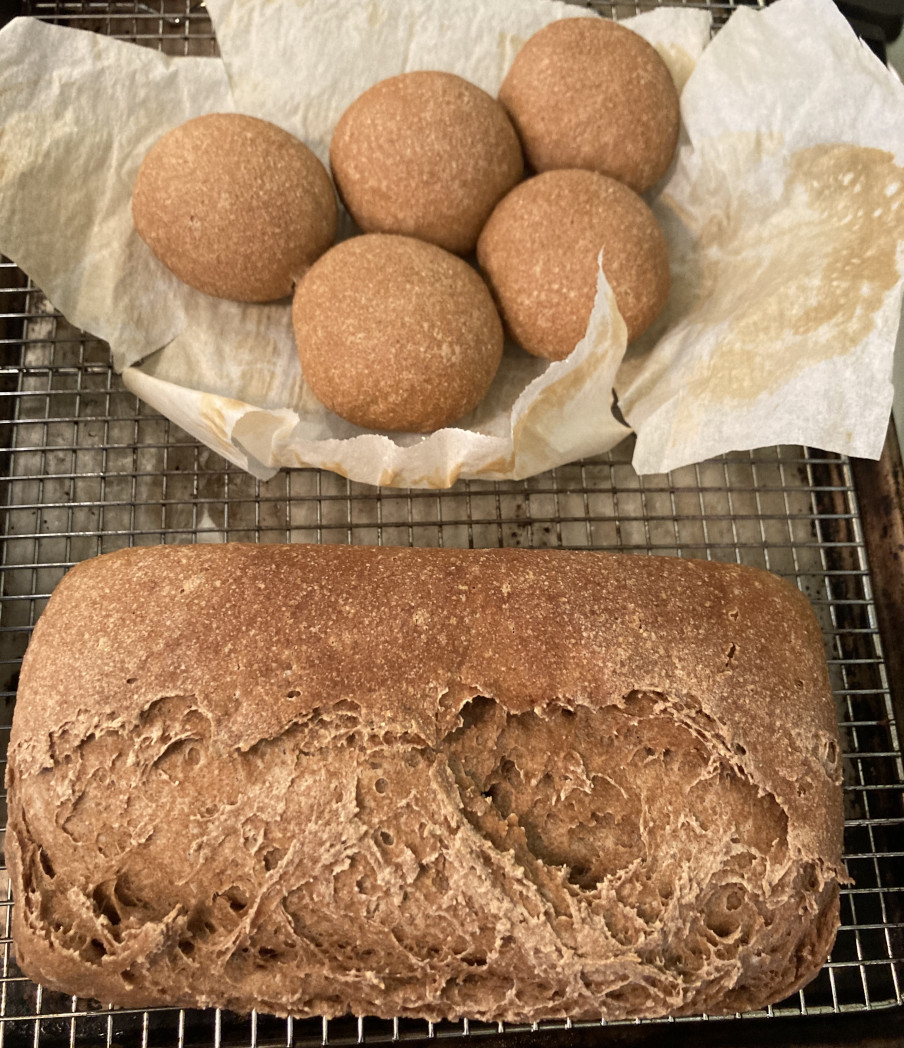
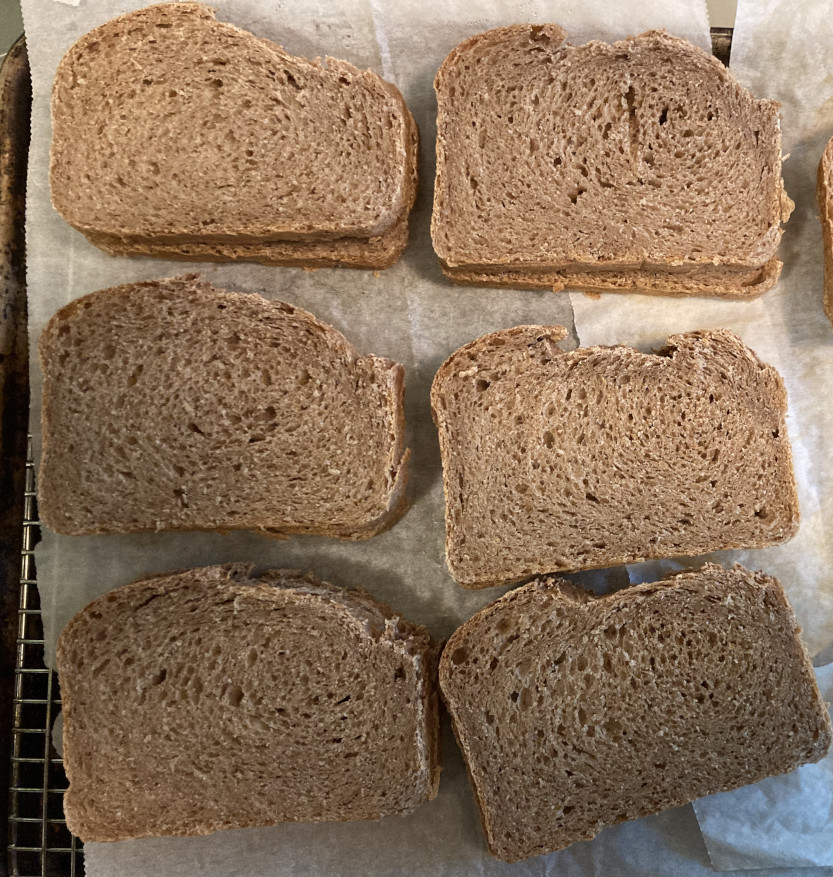
So far as natural splits go, this one's hard to complain about.
This recipe's photo in Whole Grain Breads is on the tighter and denser side for the wheat breads in that book, and I think without the overproofing mine would have been fairly close to that. For a sandwich bread I quite like this.
Day of baking, I was still pretty stuffy from my cold so unfortunately I couldn't discern much flavor-wise. Occasionally I picked up on wheatiness. The next day my head was a bit clearer and I can tell there is something here that tastes really good, different than anything I recognize, and I think is coming from the mash, but sadly I'll have to report back on that another time.
The texture, however, I can comment on. If this isn't the most tender loaf of 100% whole grain bread I've ever made, it's very close -- and with much less enrichment! A large portion of barley mash is certainly something I'll be exploring in the future when I want a soft, lower-oil bread. I've gotten whole wheat bread more "shreddably soft" before and perhaps a recipe like this could get there too, but this loaf didn't.
But, to me, this is wonderful. It's what I've been after for months. I'm so happy I tried this technique.
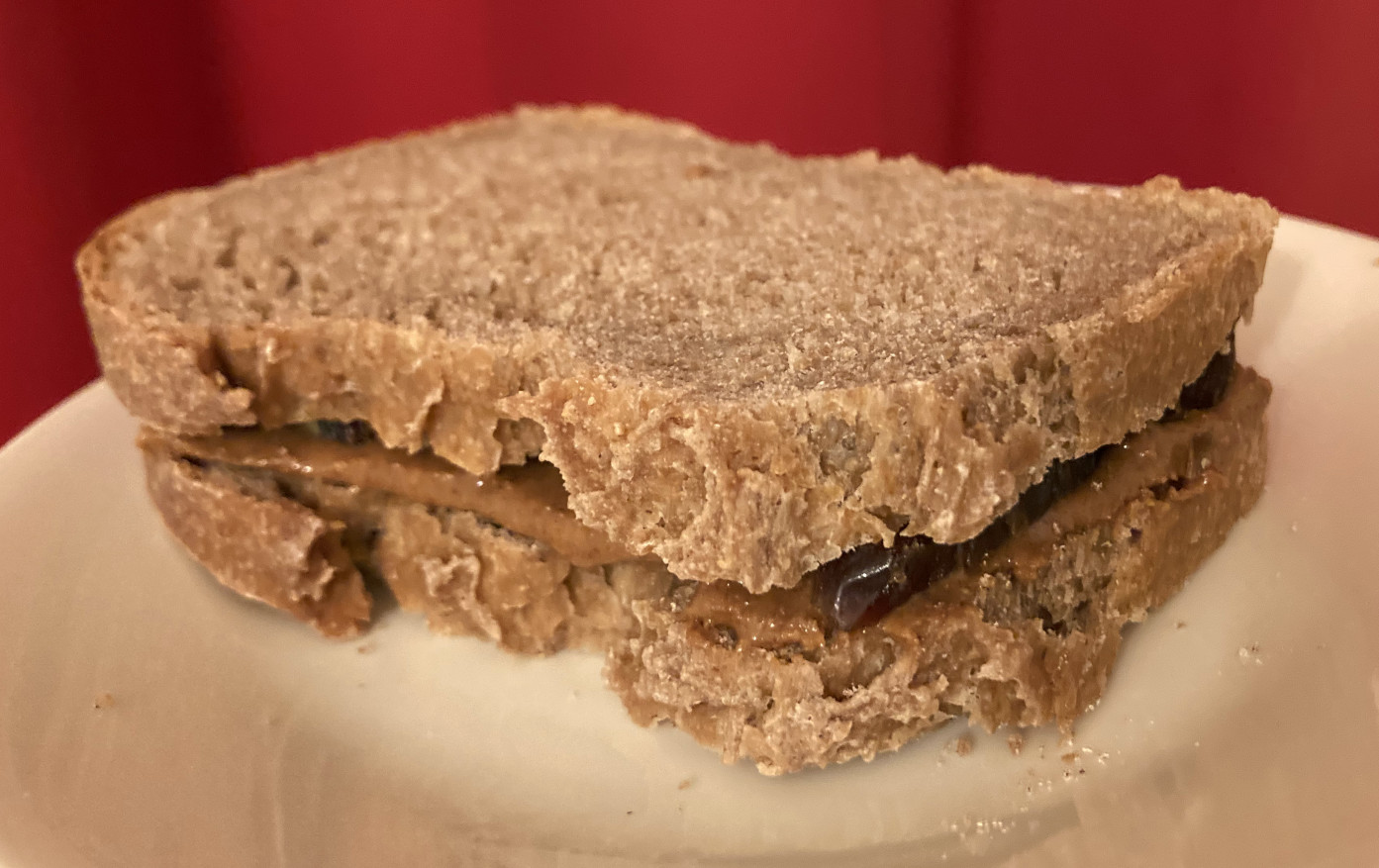
I might not have a future in food photography, but I do get to eat this peanut butter and date sandwich.
Fortunately an appropriate mixer seems to overcome the difficulties that I relied on very long "soak" times for, and without the drawbacks of my various workarounds. And this recipe was much closer to the softness I've been wanting in my sandwich bread for a long time, so I will probably continue with recipes along these lines for a bit. Some day I'll work on adding in preferments again, I'm sure. Next notable change will likely be adding soy milk and/or yogurt (in place of the lemon) and seeing if anything goes wrong there.
So, to answer the question I was previously asked: I think Yecora Rojo's gluten is just fine, but I certainly haven't been handling it right! However, when just milled, my batch of wheat does not stand up to long times in contact with water (i.e. 12+ hours autolyze or BF) and I don't know how much time is "safe." I suspect the gluten does endure for longer with salt than without, given what I observed in prior bakes with a long BF rather than salt-free autolyze, which fits with what is said in Bread Science's section on protease. For now, I don't think those will be the limits I'm testing; I've got other questions I'm drawn to explore.
- VerdigRegis's Blog
- Log in or register to post comments