
This is a recipe that Kenneth, a long-time poster to rec.food.sourdough, has posted a few times in response to requests. I made it this weekend and can safely say it's delicious. Tangy, but not overpoweringly so, with a smooth crumb that, though not full of big holes, is nevertheless a moderately light bread. It sprung well in the oven. In fact, it reminded me of some of the better Desem breads I've made. The hydration of this loaf is 68%, so one could go higher, I'm sure, and the salt is higher than usual at 2.5%, but the bread did not taste overly salty.
On a side note, I'm beginning to think my quest for holey, super hydrated whole wheat is misguided. The breads are no more tasty, in my experience, and though the crumb is more open, the high hydration has made the loaf flatten out considerably in the oven.
Back on topic. Kenneth, I believe, uses an authentic Poilane starter in his bread (I used Carl's) and emulates the high-extraction flour that Poilane uses through a combination of AP flour and freshly ground whole wheat (the loaf is about 40% white flour). He also uses 30% whole spelt flour, based on this page on Poilane's Web site.
How well does it imitate a true loaf from Poilane? I have no idea. The last time I was in France was 17 years ago when I was a not-so-well-heeled student, and today ... well, I'm not willing to part with the kind of cash it would take to have a loaf delivered to me from across the Atlantic.
All I can say is, it makes a nice loaf of bread. Here's my result:

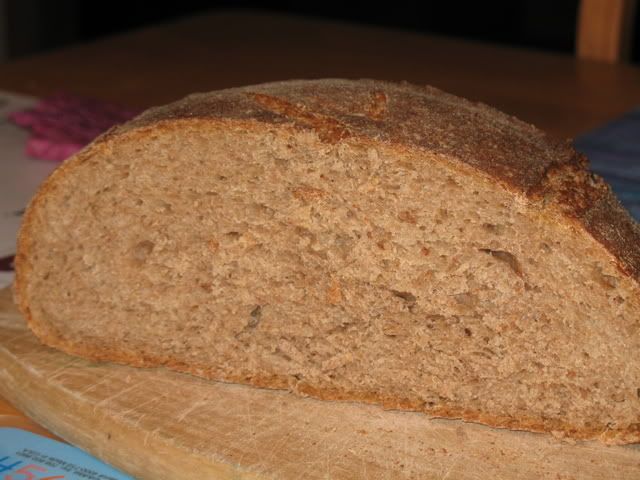
And here's Kenneth's recipe, or at least, the version of it that I used:
I'll be making this again ....
On a side note, I'm beginning to think my quest for holey, super hydrated whole wheat is misguided. The breads are no more tasty, in my experience, and though the crumb is more open, the high hydration has made the loaf flatten out considerably in the oven.
Back on topic. Kenneth, I believe, uses an authentic Poilane starter in his bread (I used Carl's) and emulates the high-extraction flour that Poilane uses through a combination of AP flour and freshly ground whole wheat (the loaf is about 40% white flour). He also uses 30% whole spelt flour, based on this page on Poilane's Web site.
How well does it imitate a true loaf from Poilane? I have no idea. The last time I was in France was 17 years ago when I was a not-so-well-heeled student, and today ... well, I'm not willing to part with the kind of cash it would take to have a loaf delivered to me from across the Atlantic.
All I can say is, it makes a nice loaf of bread. Here's my result:
And here's Kenneth's recipe, or at least, the version of it that I used:
Day 1, 9:30pm 474g Water + 120g starter + 236g coarse whole wheat, ferment at 69F.Of course, I fiddled with the recipe. First, I didn't knead on Day 2. Instead, I mixed it up and then let it ferment for 2.5 hours. I gave it a fold at 1 hour, 45 minutes and then another 45 minutes. Then, I popped it in the fridge. When I baked it, I did use a preheated oven, stone and steam, but I feel certain that a cold start would do fine as well. I baked at 460.
Day 2, 7:30am add 65g coarse rye, 254g KA AP flour, 170g wholespelt flour, 20g salt.
Knead fully, then refrigerate 24 hours. Then, form boule, ferment at 69F for 5 hours.
Slash, then bake at 490F for 35 minutes, the first 15 minutes with steam...
I'll be making this again ....
- JMonkey's Blog
- Log in or register to post comments
Hi JMonkey,
Thanks for posting this recipe. It's interesting to me because it's so far from what I normally do. The very wet, very ripe levain followed by a firm very long cold fermentation, then a long final proof is far from anything I've tried. The benefit of a soaker seems to happen during the refrigeration period, but maybe there is something going on with cold fermentation temperatures for a little while, too.
The other thing I notice is that this approach has a very high fermented flour ratio. I've always had trouble with high inoculations in medium or soft dough, but this is a very low hydration dough, given it has whole wheat, whole rye, and whole spelt in it. Maybe the high inoculation levels that would normally result in fairly rapid overproofing are offset by the very firm consistency and colder temperatures, so you end up with the right overall consistency in the end. I'm still a little surprised this recipe doesn't result in a very dense bread.
I guess it's yet another thing on the list to try. The list seems to grows bigger by the day, and I only knock things off the list a few times a month.
By the way, I agree that really wet dough may be too much trouble for little flavor gain. However, a long soak, hydration for a medium soft dough, and medium to small inoculations combined with enough kneading and some folding has resulted in a reasonably light , soft, moist texture and good flavor with whole wheat flours in my experience so far. The sourdough sandwich bread recipe I blogged a while ago is so far my favorite whole grain sourdough bread.
Bill
On another note, I'd totally missed your sandwich bread post. Very cool! That was during the period when I was almost entirely absent, trying to get ready for the big move. I LOVE how you describe incorporating the firm starter into the soaker. I'll definitely have to try that.
It's still warm in most of the house, but I noticed a bit of a chill and 69F in one end of the house today. It's been cool outside the last couple of days. So, I guess winter temperatures and different winter strategies for fermentation are around the corner finally. I've been wondering when it might finally start acting like fall around here.
Glad you liked the Sourdough Sandwich WW bread. The pizza technique for bringing together the epoxy dough does take some of the work out of it. I've now combined that approach with the Glezer "squeezing and extruding" hand kneading technique and find it works very well to both mix and knead the epoxy dough by hand. I alternate the "squeezing and extruding up and down the dough" with some french folds, and then let rest for a minute while I wash off any developing stickiness, rewet, and rest my hands, followed by another bout and just keep that going for 20-30 minutes. It is a relaxing way to knead without working up much of a sweat, if you want to knead a larger dough by hand. The squeezing and extruding not only develops the gluten quickly, but also forces the ingredients to integrate rapidly. Then the french fold quickly smooths out and stretches the gluten. The one minute rest lets both the gluten relax and your fingers to rest and recover, as well as wash and rewet.
Bill