SearchUser loginRecommended BooksFavorite Recipes
|
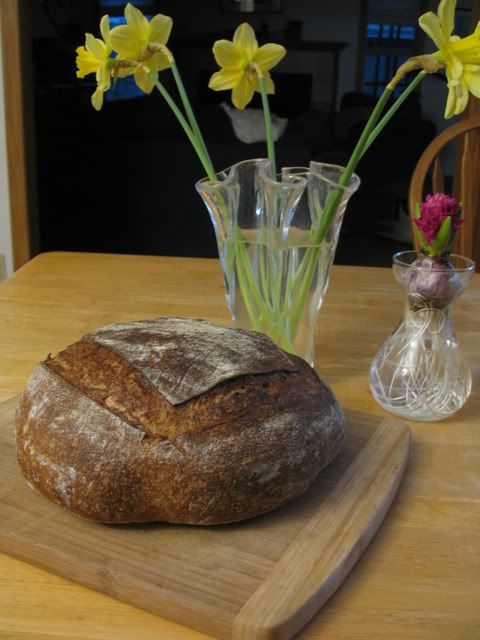
Submitted by JMonkey on February 4, 2009 - 10:26pm Flaxseed Rye, Ciabatta, Potato Pizza with a Poolish for Crust and Two Bulbous ColombiasI've not posted much, but I've still been baking, and I think my re-engagement with this site has encouraged me to try a few new things. Most recently, I made a variant of Jeffrey Hammelman's excellent Flaxseed Bread, which contains 60% rye. I've altered his recipe a bit, using whole rye instead of medium rye, increasing the hydration to 80% (to account for the extra absorbtion of whole rye) and used a rye starter at 100%, simply because that's how I keep mine. The recipe may be found in the handbook here. Usually, I just let the sourdough do its thing, and don't add any commercial yeast. But, I was under some time pressure here, so I went ahead and added 3/4 tsp of instant yeast like Hammelman. Wow! I couldn't tell any difference in flavor, which was hearty with a good tang, but I got quite a bit more volume. As for the rise, Hammelman calls for 80 degrees. Well, it was about 64 in my house, so I just threw a cup of boiling water in the bottom of a cooler, stood the dough on an upturned bowl and closed it up. The bulk rise took about 45 minutes and the final rise was just over an hour (I intended to go just one hour, but got stuck on a conference call, as I work from home -- augggggh!). Here's a picture. As you can see, I sprinkled sesame seeds on the top right after shaping.
Earlier in the week, I decided to give the Sullivan Street Potato Pizza from Glazer's Artisan Baking Across America a shot. You think you've worked with a wet dough? Trust me, until you've made the dough for the crust in this recipe, you've not worked with wet dough. The hydration on this puppy is something like 104%! It's a batter, and since I don't own a stand mixer (the recipe says to leave it in the mixer for 20 minutes) I went the food processor route, a la Peter Reinhart, and let it churn away for 45 seconds. Did it work? I've no idea. But the dough (if you want to call it that) was smooth, and I was able to spread it over the pan. It was a good potato pizza, but a little too starchy for my taste what with bread and potatoes together. Not sure I'll make it again.
I also decided to give Ponsford's Ciabatta from this same book another go, which has previously given me fits. As usual, probably because my house is so cold (below 60 at night sometimes) it took about 36 hours instead of 24 for the biga to develop. But this time around, I actually got a decent loaf of bread. Truth be told, though, I thought the poolish ciabattas I've made before tasted better. I don't see much advantage in using so little yeast (1/4 tsp of yeast is disolved into a cup of water -- then 1/2 tsp of that water is used to leaven the biga!) for the home baker, though I can see how it would be a big advantage for a professional baker to be able to let it ripen 24 hours.
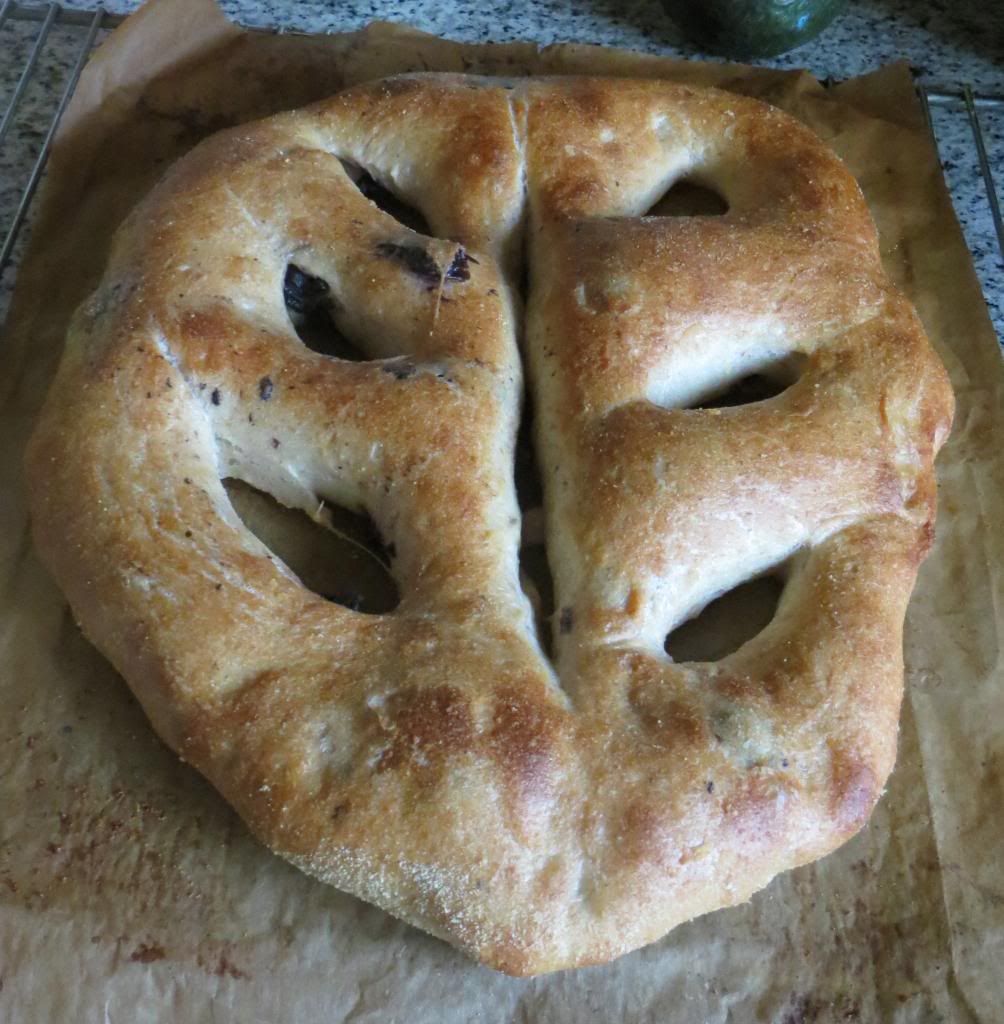
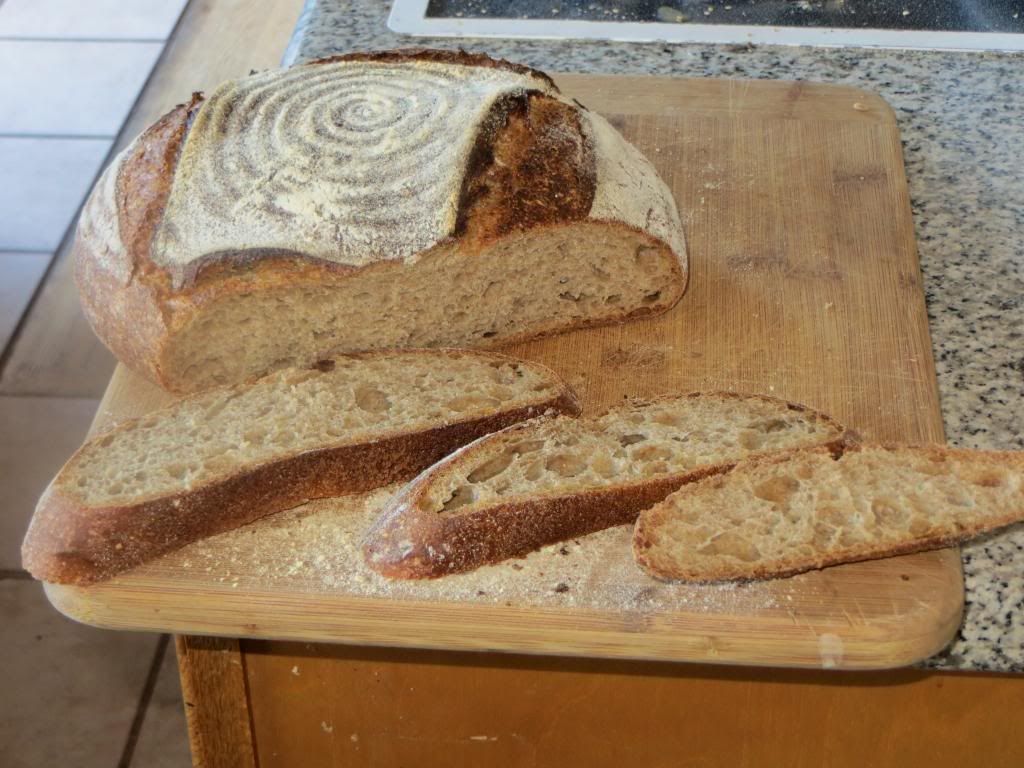
Finally, I made a couple of Colombia batards, also from Glazer's book. MountainDog turned me on to this bread, for which I'm very grateful. Clearly, as bulbous as these loaves are, I should have let them proof another 30-60 minutes, but odd-looking bread for dinner is better than day-old bread the next day (well, most of the time). They tasted lovely, as always.
And the innerds, which, had I waited another 45 minutes, would have likely been more open. But, alas, the soup would have had no accompaniment.
Submitted by JMonkey on January 20, 2009 - 10:57pm 40% Rye with Caraway to accompany Chicken Soup with Ginger & DillI swear, it's just about impossible to kill a starter. I'd left my poor rye starter unfed in the fridge for at least three months, and when I opened it a couple of days ago, the top was a slimy grey with some sort of fuzzy stuff starting to take hold. But, as I often find is the case, underneath this disgusting, repulsive crust, though the starter looked tired, it also looked undamaged. I fed a dab of this under-crust starter a few times and it soon looked ready to make a loaf of bread. So I did -- a loaf of 40% Rye with Caraway.
Such a tasty loaf. And it paired well with Carol Lessor's Chicken with Ginger & Dill Soup from Souped Up!. I'd been admiring the recipe for some time, but it called for boiling a whole chicken, which I usually don't have handy. At the Winter Farmer's Market this weekend, however, a woman was selling stew hens for cheap, so I picked one up for about $6. For those who have the book, it seemed like overkill to me to boil the chicken and vegetables in chicken stock, so I just used water. It's a good soup. The bread was good, too. Here's how I made it (It's the same recipe that I put in the handbook. I adapted it from Jeffrey Hamelman's Bread so that it would work with my 100% hydration starter. I also bumped up the water in the loaf and omitted the commercial yeast. I figure the sourdough is strong enough to do the job so long as I've got the time to wait. Formula 40% of the flour (all the rye) is in the starter at 100% hydration Ingredients Mixing Dough development and the first rise Shaping Second rise I baked this in a cloche at 450 degrees for about 40 minutes, taking the top of the cloche off about halfway through. Tomorrow: a big fat tempeh reuben for lunch! (What?! That doesn't sound good? Truth be told, it sounds awful to everyone else but me in my family, as well. But to me ... heaven.) Submitted by JMonkey on January 17, 2009 - 6:24pm Colombia Sourdough and Sourdough PizzaMountainDog's blog entry on overnight Colombia loaves struck my fancy, so I made a single loaf for the family. What a hit with my family!
I was a bit pressed for time in the morning, however, since I need to have the loaf ready to make sandwiches (I get up at 5am for work, and I work from home). They should have risen another hour, probably, so the crumb was not as open as it could have been, but the loaves tasted fantastic. It's amazing what a small amount of toasted wheat germ and barley malt will do for a loaf's flavor and color.
Earlier in the week, I also made sourdough pizza.
It's easy to do, and, since I made four doughballs, it allows me to bake a couple and then put a couple more in the freezer for another time. All I have to do is put them in the fridge the night before, and then take them out a couple of hours before I'm ready to shape the pies. Here's how I do it: Formula
Ingredients
The night before, I first dissolve the starter into the water, and then add the salt and the oil. Finally, I mix in the flours, until everything is nicely mixed. Then, let it rest for about an hour, and then do three stretch and folds with about 20-30 minutes between each. I then cover the dough, and let it rise all night. The next morning, I see whether the dough has risen enough (8 - 10 hours is usually enough) and then divide it into 4 doughballs of about 340 grams a piece. Two dough balls go into the plastic baggies in the fridge, while the others go in plastic baggies in the freezer. I remove the fridge doughballs two hours before baking, and shape them into tight balls. I then cover each with a cereal bowl. While they warm up, I prepare the toppings. Tomato sauce (for two pies)
I mix this up, and set it aside, adding salt if it needs it. Some canned tomatoes are already well salted. With the brand I use, though, I usually have to add 1/2 tsp or so. Cheese blend (for two pies)
Other toppings are, of course, up to you. I like chicken sausage, black olives and mushrooms, myself. Roasted red bell peppers are awesome. Fresh tomatoes are great (under the cheese), when available, as are fresh basil leaves, added just after the pie comes out of the oven. Shaping the pie Before adding the toppings, I make sure that the pie will move on the peel. Then I add sauce, cheese and toppings and then bake on the stone for 9-11 minutes. I let it cool for a few minutes on a rack before cutting into slices. Submitted by JMonkey on September 28, 2008 - 12:10am Poolish baguettes and a flying sourdough roundIt's been a while since I posted, mainly due to ramped up work and family obligations, but I've not stopped baking. And, despite the fact that both of these breads are white, the vast majority of my baking is still 100% whole grain. Submitted by JMonkey on April 19, 2008 - 4:58pm Recent bakes -- I'm back!I've been absent from TFL recently, as work and home have eaten up just about every waking minute, and there have been far too many waking minutes in the past couple of months. I could have stood for a tad more sleeping minutes. Submitted by JMonkey on February 19, 2008 - 9:56pm Two holidays (and off-topic pictures)
Submitted by JMonkey on February 11, 2008 - 1:08pm Ah .. the forgotten straight doughYesterday, I had two unpleasant surprises. Submitted by JMonkey on February 9, 2008 - 3:01pm Busy busy busyI've been baking a lot, I've just had no time with work and home life to post. Here's a quick update of what I've been making over the past few weeks. Submitted by JMonkey on January 22, 2008 - 9:16am Amazing, resiliant starterI wish now that I'd taken a picture, but I didn't think of it. I was too consumed with the thought that I'd lost Rhonda Rye, my rye starter. I'd been about a month since I'd used or refreshed her and, while she'd gotten pretty hoochy in the past, I'd never had any trouble with an invasion. Submitted by JMonkey on January 14, 2008 - 12:04pm Back to whole grains with a Dragon's Breath twistThough I'm sure I'll be lured away once again by the delights of a good poolish, I'm back to baking whole grains. |
ALSO ON |