
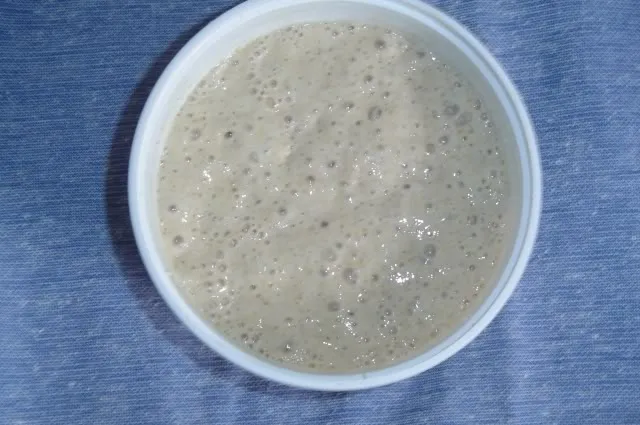
I have been baking with wild yeast sourdough for the past 5 years. It all began when I purchased a starter from Sourdoughs International. One starter led to another starter, until I had 5 different ones. Recently, I felt up to the challenge of making my own wild yeast starter from scratch. I had tried this once before, many years ago, with no success at all. At that time I knew next to nothing about wild yeast and how it works.
This starter recipe is awesome because it really works, and it explains why it works. The starter I made is very good. The flavor is amazing and it rises very well. I purchased rye and wheat berries at my local health food store and ground them in a coffee grinder to make flour for my starter. It was kind of tedious to grind but I only needed a few tablespoons. I'm sure that you could just buy freshly milled flour at the health food store and it would work just as well. The wild yeast is on the grains and you just need to provide the right conditons to wake it up.
Procedure for Making Sourdough Starter
Day 1: mix...
2 T. whole grain flour (rye and/or wheat)
2 T. unsweetened pineapple juice or orange juice
Cover and let sit at room temperature for 24 hours.
Day 2: add...
2 T. whole grain flour
2 T. juice
Stir well, cover and let sit at room temperature 24 hours. At day 2 you may (or may not) start to see some small bubbles.
Day 3: add...
2 T. whole grain flour
2 T. juice
Stir well, cover and let sit at room temperature 24 hours.
Starter at Day 3:
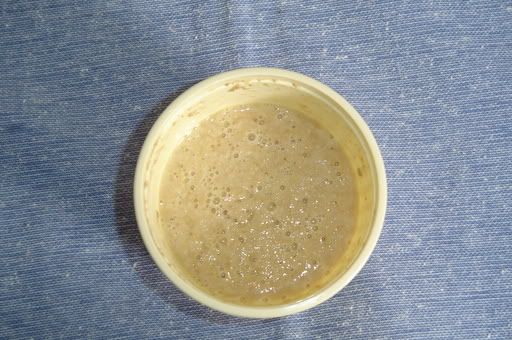
Day 4:
Stir down, measure out 1/4 cup and discard the rest.
To the 1/4 cup add...
1/4 cup flour*
1/4 cup filtered or spring water
*You can feed the starter whatever type of flour you want at this point (unbleached white, whole wheat, rye). If you are new to sourdough, a white starter is probably the best choice. All-purpose flour is fine--a high protein flour is not necessary.
Repeat Day 4:
Once daily until the mixture starts to expand and smell yeasty. It is not unusual for the mixture to get very bubbly around Day 3 or 4 and then go completely flat and appear dead. If the mixture does not start to grow again by Day 6, add 1/4 tsp. apple cider vinegar with the daily feeding. This will lower the pH level a bit more and it should wake up the yeast.
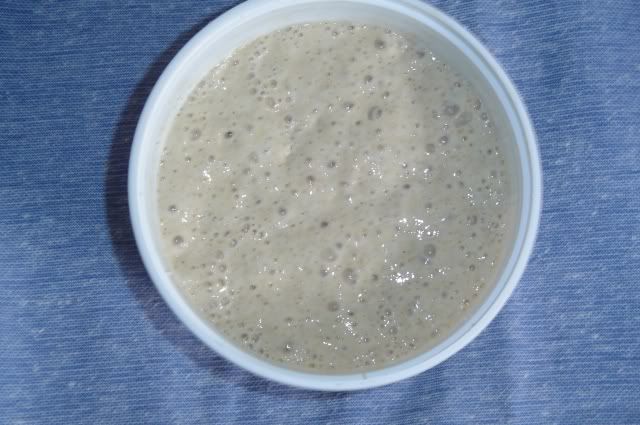
Starter at Day 7:
How it Works
The yeast we are trying to cultivate will only become active when the environment is right. When you mix flour and water together, you end up with a mixture that is close to neutral in pH, and our yeasties need it a bit more on the acid side. This is why we are using the acidic fruit juice. There are other microbes in the flour that prefer a more neutral pH, and so they are the first to wake up and grow. Some will produce acids as by-products. That helps to lower the pH to the point that they can no longer grow, until the environment is just right for wild yeast to activate. The length of time it takes for this to happen varies.
When using just flour and water, many will grow a gas-producing bacteria that slows down the process. It can raise the starter to three times its volume in a relatively short time. Don't worry--it is harmless. It is a bacteria sometimes used in other food fermentations like cheeses, and it is in the environment, including wheat fields and flours. It does not grow at a low pH, and the fruit juices keep the pH low enough to by-pass it. Things will still progress, but this is the point at which people get frustrated and quit, because the gassy bacteria stop growing. It will appear that the "yeast" died on you, when in fact, you haven't begun to grow yeast yet. When the pH drops below 3.5--4 or so, the yeast will activate, begin to grow, and the starter will expand again. You just need to keep it fed and cared for until then.
Once your wild yeast is growing, the character and flavor will improve if you continue to give it daily feedings and keep it at room temperature for a couple of weeks longer.
After that time, it should be kept in the refrigerator between uses/feedings.
My First Loaves From New Starter:

This starter recipe is awesome because it really works, and it explains why it works. The starter I made is very good. The flavor is amazing and it rises very well. I purchased rye and wheat berries at my local health food store and ground them in a coffee grinder to make flour for my starter. It was kind of tedious to grind but I only needed a few tablespoons. I'm sure that you could just buy freshly milled flour at the health food store and it would work just as well. The wild yeast is on the grains and you just need to provide the right conditons to wake it up.
Procedure for Making Sourdough Starter
Day 1: mix...
2 T. whole grain flour (rye and/or wheat)
2 T. unsweetened pineapple juice or orange juice
Cover and let sit at room temperature for 24 hours.
Day 2: add...
2 T. whole grain flour
2 T. juice
Stir well, cover and let sit at room temperature 24 hours. At day 2 you may (or may not) start to see some small bubbles.
Day 3: add...
2 T. whole grain flour
2 T. juice
Stir well, cover and let sit at room temperature 24 hours.
Starter at Day 3:
Day 4:
Stir down, measure out 1/4 cup and discard the rest.
To the 1/4 cup add...
1/4 cup flour*
1/4 cup filtered or spring water
*You can feed the starter whatever type of flour you want at this point (unbleached white, whole wheat, rye). If you are new to sourdough, a white starter is probably the best choice. All-purpose flour is fine--a high protein flour is not necessary.
Repeat Day 4:
Once daily until the mixture starts to expand and smell yeasty. It is not unusual for the mixture to get very bubbly around Day 3 or 4 and then go completely flat and appear dead. If the mixture does not start to grow again by Day 6, add 1/4 tsp. apple cider vinegar with the daily feeding. This will lower the pH level a bit more and it should wake up the yeast.
Starter at Day 7:
How it Works
The yeast we are trying to cultivate will only become active when the environment is right. When you mix flour and water together, you end up with a mixture that is close to neutral in pH, and our yeasties need it a bit more on the acid side. This is why we are using the acidic fruit juice. There are other microbes in the flour that prefer a more neutral pH, and so they are the first to wake up and grow. Some will produce acids as by-products. That helps to lower the pH to the point that they can no longer grow, until the environment is just right for wild yeast to activate. The length of time it takes for this to happen varies.
When using just flour and water, many will grow a gas-producing bacteria that slows down the process. It can raise the starter to three times its volume in a relatively short time. Don't worry--it is harmless. It is a bacteria sometimes used in other food fermentations like cheeses, and it is in the environment, including wheat fields and flours. It does not grow at a low pH, and the fruit juices keep the pH low enough to by-pass it. Things will still progress, but this is the point at which people get frustrated and quit, because the gassy bacteria stop growing. It will appear that the "yeast" died on you, when in fact, you haven't begun to grow yeast yet. When the pH drops below 3.5--4 or so, the yeast will activate, begin to grow, and the starter will expand again. You just need to keep it fed and cared for until then.
Once your wild yeast is growing, the character and flavor will improve if you continue to give it daily feedings and keep it at room temperature for a couple of weeks longer.
After that time, it should be kept in the refrigerator between uses/feedings.
My First Loaves From New Starter:
- SourdoLady's Blog
- Log in or register to post comments
Wondering if the idea is to get some fruit acid if meyer lemon juice would work? I always have so much lemon juice hanging around and never have any orange or pinapple. Although, oranges are easy to come by, just drive down the road this time of year and i can pick some up..
Thank you for your enthusiasim. It makes me try harder. I'm pretty knew at this, done a few loaves... Need the encouragment I guess. Thanks again.
Mike
I've always wondered how the early settlers managed to make such nice loaves of bread in the olden days. It seems that more or less modern yeast didn't come out until after 1850 or so with Fleishmann's innovation. I guess that is probably why you all like this topic. Bread is great. Keep baking.
> I'm quite sure the sourdours produced over
> the past 6000 years or so in Europe and the
> middle east didn't use pineapple juice or
> anything other than water!
Interestingly enough that might not be the case. King Arthur Flour is doing some research on bacteria which indicates that a non-sour bacteria might be growing more common [no pun intended] on flours, even organic flours. This bacteria crowds out the sour-forming bacteria and prevents a true sour culture from developing. This work is preliminary and I have only seen references in forum posts, but their testers are recommending that if you can't grow a sour culture with plain water you should try using an acidic juice for the starter and first feeding to create a better environment for the sour-forming bacteria.
sPh
Everybody has a different experience with getting a starter up and running, but slow starts seem to be pretty common. It always feels longer, too, when you want it to be ready right now. So, hang in there. Yours will bubble and froth, when it feels like it. ;-)
Just look at it as a practice round for the long, slow ferments you'll be doing with your sourdough breads.
Good luck and happy baking!
PMcCool
Great looking loaves of bread, you guys! Keep up the good baking.
Ray, you can feed the starter as much as you want in order to increase the quantity for your recipe. You can also adjust the amount of flour to water to get the consistency of starter that you prefer. Keep in mind that when you use a recipe the original baker's starter may have been either wetter or thicker than yours so adjustments are often necessary. It is always better to err on the side of wetter dough as too much flour makes for tough bread.
I've only made and have since maintained one starter in my life, so I can't speak from to much experience but it sounds like it's going fine. It's only been a week. Just keep throwing half out and feeding it with flour and water. I personally don't believe there is any reason to use anything but white flour or vinegar/oj. My feeling is that if it can be done without vinegar or oj, than there is no reason to put them in there at all. But there is a million ways of making/maintaining a starter out there and nearly all of them will work. If your leaving out on at room temperature I think it's best to feed it daily even if it appears to not be doing anything. But if it smells winey like you said, it should be well on it's way. A few more days and it should be ready to store in the frig, if that's what you plan to do with it.
demegrad
http://www.demegrad.blogspot.com
I guess temperature could have a big effect at this early stage of starter development. I started mine in this past summer and I started using it after a week but the first two breads I made with it I had to admittedly knead in some instant yeast because it was taking longer than I planned out. But now it's several months later and I couldn't be happier with it. I think wild yeast does better in colder temperatures than instant yeast so it's kind of perfect for baking in the winter. I think since essentially my sourdough starter "lives" in the frig that the yeast that has developed and is especially suited for cooler temperatures, I could be wrong, but your starter will become a good friend and your jar of regular yeast will get pushed to the back of the frig near some old store bought fruitcake someone gave you for christmas.
demegrad
http://www.demegrad.blogspot.com
I'm right there with you. It kills me to throw out starter but don't worry once the culture is healthy which it sounds like it is you can really choose your own way to do things without ever having to throw any out. You just have to do the whole throwing out thing at the beginning because you want to feed it with enough fresh flour and water to help the yeast grow and this just eventually leads to having to much. I've find I'm keeping less and less starter around and ever once in a while making pancakes or dog treats or something recipe that uses a lot of it. If you have any questions just let me know.
demegrad
http://www.demegrad.blogspot.com
Yay you just answered my question on what 100% hydration is (I kind of thought that was what it was).
Hi
Well I just started mine. But have a question or two.
Qt. What are the daily feedings?
Is it this again and again?
Jim
I enjoy cooking with wine. On occasion I even include it in the recipe.
SourdoLady,
So are you saying that you shouldn't use a citric juice? I do only water and flour. At first I tried equal amounts, but because of the altitude, I had a bit more water. Just as I have to increase my liquid when I make the dough. I tried adding commercial yeast, but (as S. John said would happen) some "sourdough snobs" pooh-pooh'ed that saying 'NEVER add commercial yeast to your starter.' And that's okay, since I didn't get great results from that either. When I finally got my patience, or lack thereof, under control, it finally performed as desired. After using it, I inadvertantly (I wasn't paying attention at the store) used bleached AP flour. It would double, then die. Some said use it anyway. I did when I made my stromboli. Worked well. I still don't know why the bleached AP died, but oh well. Anyway, I've seen recipes using honey, sugar, commercial yeast, and orange or grapefruit juice. If the acidic juice brings down the pH, isn't that a bad thing?
Steph
My starter is performing very nicely as of Day 7. On day 11, I have to go out of town for 5 days. If I give it a good feeding before I leave, will it survive in the fridge until I get back? Should I do anything special to revive it when I return? Thanks.
-Pam
I've been following the directions given here for making the wild yeast starter...and trying to be patient. Last night was Day 11, and the starter had lots of bubbles in it, and had risen (at one point) a little bit (maybe 1/8 inch) above the mark I put on the side of the container. This is the first time I noticed any rising. It also tasted nice and sour. Anyway, I fed it as mentioned in the directions (as per Day 4), which I have been doing all along. I've noticed that it gets more bubbly when it's thicker in consistency, ie. I mix in a little less water than flour when feeding. It's been sitting on my kitchen counter, where the temperature stays pretty much at 70° to 73°, maybe a little higher, like 75°/76°, if I use the oven. I've not yet put the starter in the refrigerator.
Some questions -
At this point, should I be feeding it more than once per day?
Is it at a point where I can use it for baking?
How do I get it ready for use in baking?
Thanks in advance.
when, after 17 days, and following all the directions above (except adding the apple cider vinegar, I haven't done that yet), my starter has less bubbles than the Day 3 picture and has never risen? I'll probably add the vinegar tonight when I get home from work, but at this point I'm not really holding out much hope for any change. And to answer questions, before they're asked...
Yes, clean utensils and containers.
Plastic container. Plastic and/or wooden spoon and spatula.
Stable temperature, 70° to 73°, with an occassional short-term rise to around 75° when I use the oven.
Starter was started with whole wheat flour and pineapple juice.
Water used is bottled and basically distilled water.
I've had these same results when in CA. I'm now in NY.
I'm at a total loss and very frustrated that my starter isn't doing anything it's supposed to be doing. I'd hoped to be baking bread soon, but...I don't see that happening. What am I doing wrong?
Personally, in that situation I would throw it away and start over. It took me three tries to get a good rye starter working; it was frustrating to throw the first two away (esp the 2nd one that was going OK and then molded) but that is what it took.
You might consider trying a different brand of (organic) flour.
sPh
Sandaidh,
I'm not sure exactly what feeding schedule you have, but here's my way of working with a starter that won't take off but has some sluggish activity after 4-5 days.
Feed it 1:4:4 by weight of starter:flour:water. Let it ferment for about 12 hours at room temperature. Then, refrigerate it for 12 hours. Repeat this cycle until it starts to "take off". The same cycle can be used for a few more days after it becomes active. After a few days, you can refrigerate it after feeding it and letting it ferment for a few hours and it should keep for weeks.
If you have the time, I would suggest splitting the culture in two. Add acid (vinegar) to one, and not to the other. I've found that the acid can help, but often it delays the process yet a few days more, depending on the cause of the sluggishness. If you notice the culture is less active after the acid is added to the feeding, then stop the acid addition and just continue the feeding/refrigeration cycle.
Bill
Yes, you did send some dried starter. Unfortunately, due to circumstance both in, and beyond, my control, I had problems with it. No fault of yours, or the starter, at all. My bad. Putting the wild yeast starter in a smaller container has helped me to see what it's doing. In the other container, all the risings and such were going out (ie sideways) instead of up. Smaller container and they're going up now. Much easier to see.
The San Francisco bread was, in a word...wonderful. The flavor was exactly as I remember from so many years in the Bay area. I used the no-knead recipe, which fits very well around my crazy work schedule. It didn't rise as much as I'd have liked, but I think that has more to do with my inexperience working with sourdough than anything else. And the crust is a bit too hard. But when I first tried the no-knead recipe using commercial yeast, I had the same 'hard crust' problem. It took some fiddling with the cooking time to fix that. I'm guessing the same will apply with the sourdough. I'm looking forward to making more. Thanks for all your help.
Hi SourdoLady,
Do you continue to feed your starter equal parts water and flour? I'm saving a copy of your deluxe sourdough bread recipe, and want to have my starter about the same consistency the recipe expects.
Also, for the lemon juice - is bottled OK? I keep fresh lemons around when I can, but not always.
I'm afraid I'm bad and I just dump flour and water in when feeding my starter. I know from looking what the consistency should be for my preference. I would describe it as thick pancake batter. The freshly mixed dough is quite soft and sticky immediately after mixing but it strengthens up nicely if you do a couple of folds spaced 45 minutes to an hour apart.
I always use bottled lemon juice also, because I seldom keep fresh lemons on hand
I am on day 4 of using sourdoughladys starter receipe of fresh wwflour and pineapple juice to get a sourdough starter. I have a white fuzzy mold growing up the side of container. I will starte over today. If anyone can tell me what I did wrong or how to prevent this I would be greatfull. I am new to baking and have never done sourdough befroe.
Thanks,
Paula
Well, I should have read more post before I wrote the above. I read sourdoughladys answer to someone elses mold problem. I had not thrown out mine yet so I was able to get 1/4 cup that was not touching the mold and put it in a diffrent clean glass container, I then added the 1/4 cup AP flour and 1/4 cup water. I used my well water. I also used a clean damp paper towel to clean the sides of the dish so no dough smears were there. I have it covered with the glass lid of the bowl. Is that ok or should I use a clean towel?
Sourdolady,
I wanted to thank you directly for the great starter recipe and for your help. The starter is taking over my kitchen and I'm thrilled. I made my first loaf of bread last night- also using your advice- I converted a recipe I use to make sandwich bread. It was delicious and is GONE! I have some rolls rising now and plan to make your Deluxe Sourdough tonight.
Thanks again,
Marni
I have two starters currently failing (or so they appear). The first I started approx. 9 days ago, just bread flour and water. It looked like it was working around day four, but since then, it hasn't changed at all. I feed it every day. What's going on here? Also, should I taking some of it out of the bowl? I was doing 1/2 cup of each for a while, now I tried dropping down to 1/4 cup just in case I was overwhelming any yeast that might reside there. (I also tried adding a pinch of active dry yeast to kick start it...)
My Second starter is your recipe for the wild yeast. I'm on Day 3, and I haven't seen any bubbles... am I a yeast killer? I long to have 4 year old yeast growing in my fridge (four years from now) but I just can't seem to get it going.
HELP!!
Ok, I can be patient. At what point, after adding 1/4 cup flour and 1/4 water (if it takes a week of doing so, every day) should I save 1/4 cup and throw the rest away? And how much starter equal 1 package of yeast? How much do I use in a typical french bread recipe. And this wild sourdough yeast starter can technically be used in any recipe, right?
Thanks sooo much for all your time and help!!
From Day 4 onward you should be discarding all but 1/4 cup and then feeding that 1/4 cup. When your starter matures enough so that you want to start baking with it, then you can increase the feeding amount so that you have a larger quantity of starter to make your recipe.
I would recommend that you start out by using a recipe that is written specifically for sourdough rather than trying to convert a non-sourdough recipe. It is just a lot simpler for you and there are several posted on this site that you could use.
Very interesting and helpful posts! I am on day 6 of the posted starter method. (I used whole wheat). My starter smells great, isn't growing so I'm being patient and have added the vinegar
I use very clean utensils for adding. However, am ***I supposed to be washing my container each time I discard before I replace and add back in? I have not been doing that.***
FYI, I'm using a rigid plastic clear container with a vacuum seal type lid (from Target - you may have seen the type...Michael Graves-designed with the butterfly-type closure on the lid to create a seal.)
Stephanie in Very Hot Almost Mexico
Visit my blog: http://bikebookandbread.blogspot.com/
Thanks for following up! I have a healthy starter, and it is now in the fridge (which reminds me, I need to feed my little bread baby).
I have made one batch of sourdough. It was NOT great, but it was a start -- seriously I chose the wroooooong recipe -- it WASN'T yours or even from this site...read my blog entry regarding my recipe choice and you'll understand: http://bikebookandbread.blogspot.com/2008/08/first-sourdough.html. Texture was horrible but the flavor and level of sourness was quite good...at least I know I have a healthy starter!
I will be beefing up the starter tomorrow morning for a loaf on Monday or so.
Stephanie in Very Hot Almost Mexico
Visit my blog: http://bikebookandbread.blogspot.com/
Glad to hear you are having some success, Brigette! Sourdough is just so much fun, and oh, the flavor.
I try to check this thread from time to time but sometimes I forget for awhile. The other day I tried to post several times and the site kept freezing up on me. Hopefully with the new upgrade things will be better.
I have never lived in a climate such as yours, but I'm sure it would work just fine. You will find that your dough will rise faster because of the warmer temps. You may have to use a bit more flour in your doughs because of the humidity. Breads that rise fast have less flavor but you could counteract that by refrigerating the dough and baking it later. There is no reason to worry about the smell. Sourdough does not have a bad smell. Give it a try!
Hi Grace,
It is not unusual that you mixture was dry. Rye flour can absorb a lot of liquid. Adding more juice is fine. It will work either way, but wetter will start the yeast growing faster. Be sure to keep it in a warmish place, too, for a quick start. Good luck! Let me know how it goes.
Hi SDL,
I started my starter with water and rye. With 24 hours it was really bubbly and rose quite a bit (almost doubled). I've read that the initial rise is often caused by "bad" bacteria. It doesn't smell to good (not sour). Do you think I should keep feeding it as outlined above and wait for the wild yeast to take over? At what point do you think it'll be ready? Other than activity, what signs should I be looking for?
Eusebius
Yes, keep up with your feedings. This first bubbling is not yeast. When it is actually yeast growing, it will smell yeasty at first and then winey or alcoholic as it ferments further. Since you didn't use the fruit juice, I highly reccomend that you add 1/4 tsp. vinegar now (only the one time). It will lower the pH and make your starter activate quicker. It will also deter the growth of bad bacteria that can foul your starter.
Don't be surprised if your starter appears to be dead for a couple of days now. When it starts to bubble again, it is the real yeast starting to grow. It will start as a few very small bubbles on the surface, which will continue to grow in both number and size. From the time you first see them begin to appear it may take a couple of days before you see a lot of activity. You will know when it happens. Keeping the starter warm (80 to 85°) will accelerate activity. Have fun, and good luck!
I doubt that you ruined it. Keep up with the daily feedings, but only do the vinegar the one time--don't keep adding more every day. You should be close to getting the starter active.
Hi, I just found your recipe and this great discussion on sourdough. I started a sourdough 3 days ago or so with flour and water. I have a question about your method. Do you keep feeding it juice and flour forever or just for the first couple days? My big question is how often can you feed sourdough? My kids and I are doing our sourdough together. They wanted a pet and so we are starting out small, with a micro-organizim. We named it "Yeasty the Beasty". The kids are enjoying feeding our little "pet" and I look forward to baking bread. We fed it in the morning and then we fed it at night. The kids have been asking me why doesn't "Yeasty" eat lunch? How often can you feed your sourdough? Can you feed it 3 times a day, or would that be bad?
Happy Baking!
First of all, I will say that I am not a fan of freezing starters. Many will not survive freezing. It is not really necessary to freeze a starter because they will keep for months just in the fridge, even without feeding, if they are healthy going in and are kept at a thicker consistency (more like soft dough).
Since you have already frozen your starter, take it out and discard all but a couple of spoonfuls. Feed it with flour/water to the consistency that you like and set it in a warm place. If it is still viable, it will get bubbly. It could take 24 hours or more to wake it up, or it may bubble within a few hours. What was the source of your starter? Did you make it, or was it given to you?
The reason for discarding old starter is that is has used up all the nutrients in the flour and no longer has any food value to the yeast cells. The yeast cells have multiplied by great numbers so you now have WAY more hungry yeasties to feed. Discarding gets rid of most of the waste and also thins out the number of hungry yeasties so you don't have too many of them competing for food. If you never threw any out, you would be feeding buckets of flour to keep them happy. Yes, you can use these discards in any other baking that you want--add to pancake batter, quick breads, etc. You don't need to save much starter for storage in the fridge. I generally only save 1/4 cup. When you want to bake with it you can build the quantity with a couple of feedings. When maintained this way, you will not be throwing out a lot of starter.
The amount of starter used in a recipe will determine the length of time it takes from mix to bake. It will also have an impact on flavor. Less starter=longer fermentation=more flavor and tang in finished bread. Whole wheat or rye included in the dough will also add more flavor and tang. Sour flavor can be very elusive sometimes. I get my best sour when I make a dough and then fold the dough every hour until the yeast starts to make the dough spongy, shape-rise-bake. You can also refrigerate the dough just before it is ready to shape OR shape and then refrigerate. Take out and continue the next day. This can add a lot of additional flavor to the bread. You just need to play around and experiment until you find the right technique to give the results you are after. For the chewy, moist bread you need a softer, wetter dough.
The shine on the crust of my loaves is simply butter brushed on the hot bread just out of the oven. This also softens the crust, so if you like crispy crusts, don't do it!
I'm currently on day 2. last night, I mixed 2 tbs. whole wheat flour and 2 tbs. of lemon juice mixed with some warm water. is this okay? I didn't have oranges or pineapple juice, and I figured lemon isn't too acidic if we can use vinegar (which has a very close pH level). still, I was reluctant, so i dulled it out with some water. I hope it works.
also, should I leave my container a little open, or should it be closed tightly?
How did the lemon juice work out? I have never used it in a starter. It sounds like a lot of acidity, but I'm just going by how sour lemon juice tastes. I have no idea what the pH level is.
Your container should be covered, but not so tight that gasses can't escape.
I'm almost at the end of day 4, and yesterday I started getting that alcohol smell and bubbles. It only worked after i dilluded the lemon juice WAY down. lemon juice has an acidity of 2 (pH). day one I put 1 tbs of water and 1 tbs of lemon juice, and on day 2, I put 1.5 tbs of water and .5 tbs of lemon juice (that seemed to work better).
Thank you for Your guide!
I am attempting to make starter from fresh pineapple after watching the Nancy Silverton PBS video where she talks about doing the same with fresh grapes. She gave no further instructions after submerging the grapes in the slurry. My questions: 1)Is there a different treatment for this type of starter? 2) When do I start feeding? 3) Should I have been stirring the slurry once in a while?
I have just completed 3 full days with no feedings nor stirrings. Since day 2, there have been tiny bubbles on the glass walls. The odor smells like that of fermenting pineapples and is not unpleasant.
Appreciate your help.
Now all you have to do is add some flour and let it rise. Then add to a recipe when it starts to smell yeasty again. It will do it. This reminds me I started Kiwi starter more than a week ago and forgot all about it... ...it doesn't look good. Looks really bad in fact. Once it gets bubbles and starts smelling fermenty, better to park it in the fridge or keep cool.
Mini
I'm just now finishing day 9, and I'm a little worried. I'm getting a LOT of bubbles, but no rising. the alcohol-like smell ceased to exist several days ago. I changed my starter from whole wheat and lemon juice to unbleached AP and water (except for 2 days in which i used bread flour, because i ran out of AP).
does this mean I'm doing something wrong?
I'm not sure about the lemon juice. It may have lowered the pH too much. Don't add any more of it. Do you have any rye flour? If you do, add a T. of rye with each feeding and see if that doesn't get it lively. If you don't have rye, and can't get any, then use a T. of WW instead. Bread flour is fine, and won't hurt anything. Are you using unchlorinated water? Are you keeping it in a place that the temps are in the mid-70's? If it is cooler than that, it will take much longer to start. I'd give it a few more days before you get worried.
i dulled out the lemon juice, and it worked after that... no rye, so i'll add WW. temp should be right, I'm just leaving it out on the counter (I live in western washington state). but how do I find out about the water? I'm using tap water.... (the tap water in washington is pretty good, though).
Glad it is working better. To find out about your water, either call or go to your city water plant's website. Ask them if they use chlorine or chloramine to treat the water. Chlorine will dissipate if you let it stand several hours. Chloramine is stable and will not dissipate--it is harmful to growing sourdough. Another alternative is to use bottled spring water. Don't use distilled water because distilling removes the minerals and you want the minerals there.
I tried looking for the info about the water, but i give up. I have no clue where to find it.
I added the whole wheat, and I got better bubbles. when I asked for a second opinion on its rising, I was told that it rose a little. (I couldn't see it)
I'm thinking about adding some honey. I read that in Rinehart's bread and crumb.
O Mi Goodness, I shocked myself! Both starter and bread were very successful! I was a little shaky in places not knowing how things are supposed to go but tried not to panic and just follow the steps. Amaaaazing! I followed her bread recipe almost exactly except for the potato flakes (used potato water for my water) and replaced some of the total flour with organic rye flour (1/2 cup and 1/2 cup white whole wheat flour) then King Arthur whole wheat bread flour for the remaining flour. Kneaded in approx 1 tsp. caraway seed towards the end of the kneading period. I used a 38 degree garage as my "refrigerator" overnight. Worked great! my room temp is only 60...I am one cool cat, ha! So I put it in the oven on warm very lightly to rise the next day to kind of raise that temp a bit but not too much bec as she says you want it to rise slowly not as fast as regular bread.
I shaped it into one big round loaf rather than two smaller ones. It turned out soooooo good, I am just thrilled and stuffed to the gills with that oh so wonderful tasting bread that I never thought I would be able to make! This has the crusty chewiness that I love. Cheers to Sourdo lady. Hope all will use her techniques.
Tha BreadHound
I'm on day 4 of my starter and it smells a bit cheesy. Not particularly good cheese, but not awful cheese either. I did not use pineapple juice, because I didn't have any. I used just flour and water.
I'm going to do the refreshment this evening, but wanted to see if this is a lost cause. I did get some pineapple juice this evening and will start another batch.
Chris
It is nothing to worry about. In the early stages starters can have unusual smells. They will go away after the starter activates well. You really don't need to start over with your starter. I would just give it a feeding with the juice now, and maybe again tomorrow--then continue on with the flour and water from then on.
Hi Sourdolady, I have followed your instructions to make my own wild yeast. I live in NW Canada and needless to say it's very cold and dry here. Today is day 10 and I am getting more bubbles but the volume has not yet doubled. I am hoping if I keep feeding it, I will be able to use the starter next week.
How do I post a picture here?
Oh, I figured that out. Day 10 of my wild yeast starter using rye flour and pineapple juice.
That's looking pretty good! Are you planning to keep it a wholegrain starter, or are you going to switch it over to unbleached white flour? Wholegrain won't rise as high. Now that it is actively growing, I would start giving it two feedings a day. Don't forget to always discard at least half of it before feeding. You will also get more rise if you make your starter thicker in consistency--more flour than water. Just because it doesn't double doesn't mean it isn't capable of rising a loaf of bread. I'd give it a couple more days of twice daily feedings and then try baking a loaf.
I have just successfully made a sourdough starter and am anxious to try the Deluxe Sourdough Bread and your recipe using dry milk powder/potato flakes as mentioned in some of the posts, but, I don't know where to look for the recipes. Can you tell me where/how to find them? Thanks for the help
The recipe is here on my blog:
http://www.thefreshloaf.com/node/257
Thanks, Sourdolady! I have started feeding the starter twice a day and today I put some unbleached flour in it. Instead of throwing away 1/2 of the starter, I saved it for an experiment. I fed half of the starter with the same amount of flour and water. For the other half, I used less water (as you had suggested). A few hours later, the drier starter did rise more than the wet one. The wet one got more bubbles but didn't rise as high. Truly interesting. I use the wet starter to make a sponge and I am going to use it to make pancakes and maybe even a loaf of bread tomorrow. Will see if the new starter have enough strengh to rise a loaf. I am getting pretty excited. Thanks again. I will keep you posted.
I did it! The wild yeast looked pretty good last night so I made a sponge. Then this morning I made this huge loaf of Russian Black sandwich loaf. I allowed it to rise 4 hours the first time then 2 hours the second, totally 6 hours. It rose a lot bigger than I thought but the texture was soft like white bread, with the nice rye flavor. We had some for dinner and loved it! Thanks Sourdolady!
You did a really good job on your bread! You should have taken a crumb shot, also. I'll bet it was really nice on the inside, too. You will notice that the flavor will change as it ages over the next couple of days.
The volume of the bread and your description of the crumb are 2 characteristics that I'd like to have in my bread. Is the recipe here somewhere? I may have missed it. I'm inspired to try it.
Thanks SourdoLady! Next time I will take the crumb shot. I am not sure if we will get to find out about the new flavor of this loaf. We loved it so much that we ate half a loaf as soon as it was cooled. LOL
Cake Diva, I actually modified a breadmachine recipe for this loaf. It's so massive that it created a muffin top upon baking. Here's the original recipe:
1-1/2 C water (I used less, depends on the wetness of the sponge)
2 T cider vinegar
2-1/2 C bread flour (I used whole wheat)
1 C rye flour
1 tsp salt
2 T margarine (I used sunflower oil)
2 T dark corn syrup (I used molasses)
1 T brown sugar
3 T unsweetened cocoa powder
1 tsp instant coffee granules (I used 1/2 T)
1 T caraway seed
1/4 tsp fennel seed (optional, but I use 1 T)
2 tsp active dry yeast (of course, I used the sourdough sponge)
The recipe says 12 serving, an 1-1/2 pound loaf. Believe me, it's a lot bigger than 1-1/2 pound loaf. Next time I will either reduce the ingredients to make a smaller loaf or make two medium loaves. The loaf I have is so big that it couldn't fit into a regular whole grain bread bag.
I'll try not to change a thing. I love it the way it looks, and from the ingredients, it must taste good and a bit on the sweet side, which is just the way I want it.
are you using only 2 tsp starter in lieu of the active dry yeast ?
Maybe you can help here with the original recipe or explain it a bit better for this newbie, grin....
Thanks !
Thanks SourdoLady! Next time I will take the crumb shot. I am not sure if we will get to find out about the new flavor of this loaf. We loved it so much that we ate half a loaf as soon as it was cooled. LOL
Cake Diva, I actually modified a breadmachine recipe for this loaf. It's so massive that it created a muffin top upon baking. Here's the original recipe:
1-1/2 C water (I used less, depends on the wetness of the sponge)
2 T cider vinegar
2-1/2 C bread flour (I used whole wheat)
1 C rye flour
1 tsp salt
2 T margarine (I used sunflower oil)
2 T dark corn syrup (I used molasses)
1 T brown sugar
3 T unsweetened cocoa powder
1 tsp instant coffee granules (I used 1/2 T)
1 T caraway seed
1/4 tsp fennel seed (optional, but I use 1 T)
2 tsp active dry yeast (of course, I used the sourdough sponge)
The recipe says 12 serving, an 1-1/2 pound loaf. Believe me, it's a lot bigger than 1-1/2 pound loaf. Next time I will either reduce the ingredients to make a smaller loaf or make two medium loaves. The loaf I have is so big that it couldn't fit into a regular whole grain bread bag.
Hi Loraleigh, I am glad to hear that you are not giving up. Cultivating you own yeast could be a challenge yet a lot of fun once you got it right. I could be wrong, but I think if you kept all the starter and fed it once or twice a day, and each time the volume doubled, you would soon have a huge batch to feed. That's a lot of flour and you would need a very large container to do so. By keeping only 1/4 cup, you only need to come up with 1/4 cup of flour for the next feed. There may be another reason behind this but at least this is why I discarded mine in the beginning. Once my starter begins to look active, I saved the rest and used it to make pancakes for the next morning. We have been having a lot of pancakes for breakfast and my fmaily is loving it.
sourdoughLady,
First, thanks so much for this wonderful article. I failed a year ago to make my own starter, using flour and water, that developed mold and bad odor. Then when I read your steps here, I decided to try again, using flour of wheat that I milled myself, and OJ. At day six, it began to smell like yeast, with bubbles, and doubled in volume after only 2 hours, then 3 times its volume 6 hours after the second feed. Its amazing how your steps work very successfully the first time. I'm now on day 7, and fed 1/8 cup starter with 1/8 cup tab water and 1/4 cup white flour. This made it rise 4 times its volume in 6 hours!
btw, I found a nice idea to warm the starter: I put my glass jar behind the fridge, on top of its heating dissipation pipes, which seem to provide continuous perfect temp for the starter.
I have one wish. I noticed that, in this lengthy thread, you have revised some of the instructions that you originally gave in your starting post. This is of course natural, as you gain more experience over the years. My wish is that you write us your revised steps, so that it include any modifications that you have settled with now. This would greatly help a lot of people, specially those with limited time to go through all the posts (it took me a week to read it all).
And I also have a few questions:[list]
[*]I put the lid lossely on my glass jar. Is that correct? or should I tighten it?
[*]should I keep the same ratio (1:1:2 in volume) and same quantities I'm currently using (1/8c yeast, 1/8c water, 1/4c flour) unchanged for the whole 2 weeks? This gives me a firm starter. So, in that case, [list][*]1- how many times should I feed per day during those 2 weeks? and [*]2- must I stir the starter between feeds? (since I started making the starter firm and thick, liquids stopped forming/separating on top). In other words: as long as bubbles are still forming, and no liquids on top, can I leave it without stirring or feeding, and feed it only when I notice the formation of liquids or the stopping of bubble activity? [/list][/list]I figure that it would be better to allow it to fully develop, as long as it has enough food, before I disturb its cycle and throw most of it away and force it to start over with a new feed. I could be wrong, but I compare that to when you're having a nap, and in the middle of an ongoing nice dream someone comes around and disturbs your slumber. How does that sound?
If you will tell me what you found in the way of revisions, I would be happy to adjust. I read through the original post and I really don't see anything that I do different now. If you are referring to the hydration level of the starter, that is just a matter of personal preference and can be changed to suit your needs.
Answers to your questions:
1. Yes, keep the lid not quite tight so gasses can escape.
2. You can make your starter either firm or liquid, as you prefer. If it is more liquid, you will need to feed it more often.
3. Feed the starter at least twice a day, possibly three times during the two weeks. The starter will tell you when it needs food. When you see that it stops bubbling as much and it falls back, it is time to feed. The appearance of hooch means that it is past time to feed.
4. You can stir or not. It doesn't make any difference. I usually don't stir.
Thanks so much SourdoughLady for your detailed response
What I meant was this part:[quote]Once your wild yeast is growing, the character and flavor will improve if you continue to give it daily feedings and keep it at room temperature for a couple of weeks longer[/quote]It would be great if you add details to that part. Me and other newbies may get the impression that we repeat the same quantities and ratio as the days before. But further down the posts you mentioned that we need only a tablespoon (or is it 2?) from the starter, and discard the rest before feedings. And regarding the hydration level, newbies like me don't have personal preferences yet, so we rely on your detailed instructions. I noticed that lots of questions here evolve around that part of the 2-weeks improving period.
What is your recommendation regarding the part of starter that we keep when we do feedings during the 2-weeks period?
You're right, I should feed it twice daily, because I noticed after 12h that it went down from 4 times its size to 2 times, plus a mild alcoholic smell, so it did tell me that its hungry and needs a new feed. I did feed it again, and will continue feeding twice a day for the rest of the 2-weeks period.
I am trying to use barley as the flour for your starter. I am not alowed other kind of flour.
Should I change the ratio of liquid to flour?
would you sugest any otrher changes?
Thanks
Rony
I have never made a starter with barley flour, but the ratio of liquid isn't critical. You just want it to have a batter-like consistency--not runny and not stiff. How are you planning to make bread if you can only have barley flour? I don't think barley contains gluten so making bread with it will be difficult. I'll be very interested to hear how your starter and bread turn out.
Thanks for the reply.
Barley contains gluten. People who suffer from Celiac are not allowed to eat it. I am using it today to make flat breads and it is OK.
The starter is 4 days old today and smells as bad as my wife thinks it should. I see no bubbles though.
I used apple juice for the liquid for the first 3 days.
I will be more than glad to update you as I go along.
Breadfully yours
Rony
Any whole grain will work for making the starter. Since you didn't use any juice, I would recommend that you add 1/4 tsp. vinegar into the mix. This will acidify it enough so that molds will not take hold and it will also help to lower the pH so the yeasts can begin to grow more quickly. Most often starters take a week to 10 days to become fully active. I wouldn't give up the ship until it is two weeks. I am sure it will start just fine.
SourDolady, I came here for help two months ago. With your help I made my first SD loaf and have never looked back. Now I bake mostly sourdough. I have been experimenting on making different types of sandwich breads with my whole wheat starter. So far I am lucky and all turned out very well. Now, I am interested in making a rice flour starter. Have you or anyone else done that before? I would like to try using a rice flour starter to make gluten free breads. Do you think it's doable?
Yes, you can make a starter out of rice flour. I have never done it, but I have read postings by people who have made them. I also have no experience with gluten free baking--sorry. You might try posting a thread asking for help with gluten free sourdough baking. Someone who has some info may come along and help you.
I will post a thread to see if someone else will jump in. Thanks again.
I absentmindedly picked up a stainless steel teaspoon to add some rye flour and water to my starter I had sitting out on the counter. Do I have to throw it out and start all over? I had been using it for about a month and was getting really nice sourdough bread with it. What will happen to it from using the SS spoon? I'm not gonna chuck it until someone tells me I absolutely have to. Will Sourdough Lady or someone please advise me?
It will be fine. Stainless steel is a non-reactive metal and is perfectly safe. Metals that would NOT be safe are aluminum and copper, for instance. I always use SS spoons to stir and SS bowls to mix.