
At SFBI, we did a 100% Spelt bread using dry instant yeast. To soften the bitterness taste of spelt flour, we did a poolish as the preferment for this bread. The result was very pleasing. Two things about that spelt bread I found worthy of a mention from my own perspective:
(1) The weak gluten in spelt flour is such that its mixing technique needs a bit of attention. Its protein may be high (14.2% according to the bag of my organic spelt wholemeal flour), but a lot of it is not gluten forming protein. However, while it is a weak flour, its gluten will happen fast (sounds counter-intuitive, doesn't it); and therefore, we need to mix faster when we are working on the spelt flour. Towards that end, at SFBI, we used the [b]double hydration[/b] method to try to get the gluten developed at an early stage [b]before[/b] all recipe water is added. (For a description of double hydration, please see my post on Chocolate Sourdough) Also note that to [b]mix faster[/b] does not mean that we use a vigorous mixing or kneading motion because spelt is a fragile flour.
(2) The spelt poolish after it's been fermented shows a lot of foams on the surface. The froth resulted from the weak flour unable to trap in gasses produced by the yeasts as seen below:
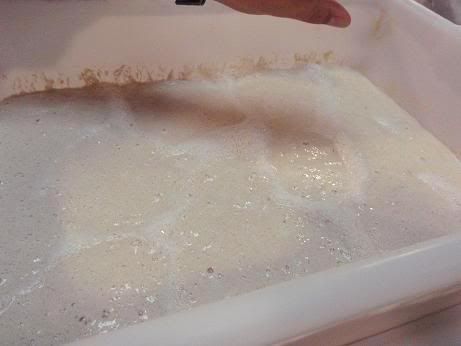
Didier Rosada's thumb, Artisan III at SFBI, August 2009
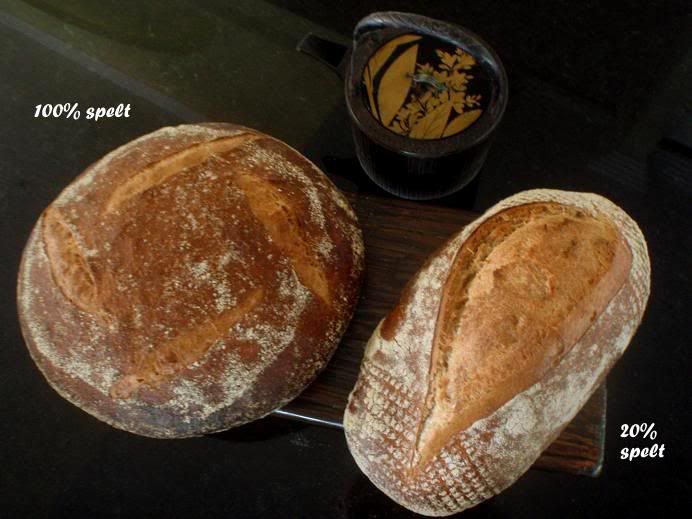
Theory aside, I have had no luck with the double hydration method using my bread machine. So, with this 100% Spelt Sourdough, I used my old trusted hand method. As well, I made another Pain le Levain with 20% Spelt flour that I posted yesterday to practice on my scoring and to see if I could get better [b]grigne[/b]. I suspected that the scoring in that earlier bake was difficult because I inadvertently incorporated too much water into the dough when I was stretching & folding my doughs with wet hands (the dough ended up much higher hydration than Hamelman's 68%). I have found grigne almost not possible with wetter doughs.
So, here are the two spelt sourdoughs:
[color=red][b][u]My Formula for 100% Spelt Sourdough [/u][/b][/color]
[b][u]First levain build[/u][/b] - day 1, night or early evening
- 3 g starter (I used my usual white starter at 75% hydration, but at this quantity, any starter you have at any hydration will do.)
- 10 g spelt flour (I used 90% white spelt flour and 10% whole spelt flour)
- 11 g water
[b][u]Second levain build[/u][/b] - day 2, morning
- 24 g starter (all from the first levain build)
- 48 g spelt flour (I used 90% white spelt flour and 10% whole spelt flour)
- 48 g water
[b][u]Final levain build[/u][/b] - day 2, late night
- 120 g starter (all from the second levain build)
- 155 g spelt flour (I used 90% white spelt flour and 10% whole spelt flour)
- 155 g water
Note: as the ratio of flour to starter is less than 1. 5 times, if your room temperature is very warm, you'll need to do this levain built as late as possible for the next day's dough mixing.
[b][u]Final dough[/u][/b] - day 3, very early morning
- 430 g Spelt starter @ 100% hydration (all from the final levain build)
- 224 g water
- 387 g organic white spelt flour (90% of final dough flours)
- 43 g organic wholemeal spelt flour (10% of final dough flours)
- 12 g salt
- Extra spelt flour for dusting
Total dough weight 1.1 kg and dough hydration 68%
- In my big mixing bowl, I first put in the starter, then poured a little of the formula water, stirred to combine, then a little more of the water, stirred to combine, then a little more of the water, and stirred, until all water was thoroughly mixed into the starter. (I have found this way my starter works very well for me; it is as if all of the little microorganisms are woken up to do their morning aerobics.)
- I put in the rest of the ingredients and stirred them just until they were combined and no dry flour was visible; more work than that at this stage was not necessary.
- Autolyse 25 minutes
- First set of stretch & folds (I did 100 strokes, more than my usual, to try to build up dough strength. I wet my hands to do the S&F's so the dough doesn't stick to my fingers.)
- After 30 - 40 minutes, the 2nd set of S&F's was done (I did another 100 strokes. The dough felt silky and smooth, and quite elastic (there was good gluten development.)
- After another 30 - 40 minutes, I did the 3rd set of S&F's (100 strokes again).
- Dusted some spelt flour on the work bench.
- 30 minutes from the last S&F's, I pre-shaped the dough by way of a minimalist S&F's so that I could pick up the whole dough easily with one hand and dump it on the floured surface (right side was against the flour, ie, seam side was up). Cover.
- Rest for 15 - 20 minutes. In the mean time, a linen lined basket was dusted with flour.
- Shaped the dough first by gathering the edges of the dough to the centre, turned the dough over (so that the seam side was now down), then shaped it into a very tight ball. Placed it in the proofing basket. Up to this point, bulk fermentation had been about 2 and a 1/2 hours.
- Proof for another 2 hours (and in the mean time, I planned when the oven was to be turned on for pre-heating).
- Bake with steam at 230C / 450 F for 20 minutes and another 25 minutes at 220 - 210 C.
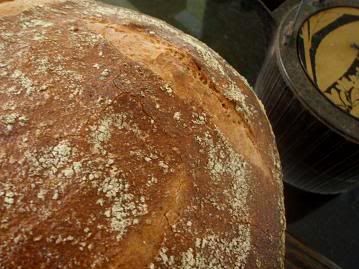
It was quite a cold morning (for a spring time) when the dough was bulk fermenting and proofing. While I was putting on a sweater to keep myself warm, it never entered into my mind that my dough might need extra flour time because of the low temperature. It was almost as if that I wanted to behave myself by sticking to a set formula - ie, bulk fermentation 2 and 1/2 hours and proofing 2 hours. This is the reason why formulas don't always work because there are a lot of details that are not spelled out but which are critical. A time-table of bulk fermentation of x number of hours and proofing of x number of hours is on the basis of a certain dough temperature and ambient temperature perimeter as well as the amount of the pre-fermented flour as a percentage of the total flours, etc. While we may know those base temperatures and percentages very well, we may not be quick enough to adjust for our scenarios, which incidentally is never exactly the same as the last one.
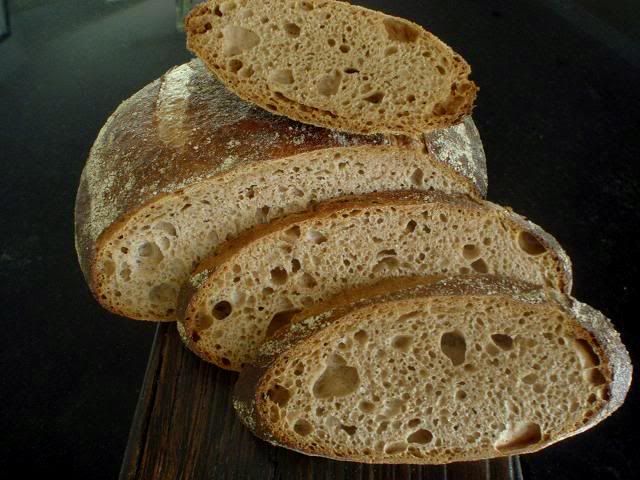
Because of the low temperature, the fermentation should have been at least 1/2 to one hour longer. The crumb could have been more open, I believe, if the yeasts in the levain had been given a longer time to work. The effect may be more apparent in the 20% spelt levain bread below (and I would like to come back to this point again).
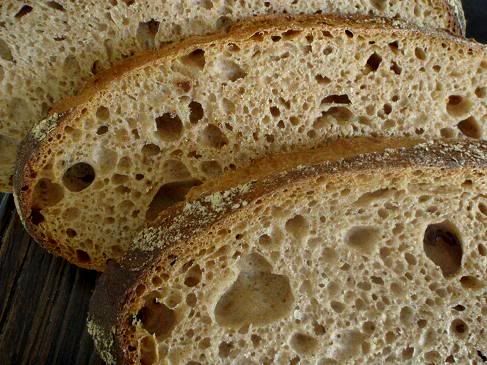
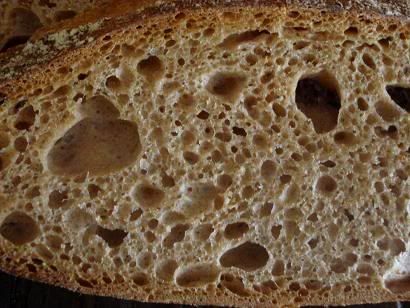
Despite the above, this 100% spelt levain bread has a lovely crumb flavor. Because of the way the levain was built up and its hydration, the acidity is very well balanced with the nutty flavour of the spelt flour. I didn't taste the bitterness, very often associated with spelt. The sourness is less than medium strength to me.
[b][u][color=red]My formula for the 20% Spelt levain bread[/color][/u][/b] - please refer to my post yesterday.
To adjust for the fact that I normally dip my hands in water before I stretch & fold the dough, I did 1% less hydration in this dough. As well, I did 100 strokes at each set of S & F's, trying to build up more dough strength for the "grigne" that I was looking for (but was unable to get in that last bake). These two being the only adjustments, see how different the profile and the crust of this bread look compared to those posted yesterday:
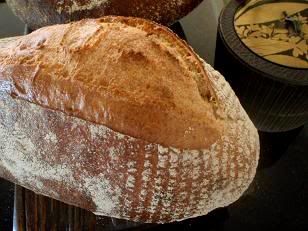
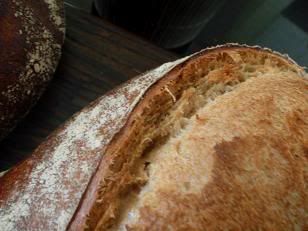
When the dough was loaded onto the baking stone, it was about 3 - 4 cm in height; it rose to about 12 - 13 cm in its oven spring. I think the 100 strokes of S&F's were doing the trick.
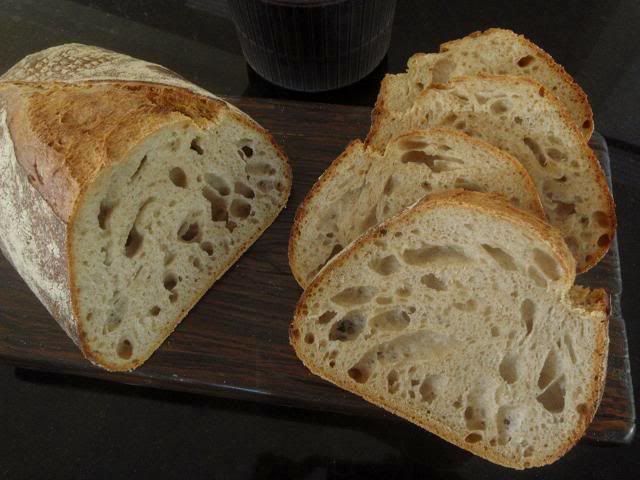
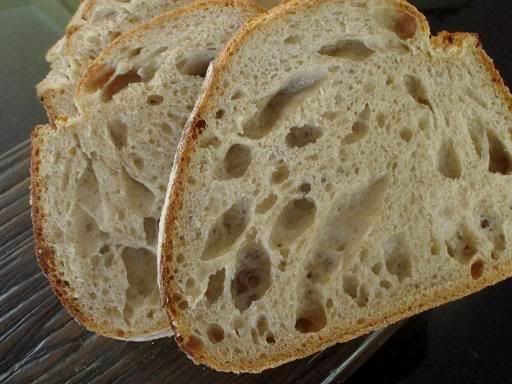
For signs of good fermentation, I look at the cell structure of the crumb, [b]especially[/b] the area where there was no visible big holes - I think the parts where there are no holes tell more story about the fermentation than the area where there are a lot of holes. In the crumb shots above:
(1) where there are no holes (big or small), you see that the cell structure is quite dense; and
(2) where there are holes, they are not all there to register the presence of yeast fermentation, but they could possibly be there due to the way my hand stretch and folds the dough - it is possible that I had simply folded in too much air than I should have.
The somewhat dense cell structure (where there are no holes) tells me that the fermentation probably did not happen at the optimum temperature, given the time in which the levain had to work. From this I learned that, even with the same formula, each bread is a new situation to be assessed independently in terms of its action plans regarding dough strength and fermentation.
It is a flavorful bread just the same with very mild acidity. If I could get yesterday's cell structure with today's crust and grigne, it would be a near perfect world for me.
Shiao-Ping
- Shiao-Ping's Blog
- Log in or register to post comments
100% spelt behaving itself! Beautiful! I love spelt. I don't think it's underproofed. Spelt is easily overproofed in my experience.
I am confused by the stretch and Folds and 100 strokes. 100 Strokes? How do you make a "stroke?"
I think spelt interacts interestingly when combined with other flours. Sweetness and crumb softness seem to be major observations which leaves me to wonder about the glycerol contribution spelt flour makes with fermentations. Was the crumb soft?
Mini
Mini, I believe Shiao Ping is doing her stretch and folds in the bowl. You are turning the bowl and lifting the dough in sections, up and over, 100 times with your bowl scraper.
Shiao Ping, lovely bread. I also experimented with spelt this weekend. I wasn't quite sure how it would behave. I made a chili cheese sourdough with 400g bread flour, 100g dark rye and 67 g spelt. I'm a chicken!! The taste is very nice. Next time I'll be a bit braver.
Betty
What??? Betty, you're a chicken?!? I didn't know ...
... I know but the technique: "100 strokes" (with or without a wooden spoon) is very different to Stretch and Fold, which I interpret as 4 times or maybe 8 times folding the dough over itself. To me, "100 strokes" is more like kneading... that is why I ask. "100 strokes" also implies a very wet dough.
The loaves are lovely, the dish towel pattern works out well too. Embroidery might also show up on the surface...
Mini
Hi Mini,
I might have warned you before ... but I have problems with certain English words - I don't seem to get their meaning right (and "stroke" is one of them). Betty was right - my 100 strokes were simply 100 times around the bowl when I was doing the stretch & folds. You are also right in saying that that's more like "kneading." What I was trying to achieve was to build up the dough strength as fast as I could at the early stage of the dough fermentation.
Was the crumb soft? Yes, more soft than if it were 100% wholemeal flour. It is interesting that you mention sweetness. People would probably not believe it if I say that I could taste more sweetness in this 100% spelt levain bread than if it were 100% wholemeal. I think I prefer spelt to wholemeal.
And Betty, chilli cheese sourdough! How exotic.
Thanks for both of your comment. I should do more spelt experiments just to learn more about this flour. Didier Rosada mentioned that 5% oil and 5% honey will increase the shelf life of spelt bread.
Mini, I didn't know about it; but I guess that would be about right. So it was lucky that I "under-proofed" it... When I made my ancient grains sourdough, I did notice that there was a lot of enzymatic activity and the dough was a bit volatile. I guess in situtations like that, it is best to underproof it than risking overproofing.
I have made several versions and still am having trouble getting the hydration and proof time right. It also seems that this bread bakes better at lower temperatures. I usually bake at 450 degrees in a clay baker with top on for 30 minutes and then take top off until crust is right,(5-15) minutes.
On the hydration issue, i have used everything from 72%-56%.
I have found that often the dough is about right when doing a stretch and fold, then place bowl in a plastic bag- secured at bottom and left for 12 hours. The dough is too wet to handle . I have a experiment going using a cloth instead of a plastic bag to allow moisture to escape.
... but in fact it may have over-fermented?!
Hi swifty, I am currently experimenting with flour with higher ash content than my usual white bread flour. I find that they ferment very fast and it's quite a job trying to slow them down. As you said, the dough felt about right (in consistency) at first but, after a long ferment, they seem to have turned "wet" to handle. I experienced the same thing not just with spelt flour, but also with other types of flour. Look at this Ancient grans sourdough that I made a long while ago - just 7% each of three types of ancient grans (spelt, bucketwheat, and teff flour) and the fermentation was almost uncontrollable.
I would say if you prefer long ferment for flavour build-up, you'll have to watch the temperature. I would place the dough in the refrigerator if I were you (with no more than 1 hour bulk at room temperature before hand). I am not sure if changing the plastic bag to cloth would help.
Hi Shiao-Ping
I notice that you are using mostly white spelt and a small amount of whole spelt.
Would there be any problem using your recipe and using 50% of whole spelt and 50% white spelt?
but with higher whole spelt you may need to increase your hydration to 70 or even slightly higher. Just watch the consistency of your dough and see if it can take more.