
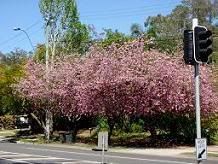
Very soon it will be Celtic New Year (see my Van Morrison post). It doesn't mean anything to me except that here in Australia spring is in full swing, spring is the season for new growth and that's what you get after New Year . Here in Brisbane Hong Kong Orchid trees are towards the end of their flowering season; when their flowers have all fallen, Jacaranda will be in full bloom. I put on my joggers, went around my neighborhood and took these photos of Hong Kong Orchid trees:


Yesterday while I was watering my husband's baby avocado tree in the backyard, in amongst Polly our dog's droppings, I saw little bell shaped purple flowers; I lifted my head and was surprised to see one of our jacarandas is showing the new season's color. Very soon my one and only surviving rose bush will be blooming, and when all the jacaranda flowers have fallen, roses will be in full bloom.
I'd like to celebrate spring by this Ancient Grains Sourdough (anticlimax?). Safa, our instructor at Artisan I, SFBI, once told us he made a 7 x 7 sourdough, which has 7% Teff flour and 7% spelt flour. He calls it 7 x 7 because it is easier to remember. He said a small percentage of Teff flour gives a pleasing sweetness to the bread. Teff is the smallest grain in the world and compared to other grains, it has a much larger percentage of bran and germ. My idea of this Ancient Grains Sourdough indirectly came from him. I added buckwheat flour which I bought from Ferry Building in San Francisco last month, together wiith Teff flour. The whole grain buckwheat is ground into flour with little black specks that come from the ground seed hull. This is how traditional buckwheat flour has been made for hundreds of years. All three grains are considered "ancient grains."
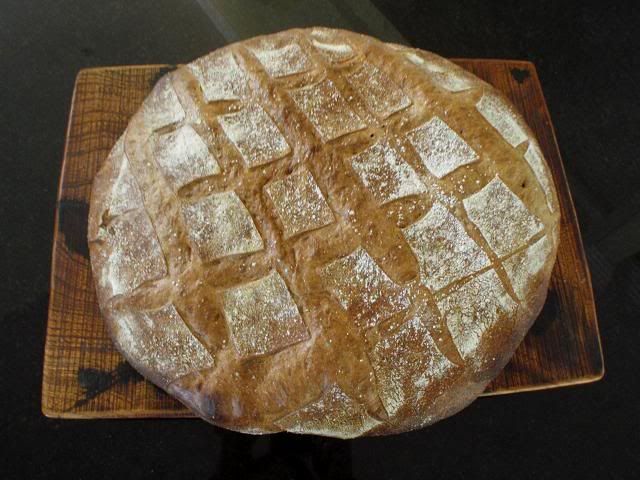
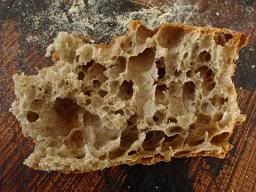
I noticed the dough seemed to be quite "volatile" as there were a lot of bubbles happening at very early stage of the fermentation. There must be more enzymes in the dough because of the bran and germ from the whole grain ancient flours than just plain white flour. I ended up doing more stretch & folds with this dough to try and slow down the enzymatic activity. And here is my Ancient Grains Sourdough (Sourdough 7 x 7 x 7):
[b][u][color=red]Formula for My Ancient Grains Sourdough[/color][/u][/b]
For a description of Chad Robertson's method as decribed in Daniel wing and Alan Scott's [i]The Bread builder[/i], please see my previous post.
[u]Two nights before bake day - first stage of levain build-up [/u]
- 62 g starter @ 75% hydration
- 124 g bread flour (i.e. two times starter amount for me; I do not know what ratio Chad Robertson uses.)
- 94 g water
Mix and ferment for 6 - 8 hours at 18C / 65 F (depending on your room temperature, you may need shorter or longer fermentation time for your starter to mature)
[u]The morning before bake day - second (and final) stage of levain expansion[/u]
- 280 g starter @ 75% hydration (all from above)
- 280 g bread flour (I use one time starter amount in flour but I do not know what amount Chad Robertson uses)
- 210 g water
Mix and ferment for [color=red]two hours[/color] only.
[u]Formula for final dough[/u]
- 770 g starter (all from above)
- 770 g bread flour
- 54 g spelt whole meal flour (7% of bread flour)
- 54 g whole grain buckwheat flour (7% of bread flour)
- 54 g whole grain Teff flour (7% of bread flour)
- 630g water
- 25 g salt
- Extra rice flour and bread flour mixture for dusting
Total dough weight 2.35 kg and total dough hydration 70%
- In a big bowl, first put in water then put in the starter. Break up the starter thoroughly in the water with your hands.
- Add all ingredients and stir with a wooden spoon to combine for 1 - 2 minutes. (Take down the time when this is done; this will be your start time for calculating the 4 hour bulk fermentation. Starting from this time, your dough is fermenting. The preferred room temperature is 18 - 21C / 65 - 70F. You may need to adjust your dough temperature by using cooler or warmer water.)
- Autolyse 20 - 30 minutes
- Start the first set of stretch and folds in the bowl by grabbing the edge of the dough with one hand and fold to the centre onto itself (10 - 20 times) while rotating the bowl with the other hand as you go. The hand folding serves as mixing. As you stretch and fold, try not to tear the dough; only stretch as far as it can go.
- After 30 minutes, do the second set of stretch and folds. You will see that this dough is very easy to work with and the fermentation seems to be under way quite nicely as there will be some bubbles already forming in the dough. At the end of the folds, the dough will feel silky and smooth and almost leave the side of the mixing bowl. (The dough appears to be quite "volatile." Because of the activity that seems to be taking place inside the dough, I made a mental note to come back to it for the next set of stretch and folds very soon.)
- When you fold, be mindful that the bottom of the dough is the right side of the dough; and the right side of the dough always remains at the bottom in the bowl. [color=red]*See note below.[/color]
- After another 30 minutes, do the third set of stretch and folds. You will see that the dough is very active in that there seems to be a lot of fermentation already going on as the dough feels quite bubbly and has expanded quite a lot by the time you do the third S & F's. (So right there and then you know that more stretch & folds will be necessary to slow down their activity.)
- After another 30 minutes, repeat the stretch & folds.
- After another 60 minutes, do the fifth set of stretch & folds.
- After another 30 minutes (that will be [b]the end of the 4 hour bulk fermentation and the start of the 2 hour proofing[/b]), pre-shape the dough to a very tight ball as follows: First sprinkle some flour on your work bench [b]and[/b] some flour at the edge of the dough (ie, in between where the dough meets the bowl); scrape the dough out onto the bench, trying as much as you can to land [b]the right side[/b] of the dough (which is at the bottom) onto the floured bench. Gather the sides of the dough to the centre, flip the whole thing over (so now the right side is on the top) and pre-shape to a tight ball. You will see that the dough is very wobbly and after 10 minutes resting on the bench, it will have completely spread out. I decided to do [b]another pre-shape[/b]. I flipped it over, gather the sides to the centre, flipped it over again, then shaped it tight again.
- Dust your linen-lined basket or banneton with a mixture of bread and rice flours.
- After another 10 minutes resting, shape the dough and place it into your basket for proofing. Cover.
- My room temperature is 18 - 21C / 65 - 70F; if your room temperature is cooler or warmer than that, adjust your proofing time accordingly.
- At the end of the 2 hour proofing, place the dough into the refrigerator for retarding (minimum for 8 hours; I retarded mine for 16 hours).
[color=red]* Note on [b]the right side[/b] of the dough:[/color] Since I started doing what I thought was Chad Robertson's sourdough procedure by hand, I recalled an incident during my Artisan III class. My team had members who worked in commercial bakeries and one day, towards the end of our first speed mixing for a dough, a team member switched the spiral mixer to the reverse gear to try to pick up some dough stuck on the side of the wall. Our instructor saw it and told us never to do that; he said that you can do reverse gear [b]only[/b] at the beginning of the mixing process when the ingredients are still being incorporated. The reasoning is: once the gluten structure has started to form in a certain direction, it is [b][color=red]not[/color][/b] advisable to do anything to alter or disrupt that direction. Therefore, my thinking is when I am hand-mixing and folding the dough, I want to keep that "direction" in tact.
[u]Bake Day[/u]
- Bake the boules cold (ie, straight out of the refrigerator). Just before baking, sift flour on the dough and score it or stencil it any way you like. Once the dough is loaded onto the baking stone, steam the oven with 1 cup of boiling hot water.
- Bake at 220C / 430F for 30 minutes, then turn the oven down to 200C /390F (or higher if you wish for a darker crust) and bake for another 25 - 30 minutes.
- Cool completely before slicing.
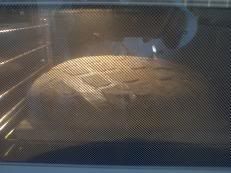
The dough spreads out enormously and fills my whole baking stone (measuring 34 cm x 34 cm)
with a little bit hanging out on the side of the stone.
This is an unusual sourdough. It is quite sour (medium strength sourness) even though I used the same starter as for my other Chad Robertson sourdough. I can only surmise that it is because of the ancient whole grain flours that I used here. The enzymes in the flours must have sped up the fermentation process quite a lot such that the dough was far more fermented than that other sourdough I made, hence more sourness. The sourness is more of an acidic, rather than lactic, acidity.
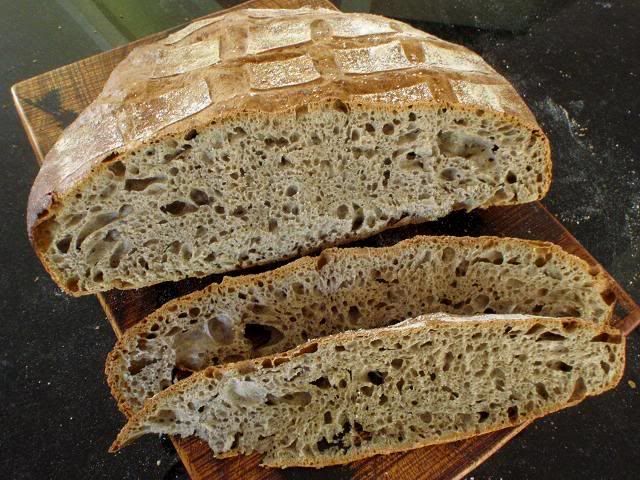
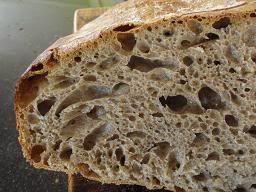
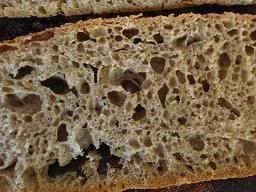
The [b]texture[/b] is very different from that other sourdough, too. The texture of sourdough made from white bread flour is normally tender, whereas this one is quite "robust," as if the crumb has "strength" when you bite into it and is quite chewy. The comparison is a bit like the difference between red wine made with shiraz (syrah) grapes (very "robust") and other red wine made with merlot or cabernet sauvignon (more "mellow"). It is very moist just the same.
I couldn't taste the sweetness that Safa mentioned of Teff flour but it has a very interesting nutty flavor.
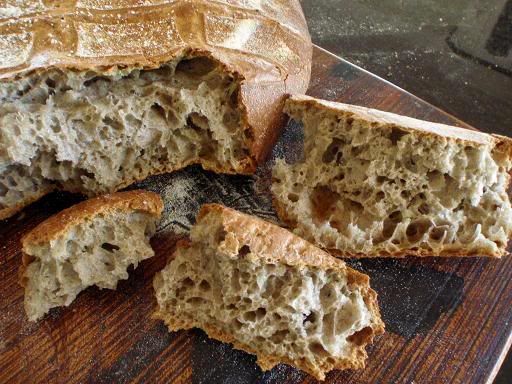
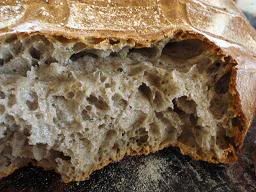
The crumb is very open, as open as what I can hope for. As the dough had a lot of enzymatic activity during fermentation and spread out enormously (not keeping its shape), I wonder if cutting down the hydration to say 67% would make it more manageable and at the same time not hurt its open structure.
Chinese collects stones or rocks which show formations of nature. My uncle Chang has a rock which looks like a mountain.
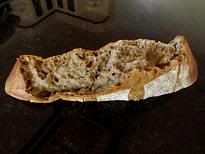
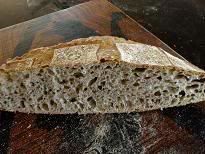
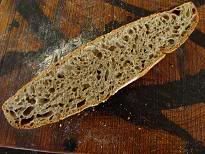
My bread mountain Bread mountain -other view 1 Bread mountain - other view 2
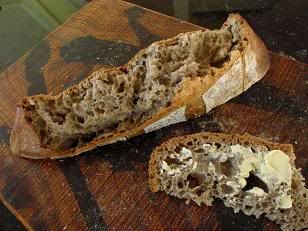
This ancient grains sourdough is delicious.
Shiao-Ping
- Shiao-Ping's Blog
- Log in or register to post comments