
Usually when I get it in my head to cobble together a formula based on two or three things I've seen mentioned on this forum, two more in my head, and a bit of whimsy, the results are not pretty. Especially when it comes to baguettes. The last two or three times I've tried to make baguettes, they've come out flat, with closed crumb and, with the sourdough versions, crust that provides a thorough jaw workout.
But not this time, oh no! This time I tasted victory. Victory, and some very yummy bread.
Here's what I was trying for:
- 100% Sourdough baguettes
- All white flour
- Two preferments (saw this mentioned a couple places and it sounded good).
- Roughly 65% final hydration (also based on some other posts at thefreshloaf)
To this I arbitrarily decided that 50% flour weight would be prefermented, of which about half and half from a 50% hydration pate fermente and a 100% hydration wet starter. Because, y'know, why not? I decided on 700g total flour and worked out the math to get:
- 340g wet starter (170g flour, 170g water)
- 273g pate (180g flour, 90g water, 3g salt)
- 350g final flour
- 200g final water
Got to set up a bakers math calculator for myself. Anyway, the formula ended up being thus:
Liquid Levain
- 32g active starter (I'd converted part of my firm starter to 100% hydration the day before, but I doubt it matters much)
- 150g Stone-Buhr bread flour
- 150g water, room temperature
Sourdough Pate Fermente
- 45g active starter (50% firm starter, in this case)
- 150g Stone-buhr bread flour
- 75g water
- 3g salt
Mixed starters at about 9:30pm the day before baking and let them sit overnight. My firm starter had been in the fridge since that morning, so I used warm water for the pate. Began the next stage at 7:30 the next morning.
Final Dough
- 350g Stone-buhr bread flour
- 200g water, room temperature
- 11g salt
- Liquid Levain (all)
- Sourdough Pate (all)
Mixed Flour, water, and liquid levain until a shaggy mess, then covered and left to autolyze for 45 minutes. Held off on adding the pate partly because it seemed like The Proper Thing To Do(TM), leaving out the salt and all that...but mostly because the pate looked pretty sluggish and needed at least another 45 minutes to ripen.
Added pate and salt and kneeded for a couple minutes. The stiff pate really didn't want to incorporate, so I gave it a 5 minute rest then kneaded a little more until the lumps were more or less dispersed. Then it was into a bowl to rise.
I gave the dough 30 folds in the bowl with a rubber spatula after 30 minutes of fermentation, then again after 2 hours. Total time for the first rise was 5 hours (I meant for it to be 4, but got confused, and anyway it wasn't rising hugely).
Preshaped the dough into 4 ~10oz pieces (yeah, yeah, switched measuring systems midway), and let rest for 10 minutes. Then final shaping, and rising on my well-floured couche-tablecloth for 2 hours.
Baked at about 475 (my oven's temperature sensor is wacky) with steam for 22 minutes, opening the oven a crack after 10. Then left the oven cracked and turned off for another 5 minutes before removing the baguettes from the oven.
The results:
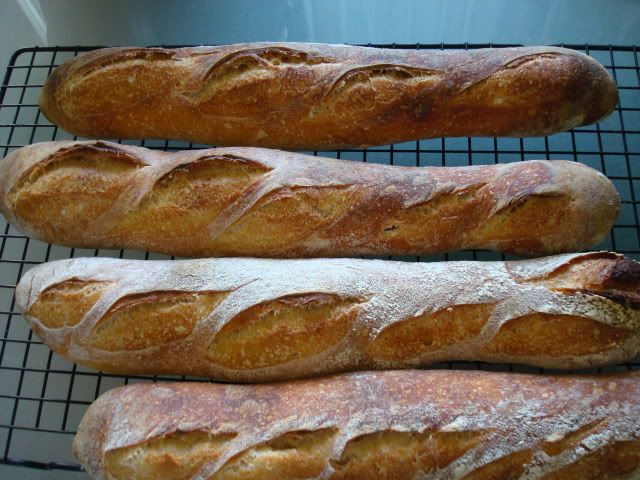
Sourdough Baguettes, Exterior:
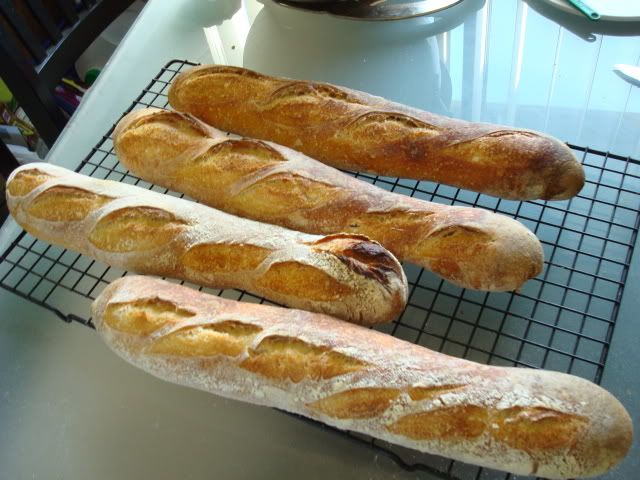
Another Angle
Crumb Shot
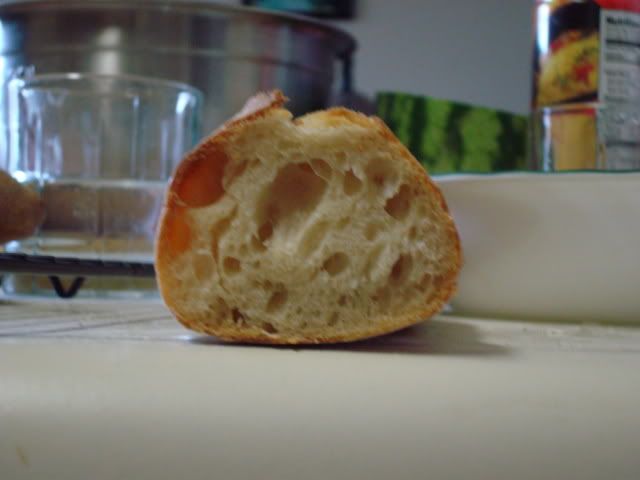
I was incredibly pleased with the results here. The scoring is easily the best I've ever done, though there's clearly room for improvement. The mere fact that the things didn't turn out flat was a huge improvement of my last attempt at a sourdough baguette. The crumb turned out well. The flavor was wonderfully complex, moderately sour, with a thin, crisp crust that was just slightly chewy (hey it's sourdough, after all).
Those look gorgeous. I am definitely adding your recipe to my "to-do" bread list.
I was wondering, though, what's the reason for using both the pate fermente and the liquid levain, instead of mixing all of the initial ingredients together at once? I'm pretty new to sourdough, so maybe I'm missing something, but all of my recipes so far have used just one type of starter concoction...
Well, the short answer is "I saw it mentioned somewhere on the forum and it sounded like a good idea." But the theory goes something like this: The firm starter/pate is more condusive to the more sour lactic bacteria, while the liquid levain is more condusive to the milder acetic bacteria and the yeast (and maybe has more protease for that poolish-y flavor?) So by doing both, the whole range of flavors would end up in the bread. Or so I supposed. Seemed to pan out, anyway.
thanks! I will definitely give it a shot. my sourdough's been fairly mild, and I do use a more liquid levain-ish mix, so sounds promising!
Congratulations, Ryan!
David
Outstanding looking baguettes!
Bix