
Have you ever seen a photo of very stiff starter wrapped up tightly in cloth then tied up in string (as if making absolutely sure that the little beasties have no way of escaping)? I never understood the purpose of the tight string until the other day when I was writing about Chad Robertson. [i]A Day in the Life at the Bay Village Bakery[/i] in [i]The Bread Builders[/i] says Chad "uses a brief two-hour final stage of leaven expansion before he mixes up his dough" (page 221). In both of these two cases maximum natural yeast population is achieved without them further fermenting (because there will be plenty of fermentation once final dough is mixed).
Chad Robertson's rustic sourdoughs from Tartine Bakery were my most favourite during my recent stay in San Francisco. I wanted to see if it was possible to reproduce his style of sourdough at home. I was told that a bread cookbook is coming out soon (in addition to their existing pastry cookbook), but no date is given. Alain Ducasse's [i]Harvesting Excellence[/i] quotes Elizabeth Prueitt as saying that Chad's breads were hand-made from the very beginning to the very end, and that [b]"it is one person's expression"[/b] (page 19).
By the time [i]The Bread Builders[/i] wrote about him, Chad Robertson had acquired a mixer from Europe which helped him in meeting the growing demands for his breads. A brief description of timeline for a typical load of breads that he baked at his (then) one-man bakery at Point Reyes, Califorina (before he and Elizabeth moved to San Francisco and opened Tartine) is as follows (according to [i]The Bread Builders[/i]):
- At 8 am, he mixes his final intermediate levain and let it sit in room temperature for two hours (note: I assume the levain is fully mature before the two-hour final expansion);
- At 10 am, he mixes the final dough by first putting all the ingredients or all except the levain into the mixer and running it for 2 - 3 minutes at 45 - 50 revolutions a minute;
- Autolyse 15 - 30 minutes
- Adds the levain if necessary, then mixes it for 4 - 5 minutes
- Bulk fermentation 4 hours (counting from 10 am to 2 pm), during which time several stretch and folds in the tub are done;
- At 2 pm, divide the dough and pre-shape them, then rest for 15 minutes
- Shape the dough and place them on the bannetons or couche dusted with a mixture of bread and rice flours;
- Proof in room temperature for 2 hours before going into proofing boxes (at 55F) to retard for 8 - 10 hours ([i]Harvesting Excellence[/i] says up to 12 hours); and
- The next day, start baking between 4:30 - 5 am.
Based on this timeline, my formula for Chad's sourdough follows:
[b][u][color=red]My formula for Chad's Sourdough[/color][/u][/b]
[b][u]Two nights before bake day - first stage of levain build-up[/u][/b]
- 82 g starter @ 75% hydration
- 164 g bread flour (i.e. two times starter amount for me)
- 124 g water
Mix and ferment for 6 - 8 hours at 18C / 65 F (depending on your room temperature, you may need more than 2 times bread flour, or shorter or longer fermentation time for your starter to mature)
[b][u]The morning before bake day - second (and final) stage of levain expansion[/u][/b]
- 370 g starter @ 75% hydration (all from above)
- 370 g bread flour (I figure one time starter amount in flour is enough)
- 277 g water
Mix and ferment for two hours only
[b][u]Formula for final dough[/u][/b]
- 1,017 g starter (all from above)
- 1,017 g bread flour (Australian Laucke's Wallaby bakers flour, protein 11.9%)
- 651 g water
- 30 g salt
Total dough weight 2.7 kg (divided into three pieces) and [b]total dough hydration 68%[/b]
- I followed the timeline above but I did everything by hand. I fully intended to fold as many times as necessary to build up dough strength but as my dough was not very wet the gluten developed very fast and by the end of first set of stretch & folds, the dough already felt silky and smooth. I did only two sets of stretch & folds in the bowl.
- After the dough was divided into three pieces, I pre-shaped them to tight balls, rested them 20 minutes, then shaped them into batards and placed them on bread & rice flours dusted couche.
- The shaped loaves proofed for 2 hours in room temperature then went into my refrigerator to retard overnight (for 12 hours).
[b][u]Bake day[/u][/b]
- I baked the loaves cold (straight from the refrigerator). I pre-heated the oven to 250C / 480F. Once the loaves were loaded, I poured 2/3 cups of boiling hot water onto lava rocks (enormous steam was generated), and turned the oven temperature down to 230C / 450F. They were baked for 20 minutes, then another 15 minutes at 210C / 410F, and rested for 5 minutes in turnoff-off oven. (You can bake them for 10 minutes more if you like darker crust.)
- There was an impressive oven spring with this bake.
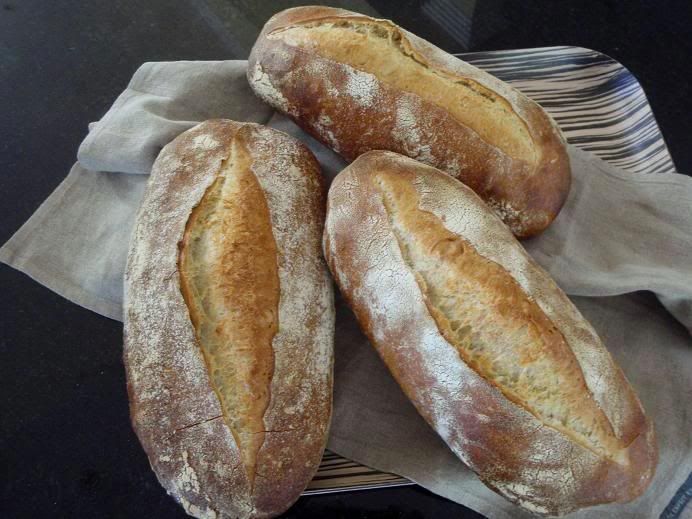
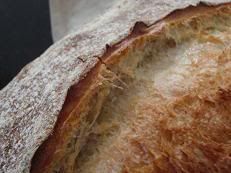
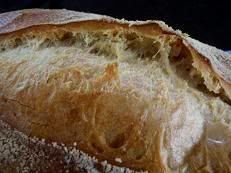
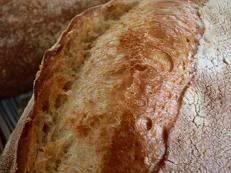
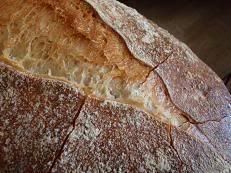
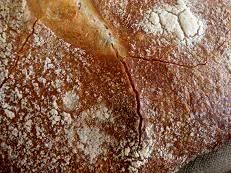
I am quite pleased with the result, although without rye and whole meal flours, I probably cannot call this country sourdough. Also, Chad's country sourdough has a very rustic look (quite dark) as if from a wood fired oven.
As I was drafting this post and looking at the black and white picture of Chad's bread in [i]Harvesting Excellence[/i], my daughter came by, I said to her he is the reason why I bought this book; she asked, is he "hot"? I never understand teenagers' lingo - why "hot" and "cool" mean the same thing.
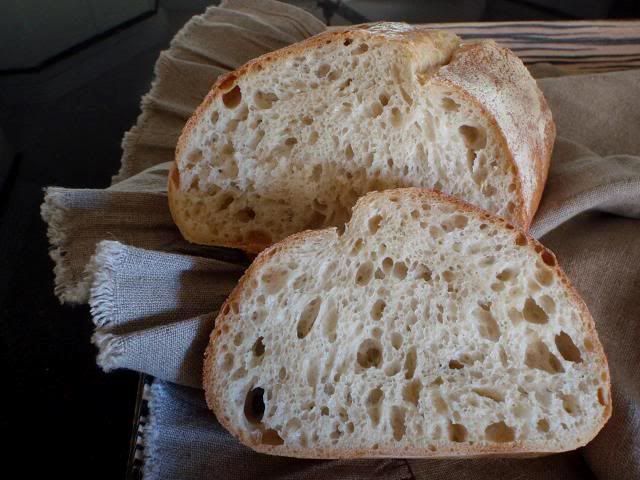
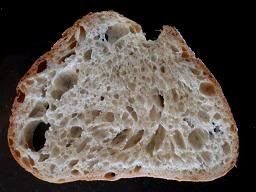
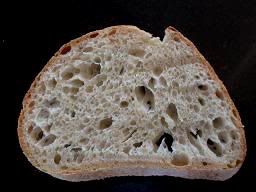
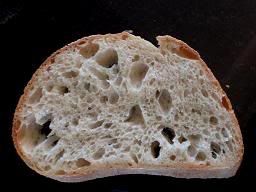
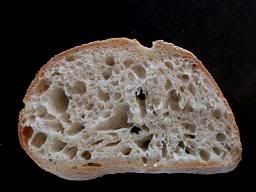
The crumb is really tender and moist. It has a very supple texture and open crumb that I did not believe I would have been able to achieve with low hydration dough. I really don't know what hydration level is Chad Robertson's sourdoughs; I did 68% here because I wanted to have good volume and, possibly, good grigne. Well, it worked.
I like the flavor very much, more so than my Sourdough 50/50.
Shiao-Ping
- Shiao-Ping's Blog
- Log in or register to post comments
Your breads always have such a lovely-looking crumb :-)
Shiao-Ping, you're somewhat like my baking idol here on the fresh loaf. Your breads simply look perfect, post after post. Am I right that you started baking just a couple months ago or did I misunderstand something? I'm dreaming of such a crust. and I'm dreaming of such a crumb.
Salome
Time is flying, very soon it will be six months. I still remember that first ever comment that I made at TFL back in mid Arpil. I always love arts and crafts. My mother is one of those rare Mums who still sew and my father is one of those rare Dads (Chinese Dads) who still do calligraphy with ink and brush. When you were in primary school, did you ever do home economics or craft? I must have been in grade 6 or 7, we knit a scarf and my teacher gave me a A+, not that what I did was perfect although it was quite a daring intricate design with flowers, leaves and stems for a youngster to try; in fact he gave me A+ for the obvious imperfection in my execution as a proof that I did it, not some old aunty who helded out.
Shiao-Ping-
Gorgeous loaves as usual! I'm envious of the crackling effect you always seem to get with your breads.
Ok, though, I still don't get why he ties the starter up tightly with a string. Inquiring minds want to know!
Larry
I don't mean Chad Robertson ties his starter up tightly with a string. I meant that I see a connection between his 2 hour final "levain expansion" method and the stiff starters that are tied up with a string - both want wild yeast reproduction/multiplication but not fermentation. You know when we ferment our starter, we mix the flour and water and we use a container roughly three times the size of the starter we mix. The wild yeast first go through aerobic stage where they multiply, and when all the oxygen is used up, the wild yeast will then go into an anaerobic stage where their main function is fermentation, which is also the stage when they produce a lot of gas. When the stiff starter is tied up with a string, I imagine the wild yeasts can multiply but cannot gas up. For Chad Robertson, the way he limits fermentation is by shortening the time so the wild yeasts barely complete their aerobic stage. I notice after 2 hours, the size is not yet doubled. His purpose is to reduce the sourness. He said that in France there is a lot energy spent on producing a dough that doesn't keep too much sourness.
I was trying to look for a picture of a stiff starter tied up with a string for you. It is in several of my Japanese and Taiwanese bread books; the Japanese learned it from the French, and the Taiwanese in turn learn it from the Japanese.
Now I see....thanks! All I could think of were accounts of how the 'sourdough' prospectors used to roll their starters up in a sack of flour they carried with them, but that was strictly for convenience sake.
There is a critical error in the logic, and that is assuming that fermentation generates more gas, or that the aerobic phase doesn't. In fact, yeast produce as much or more CO2 in aerobic conditions because all six carbons in a sugar molecule are turned to CO2 during aerobic respiration, vs only two during anaerobic fermentation (the rest are turned into ethanol). They have to metabolize sugar (and produce gas) to make the energy they need to reproduce. So you can't have the reproduction without the attendant CO2. Tying it up with a string isn't going to keep it from producing gas, but may serve as a useful indicator when things have gone far enough.
Reducing sourness can be accomplished by shortening the refreshment cycle, not because of aerobic vs anaerobic, but rather by taking advantage of the disparity in lag phases between yeast and lactic acid bacteria (LAB). Bacteria reproduce faster than yeast, but yeast have a shorter lag phase. The lag phase is that time between refreshment and the start of population growth (reproduction). The organisms need a little time to sense their environment and re-orient themselves to the change that refreshment brings (pH, nutrients, waste products, etc.) before they begin growing again. For LAB it takes longer, so yeast start growing first. Each time you feed, it starts a new lag period. If you stop the refreshment cycle short, so as to keep the LAB from taking off, you give the yeast a little advantage in the race by cutting the LAB off at the knees.
You can't completely eliminate LAB, but you can reduce the sour by cutting their numbers.
Hope that helps :-)
-dw
Many Thanks! That is just about enough technical knowledge that I can handle in one go.
Great stuff!
Shiao-Ping
p.s. Now I see where that jar of yours coming from.
Those who know me, understand why I chose it as my avatar :-)
Frankenstein (the film, the romantic simplistic comic version of it, based on Mary Shelley's novel in 1818) is one of my favourite movies. (The real story doesn't do much for me; I just love the scene where the crazy scientist with his mad fuzzy hair sitting on the roof gazing into the night sky.)
And p.s. great looking jars!
And what an interesting formula and method.
Robertson uses a high percentage of pre-fermented flour in both his final levain build and in the final dough, but his fermentation time is short.
How sour was the bread flavor?
David
When you said "Robertson uses a high percentage of pre-fermented flour in both his final levain build and in the final dough," are you referring to my formula in this post? I actually do not know what his formula is like (I only have the "timeline"). It will be interesting to compare once his bread cookbook is out.
The bread is only slightly more sour than my Sourdough 50/50 but not much more and the texture is also more chewy. From what I know, I would say the flavor is more like a French sourdough (and my Sourdough 50/50 is almost like a hybrid between French baguette and French sourdough due to the presence of poolish and a very small amount of instant yeast).
I am finding that I am more a white sourdough kind of person (as opposed to rye or WW). It is interesting that back in those days when I used bread machine to make pan breads, I tend to use anything but white flour. But now I use more white than other flours.
Hi, Shiao-Ping.
Yes. I was referring to your formula.
I love sourdough rye, and I love white sourdough with 5% or so rye. I also like whole wheat bread, but I prefer it as a yeasted bread, like the 100% WW bread in BBA. Oh! And did I say I like variety? ;-)
David
Oh, Shiao-Ping, you are killing me!!!!
WHen i saw the title of the post, I said to myself - there I will go again, following her footsteps....
of course, I only have another 15 breads on my "to do last week" list!
those loaves are too gorgeous! You are so gifted!
Gorgeous loaves, Shiao-Ping! I love the crumb, crust and gringe and I can just imagine the flavor!
Sylvia
just beautiful! I love the crumb and crackly crust.
Betty
Amazing looking loaves as usual Shiao-Ping, is it possible to cut this recipe down to produce one loaf only, if so should I just divide everything by 3?? Oh, and I love your comment about teenagers lingo, I'm glad I'm not the only one who fails to understand how people could be hot and cool and why suddenly everything in the world could be labelled sexy instead of nice LOL.
Tereze, Sydney
Shiao-Ping, your loaves are beautiful, and I thank you for developing this recipe. I can't wait to try it!
When we go to San Francisco, we visit Tartine mostly for the excitement of seeing so many enticing baked goods. Everything tastes good, too, but don't plan on buying a loaf unless you plan ahead! Here is the policy on bread (copied from the website):
"Our bread is available Wednesday through Sunday after five o'clock in full
or half loaves. Advanced orders are accepted in the cafe or over the
telephone. Phone orders are not confirmed until availability has been
determined and you receive a call back from our staff.
Tartine bread comes out of the oven fresh by 5 pm. We bake our bread in the
afternoon as our oven is full of baking pastries all morning."
So we had better get good at this recipe, because most of us won't attain this level of organization on a vacation...
If you visit their bread website, http://www.tartinebakery.com/bread.html, you can also see a picture of their bread, and the crumb looks amazingly like Shiao-Ping's. The only difference I note is the darkness in the crust that comes from a commercial oven.
Delfina (and their pizzeria) is right around the corner, and they make great bread and excellent pizza, too.
Patricia
Thanks for your note. I was lucky, when I was in San Francisco, one classmate is a local and he had his secretary order 4 loaves of Tartine breads for him, he picked them up on his way home after class and brought them to SFBI the next morning for everyone to sample. One of the breads was walnut sourdough and it was amazing - imagine the airy open crumb stud with whole walnuts! I used the formula that I developed here and added toasted walnuts (30% of flour weight) trying to reproduce what I had, but the crumb came out really dense. It is hard.
The crust of their sourdough does look darker than mine (I guess, to have the wood fired oven look, even though they now use commercial deck oven). To get that look the temperture must be very high (but controlled), I am not willing to experiment on the very high temperture yet. Every time I open and close my oven door, I think the plastic knobs on the top panel are going to melt.
Yes, you can certainly divide everything by 3, but make sure you gather everything in a bundle - for thermal mass effect. For instance, when your starter or dough is only a very small portion to start with, after mixing, try gathering it (using a wet spoon for instance) from the sides of the container to the centre.
I think modern day teenagers are pawns under the hands of mass media but they think they are independent thinkers.
Fabbo bread, by the look of those great pics, Shiao-Ping. I've been lurking (hate that word - it sounds so sleazy, but that's the web vernacular, innit?), checking out your posts since I first stumbled on to them a few weeks back. Count me among your growing tribe of fans!
I'm looking forward to trying this one. Just one question. I habitually keep my starters at 100% hydration (one is 30rye/70flour, the other 30spelt/70flour). I've made quite a few nice breads since the sourdough obsession hit a few months ago, but am still at the stage of slavishly following recipes without really understanding properly what I am doing in terms of sourdough and bread-making technique and theory. Hence the following query:
Do you think I can use my 100% hydration starters in your recipe, instead of altering them to 75%, in line with yours? If so, I guess I need to add a little flour, or reduce the water a little, to compensate. I'm not sure how to calculate this, or whether to go the former way, or the latter. So, would you mind suggesting what sort of adjustment I would have to make to your recipe?
This sort of question is no doubt a bit of a pain, but I figure I can most easily learn by example, rather than seeking out all the theory then risk misapplying it anyway.
Keep up the illuminating and aesthetically exquisite posts!
Cheers all
Ross
It can be very easily done, you just need to do some simple math. For instance, a starter that is 75% hydration means there is 100 parts flour to 75 parts water (75 divided by 100 = 0.75 = 75%). If the starter weighs 82 g that means there is 47 g of flour and the balance 35 water. You get this number by dividing 82 g by 175 parts, you get 0.47 per part, therefore 100 parts is 47.
The easiest way to change your 100% hydration starter to 75% is to add flour. Say your starter is 100 grams, there is 50 g flour (30 % rye/70% flour) and 50 g water. However, if 50 g water is 75% hydration rather than 100% hydration, the flour weight should be 67 g, not 50 g; you get this number by dividing 50 by 0.75 = 67. Therefor you just need to add 17 g extra flour into your 100 g starter. This 75% hydration starter then weights 117 g in total. You only need 82 g to start my formula in this post, so you discard the rest. And say if you only want to do 1/3 formula, you divide by 3 again to get the right number.
Another example, you have 100% hydration starter of 200 g which means there is 100 g flour (30 rye/70 white flour) and 100 g water. If you want to convert this to 75% hydration, you divide 100 g water by 0.75 and you get 133, which means you need to add extra 33 g into your starter to convert. (33 g x 0.3 = 10 g rye and 33 g x 0.70 = 23g white flour)
Well, that's about as clear as explanations get! Thanks, Shiao-Ping!
One last point of clarification, please. Would I need to allow some time for the starter to integrate the extra flour once I had added it to adjust the hydration to 75%? Or could I just take my current 100% hydration starter, add the appropriate weight of flour to change it to 75% hydration and use it immediately in your recipe?
Cheers!
Ross
the reason is it is too little in the whole scheme of thing. (You know normally you add at least double the quantity of flour to your startar weight for a 6 - 8 hour fermentation, whereas in this case it is only 17% of flour.)
Actually, I didn't know that! Thanks Shiao-Ping, both for this bit of education on the side, and for clarifying my query.
Here are 4 loaves based on your recipe; thrilled with the result
Great taste! Excellent recipe & method,
Best,
Stefan
missed your pictures the last few days.
Breads look great - an assortment of different shapes, love that!
Thanks for posting the photo.
Shiao-Ping
I don't know if it's me but I tried this formula twice and the dough is so slack acutally very wet! What am I doing wrong?
You mention twice in the feeding of the levain, (i.e. two times starter amount for me) next to the flour, or could it be the difference in protein in bread flour here??
Shiao-Ping, help!!!
Jeremy
The total dough hydration is only 68%, so even with the different type of flour I don't imagine that the dough consistency will be very different.
Could it be that when you were refreshing (or when you were doing the 2 hour levain expansion) that, instead of maintaining the 75% hydration of the starter, you'd put in 100% hydration (ie, you put in same quantity of flour and water)?
In the feeding of the levain, the flour is two times starter amount, but the water is only one and a half itmes. And in the 2 hour levain expansion, flour is same weight as starter and water is 75%.
Shiao-Ping
Well, I've been working my way through a queue of breads, and this one's turn came up - baked this morning, and just had one loaf for lunch. I adjusted the baking times a bit, but essentially followed your directions, Shiao-Ping.
I have to say, this is the best white bread I've baked to date. Lovely golden brown crust, crisp but not too thick, and a soft but stretchy crumb, open and even. Great flavour.
Most of my bread these days has some whole-grain rye or wholemeal flour along with the white, but I do love a good white sourdough, and this hit the spot! So thanks again, Shiao-Ping!
PS: Forgot to recharge the camera batteries so no pics [bangs forehead]. Oh well, next time...
That was a miracle - my formula worked! I had no idea.
These days I make it a point to always put up my formula in my post so that people don't have to trouble themselves to ask me, but I seriously have no confidence that my formula works for other people (there are just so many variables that could change the outcome). When it does work, I have to say, sincerely, that the baker is the main reason for success, not the recipe!
Shiao-Ping,
I, an ignorant western, have always loved this thought, attributed to an unknown Chinese sage. If true it is of Chinese origin, please forgive the clumsy translation.
"If I had two loaves of bread, I would sell one and buy flowers for my soul."
Well, if my posession was two loaves of your bread, I'd eat (and share) both, and let the flowers wait for another day.
David G.
I am the opposite. If I had two loaves of bread, I would be happy to give away both of my loaves in exchange for ... a hungry feeling. I have not been hungry for the longest time now.
Hi David G.
Thank you for the high praise. Bread for the body and flower for the soul. How appropriate. I did not know of any Chinese sage who would say anything about the soul though. Soul is a concept that is more Western than Chinese.
Sometimes when I went back to my old posts, the bread pictures in this post, in particular, would fill me with delight. Up until a few years ago I was a collector of interior design books of all cultures and all ages. There is a French style that I like, sort of rustic but chic at the same time. When I was photographing the pain au levains pictures for this post, I thought of using a late 19th c. French style chair that I have as a backdrop, but I did not know how to mount the bread on the chair without for them to look silly. It was a "feeling" that I wanted to capture. And that is hard to come by. To me good breads are a dime, a dozen.
Thank you for your comment again and sorry for the late reply. I had been away. If it is possible, I would love to read the Chinese verse on which your translation was based.
Happy holidays season!
Shiao-Ping
Shiao-Ping,
I googled the phrase, and immediately discovered my errors: my attribution was entirely wrong, and I misquoted the phrase, not so badly that its meaning was lost, but the beauty of its accepted English translations is more elegant, at least to me. I say translations because there are at least three:
The Prophet Mohammad is credited with,
"If I had but two loaves of bread, I would sell one and buy hyacinths, for they would feed my soul.
"But I also found these two alternatives:
"If I had but two loaves of bread
I would sell one of them & buy White Hyacinths to feed my soul."
-Elbert Hubbard (1856-1915)
I suspect this is plagiarism.
However, I am not certain about the following. At the risk of being politically incorrect, prophets are often credited with thoughts and words they never had nor spoke. On the other hand, poets have embellished prophet's words in adoration. The following is perhaps such a case.
"If, of thy mortal goods, thou art bereft,
And from thy slender store two loaves
alone to thee are left,
Sell one & from the dole,
Buy Hyacinths to feed the soul"
-Muslihuddin Sadi,
13th Century Persian Poet
In my own defense, I've known this quote (wrongly) for fifty years. It has stayed with me--one of those things, like certain dreams, that have taken on new or deeper meanings as they've aged with me. I only remember it was told to me by a friend; I didn't read it, and, at only twenty-something old, lazy and trusting, I didn't question its origin.
So, there is a poem, as you wished for.
Happy Holidays!
David G.
P.S. I don't know what those two strange lines are; they resulted from my cutting and pasting the alternative quotes. And I can't get rid of them.
Thank you, David G., for the above. And, may I say, it is a beautiful poem.
Shiao-Ping
Thank you for sharing !
Shiao Ping,When I see your name on the post, I have to read right away. Every post is so amazing that I want to make the bread right away. Now I am torn between this one and going for the butternut squash bread again.
Salma
Well, what do you feel like, I mean, what do you fancy right now? Clean and pure taste of flours or the wintry/autumn-ie warm butternut squash? If you do choose to make this one, why not give the other Chad Robertson's bread a try (Bread inspired by Chad Robertson's country sourdough)?
Just decided to make both! Started the first Levain tonite and will play with it tomorrow morning and the rest of the day and hopefully bake on Saturday. The piece of butternut squash I had was no-good anymore, so I used sweet potato again and stared that too. I will bulk ferment tonite and bake this one tomorrow. Thanks again for your wonderful recipes.
After baking the sweet potato, I threw in a piece in my chapati dough with a little bit of starter, dash of cumin and turmeric. This came out nice and soft for dinner tonite. I didnt have time to let the rolled chapatis sit to see if they would rise some, may be next time.
Salma
I am really glad this recipe popped back up. Gorgeous crumb! Shiao-Ping, you should tell your daughter your bread is "hot"!
Well done!
Jay
Thank you, Jay.
Thank you Shiao-Ping for sharing recipe and thank you for the pictures. I llike your bread a lot. I'll try it out soon then I'll let you know.
Let us know how you go. Thank you for your comment.
Shiao-Ping
That is my ideal kind of crumb. Absolutely beautiful! I'm just starting baking bread and getting crumb like that has so far eluded me. It could be partly because I am using a lot of wholegrain (mostly 100% loaves) but it's been very difficult to get large (5mm+) holes in the crumb. Although the do occasionally pop up.
The recipe is quite long so I probably won't try it as my first sourdough recipe, but I definitely want to try at some point. Great job!
If you like wholegrains and want big holey crumbs, why not try[b] this formula[/b]?
Shiao-Ping
Hi,
sorry for my bad english and mistakes.. I´m italian ... I tried this bread with medium gluten organic wheat flour...now is sitting in the oven for the last 5 minutes...
It has an awful shape :-/ ... My dough was too much soft and wet... Is it right to be in such a way? Is more like a ciabatta...
My questions:
after 12 hrs of refrigerator, do you put outside down the dough and score it immediately before baking?
Did you bake on the stone or in a pan?
Do you suggest also for this bread the technique of a longer S&F to rise gluten - as per the Hamelman´s miche point a callier - instead of only four hours, as this recipe says (but I made only two hours, as per your advice)?
thank you so much
Linda
p.s. - in the meantime the crust is singing out of the oven (I made two loafs, with 2 out of 3 parts of the total amount) .
p.p.s. - in the meantime I tasted a little warm slice (I know it´s not nice to do.. but;-)) ...wonderful flavour - dry crumb - big holes;-)
I´ll try again and again I suppose, but have to develop a nicer shape...
p.p.p.s.
here a shot
Your bread looks very, very flavourful. And thanks for the photo. I very much like the look of your crumb.
The shape is because of the wet dough. It looks to me that you cannot use the same hydration that I used with YOUR flour. My Australian 11.9% protein is problably equivalent to your 14% or even higher because your measurement is different from mine. Anyway, not to worry, cut down at least 5% hydration next time if you are using the same flour and see if you like handlying it better.
You score it just before you load the dough into the oven. My bread in the post was baked on a baking stone.
Instead of a longer bulk fermentation, why not try more frequent S&F's, but be careful not to overdo it - if you see that the skin of the dough is "tearing," that means you have done too much. Also, each time when you finish your S&F's, try turning the dough over and place it in the lightly oiled bowl (but remember to turn it back again to do the next S&F's). It would be okay, too, to increase up to 1/2 to 2/3 hour bulk time, but you'll need to watch - I don't normally let my dough rise for more than 100%.
If you cut down the hydration, you may find that you don't need more S&F's. If the dough is still too soft, cut it down by 10% next time, and see how you like it. (If you end up cutting down 10% hydration, you may need the extra 1/2 hour bulk time after all as dryier dough ferments slightly more slowly.)
Great effort, Linda.
Shiao-Ping
Hi Shiao-Ping,
thanks a lot for the answers.
Only one thing more: did you take upside down the loaves before scoring and baking?
Ciao
Linda
because the dough was proved right side down. You turn over the dough, so the right side is up, to score and bake.
Hi Shiao-Ping,
it's not like yours, but thank you very much for the recipe (I found out the mistake of last time: a wrong long fermentation of about 8-12 hours before the retard time in the fridge ;-/ ... but sure not so bad the taste of that bread ;-)
and this is a wholemeal bread with the same recipe (a little smaller)
hugs
That is sure a GREAT looking bread!
Thank you for your reply.
In your opinion, is it better to use twice the starter in some bread recipes?
For example in a first and also in a final step of the dough?
This, in order to have more lightness in the whole crumb.
Thanks
Linda
- for lighter crumb? Linda, are you thinking of more starter, more yeast, and more troops to do the job? The result may be just the opposite - slightly dense and heavy, BUT very flavourful, crumb. It is very easy to over-ferment when there is more starter vis-a-vis the flour because there is less [u]food[/u] for the yeasts. When the fermentation happens too much, you may compromise on your crumb flavour.
I've got it.
Thanks a lot for the reply and.... yes, now - with your explanation - I agree...
less food, earlier fermentation..
so... I can use twice a starter if I wont a stronger taste?
Like a wild yeast bread, right?
In Italy, a lot of us have a hydration of the wild yeast with 1 part of water and 2 parts of flour.
The taste of this bread is very strong (a little acid)..... delicious in my opinion.
bye and kisses
Twice the mount of starter to get a "stronger" taste? It depends on what you define as a "stronger" taste. It is not as simple as it may sound. Why don't you give it a try, and see what happens. Be careful of your fermentation time.
A "wild yeast bread"? All sourdough breads are wild yeast breads. Your starter - flour and water; your bread - flour and water (plus salt); so they are essentially [b]the same thing[/b].
I think the real stiff starter with one part water and two parts flour makes a great starter.
Would love to see more of your bread.
Shiao-Ping
Yes I know that my and your starter is a wild yeast.
I meant a strong taste like a little bit acid taste, that comes from a less hydrated starter (the italian way.. 1/3 - 2/3).. like an ancient country bread from our grandfathers.
Ok, maybe it's better only to have a look here, when you have time:
http://www.cookaround.com/yabbse1/blog.php?u=26998
there is also a section only for tradizional oven baked bread (pane in forno tradizionale)
thank you for all..ciao
Linda
Hi there Shiao-Ping(such a lovely name)
Great baking again. You always have great results.
I noticed you use Laucke Wallaby flour. I too use Laucke bread flour using Laucke white, German Mixed Grain and their wholemeal. I notice you wrote the protien level on their Wallaby flour is 11.9%. This is about 2% to 3% higher than the styles I've mentioned.
My 2 questions please
1) Have you used their other bread mixes I mentioned?
2) Does the higher protein level give you a different or better result of texture and taste in your baking?
I am interested to know as I have been tempted to buy the "Wallaby" flour but storing a 10 kilo bag could be difficult but I will make an effort if it is worth the result of using a higher protein flour.
I mainly buy their 2.4kilo box of white but always will have one of their others on hand for variety. At a guess I will buy 3 white to 1 of the others. I sometimes do a 50/50 mix of their flours as well. Especially with the German Grain mix as it can be a very heavy bread.
At present I have 2 sourdough starters on the go. One made on the Laucke German Grain flour(with a bit of white) and the other on plain wholemeal but now fed on plain white flour. Both were hydrated on pineapple juice but water is now used. The wholemeal starter is only new and started to "sprout and bubble" bigtime yesterday after 5 days. I've yet to bake with this. The German Grain starter took longer to come alive and last weekend gave me my best result yet.
Thankyou in advance and Happy baking Shiao-Ping..............Cheers Aussie Pete.
PS One day when my crust and crumb look as good as yours I will learn to post some pictures of my results.
Hello Aussie Pete
Lovely to hear from you and sorry for the late reply. I had been away.
Recently I have had a craving for grains and seeds and had been baking with Laucke's German Grain Bread Mix before I went away. Laucke's bread mixes work quite well with sourdough baking. The only thing that I would be careful about is not to double up the salt quantity as salt is already built into the bread mixes. These were my German Grain sultana sourdough breads with treacle (made a couple of weeks ago):
Both with 25% sultanas (one with 8% treacle and the other with 12% treacle)
(with 12% treacle)
(with 8% treacle)
To me, using bread mixes to make sourdough bread is like cheating. You are almost guaranteed success because the flour has been conditioned for performance. When I used Laucke's[b] Multigrain Bread Mix and made a miche [/b]back in September last year, I didn't do exactly well as I was still getting used to my starter (the crumb was not open throughout and the bottom was dense).
If you are serious about sourdough baking, Laucke's Wallaby bread flour is the proper flour to use, not its bread mixes. The reason is in the philosophy behind artisan baking. The artisan baker hand-makes his/her bread and tries to bring out the true flavour of flour, unadulterated, using his/her skill in fermenting the flour. The higher protein does make a better texture.
If you are interested in posting photos to TFL, [b]this link[/b] might help.
Thanks for your comment.
Shiao-Ping
Hello Shiao Ping,
I didn't realise I might be cheating. I guess I will have to buy Laucke Wallaby flour and "raise" my standards. Thankyou for the advice. You have set me a new challenge to "rise" up to with not using a pre mix bread flour.
Although my first starter is made on Lauckes German Mixed Grain flour the second starter is made on a everyday plain wholemeal flour and is fed on plain white or plain wholemeal flour. Both started on unsweetened Pineapple juice but now I use water.
I don't get what I call a sour flavour but certainly the taste I could describe as more mature as compared to a instant loaf made on active dry yeast. The starters are only young (4-5 weeks) so maybe the sour flavour will develop more as they become older.
I've had some lovely bread from the starters latily but I will now change my direction and "hop" over to the Wallaby flour.
Thanks again for your help. I will let you know how I go........Cheers............Pete
I tried out this formula for country sourdough yesterday and was really pleased with the results (I upped the hydration a little and added about 50 grams of rye). Moist, tender crumb, good color and expansion, and very mild SD flavor.
I baked three loaves concurrently - the two on the outside of my stone developed ears - the one in the middle didn't develop ears though it was proofed and slashed the same as the other two loaves. I've never had such a clear indicator that position of loaves in the oven (or in relation to each other) can determine bloom.
What gorgeous looking breads you've got! Thanks for uploading the photos. It is exciting for me to see beautiful breads such as these you've baked.
High praise coming from you!
Love your bread!
How did you make your first 82 g starter in your recipe for "82 g starter @ 75% hydration"?
I have kingartherflour sourdough starter. It is 4.5 oz four + 4oz water. Can I use for "82 g starter @ 75% hydration"?
Thank you for your help.
Goodmorning
Shiao-Ping hasn't posted here for quite sometime. I don't think she'll mind if I respond to your question.
When speaking of starters in % terms we are referring to how much water is used in relation to the flour, by weight. A 100% hydration starter is made up with equal weights of flour and water (could be 1 pound of each, 1 oz of each, 100g of each etc). For the 75% hydration starter which Shiao-Ping used to seed the first levain build, the starter was made up in a ratio of 100 flour:75 water, by weight. So 82 grams of this starter consisted of 47g flour and 35g water.
Your starter is at a ratio of 4.5 flour: 4 water, by weight. If we adjust the flour portion to 100, keeping the same ratio, we can determine the hydration of your starter. Doing this we find that your starter is at 89% hydration. Your starter has a bit more water in it than the one Shiao-Ping used.
Assuming you are going to use gram measurement as you follow the formula Shiao-Ping has shared here, I will work in grams.
Her first levain build was made up at 75% hydration and consisted of 211g flour (47g from 75% starter seed and 164g added flour) and 159g water (35g from starter seed and 124g added water).
For you to mimic this, you would take 91g of your 89% hydration starter (this will be made up of 47g of flour and 42g water), then add 164 g of flour and 117g water.
As you will see, it is a very small adjustment.
You might be interested in reading this letter from Jeffrey Hamelman of KAF on Paul's (rainbowz) blog, relating to the use of starter at different hydration levels.
Shiao-Ping's blog is a great resource. Her chocolate loaf is suited to the season too!
Cheers, Robyn
Hi Robyn
I had been in Taiwan and just came back to Australia yesterday. Thank you for responding for me. It was cold and wet in Taipei so I was very happy to come back to the sunny Queensland. Chocolate sourdough is indeed a good choice. The weather is unseasonably cool. I am thinking to make something and I asked my son what he would like. He said, anything cholcolate!
Thanks again.
Shiao-Ping
Goodmorning Shiao-Ping
Good to hear from you. How's progress with your place in Taiwan?
Have you been following your fellow Queenslander Phil's, 'PiP's blog'?
Season's Greetings, Robyn
Good morning and Season's Greetings to you too, Robyn!
Well, I am so out of touch with what's happening. Thank you sooooo.... much for telling me about PiP's blog, such refreshing colours and bakes! I devoured every page in one go from his first post in September, so refreshing to look at!
My apartment in Taipei is coming along quite nicely, after a few difficult twists and turns, thank you for asking, completion sometime in February. I seem to have lost a lot of inspirations for baking since I started this apartment project early this year. I did bake here and there but almost entirely the everyday stuff, nothing inspirational.
Cheers, Shiao-Ping
Am halfway through and refreshing my skills to learn , I watched the video on the tartine website and re reading this thread to inspire, I can't put my loaves to bed till 2am due to the time I started..
I am so confused about the hyrdation thing, really doing my head in. I make sure I weigh to a recipe, but I am feeling dumb I could not prepare my own recipe. I think I get the percentages, although I am still roughly working it out. ..glad you have put them up and woefully inadequatre scales are going to be turfed soon.
Meanwhile I appreciate those who have taken the time to post. I am learning S&F at the moment and this is my miaden try. I accidently make a couple of loaves once with crumb depicted in the lovely pictures above, wish I could remember.
I am new to shaping the wetter doughs and keen to try the basket shaping too.
Thanks for the journey shared its a gift to share.. what could be a closely guarded secret.