
My husband text me from China and said his boss told him over pre-dinner drinks that he is a sucker of sourdough! Immediately I was thinking what would I bake if he ever makes a trip to Australia, not that I've been forewarned of any near-term possibility, but I was just entertaining hypothetical visits. Somehow, I know it's not MacGuire's that I've been making lately even with all those lovely big holey crumbs that I've been getting. The flavors of all those MacGuire breads/sourdoughs are not the best of all breads/sourdoughs that I've made. Indulge me with this explanation: the flavors of all those super-hydrated (and the resulting super-holey) crumbs are not deeply alluring for me to want to come back and have another slice once chewing is done.
I was out doing a bit of gardening and enjoying the gorgeous sunshine of Australian winter. It hit me that my husband left a bottle of Irish ale in our bar fridge. There is a Dan Lepard's recipe that uses ale (as one would expect) in his "The Handmade Loaf" that I've been wanting to try. It's called "Barm bread." For most of you out there there will be no difficulty guessing what a barm bread might be, but I've never heard of this word, barm. My Wiktionary says it is an old English term referring to the foam rising upon beer or other malt liquors, when fermenting, and used as leaven in making bread (and in brewing). So, that's it - a barm bread is like a sourdough bread.
[b][u]To make a quick barm[/u][/b]
250 g ale (or bottle-conditioned beer)
50 g white bread flour
4 tsp white leaven (Dan's starter is 80% hydration; as the amount used is so little, it would not matter if your is not 80%.)
Heat up the ale or beer in a saucepan to 70C (158F), then remove from the heat and quickly whisk in the flour. Transfer to a bowl, leave to cool down to 20C (68F), then stir in the leaven. Cover with a plastic wrap and leave overnight to ferment. (My barm took 36 hours to be bubbly.) Use as you would a leaven (but adjust your recipe water as the barm is quite liquid).
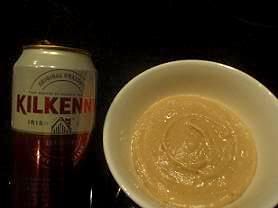
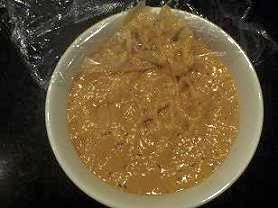
[color=brown]the ale and the barm freshly made up[/color] [color=brown]the barm is ready[/color]
Dan Lepard says this is a perfect replica of the complex barm of olden times for the home bakers.
Now, the above formula is really curious to me. Recently a TFL user Bruce (Frrogg1son) asked me about a Chinese [b][url=http://www.thefreshloaf.com/node/12866/james-j-macguire039s-pain-de-tradition#comment-76511/]"65C soupy dough"[/url][/b] and when I Googled it a whole string of Hongkonese and Taiwanese bread recipes ran up; many of these breads are on the sweet side with milk powder, butter and sugar, almost like French brioche breads. I see these type of sweet white breads in Japan a lot too.
The curious thing is that the ratio of water to flour in this "65C soupy dough" is the same as Dan's ale to flour ratio; ie, 5 to 1, and it is heated up to 65 C, closed to Dan's 70 C. Bruce told me that the science behind this soupy dough is that "when the flour particles reach about 65C, they burst, releasing starch molecules, which have the capacity to absorb very large amounts of water. It is like gelatinization." What this does to a dough is that it improves the moistness of the crumb and keeping quality of the bread. He first discovered it on the internet as a natural way to extend the moistness of some doughs. How interesting. I imagined what this does is similar to what potato does for some sourdoughs - very most crumbs and good keeping quality.
That said, I felt a sense of auspicious foreboding coming for this barm bread. Dan's book (page 41) says the Barm bread is the traditional wheaten bread of England. Wow.
[b][u]The formula[/u][/b]
150 g barm from above (the rest can keep in the fridge for a week)
250 g water (adjust your water temp to achieve a dough temp of around 21C / 70F)
500 g strong white flour (or a flour mix of rye and wholewheat, or even soaked grains, but I used white flour only)
10 g salt (or 1& 1/2 tsp)
[color=red]*[/color] Note: This is a 68% hydration dough; but I added 20 g extra water to bring it to 72%.
[b][u]Schedule in hours and minutes[/u][/b]
0 :00 In a large bowl, whisk the barm with the water. Add the flour and salt, and stir until you have a sticky mass. Cover. Autolyse. The dough temp should be about 21C (70F).
0 :10 Turn the dough out onto a lightly floured surface and knead for 10 - 15 seconds. Return the dough to the bowl. Cover. (I gave the dough 7 - 8 folds [b]inside the bowl[/b], which lasted 15 seconds, much the same way as dough is folded in James MacGuire's pain de tradition [url=http://www.thefreshloaf.com/node/12866/james-j-macguire039s-pain-de-tradition/][b]here[/b][/url] that I recently posted.)
0 :20 Knead again as above. (I folded the dough again in the bowl.) The room temp should be about 20C (68F), if not, you may need to place your dough in the fridge for part of the time to keep the dough temp down.
0 :30 Knead again as above. (I folded again.)
1 :00 Knead again as above. (I folded again.)
2 :00 Knead again as above. (I folded again.)
3 :00 Knead again as above. (I folded again.)
5 :00 Turn the dough out and divide it into two pieces of 450 g each (I left mine as whole). Pre-shape each into a ball. Cover.
5 :15 Shape dough into boule and place into floured linen-lined baskets or bowls. Cover. Leave at room temp of around 20C (68F) for a bit longer than 4 hours or [b]until dough almost doubled[/b].
8 :30 Turn on your oven to 220C/425F (if it takes one hour to pre-heat).
9 :30 Bake with steam for 50 - 70 minutes.
Phew! This schedule may look like a bread making marathon to you but in truth my dough was not ready until after 12 hours! I started mixing my dough at 7am yesterday, and it was only ready to bake at 8 pm! Possible reasons are that my room temp was only around 18C (64F) and/or my barm was very slow. And this is it:
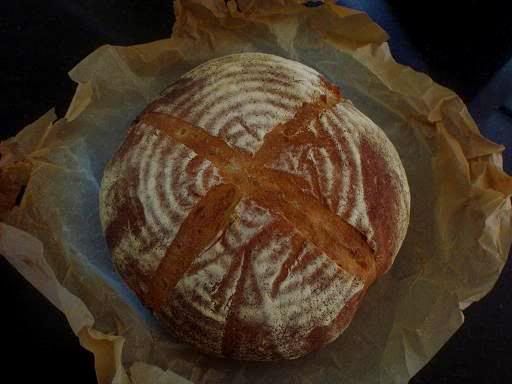
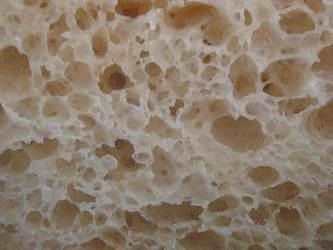
[color=brown]Dan Lepard's Barm Bread[/color]
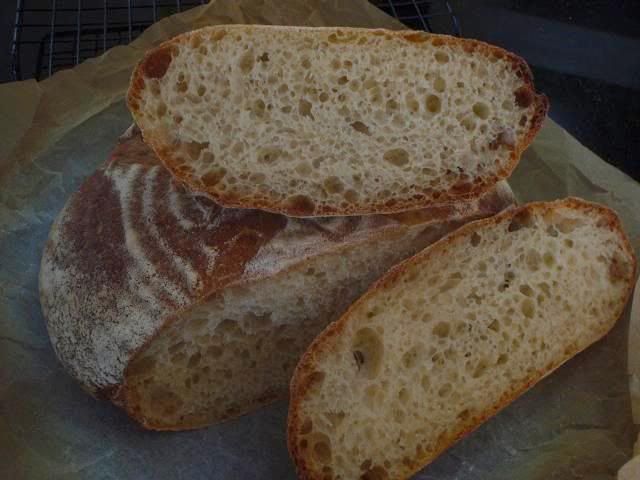
What a beautiful barm bread; the taste is most amazing, richly flavored from the ale-based barm, which has a slight bitterness and sweetness from the ale. I am most impressed by Dan's formula. The crumb is sweetly fragrant. It has a very deep aroma, and allure. Now, this is something that I would come back to have more.
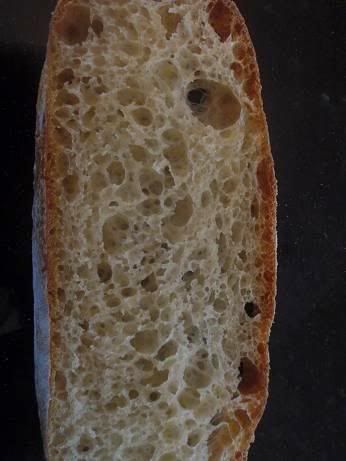
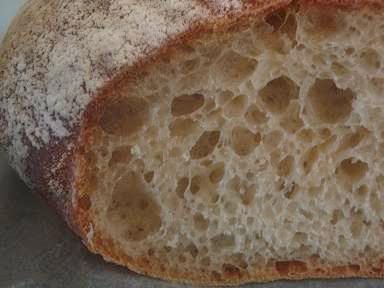
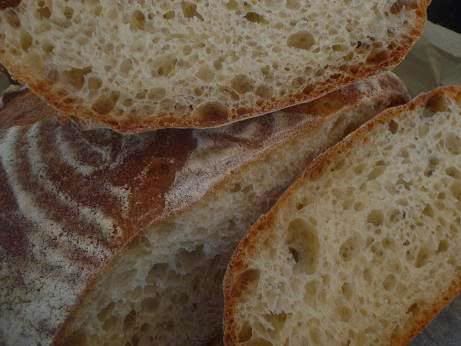
It's been years since I ate past 8pm but last night I literally had 1/3 of the loaf on my own! Any of you ladies out there, don't do what I do.
I have not recommended any breads to people up until now because most of my breads are frivolous experiments and for my eyes only, but I do commend this one. Whether your guests are experienced connoisseurs or no foodies at all, there would be no qualms about this superb sourdough. (I am blowing my own trumpet.)
Thank you, Dan.
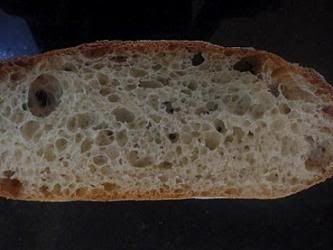
It's time Polly our dog go out for a rumple-trot in our yard; I sang out her name and she stirred from behind my couch. Out she went through the hallway door to enjoy the green and the afternoon sun. And me? I am having my afternoon tea with this bread!
Shiao-Ping
- Shiao-Ping's Blog
- Log in or register to post comments
I'm sold!
Beautiful write up, as we've become accustomed to, Shiao-Ping!
I am only allotted so much time per week (or even month, for that matter!) to experiment with new recipes, or work with ones that have layers of steps, but you got me.. I absolutely must try this one = )
I vote front page! = )
- Keith
Having home brewed beer in the past, I'm curious enough to ask if some of the dried beer yeasts must be used in baking bread. Obviously, they are cultivated for different characteristics from bread yeasts, are more expensive and are usually just sold in home brew beer shops. However, I can't see any reason why they wouldn't work for bread. Proofing times might be difficult to judge without experience. I've seen a single package of British ale yeast turn a five gallon carboy of wort into a foaming yeast beast that that took about four days to ferment out.
If someone has actually tried this, I'd be interested in the results and what you thought of bread's flavor.
Thank you for this very nice formula for a wonderful. ' Barm Bread'. Not to be nick picky..most understand steaming instructions -but you never know- 9:30- someone might steam for the whole bake time!
Sylvia
Looks interesting Shiao-Ping,
Was there any hint of the flavor of the Ale in the bread? I'm guessing it was a mild sour as well.
Eric
The sourness is very, very mild. The flavor is really pleasant.
Shiao-Ping
I love an ale taste in my breads. I must say, your breads always look perfect. Dave
I have just realised that I committed yet another "naughtiness" in calling this loaf "Dan Lepard's Barm bread." Sorry, Dan.
James MacGuire, after seeing my post at TFL, was very kind writing to me and told me that:
No wonder my "barm" took so long to ferment! Now I know why. Sometimes when I read English, I don't get the exact meaning -- like [b]bottle-conditioned beer[/b] is not [b]bottled beer[/b]. Now I know.
Thank you, James.
Shiao-Ping
I researched the phrase last night, and found out the same info... I did not have true bottle conditioned beer on hand, so I am currently fermenting your recommended 'barm' with a bottle of Samuel Adams Boston Lager. I'm at about the 12 hr mark, and there's lots of fizzing... so we'll see!
- Keith
Hi Keith
Glad to hear that you are experimenting. Last night I found an excellent write-up by Dan Lepard in his website [url=http://www.danlepard.com/forum/viewtopic.php?t=117&highlight=barm+bread/][b]HERE[/b][/url]. I wish I read it before I did my barm bread (sigh...).
Shiao-Ping
Hi again -
Well, what can I say... a very nice full flavored boule is sitting on the counter! The yeast content was not what I'm used to in my sourdoughs, so therefore things happened faster than expected. I was unable to stay awake long enough to final proof and bake, so I retarded the shape in the fridge, inside a banneton. When I was ready to bake, I removed the banneton and realized that it was already at least 100% proofed. With no time to bring to room temp, and no time to properly pre-heat the oven, I slashed and put it into the oven.
The amount of final proofing left it good structure, but no great spring. Far from a brick, but far from what I'm capable of producing with other recipes that I'm familiar with. Unfortunately, a search for the camera led to a phone call to the wife at work, who says she took it in to work to have it ready for baby shower pictures tomorrow.
Without much spring or bloom, the crumb is fairly open, but nothing wildly so. Who cares, right? This was an experiment, and my main goal, before making it look as pretty as possible, is to get the flavor dialed in.
The Sam Adams Lager defintely gave it a rich carmel color within the crumb itself. The bread is super soft, the crust is French Bread quality crispy, which will of course soften significantly over the next few hours.
The taste? There is something just slightly beery there, but if I was blind tasting and asked what I thought it was, I might not guess beer. That 'something' is not distracting at all. It's mild, it's pleasant if not complimentary. There is very little sour, and that is where I will need to work on it, because I want a fairly robust tang to see how it works with the 'something' that's already there.
Shiao-Ping, I thank you for inspiring a journey for me. I get stuck baking the same things out of necessity of schedule. I ventured wildly from the recipe, realistically only using the barm instructions verbatim. You are a true improviser, and while I was busy improvising away the hours, I understand why you enjoy what you do. It is indeed a completely different approach and reward system.
For the record, here's my ingredients:
Faux Barm (hehe):
250 g Samuel Adams Boston Lager
50 g King Arthur Bread Flour
24 g 75% hydration King Arthur All-purpose fed starter (at peak activity)
Final Recipe:
The entire Faux Barm from above
100 g King Arthur Bread Flour
180 g King Arthur All-purpose Flour
31 g King Arthur Organice Whole Wheat Flour
6.2 g Kosher Salt
Additional water
I did a rookie and forgot to subtract the bread flour in the faux barm from my final formula, so I needed to add some water. I spritzed from a bottle while I was doing the frisage. Turned out to be a very well-behaved dough! As you can see, quite a departure from your recipe, which I did solely because I wasn't sure what this faux barm was all about or how it would work. I was both pleased and surprised at the amount of yeast activity available. It worked more like a slow commercial yeast rather than a sourdough.
I will do this again, and I expect it to be as fun. This time I will better manage my time, and concentrate on getting some sour into the dough. Thank you again for the inspiration!
- Keith
that's an excellent try. I hadn't thought of using the entire "faux" (how befitting) barm, but that's great. I still have the leftover in my firdge, am just wondering what I would do with it. How you've done is smarter. (And now I have even more leftover after the weird Celtic Sourdough I made - not the bread, the idea).
Shiao-Ping
As with pursuits in most fine things in life, one may learn about sourdoughs or breads and obtain most information about the subject in a very short space of time; however, only after years of experience in the field can one grasp the nuances and subtleties.
James MacGuire was very kind and wrote to me that:
To discern the delicate flavors of the flour, the flour we use has to be "right" in the first place. How many tongues can differentiate the various delicate flavors in flour, given the "right" flour? Why can't everybody be a good sommelier? It may not be just a matter of training.
I made a hasty call when I said at the beginning of the post that the flavors of all those super-hydrated crumbs are not deeply alluring for me; after all, I have only made them three times, each time with different flours and variations, making subtleties with each harder for me to accumulate and compare.
Thank you, James, once again.
Shiao-Ping
I suppose purists would object to your post. It was very nice that your brought to light that your "barm" wasn't true to the definition.
I know I, as well as the majority of your fellow TFLers, have enjoyed this and all your posts. New flavors will be awakened with the choices of different flours, brews and baking techniques. Your pleasure in the flavor of this bread has already enticed others. That's why we are here, that's why we share.
Thanks again,
Betty
Both the bread and the writeup!
I've yet to try it, but recall the "65C soupy dough" is sometimes referred to as a water roux (湯種) starter, which can help improve the texture of the bread.
Now in terms of bottle-conditioned beer, is that the same thing or very similar to an unfiltered wheat beer, such as a Hefeweizen?
- Jackie
Bottle conditioned beer is usually an ale where the brewery adds a bit of live yeast to the batch of beer before bottling. This helps to ferment any residual sugars to add a bit of carbonation and enhance the flavor. The practice seems to have started in England but has traveled well in the US. Sierra Nevada Pale Ale from California and Kansas City's Boulevard Pale Ale are two examples of the practice. An unfiltered hefeweizen is similar but the yeast strain won't be as pure as the SNPA.
Ale yeasts are used for fermentation at temperatures (about 64-69F) that are similar to bread yeasts. Lager yeasts are more commonly used at temperatures around 40F but have been used for California Common beer such as Anchor Steam at ale fermentation temperatures. Wyeast is a very popular and reliable manufacturer for all types of beer yeasts.
I've never heard of Sam Adams lager being a bottle conditioned beer nor have I ever seen any evidence of that in the bottles I've researched. What I do know is that if it's working, don't fix it.
... and brand names.
Shiao-Ping
Hi Jacqueline
The point of the matter is the bottle-conditioned beer finishes fermenting in the bottle, and as such, there is still yeast remaining in the bottle. But bottled beer as well as beer in tins are bottled/tinned after the beer has already done fermenting (and therefore, no yeast in bottles/tins).
That is the reason why my barm took so long to be ready (because the vast quantity of flour/water relies on the very small quantity of levain that I put in). Had I not put in the levain (as in Dan Lepard's method), I don't know if my barm would ever be ready. Dan's recipe specifically asks for bottle-conditioned beer. As I understand from his website forum discussion, he had the levain there more for flavor, not for leavening.
Hope your parents and brother had a good visit.
shiao-ping
Now we all understand what bottle-conditioned beer is and why it's important for this recipe!
Thank you for introducing 'the Art of Eating' James MacGuire article and Breads Shiao-Ping. It's been a revelation to me to put the mixer aside and get into the dough so directly again. Revisiting time and temperature through the methods James uses has already brought about more experimentation and creativity with the simple loaves I had been making on my own.
But, I'm a bit confused about the quote from earlier today:
James MacGuire was very kind and wrote to me that:
"With regard to the Art Of Eating miche and flavor, I don't feel that the no knead or the 80% hydration are at play in terms of flavor. Calvel was fond of straight doughs---panification en direct---because the subtle fermentation flavors allowed the delicate flavors of the flour come shining through. "
I was just seeing more clearly the connection between the fermentation time and this style of handling of the dough and how directly the Bread quality seemed to be affected by the no-knead, hydration, temperature, yeast% etc.
If the no-knead and the hydration are not at play in terms of flavor where does James recommend we put our focus?
Above all, many thanks again for introducing these methods of Mr. MacGuire's. His work is hard to come by and of great help and fun to play with.
Dave
I believe, in terms of flavors, the focus is "flour." That's how I read it. The article stresses that the flour has to be "right" (ie, KAF's all-purpose flour) for the artisan bread we are making here. The no-knead and 80% hydration assit flour in allowing it developing the flavors. Conversely, the excessive kneading destroys the flavors that the flour otherwise is capable of developing.
This is my understanding and I am not even sure if it is absolutely correct. I welcome any comments.
Shiao-Ping
There have been lot of writing about what is bottle-conditioned beer, but the nail hasn't been hit exactly on the head yet. Bottle-conditioned beer is unpasturized beer that has undergone a second fermentation in the bottle by tapping the "finished" beer on the bottle with a little bit of sugar. The purpose is partly to produce CO[sub]2[/sub], instead of adding this artificially.
I guess the ale gave some flavor to the bread anyway an thus wasn't in wain. I will try this recipe when my homebrew is finished.
information. shiao-ping
I am in awe, Shiao-ping
Loved everything about this thred: the photo of the bread, your writing, and you join two things I am fascinated about: China and Dan Lepard :-)
I am going on with the Baker's Apprentice Challenge, and that has been limiting a little bit the kinds of bread I can try, as I only have the weekends to indulge in yeasty activities :-)
but I MUST make time to bake this barm bread. I've had the book for a few years, but never tried that one.
谢谢,
牛莎丽
It's lovely to hear from you. Dan Lepard's beguilingly light weight book "The Handmade Loaf" is a gem in an unpretentious way. I would like to do more from his book myself. Thank you for your comment.
Shiao-Ping
I made this bread over the weekend with wonderful results, but I made some changes to the recipe.
To begin, I retarded the mix overnight in the refrigerator, because it better suited my work schedule. The next afternoon, I formed the cold dough into a single boule, then let it proof for 4 hours at room temperature in a banneton. I baked it on a stone at 450 for the first ten minutes, then 425 for the remainder of the bake. For steam, I used a cup of boiling water over lava rocks in an iron skillet. I got very good oven spring, a nice crust, and a moist, airy crumb with an intensely wheaty taste. I decided to refresh the leftover barm with equal weights of flour and water and try for another batch.
While the first barm took 24 hours to double, this second mixture took only about 5 hours. The yeast was apparently still active. I did as before, mixed up the dough and put it in the refrigerator overnight. This time I pre-heated the oven to 500 degrees and immediately lowered it to 450 for the first 15 minutes of baking. Then I completed the bake at 425. My loaves were smaller this time (two boules) so they only took about 50 minutes to complete.
One loaf I baked on an open stone with steam as before, and the other I baked in an Emile Henri clay pot with a cover. The boule that was baked on the stone appeared flatter with not as much oven spring as the first batch, but the interior of the loaf still had large, irregular holes and a creamy, moist crumb. The boule baked in the Emile Henri had more height, but I think I got a much better crust on the first boule, probably because I forgot to take the cover off the baker.
All in all, the second batch was very successful, producing loaves that were somewhat milder than the first but still very flavorful. The bloom was not quite so dramatic as the loaves produced with the original barm, but I suspect the reason is that I didn't allow for quite enough proofing time.
Your experiments sounded so good. They made my mouth watering and bring back the memory of my barm - the flavor was very much to my taste (unlike the recent sour Miches that I've been making). Thank you for your comment and next time I will do what you did and retard in bulk (or even another one and retard in shaped loaf). Thank you for taking time to write.
Shiao-Ping
Hi Shiao-Ping,
I've learned so much from your posts and have so much admiration for your breads; it's my pleasure to be able to add something to the discussion.
Cheers,
Barbara
Great report! I've been trying to set a schedule to bake this bread, since I first saw Shaoping's post - I think retarding the dough as you did will make it a lot easier.
Not sure I can make it this weekend, but maybe I can pull it during the week, using your method
Hi Sally,
Doing it this way makes it a three-day process (barm on day 1, mixing, folding and retarding on day 2, baking on day 3.) But at least it's an easy three days.
Barbara
It should be noted that these beers listed by Ty are SOUR beers.
· Lindemans (Belgium) Gueuze Cuvée René (up to 15 years)
· Frank Boon (Belgium) Gueuze Mariage Parfait (up to 20 years)
· Cantillon (Belgium) Gueuze (up to 20 years)
That is, they are fermented with wild yeasts and bacteria. Sort of like the beer equivalent to a sourdough. So expect a different, more sour, flavor if using any of these.
-Bob
your info. So, are the [b]other[/b] bottle-conditioned beers listed in Ty's comment fermented by chemical fermenting agents?
Thanks, Shiao-Ping
other beers, like the vast majority of beers, are fermented with brewer's yeast only. The sour beers I mentioned have wild yeasts and bacteria in addition to brewer's yeast. Therefore, you may get some sourness from the bacteria if you use those.
By the way, there is no such thing fermentation chemicals. All fermentation can only be accomplished with living yeast or bacteria.
-Bob
I'll definitely hunt for one of these to make my next barm.
I am soooo happy I finally managed to make this bread!
It is absolutely delicious! The taste is quite differente from your regular levain bread, like Shiao-Ping I used only white flour. I had no idea if my barm was at its peak, as it was the first time making - I do think it was slightly past its prime time, but it worked very well
I don't think I would have tried this bread if it wasn't for this thread, so a huge thank you is in order.
I used Chimay beer, allowed it to ferment for about 30 hours - followed the recipe exactly as described in Lepard's book. Baked in a clay pot, 30 minutes covered, 15 more uncovered, at 430F
That's a beauty!! Wow, spring, crumb, crust and slashing! The only thing I can't vouch for is taste, but I'll trust your judgement ; )
Very nice, Betty
really yummy! Thanks for showing us the photos. Shiao-Ping
Shiao-Ping (or anyone who has experience with barm breads),
I have prepared the balm as per Dan Lepard's recipe, and it has been resting for around 16 hours now...but the ale is sitting on top, and underneath is a sludge of flour and starter. I've stirred the barm mix a couple of times, but after a while this separation of ale and flour sludge occurs again.
My starter is fresh and active, and I maintain the feeding daily; I have used it successfully many times for baking all sorts of sourdough breads, bagels, banana bread, etc. So I'm sure there is no problem with the starter.
I'm just wondering, should it be obvious by looking at the barm that fermentation has taken place? I note Shiao-Ping's took 36 hours to look bubbly, and I'm hoping mine will also come good in time, but at the moment it doesn't look very promising!
Would be grateful for any insights or soothing reassurances!
Cheers
Ross
Thanks, Ken, but I decided to go ahead and make the dough when bubbles started bursting regularly on the surface of the ale. I had been stirring the barm every few hours, but the separation of ale and flour/starter continued. Anyway, the dough appears to be rising, and is in the final 2 hours of proofing before going into the oven...feeling optimistic, but we shall see.
Is there any particular reason for keeping the dough at 20 degrees?
Wouldn't it be better to keep it at about 25-30 degrees, to get a faster rise?
Faster rise compromises crumb flavor. 24 to 26 degree C is the classic recommended temperature. I can't exactly remember why when I was making this bread the temperature was left at around 20C, but it may be so that the fermentation was slow enough to achieve a particular flavor for this particular bread. You can certainly do it at any temperature you are comfortable with.
I made this bread today.
The thing is the bread didn't rise as it should have, even though it stood for about fourteen hours. I usually want my wheat-doughs to double in size before I consider them ready for the oven, but this dough didn't double. But it had bubbles in it so it was fermenting. The taste was really good though.
Any ideas why it had such a puny rise?
The gluten-strength was good and the dough was maybe about 70 hydration. But it didn't rise as I thought it would.
Maybe my beer just wasn't good enough? I used the brand "Breznak" from czechoslovakia. I don't know if it has been pasteurized or not.
How important is the kind of beer used, for the end-result?
I also wonder why it is a good idea to heat the ale to 70 celsius? Wouldn't this kill of the live yeast in the ale?
To me this formula is more for the flavor rather than the rise. I remember at the time when I made it I also had the problem of it not rising very much but, as you also pointed out, the flavor was very, very good. You are right that 70 degree C kills the yeast and this goes to show that we are not relying on the beer yeast to rise the bread.
Brilliant thanks