The Fresh Loaf

News & Information for Amateur Bakers and Artisan Bread Enthusiasts

wassisname's blog

  • Pin It
wassisname's picture
wassisname

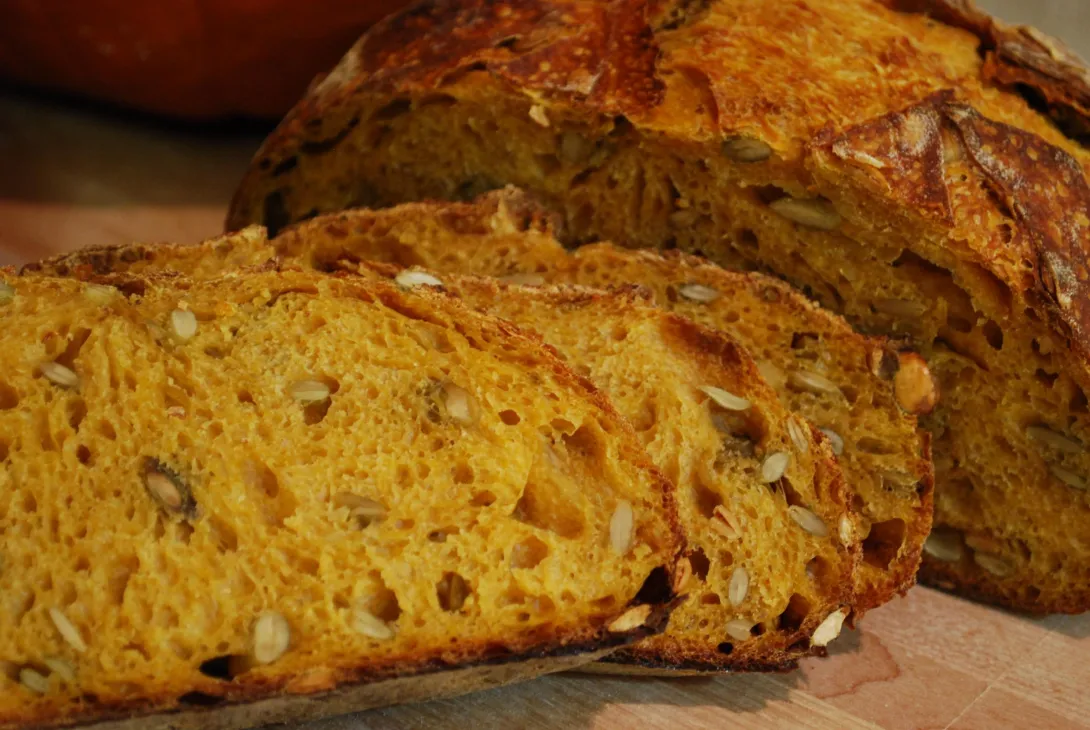
I haven't been able to get pumpkin and sunflower seeds out of my head since Franko posted about the combination here.  In the end I went in a little different direction, using 25% whole wheat instead of rye and adding flax seeds.  No special reason for either change - the flax seeds just happened to be beside the other seeds in the freezer, so in they went, and I've been on a light whole wheat kick lately that isn't quite out of my system.  So, I came up with this:

The pumpkin and sunflower seeds were toasted in the oven at 375ºF for 6-7 minutes.  The flax seeds were soaked in all the cold water they could absorb for about 8 hrs.  I drained the flax seeds before adding them to the dough so the water used does not figure into the formula at all.  I should note that the weight in the formula is the dry weight of the flax seeds.  I didn't think to weigh them after the soak... hmm... throws my formula off, doesn't it... sorry, too late now.  Between the toasted seeds and the wet flax I think I came out about even on the hydration.

For the final dough the white flour and water were autolysed for 20 minutes.  The starter and salt were then added.  I kneaded until the WW starter and white flour portion were fully incorporated.  Easy to see because of the color difference.  Then I added all of the seeds by flattening out the dough, spreading the seed mixture over it and folding repeatedly.  When it turned into a sticky mess with seeds falling out everywhere I gave it a five minute rest.  It behaved much better after the rest and I kneaded another minute or two until everything was evenly incorporated.  The dough was given 3 S&F's at about 45 minute intervals before I went to bed.

The weather had turned chilly so I decided to use an overnight bulk ferment in one of the cooler corners of my house.  That corner turned out to be considerably cooler than I expected and by morning was 42ºF.  Oops.  So much for shaping the dough first thing in the morning!  It took a couple of hours more in a warm place before it looked even close to ready .  Probably could have used longer but I was tired of waiting. 

Final proof was about 3 hrs (75ºF - 80ºF).  I baked at 450ºF for 15 minutes with steam, then about 40 minutes at 410ºF.

The result was delicious!  The smell filled the house and was almost too much to bear.  The "bread" turned out mild and tasty but the seeds are, of course, front and center.  I mixed a little honey and butter "just to see how it would go with the bread" and went weak in the knees.  More seeds please!

Marcus


wassisname's picture
wassisname

This is my salute to the land of pinyon pines and sage brush, aka home.  I can't resist buying locally gathered pine nuts every autumn, even if it means shelling them myself.  Of course, shelling them myself means my fingers smell like pine pitch for days but that's half the fun - at least I don't have to go out and fight the squirrels for them.

Not only does sage fit the theme, but it seems like a natural accompaniment to the pine nuts.  There's no shortage of wild sage brush in the neighborhood, but I'm not sure I should be eating that, so I use domestic sage from the garden. It gives a distinct savory flavor to the bread that, combined with the nuts, reminds me of bread stuffing.

The sourdough could be any sourdough.  This one happens to be 15% whole wheat, no rye.  It makes a good foundation for experimenting with different add-ins.  The percentage of pine nuts seems high, but they are so dense that the weight is a little misleading.  It isn't as much as it sounds.

This bake reminded me that the seasons have definitely changed.  Summer is well and truly over when my starter goes into slow motion mode.  I picked-up on this about 3 hours into the first rise, did some quick math, and realized that even keeping the dough warm I wasn't going to have time for a full proof.  I considered retarding the final proof but the timing wasn't going to work for that either, so I gritted my teeth and went ahead with the bake.  I must be getting better at judging my dough because this bread behaved exactly as I expected.  Woefully under-proofed but tasty! 

So close!  Another hour or two would have been magic.

It did make for some interesting photo opportunities.


I think I'll go get another bag of pine nuts and try this one again!

Marcus

wassisname's picture
wassisname

     This bread is growing on me.  If I'm going to keep baking it, it needs a name.  A really cool sounding name that may or may not make sense in it's native land.  A name like: Doppelsauer Bauernbrot.  Now, that's a name that sounds like it means business.  There's something about Oktoberfest season that always brings my German roots bubbling to the surface!
     The first version of this bread was so tasty I couldn't help but try it again, especially after getting so many insightful comments.  My first impulse was to change everything!  Then I came to my senses and decided to keep the changes to a minimum.  I wasn't looking to end up with an entirely different bread, there's time for that later.


     I made a number of small tweaks based on how the last one behaved, but the primary change was to let the rye starter ferment twice as long.  In the last version both starters were at a stage where I could have let either one raise the bread on it's own.  That didn't really test the idea I was trying to work out in the first place so this time around I let the rye ferment far longer than I would if I were expecting it to raise the bread.
     The monkeywrench in all of this was the vigor of my starter.  It was a little too happy.  The WW portion of the build that was meant to be the lively, energetic component was already past it's prime and sagging by morning.  Oh, well.  I can test that next time, along with the myriad variations I already have swimming around in my head. 


     The result was another nice loaf of bread!  And, what seems to be a fairly forgiving recipe.  The crumb was a little more uniform than the last one.  The flavor had a more distinct tang from the well-soured sour.  There was even enough spring in the oven to get the scores open.  I am a happy baker!  A thin slice with a little butter is just... something to savor.
     Someday I will try this without the WW starter and see if it even makes any difference.  Of course, then I would have to come up with another name...


A note on the scoring - I've always liked the swirly, organic look of seam-side-up ryes.   With breadsong's recent posts imprinted on my brain I just couldn't resist trying it.  I'm sold.  Not only is it easy on the eyes, but now there's no more standing over the loaf, knife in hand, frozen by indecision.  Let the loaf be what it will be... with a little help now and again.

Marcus

wassisname's picture
wassisname

     I've had salzstangerl (salt sticks) on the brain for a while now. I loved these in my younger days and ever since I saw them mentioned in Bread I've been looking for an excuse to try them.  Hamelman recommends his 40% rye sourdough dough for the purpose.  It's been quite a few years since I've had one, but I can say with confidence that the German bakeries in southern California I once frequented were not using a dough like this.  They were more like straight pretzels.  Probably no rye and certainly not sourdough.  As with most breads I'm sure there are innumerable variations, but I'm a sucker for rye sourdoughs so I went in the Hamelman direction. 
     I already have a 30% rye that I like so I used that instead of the recommended 40% rye.  The dough came together nicely, then I began shaping...  oh, the poor unsuspecting dough.  The look I was going for was a long, slender, gently tapered roll.  Imagine a croissant, without the layers, and straight, and not so plump in the middle, and sprinkled with coarse salt and caraway seeds.  Easy, right?  Heh, heh, heh...   I was laughing aloud by the time I "shaped" the last of them.  "Sea slug" was the first association that popped into my head.  Having since looked-up photos of sea slugs I don't think that was entirely fair... to the slugs.  Ba-dum-bum!
     They still turned out pretty well, but not quite what I was after.  The recipe for Czech Crescent Rolls in Leader's Local Breads actually sounds closer to what I remember.  I think somewhere in the middle is where I want to be.  The next batch will have less rye, less prefermented flour, and lower hydration.  I'll add some butter and maybe some yeast.  And now that I know how not to cut the triangles the dough will be less abused during shaping. 


The nice surprise came from the other half of the same dough:

Clearly this is what this dough was meant for.  I was really happy with this one (though, by the look of the crumb, I still need to work on the ol' shaping skills) and it only got made because I didn't feel like shaping another pan of salzstangerl!  The dough is 30% whole rye (all fermented @ 100% hydration) with a final hydration of about 70%.

I've been tinkering with my oven set-up, testing the lower limit of my top stone placement.  The loaf sprang more than I ever thought it would and just touched the rack above it.  That's cutting it a little too close!

-Marcus

wassisname's picture
wassisname

I considered throwing this idea out there as a hypothetical but never got around to it.  So, I went with my preferred method: bake first, ask questions later.  The question that led to this formula went something like this:  Instead of adding yeast to a rye sourdough, as so many book formulas do, what would happen if I added some whole wheat starter? 

The hope is that the vigorous population of yeast in the wheat starter would compensate for the possibly not-so-reliable leavening power of the well-fermented rye starter.  Sounds plausible enough, even if it turns out not to be true.  It sounded even better when I thought of it as something like a multi-stage rye, but with the two stages happening concurrently rather than consecutively.  Yes, a little knowledge is indeed a dangerous thing, but I decided to try it anyway.

Since my "scientific" baking experiment lacks even the pretense of a control bread I am left with not much to say regarding  the relative merits of this method vs. any other method... hmmm... awkward.  I'll just go ahead and describe the bread. 

The dough was a sticky mess.  The final hydration was probably 80% or better because of all the water I had to use to keep the dough from sticking to everything.  The dough fermented really quickly.  It rose so fast during both stages that I cut them short.  Even so, there was only the slightest oven spring, and the finished bread was very dense.  When I cut the bread about 4 hrs out of the oven the crumb was still a bit tacky, but not terrible.  The next day, however, the crumb had finally set and the result was very nice.  This is one of those breads that needs 24 hrs to sort itself out.  The flavor was delicious (maybe a little heavy on the coriander).  The crumb was dense but moist and soft - not gummy at all.  48 hrs later it was still every bit as good.  Overall I am pleasantly surprised.  This turned out to be one of the nicer "heavy" rye breads I've baked.

Thoughts for next time:  Let the rye starter ferment longer - I don't think I let it go long enough this time to really test the method.  Shorten either the bulk ferment or the proof (or both?) and see if I can get some oven spring.  See if I can get any more gluten development during kneading.  Any other thoughts are more than welcome :)

Marcus

wassisname's picture
wassisname

Baking for the county fair.  Or, what if they gave a bread competition and nobody came?  Well, I would win lots of ribbons, that's what!  I'm exaggerating a little, there were a few other breads but none were in the categories I entered (fortunately for me).  Makes the blue ribbons a bit less impressive but I still had fun doing it.


It is always a good learning experience as well.  Things I learned (or was keenly reminded of): 

Baking three batches of bread makes for a much longer day than baking one batch. 
Baking a loaf for a random, judgemental stranger is much more stressful than baking a loaf for myself. 
Baking an olive bread next to a plain bread makes the plain bread taste really funky. 
Pitting a whole jar of lucques olives by hand is a pain in the neck (and the hands).
Sourdough always seems to proof faster when the oven is occupied.
Taking photos of my own bread at the fair may give people (non-bread enthusiasts, anyway) the impression that I am a narcissistic weirdo.
Giving away a loaf of bread feels really good.
I sincerely hope that at least one person walks by my breads and says, "Heck, I can make better bread than that!" and brings it to the fair next year.

The breads:  a basic sourdough with 10% whole wheat, the same sourdough with olives, a 30% rye sourdough, and the same rye with walnuts and raisins The group photo has a couple of extra loaves because I doubled-up on two of them. 


This is the extra olive bread I kept for my own enjoyment:


Marcus

wassisname's picture
wassisname

I have a zinfandel grape in the yard, originally planted more as a whimsical tribute to our favorite wine grape than for any practical purpose.  It is now producing grapes, something I should have seen coming, but what to do with them?  They are tasty enough to eat fresh if you don’t mind the seeds but still…

Grape focaccia!  Of course!  I’ve never tried it but it sounds tasty and fun.  The catch? The seeds.  These are small grapes, so I needed a lot.  After about 10 minutes of seeding I had a much better idea of what I was in for, stopped seeding, and split the dough in half.  I decided to top the other half with tomatoes and resumed seeding.  Later that day… I finally had enough grapes.

I wanted to know what the grapes would do on their own so I kept it simple.  Just a little olive oil and a very few bits of rosemary sprinkled on.  The other half was topped with rosemary and yellow pear tomatoes.

In spite of a lackluster focaccia dough (no formula posted – I am confident that you can make a better one)  they were both tasty.  I was amazed at how sweet and concentrated the flavor of the grapes became.  If I can work up the enthusiasm to seed all those grapes again I’ll make a thinner bread, maybe even a regular pizza crust so the grapes will stand out more.  A great seasonal summer treat! 

Marcus

wassisname's picture
wassisname

First the old:  An 85% whole wheat sourdough.  I'm still tinkering with this formula and getting good bread, but I'm coming to realize that the way I handle the dough has more impact on the bread than my endless tinkering with the numbers (if only I could spend as much time baking as I do in front of a computer). 

Now the new:  I finally got a copy of Hamelman's Bread.  Wow.  Now I understand.  I also tried scoring with a safety razor-on-a-stick for the first time.  That was weird.  I didn't think it would be so different from scoring with a bread knife.  It will take some practice, but I think it will be an improvement.  Lastly, but no less exciting, I recently discovered that the little health food store in town will happily special order 25lb bags of Giusto's flours at rock-bottom prices.  Who would have thought?

The Little Things:  That's what this bake really threw into sharp relief.  These two loaves came from the same lump of dough and were meant to be exactly the same except for the scoring.  I don't think scoring alone accounts for this much difference.  The larger loaf isn't just larger because of a better oven spring, it actually is larger because I didn't get them divided exactly in half - there's one little difference.  But obviously the larger loaf did behave quite differently in the oven.  Shaping.  I tried a new (to me) method, first on the smaller loaf.  It seems that by the second loaf I was already better at it.  The crumbs differ significantly as well, though they don't look as different in the photos.  A good lesson for me - keep an eye on the little things!

And the garden is in full swing, so I put the bread to good use!

Marcus

wassisname's picture
wassisname

     This is a bread that came from having too many different flours in the house at once.  I went to the freezer intending to make another bread altogether but saw these flours and thought, "beans and corn, classic!" Beans and corn and chiles?  Even more classic!  This was to be my sourdough salute to the American southwest, except... the bread never really worked like I wanted it to.  It's not a bad loaf, it just isn't making me as happy as I thought it would.  Hmmm... maybe therapy is what I need.  I could analyze this bread all day, but here are the highlights:


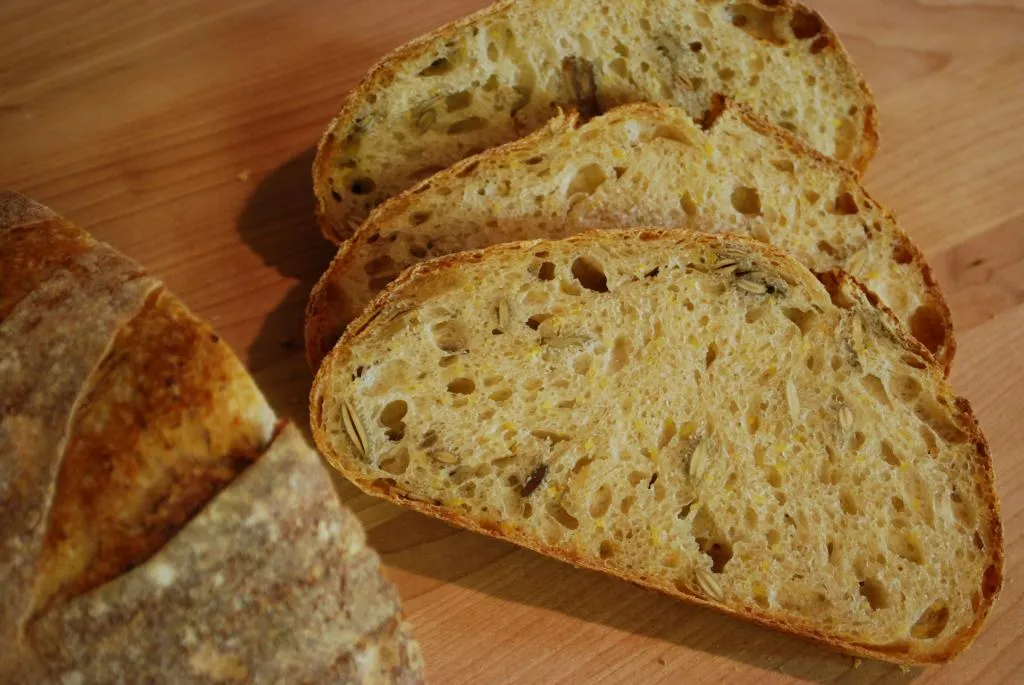
What I like about it - The color contrast between the yellow tinted crumb and the reddish paprika tinted crust gives it a nice look.  The flavor works for me - a nice "something different" - particularly good when very fresh with butter and honey.  It looks better in photos than it actually is... maybe that's not such a good thing.


What I don't like - Stales very quickly, though the up-side to this is it makes very tasty melba toast-style crisp bread.  The corn flour seems to wreck the structure of the dough, which leads to this problem:  as you reduce the corn flour and the structure improves, the flavor goes bland; when there's enough corn flour for a nice balance of flavors the crumb starts to go flat, weak and crumbly - and stale even faster.  The dough is slack, sticky and feels like it is broken down almost immediately after mixing.  Worst of all?  I keep thinking, "Maybe it's me...?"  But, no other dough I make behaves this way so I don't think it's just me.

 The Final Attempt

The formula - This is the final formula I used to try to improve the structure.  It is not the one that produced the best flavor.  For better flavor the corn flour should be about 15-17% and the garbanzo (potent stuff, by the way) should be about 8-9%.  The WW comes from my starter and would not otherwise be necessary.  I tried this with a little more WW but it just got in the way of the other flavors.

A retrospective:

     A promising start


Even when they looked good there was just something missing.

  The tendency to go flat.

     Pretty, but...


Where to go from here - In a word:  Polenta.  I have a good feeling about polenta.  Forget the fine corn flour.  Otherwise, this dough as it is could make a good roll, or flatbread, or even a full loaf if it will be eaten very fresh.

Marcus


wassisname's picture
wassisname

     I enjoyed the last country rye I baked so much that I tried another one.  This is the Polish Cottage Rye from Local Breads and the formula is pretty similar to the one I used for the last bake.  The only place I really strayed from the book was to use a coarse, whole rye instead of a white rye. 

Two main differences between this and the last bake:  a long knead rather than stretch and folds and a less aggressive bake.  It was nice to be kneading again, even with such a sticky dough.  All that kneading lent a bit more strength and a bit more chew to the crumb.  In combination with the cooler bake it made a crust that was more crispy-chewy than crispy-crackly. 

   All in all a very nice bread.  These light ryes are beginning to grow on me.  I think I'll head back to the books to find the next one.

Marcus


Pages

Subscribe to RSS - wassisname's blog