SearchUser loginBread BooksFavorite Recipes
|
Submitted by arlo on November 24, 2011 - 4:15am Thanksgiving at the new BakeryAdvanced warning: For those seeking pictures, turn back now. I was too busy to pull out my phone and take pictures over the course of production. Sorry. Maybe in December though! As some of you may know, I moved on to a new bakery a little bit more than a half a year ago. My new employment brought along great opportunities, such as being in charge of bread production, recipe development and better hours. I have been enjoying it, though it has given me plenty of ups and downs, but thankfully I made it through my first holiday at the new bakery. I arrived Tuesday morning a bit before 2:00 a.m., so not much earlier than normal. I had been working through the weekend on and off formulating what I felt I would need to bake for Tuesday and Wednesday, and had it checked over with the owner. This saved some time Tuesday morning allowing me to start the mixing as soon as I arrived. I had on the agenda 250-300 rolls (butter, sour-seeded, multigrain, rye, pumpernickel), around 70 loaves of bread (eight varities), stuffing mix (essential old bread, re-baked, seasoned, ect.), crostini, numerous brioche-cinnamon rolls, and I am sure something else as well. Doesn't seem like too much, but I am the only one who does any of the bread baking, shaping, mixing, ect. And I also needed to be at college by 9:30 a.m. Ha! Challenge accepted. I just turned on my favorite cd and began. Needless to say, I took up every deck of our Blodgett Oven, used a lot of flour, butter and other goodies and made a nice assortment of products for our small bakery. When my time came to leave, I had everything out of the oven and all products cooling. Wednesday morning I arrived a bit earlier than Tuesday. I had another 200 rolls to make, about the same quantity of bread, and even more crostini. Also some help making various pies, scones and other assorted pastries a bit later in the day. Thankfully because of my early arrival, I was able to make the most of my time and used it effectively. I was able to leave around 10:00 a.m. with everything all cleaned up and the products cooling on the racks. I felt accomplished and hoped for a good day! I stopped by my old bakery to chat with my friends since it is right across the street from my current apartment. They were up a great percentage from last year (not that they were down the past years) and made around 1000 rolls on Monday and Tuesday, plus they worked Sunday. Wednesday was another day for a tremendous amount of rolls as well. It was nice to see everyone and they let me run the oven for a bit, finishing off some rolls and loaves of bread. I thought about how different my two jobs are from each other when I walked home. One was a large production kitchen were I was a baker among three others, not including the two table helpers for shaping and panning. At the new place I am all alone with my music and my craft. Do I regret the switch? No, I do not think regret is the right word. I enjoy my freedom and responsibilities now, and the thought of growth. But I do miss sharing all those laughs with my co-workers. Such is life though! So it goes. Now here I am, I didn't sleep-in since I was planning on making some goods for my fiance and I while we relax before she has to work tonight for Black Friday (4th year at Best Buy and watching those crazed shoppers) and before I go back in and start all over again. Hope you baking goes well today :)
Submitted by arlo on October 22, 2011 - 2:24am One hour to go...I am in my Columbus, Ohio suite waiting patiently till I can leave to go to the culinary institute to take my American culinary federation pastry test. I have been working on this for pretty much the whole year, maybe starting around Febuary. I believe I will be testing with six other candidates today, some doing pastries, some doing artistry. Nervous, slight headache, and a father who has smoked more cigarettes than I could remember, telling me to take it easy. If I don't succeed today, just gotta save up the money, practice more, and try it again. -Arlo Submitted by arlo on September 4, 2011 - 3:26pm Pain De...Urban...?At work I make a 'Pain de campagne' style loaf that features a whole wheat preferment. The outcome is a delicious dough with a flubbery like feeling when it comes off the mixer. It is an all around good loaf of bread for toast, sandwichs, dipping and so on. I have come to enjoy the flavors offered by prefermenting whole grains which is why I decieded to formulate this new recipe featuring a whole grain preferment, but better yet, a whole-rye sour also removing any commercial yeast from the loaf!
Now, I live in the heart of the capital of Michigan...hardly the country. So I felt it wasn't right in calling this loaf a 'country bread'. So I suppose it is my Pain de Urban if you will. The formula for the loaf follows; Rye Sour - The night before or depending on how active your rye starter is; 3.4 oz whole rye flour - 24.3% 3.4 oz water (68 degree water for me at the time, my apartment was very hot with the 90+ degree weather outside before I went to bed) - 24.3% 1 tspn of starter Combine to form a paste lightly sprinkle the top with rye flour. Let ferment until the starter is ready for use. The flour on top should form little islands. Dough - All of rye starter 10.57 oz all purpose flour (used KAF) - 75.8% .25 oz salt (used grey salt) 1.7% 5.1 oz water (once again I used a bit cooler water since even at 4 a.m. my apartment was rather hot) - 36.5%
Combine all the ingredients in your mixer, holding back a little bit of the water. Mix till a shaggy mass forms, at this point turn off the mixer, reach inside and squeeze the shaggy mass. If the center feels a bit dry, add the water and continue mixing for another thirty seconds or so. Turn off the mixer if needed and check again. A bit more water may be needed at this point, but if you take a look at the doughs percentages, this isn't really a 'rustic' loaf, its around 60% hydration. Complete the mix till it cleans the bowl and forms a very low degree of window pane.
At this point though, the loaf should be fairly smooth, but not fully developed. The developing will come later with a stretch and fold on the bench.
This was my dough after mixing, I'd say very presentable! Allow the dough to ferment for one hour, apply a stretch and fold and return to your proofing bowl/basket/bucket/ect. After two and a half hours, my dough became nicely fermented and was ready for shaping!
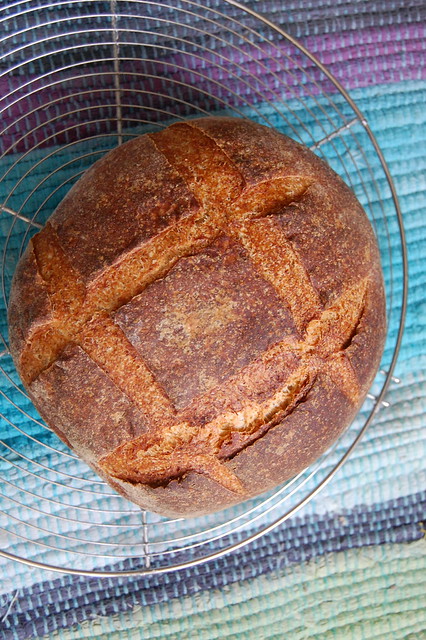
Numerous bubbles of all sizes all over the dough and easily doubled in size. The dough felt supple as I removed it gently from the container to begin with shaping. I shaped the loaf into a boule and placed on linen and covered. An hour before you think the loaf is ready, pre-heat your oven to 450 and prepare whatever new wild steaming method you find to be helpful. For me today, since I was baking one loaf, I used the good old dutch oven. The final proof lasted around two and a half hours. I then scored the loaf gently and placed under the dutch oven for twenty minutes covered. After twenty minutes, I uncovered the loaf and let it bake for another twenty minutes, then a final five minutes with the oven off.
Crisp, crackley crust, and a nice rye flavor to it.
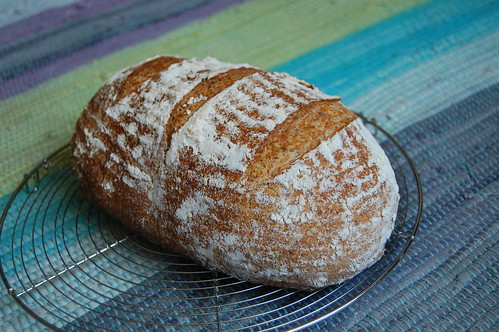
It went well as a vessle for Dubliner cheese grilled and pressed sandwiches served with a side of some fancy french mustard as my friend and I brewed some more beer this weekend. Our ritual is now becoming beer brewing, discussion of new tattoos, and delicious sandwichs when all is said and done. I am ok with that. Submitted by arlo on August 13, 2011 - 12:15pm A few loaves for those closeTrust me, I've been baking, but not much in my tiny apartment where if the oven gets turned on, it feels like it for days. But on and off in the wee early hours of the morning on the days I have off I try to squeeze in a few small bakes that have been used as gifts for those around me. Included in those bakes are; 40% rye with caraway - went to a fellow baker at work. Vermont Sourdough, though the loaf was longer than anticipated resulting in the ends being a bit smooshed. Family friend felt this one was of the tastiest loaves yet, I on the other hand could not get past the superficial factors of my poorly planned length during shaping. Here is a shot of the crust crackling shortly after being removed from the oven... And finally, this loaf I baked today shortly after leaving the bakery in the morning. It's your basic Pain Rustique, a loaf I highly recommend for those who have yet to try it. It will be going to a high school friend I recently reaquantied with after a few years away from him during college. He brought me along to brew a very large batch of Hefeweizen yesterday after last week we met up for tea and discussed what we are becoming involved in. It was quite lovely to catch up, realize how similar our passions are and how great they can taste!
Submitted by arlo on July 10, 2011 - 5:50pm Miches?? Psshh....who needs umI love the new bakery I am working at. Everyday I get to work by 2-23oish a.m. and bake till 10 a.m. Five days a week, sometimes six. I experiment with new ideas, new shaping methods and have just so much fun. Though after work I walk down the road and attend school for another 8-9 hours. So I am pretty tired out and never really get the chance to bake at home, so lately my blogs have been lacking and all I can do is comment on the wonderful works I have been seeing on TFL lately. But I had a moment tonight and wanted to share this with everyone. While David is making Miches, and everyone is going crazy over excellent pastrami sandwiches on rye...I was attending to my cravings and crafting the 'wich I fall back upon time after time. Plus, I wanted to see if I could start a trend or something on TFL, similar to the miches and possibly the semolina loaves we saw last week ; )
Right? I baked off a tiny sandwich loaf at work and brought it home to my fiance who always says she isn't like me when it comes to being able to eat a whole loaf. I thought this would be the right size then :) It's about 1 3/4 to 2 inches in height, about 1 1/2 inches wide. Baked in an itty bitty loaf pan at work. Cute isn't it.
Up next... Micro Monte Cristos
Submitted by arlo on May 20, 2011 - 9:09am Started at another bakeryAfter nearly two good years at my local Great Harvest, two weeks ago I packed up, called it good and moved to a new venture down the road. It was hard to leave good friends and a great boss, but after talking to my Chef/Professor at college and my fiance, I decided I had hit the wall, learned everything I could at the bakery and because of that, it was time to move on from my current bakery. In order to grow and develop I needed to start working on other skills and making different loaves daily. Talk about a change! From making 200-300 loaves a day and even more during the holidays to making about 30 loaves a day and being in charge of the the whole bread department (just me mind you : ). My two weeks at Aggie Mae's has really made me appreciate taking time to work out the kinks, experiment and get in touch with my cake making, frosting and pastry skills! The Great Harvest I worked at was wonderful, unfortunately I have had my mind set on my ACF Certification tests and working towards becoming a Certified Executive Pastry Chef down the line in a few years. I love bread mind you, I love it more than pastries, but I understand where the money is at in my area and how pastries can really help me out in this career, so I gladly took the position as the head baker and then helper with cakes. I am certainly glad I did shift jobs. The first week I began baking in a hearth oven, making entirely new pizzas (asked on the spot, "Ok Arlo, what are some new pizzas you are going to put out this week?") Talk about pressure, but I came through! I made Prosciutto wrapped asparagus with red peppers and Parmesan pizzas. Blue cheese, pear and walnut pizzas and more. I also worked out a new multi-grain bread recipe which went over well enough today the owner asked me to triple the recipe for the Saturday crowd! From croissants, to mini fresh fruit tarts, country bread, sourdough seed breads, creme anglaise and more, I have certainly learned a lot this week alone and have worked on some great products. The only rough side, work starts at 2 am now instead of 3 am. Such is life though : )
Submitted by arlo on March 19, 2011 - 4:45pm A cookie (or two)Though I haven't posted about bread in a while, I have my reasons. No, I am still working at the bakery baking bread daily which hasn't made me bread-sick. I still am studying to complete my degree (end of this fall it looks like!) but I make time for the important things in life (like baking!). But what is keeping me away from bread is that I am working towards my American Culinary Federation Certified Pastry Chef title, which I hope to obtain this year. What that means is I have been baking a lot of genoise cakes, cookies and attempting Bavarian cream. Since those are the required pastries to be made for the practical examination. Today, after getting off my shift I went ahead and made some molded Bavarian cream which is actually still in the fridge due to other time restrictions and appointments, but also went ahead and changed my game plan when it came to my cookies. I decided against my original molasses and oatmeal raisin cookies and went for the more familiar. Although I am still sticking with my two brownie recipes I decided. It's not that my molasses or oatmeal raisin recipe were bad, it's just I thought I should pay homage to the bakery that has taken me in and taught me so much. I took a look at some of my aforementioned baking knowledge from working at a bakery that promotes whole grains and decided to make a two cookies using 100% whole wheat flour. They are different than what I make at the bakery by a long shot, but they remain true to using entirely whole grains.
The end result was a deliciously chewy whole wheat oatmeal cookie, and whole wheat oatmeal chocolate chip cookie! I made roughly four dozen, two and half went to my fiances work to be shared (they see lots and lots of my pastries from homemade poptarts, cakes to truffles) and the other half will be for her father, who is in the armed forces and is going overseas to the middle east again this month. I am very pleased with the taste and texture and am glad I went with something I am familiar with. I think it will bring along confidence when it is time to step up to the plate. Submitted by arlo on March 8, 2011 - 3:53pm Simple bostockA good bostock turns my day around 180 degrees. From wrong to right, goodbye to hello, ok to fan-freaking-tastic. Just yesterday happened to be one of those times I needed a bostock to help me out. While my other classmates are out and having fun during spring break, I am still at home baking each morning at 3 a.m. for work (and home!), trying to catch up on arranging our new apartment, and getting an early start with semester end projects. Not really much of a spring break, considering it is still in the thirties outside too! Enough idle chit-chat though. Bring on the pastries. For the brioche I used the Culinary Institute of America's "advanced brioche" recipe, which is really just a nice 60% butter brioche. I scaled the recipe to make 12-2oz rolls to fit in my muffin tray. Soaked the baked mini-brioches in an orange simple syrup with a bit of Mount Gay rum added to it (wish I had more cointreau), topped with an almond frangipane and one whole almond, baked at 400 for 18 minutes, dusted with powdered sugar and snarfed down asap.
Fiance asked me after finishing the first one and holding a second one in her hand, "How many did you say we could keep?" Submitted by arlo on January 18, 2011 - 12:46pm Most Recent Whole Wheat BakesBefore I went and watched my boss's dogs and house while he was away on vacation, I managed to bake a few loaves of bread that I did not get a chance to blog about. The first loaf was a 100% whole wheat mash bread from Reinhart's Whole Grain Breads. I was rather curious about this loaf after having made a few rye breads using Hamelman's hot rye soaker technique. What I remembered from those loaves is the mash imparted a slightly sweet taste to the final loaf as if there was a touch of sugar or honey. Bwraith blogged about this bread as well seen here; Whole Wheat Mash Bread. There is no need for me to rewrite the recipe since it is available on Bwraith's blog, which he kindly supplied in his post. I only made two changes to the loaf. I used a whole wheat starter in place of the biga, as Reinhart provides as an alternative leavening agent. Also I left out the suggested sweetener in the recipe for two reasons; I felt many of Reinhart's recipes from WGB to be far too sweet to begin with, and second because I wanted to see the potential of the mash. To my surprise I found the end loaf to have a full 'whole grain' taste which I desired, a slightly sour taste, but only a slightly sweet taste too. I half-expected the wheat mash to match the rye mashes I have dealt with before, but to my surprise it couldn't compare. Though this loaf was still very tasty. I imagine the sweetness I was looking for has to do with the more ferment-able sugars found in rye.
The next loaf of bread I baked was from The Culinary Institute of America's Baking and Pastry book.
It was a simple whole wheat sourdough. The end product though after an over night retardation provided a very, very tasty loaf in my opinion that certainly surpassed what I was expecting. The formula and procedure follows; Whole Wheat levain Ingredients Bakers % Weight Bread Flour (Sir galahad) 50% 5.4 oz Whole Wheat Flour 50% 5.4 oz Water (DDT 76) 75% 8.1 fl oz 100% Starter * 40% 4.32 oz Salt (Grey Sea Salt) 2.7% .3 oz
*Starter used was a 50/50 of Sir Galahad and Fresh Milled 100% Whole wheat flour. As with the whole wheat flour used in the loaf, it too was fresh milled.
Method 1. Combine the flours, water, sourdough and mix on low speed for about 4 minutes. Let the dough rest for 20 minutes. Add the salt and mix 1 minute on low and then 2 minutes on medium. Aim for a improved stage of gluten development. The dough should be slightly soft but elastic. 2. Bulk ferment the dough until nearly doubled in volume, about 1 hour. Though it took me about 3 hours in a cold apartment. Fold gently and ferment for another hour. Fold again. Ferment for another 20 minutes. 3. Preshape the dough into a round and let rest for 15 - 20 minutes. 4. Gently shape the loaf into a batard or round when sufficiently relaxed. 5. Place in a banneton lightly floured and covered with plastic overnight in the fridge to have a slow final rise. 6. When the dough has risen, or the next morning, preheat your oven with your dutch oven or cc, or latest crazy steaming method to 470F. 7. When preheated, remove bread from retarder, load into your oven, score and cook covered (or steamed) for twenty minutes. After twenty minutes remove steaming apparatus, bake in a dry oven for 17 minutes, or until loaf registers 200F, sounds hollow when thumped or looks nice and done to you! 8. Cool completely, slice and enjoy.
Two different loaves, but both very tasty. Submitted by arlo on January 10, 2011 - 3:42pm miche pointe à callière, Tartine procedureThe past few loaves I've baked since I have moved into my new apartment at the start of the new year have been variations on the Tartine Bread whole wheat dough. Out of the five or six whole wheat loaves I have baked, I have been very, very pleased with the results. More often the crumb is remarkably open for such high percentage of whole wheat, the crumb is moist, the tang, though not assertive, lies in the background for an added depth of flavor. All in all, a lovely loaf of bread I am quite proud of and have shared with friends and family with high praise. I thought about why this recipe makes such tasty loaves time after time for me, and then, like a good culinary student and baker, I asked myself, "What have I acquired and learned from this recipe that I can take and use in my future bakes that I haven't used before?". I have implemented natural leavening to many doughs before and have been impressed, but I knew it wasn't just that with this recipe. It then struck me, perhaps, it wasn't the ingredients as much as the method/procedure used for the formula that helps create some excellent loaves time after time. So I went back to a book I have cherished in my baking career; Bread, by Mr. Hamelman, and attempted a loaf that has troubled me often; Miche pointe a calliere. I feel there is no need for me to post the recipe since I am sure it can be found on this site, and if not, let this just be another great reason on why this book should be purchased. But I did alter the recipe slightly to fit my schedule, and to match the Tartine procedure, which I will go into detail now. I developed a stiff levain before work around 2:15 a.m. using freshly milled (from my work) higher extraction flour by blending freshly ground wheat berries with Sir Galahad flour at a ratio of about 81%. After unsuccessfully having attempted to purchased Type 65 flour from King Arthur and also germ restored flour, since my supplier would have required me to order a pallet, I spoke to Mr. Robert Smith from King Arthur who pointed me toward attempting to create my own type 65 flour (for later use) and high extraction flour through my mill at work. If making this at home, just blend KAF AP and Whole wheat flour together at around 80% whole wheat to all-purpose to end up with similar flour that is needed. After my shift ended at 11 am, I returned home where my levain was about ripened. I mixed the final dough together by hand holding back the salt at noon with my ripe levain, this does differ from Tartine since I wanted to see how much of the original recipe I could retain without changes. I performed an autolyse of around one hour. I added the salt, mixed by hand by pinching the dough and doing some stretch and folds in the bowl. When the salt felt like it was appropriately mixed, I transfered the dough to a 3 quart bucket (double the size of the dough) and let it sit while I set a timer for thirty minutes. Much like Tartine, I preformed four stretch and folds in two hours to the dough every thirty minutes. When 2.5 hours rounded the clock, the dough was adequately strengthened and I let it nearly double in size, taking a total of around 3.75 hours. I shaped the loaf into two 1.5 lb loaves, saving the extra dough for a pate fermentee in the week, and refridgerated the shaped loaves to be baked when I was to awake. I finished the loaves off like suggested in Tartine, dutch oven, or combo cooker with 20 minutes of covered time and right around 18 minutes uncovered. The final loaves looked great, though the boule was a bit flat compaired to the batard. Both loaves had a nice crumb, a bit less opened than expected, but to my liking consisted of a rather creamy, soft chew with that nice miche tang I have had with prior Hamelman miche experiences. Most likely amplified by implementing Tartine retardation procedures to the loaves. I have been eating the boule and I happily took the other loaf to work to be ran through our slicer and shared amoung friends who thought it was rather tasty too. Pictures can be seen here: http://www.flickr.com/photos/arlo-b/sets/72157625668922143/show/ Though this procedure is nothing really new here at TFL, considering lots of fellow bakers have been using S&F over timed intervals to develop strength, I have not been until now. I had been following Hamelman, Reinhart, ect. recipes closely and never gave thought to take other methods into consideration for their formulas. I am thankful I did this time though since it turned out to be a tasty experience. That's it for now really, I have some Reinhart bagels retarding, puff pastry in the fridge and my culinary program starting up again this week. So until I get time to blog for my benefit and hopefully someone elses, take care! -Arlo |
ALSO ON |