The Fresh Loaf

News & Information for Amateur Bakers and Artisan Bread Enthusiasts

Anomalous's blog

  • Pin It
Anomalous's picture
Anomalous

I've been refining the technique for making sourdough during the working week so that it's out of the oven in time for dinner. It's going pretty well now, and I'm regularly turning out loaves that I'm really pleased with.

It starts off the evening before, when I put 100g of sourdough starter and 200g strong white flour and 200g water into a tub, give it a mix and put the lid on to mature overnight ar room temperature. It seems that the longer I mature this levain, the more of a distinctive sourdough tangy quality shows up in the final loaf, but I'm not 100% sure of this. At the same time, I put 300g of strong white flour and 9g salt in a separate dry tub, just to save time next morning, and 100g water in a third container. Sometimes I use 100g wholemeal spelt or a bit of Kamut instead of some of the white flour, or I might toast some hemp seeds, crush them and put them with the dry flour for tomorrow.

Next morning.

07:00. The levain in the tub is nice and bubbly. I tip in the dry tub of 300g flour and 9g salt, plus the little tub of 100g water, then it gets a good mix for a minute or so, the lid goes back on and I go and shower.

07:15. The dough has developed a little. I tip it out onto the board and stretch and pull each corner of the dough up and into the middle as though forming a parcel. This goes on for a minute or so then I flip it over and form a round by scooping my hands half under it and pulling it toward me so the friction of the work surface pulls the surface of the dough taut. This takes about a minute and a half. I cover it with a bowl and get my breakfast.


07:30. The dough has relaxed a bit.

I flip it over and repeat the parcel-forming pulling and stretching then flip it again and form a round. This takes about a minute. The bowl goes on to cover it again and I go and get dressed.

07:45. The dough has more structure now.

Flip, pull, stretch, form a round, cover. This takes less than a minute. I finish getting ready for work.

08:00. Now the structure is more apparent. For the fourth time, I flip the dough, stretch and fold, form a round and now it's looking really taut and elastic.

I flour my proving basket and put in the dough, top side down, dust with a little semolina and put it in a big ziplock plastic bag, then into the fridge. Off to work.

19:00. 11 hours later the dough has nicely risen in the fridge. Not so much this time as it often does, but it will be OK.


I put the oven on to heat for 20 minutes at 230C with the cast iron combo cooker in the oven.

19:20. I dust the skillet of the combo cooker with semolina and tip the dough into it then slash it, put on the lid of the combo cooker and put it in the oven.

This seals in all the steam that would otherwise be lost, and prevents the crust from forming for the first 20 minutes so as to allow the maximum expansion of the dough.


19:40. I take the lid off, so that the crust can form. When the lid comes off, a cloud of steam escapes and the loaf is fully formed, though pale and soft.

Back in the oven. I usually turn it after another ten minutes so that it's evenly browned.

20:00. Finished. Out it comes and onto a rack to cool for at least 30 minutes.

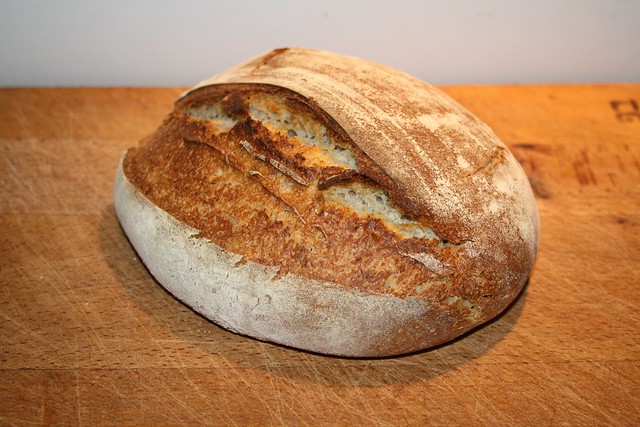
I love the craggy, caramelised crust produced when using the combo cooker. You can hear the crust crackling as it cools.

It's a really nice loaf with a good shape, nice sourdough taste, but not the most tangy I've had, and a good, moist, open crust but without too many impractical big air holes. This is bread for sandwiches and I don't want everything to fall out.

The starter is one which was given to me on a training day at a Hackney bakery. I feed it with equal quantities of filtered water and stoneground wholemeal rye and I keep it in the fridge.

The technique works well for me and I can keep up the sourdough production during the working week, though only because of my leisurely one-hour pre-work routine.

Anomalous's picture
Anomalous

I've experimented a lot with sourdoughs but this is my first 100% spelt effort. I used 60g wholemeal stoneground rye starter from the fridge to make a levain with 80g white spelt flour and 80g water and left it at room temperature for about 3 hours until it was nice and bubbly.


Then I added another 220g of white spelt and 60g water, mixed thoroughly and left covered for 15 minutes. Next, I added 5g salt and a good glug of olive oil and mixed thoroughly then put it onto an oiled worktop and did a bit of folding and stretching for about a minute and formed it into a round. I waited 15 minutes and did another minute of folding and stretching and shaping into a round, and repeated the process another couple of times before forming it into a slightly longer shape and putting it into a floured towel with its ends held together by bulldog clips to form a kind of hammock shape. 

After about four hours it seemed to have risen enough so I turned it out into my preheated combo cooker, slashed it and put it into the preheated oven at 230C. I took the lid off after 18 minutes and baked it for a further 20 minutes at the same temperature.

I'm very pleased with the result. The crumb is soft and light and the crust is very crunchy; much more so than with wheat flour. 

The starter was about 120% hydration, so the 60g that I used was probably about 27g rye and 33g water, so I think the overall hydration of the loaf, starter included, is about 64%. Next time I'll try it with a cold final proving in the fridge.


Anomalous's picture
Anomalous

This is a bit unusual. I saw smoked flour on the shelf of Waitrose in Kensington so had togive it a go. The flour is from Bacheldre watermill in Wales and is described as organic smoked stoneground malted blend flour. Their website says that malted wheat flakes are cold smoked over oak chippings for 18 hours in the smokehouse then mixed with organic stoneground malted blend flour. There's a gentle smoky aroma from the dry flour which becomes more assertive when it's wet.

I baked it as a sourdough made with a sponge (60g starter, 200g flour, 200g water) refrigerated overnight and left out for a couple of hours in the morning. Then I added 300g flour, 150g water, 12g salt (total 71% hydration), did a bit of stretching and folding, shaped it and let it prove at room temperature for a couple of hours or so then baked at 230°C for 20 minutes then 20 minutes at 185°C.

The result is less smoky than I expected, and the predominant flavour is still that of a malted loaf, but with a subtle, smoky background which adds interest and a distinctive character to the bread. It's certainly worth a try if you can get it, but apparently it's difficult to get it across the atlantic. I'll try it with a higher hydration next time.


Anomalous's picture
Anomalous

Since I started bread baking last year I've been aiming mainly at sourdough and have made some reasonably good loaves at the weekend but it has been a challenge to fit it into the week's work schedule. The comparatively long rise of approx. 4 hours means I'd be baking at 22:50 if I made the loaf on getting home from work. Letting it rise in the fridge while I'm at work seems a pretty good solution to this, and here's how I've worked it so far.

08:00 Tuesday: mixed 50g starter with 50g wholemeal rye flour and 50g water (the starter is 50% hydrated wholemeal rye and lives in the fridge all the time. It's pretty active despite this). Left it at room temperature, went to work.

18:00 Tuesday: home from work; added 50g strong white organic flour and 50g water. Still at room temperature.

22:00 Tuesday: added 100g white flour and 100g water, still at room temperature.

07:00 Wednesday: added 300g strong white flour, 100g water, 11g salt, a glug of olive oil; mixed, a little bit of folding and stretching, formed a round, left whilst showering, dressing, breakfasting.

07:50 Wednesday: a bit more stretching, folding, gentle kneading and it's looking good. Shaped into a stubby cylinder, into the banneton, bagged, in the fridge. Off to work.

17:30 Wednesday: home from work, dough looks ready. Oven on, 230°C, baking stone in. Oven ready, baking stone out, turned loaf onto stone, dusted with wholemeal rye, slashed, into the oven, 300g boiling water into a hot baking tray for steam. Baked for 20 min at 230°C then 25 min at 190°C. It needs longer baking due to going into the oven fridge-cold.

Result: pretty good. Nice, crunchy crust; moderately airy, moist crumb; reasonably good sourdough tang. For such a relatively small amount of wholemeal rye, it has a surprising amount of wholemeal flavour. I'm not sure where to take it next to get a lighter, airier crumb, but I think I might experiment with leaving it out of the fridge a bit longer before baking in order to let it warm up a bit and do some more rising.

The overall hydration is about 62%. The starter came from a training day at e5 Bakehouse with a reputed 200 year trans-European pedigree and seemed better than my own home-grown starter. I always feed it with equal amounts of wholemeal rye and filtered water and keep it in the fridge.

Subscribe to RSS - Anomalous's blog