
I'm just starting my sourdough journey. I've been baking since I was a kid, but never bread. Started it as a new challenge. My starter is reacting great. It doubles (or more) in 4-6 hours, is full of bubbles and seems to be the right texture, However, I am on my third attempt to bake a loaf and, from the looks of things, the third time is not going to be the charm. I've tried hand mixing ingredients, doing the autolyse, a stand mixer, Hand mixing the dough for 7 minutes to build up gluten...but my dough appears just as flat as my first two attempts. I've done two stretch and folds so far on this batch and it just doesn't look like the doughs I see in all the videos I watch to try to gain tips and ideas. This batch, I added the flour and water, let stand for 30 minutes, hand mixed in the starter and salt and mixed it for seven minutes (until my hands cramped), I let it rest 30 minutes and did my first stretch and fold and thought I had made a breakthrough, but when I went to do my second stretch and fold, it had spread out and had no structure. Is this normal, am I overthinking things or am I not doing something right? Help would be appreciated.
Sometimes the problem is with the flour. Please tell us more in the way of details. What kind of flour is it, what is the hydration of the dough, how much starter did you use? Where do you live (so we can get an idea about what kinds of flour may be available)?
What you wrote sounds similar to kay-dee's several posts asking for help. Here's the first one:
https://www.thefreshloaf.com/node/76635/gooey-dough
For later posts in the series, click on her name to see a listing of them. It's been a long haul but she is starting to get decent bread from poor quality flour.
TomP
The first try was 600 grams of King Arthur bread flour, 100 grams King Arthur Whole Wheat flour and 100 grams rye flour. The second one was just King Arthur Bread flour, as is the batch I'm working on right now. I used 700 grams of water to 100 grams of flour, 200 grams of starter and 20 grams of salt. I live in Florida, it has been cold, but I've been using a heated mat for my starter and dough. The first image is my current dough just after the third stretch and fold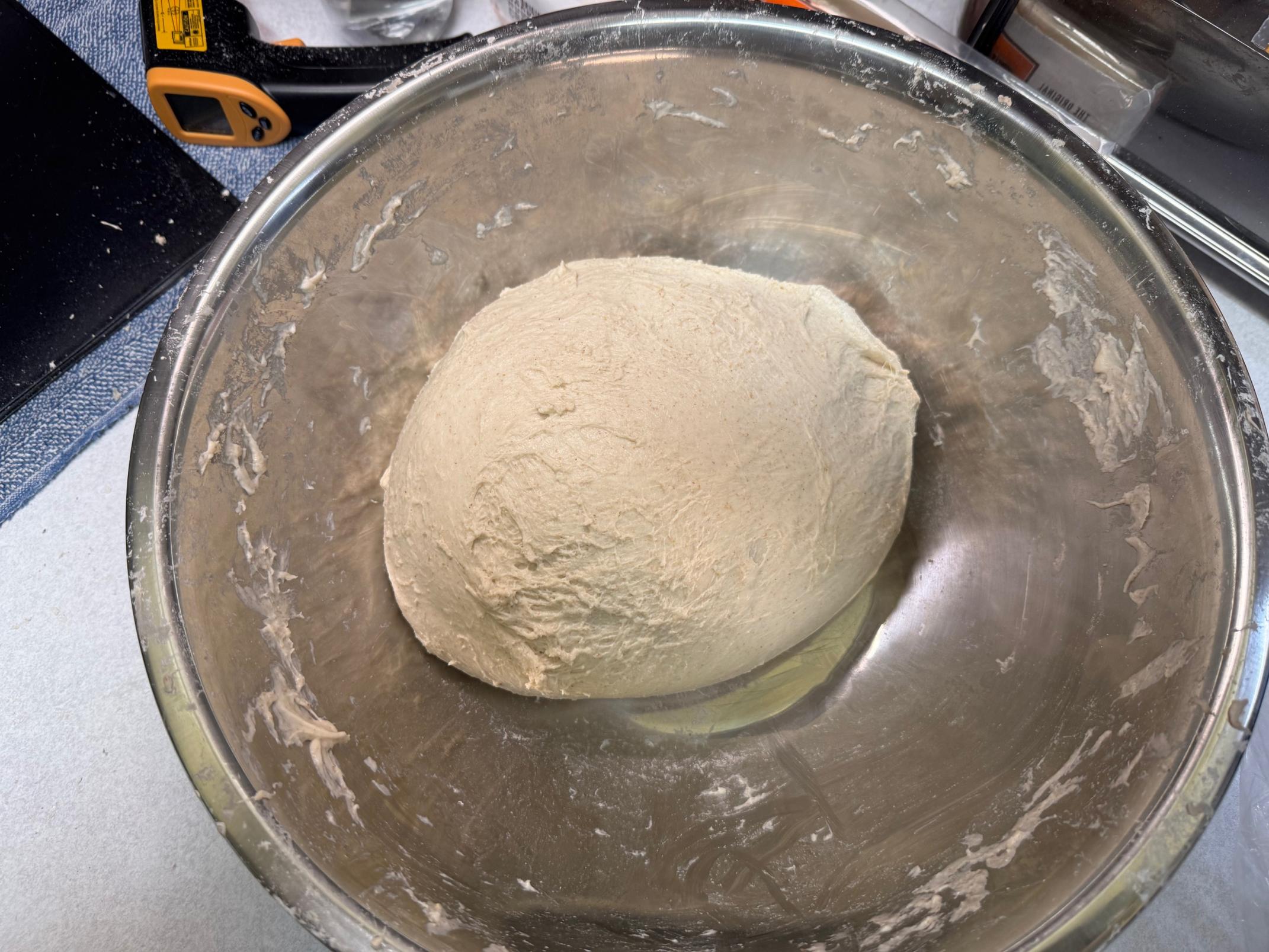 The second image is after the 30 minute rest period before the last stretch and fold.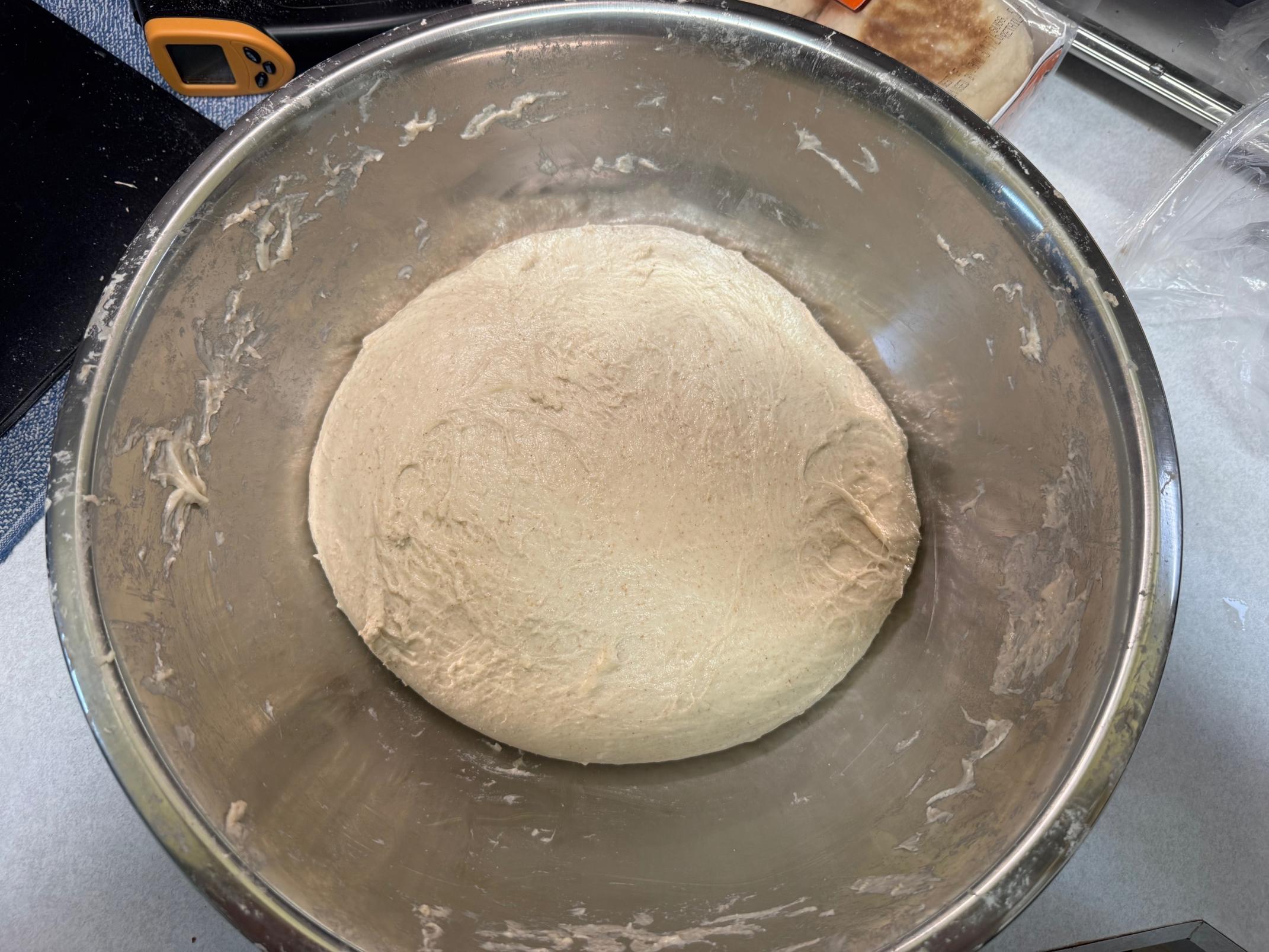
Those are good flours, all right. Now how about the other information?
Some people have found that changing to bottled water (not sure if distilled would work) has solved their intractable problems.
The pictures don't look too bad honestly. I don't know how you do the folds, but might you simply be a little too aggressive and tearing the dough, for example?
But the main thing is, no need to go over 70% hydration when you are just starting. I guess Florida is also humid? So it makes it worse too. Start with e.g. 65% hydration, and don't forget to include the water and flour from the starter into the calculation.
I'm using jugs of bottled water from Publix for my starter and my dough. I don't touch the tap water here. I used 200 grams of starter with this current dough. I've been feeding my starter organic AP flour, whole wheat flour and rye flour. It seems to 'react' the best to rye flour, though I've discovered I have a dermatological allergy to rye flour. I'll take any tips anyone has. I've been 'collecting' tips and ideas off of different websites and YouTube videos.
OK, good. What hydration have you been using?
I'm sorry, I missed your reply with the details. I agree with Ilya that the dough doesn't look obviously wrong. But it ought to look smoother and not seem to be torn on top. At first look, I thought those were places where the dough had stuck to the bowl, but the last picture, where the dough should have relaxed more, ought to be smoother, I would think.
When you are doing stretch-and-folds, what you should experience in the early ones is that the dough will get rather stiff without being all that elastic (bouncy), and it probably won't be very smooth. After a rest, the dough will have relaxed and spread out some. It should be more extensible (taffy-like) than before, and seen smoother and less sticky. Then after the S&F the dough should again stiffen up but be more elastic than the last time. After that, the cycle repeats. Each time the dough ought to get smoother, less sticky, and more elastic right after the stretching. It will still relax, maybe quite a lot, after more rest. The longer you wait, the more the dough will relax. The goal is to have the dough be elastic enough to hold its shape during proof or the early baking, yet extensible enough that it cal expand well while it bakes.
If my dough looked and acted like yours, I would
1. Wait longer before the next S&F, even a couple of hours, to get more relaxation;
2. Be gentle, and work a flexible plastic dough scraper underneath to try to unstick the dough from the bowl without so much pulling and tearing. It might be time to transfer to an oiled bowl for the rest of the fermentation, so as to reduce that effect. A plastic or glass bowl would also make it easier to ease the dough from the bowl.
I think you are close to getting a good loaf. You wrote
I imagine you meant "1000" grams of flour, right?
I'm with Ilya, dznyntnh: your dough doesn't look bad at all. I often make breads that relax just as much as yours during the rest between stretches. In my experience, further stretches and folds tend to retighten it.
So, a couple of, I hope, simple questions might help clarify things:
Thanks.
Rob
My first dough was a total of 800 grams of flour with 70% hydration. The new recipe I'm using is 1000 grams of flour with 70% hydration. It's been below freezing for a couple of nights, but it's 'settled' into 40s at night and 60-70 during the day (should warm up more this week). I'm measuring the temperature of the dough at about 75 degrees (just measured it while it's bulk rising). My starter smells like flour and water to me...nothing acidic or off putting. The final product (using two different recipes) was very dense. Taste was very good, it was edible, but not fluffy and risen.
No it is not normal. That's the usual sign of to much acid in your starter. If you like it - and you probably don't - no big deal. The fix is time. Let the yeast grow. Or use a little yeast and a lot less starter. Either way the starter needs time. Is it worth it - you can decide. Enjoy!