
Following my last thread, “Weak Flour Revisited” and trying Solano’s method of Coil-Folds to overcome the problem, I was left with a soft, over-proofed dough that couldn’t be shaped nor scored but I did managed to shovel the cow-pie into the oven.
In the resulting loaf, I saw the beginnings of an airy crumb (hydration 65%), so I was reluctant to reduce water. I first wanted to address the problem of over-proofing so my original recipe remains the same, except for Rob’s suggestion to use cold water. I even chilled the flour.
RECIPE: 320-gm of cold flour, 210-gm refrigerated water, 1-tsp sea salt, 1/4-tsp yeast— but I have drastically reduced fermentation times: mix dough for 4-min (instead of 5), and let hydrate for 10-min (instead of15). A 15-min rest (instead of 20), following the Bowl-Folds. A 15-min rest (instead of 20), between the four Coil-Fold sessions. Then straight into the fridge for 24-hrs (no 1-hour bulk fermentation at room temperature).
RESULT: The cold “flour and water mix” produced a much stiffer dough. The cold dough was harder to handle during the Bowl-Folds, tearing after stretching 3-inches. The dough was still cold and stiff during the first Coil-Fold session and not “stretchy” but by jiggling the dough, I got it to elongate.
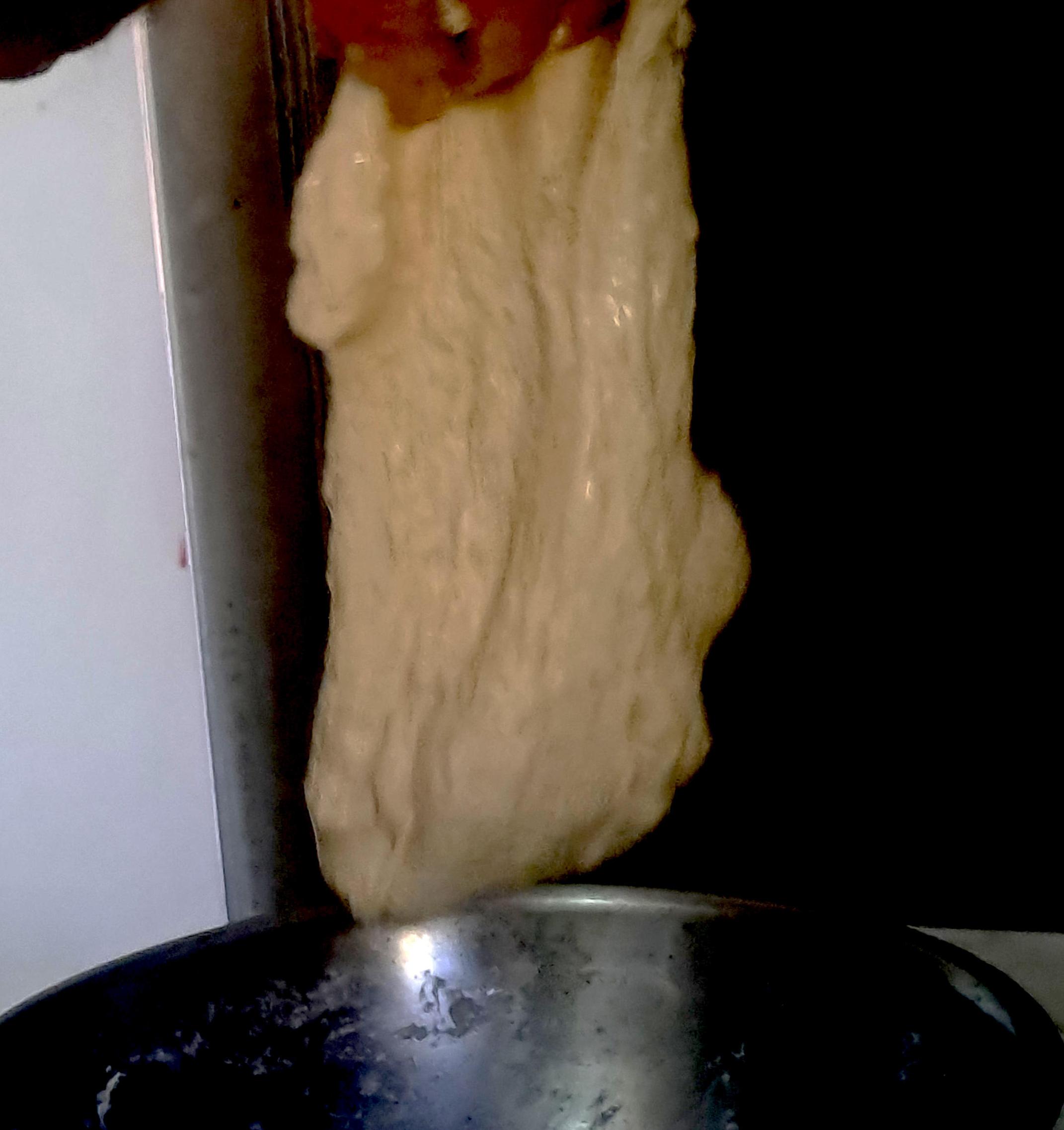
The dough wasn’t “stretchy”
The remaining Coil-Fold sessions were much the same except the dough grew softer as it warmed-up. It never became stretchy and I found I had to jiggle the dough while holding it by one end, instead of in the middle. Even during the forth session of Coil-Folds, when the warm dough was soft and sticky, I still found it necessary to let the dough stretch down by holding it by the end and shaking to force enough impetus for a 12-inch stretch.
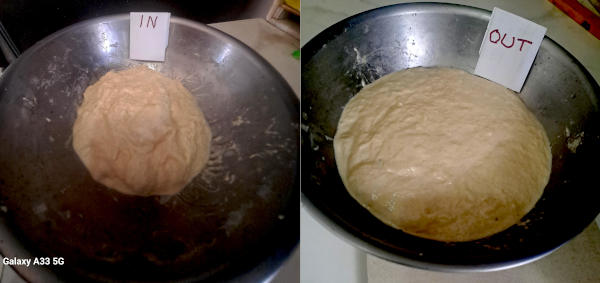
Comparison of dough, in and out of fridge
After 24-hours in the fridge, the dough looked like a bowl of potato soup but was surprisingly stiff and had risen.
I had to coax it out of the bowl with a spatula but it dropped onto the peel where I was able to shape it, tucking under to provide some surface tension. No signs of over proofing. The dough ball was too soft to score properly but held its shape while I got it into the oven. There was a reasonable oven spring though the score marks filled-in. I ended with a round loaf with a nice crust.
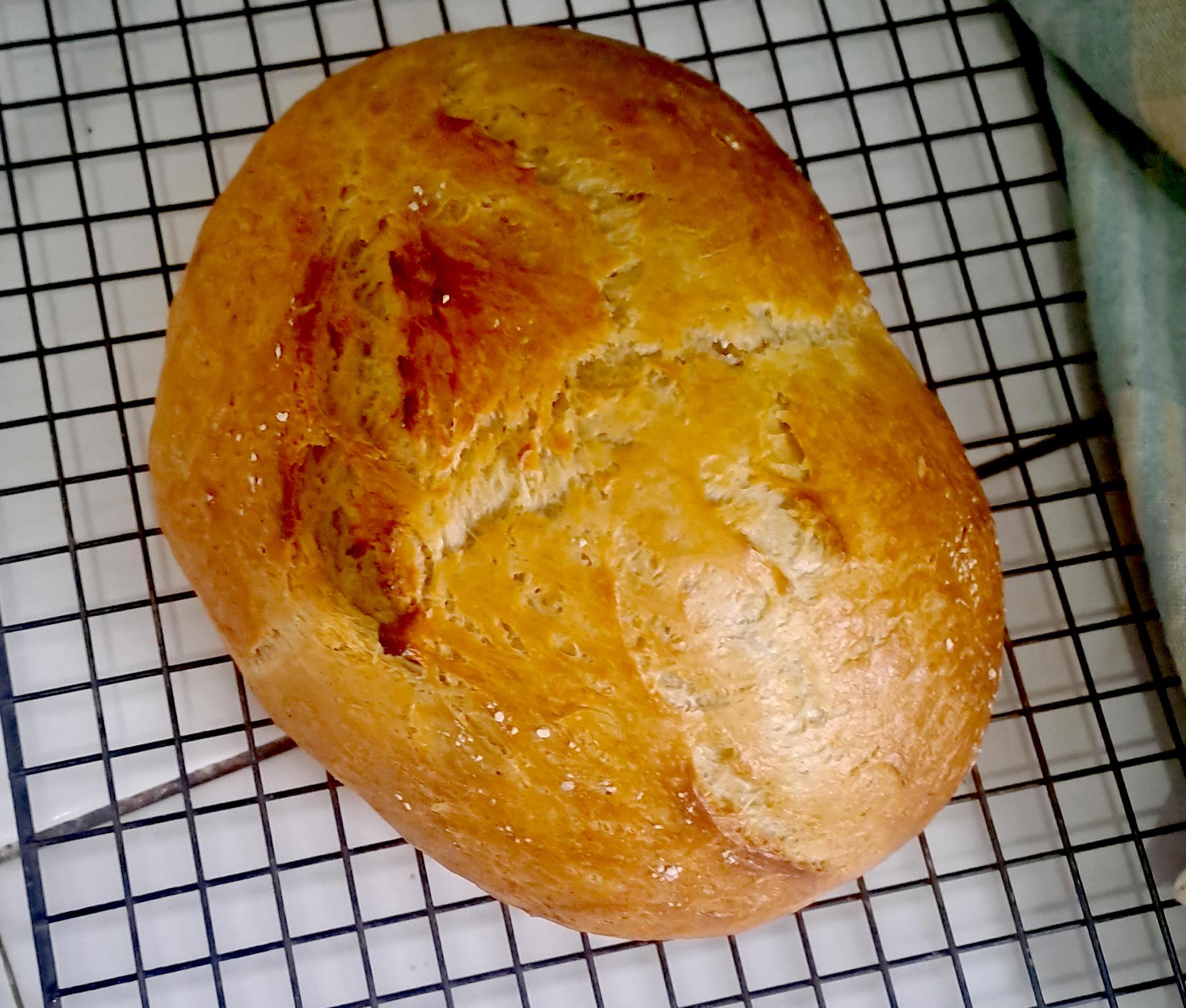
Crust
The crumb was chewy but again, not as airy as I was hoping for and there were some pockets of what seemed to be raw flour. Never had that before and not sure what caused it.
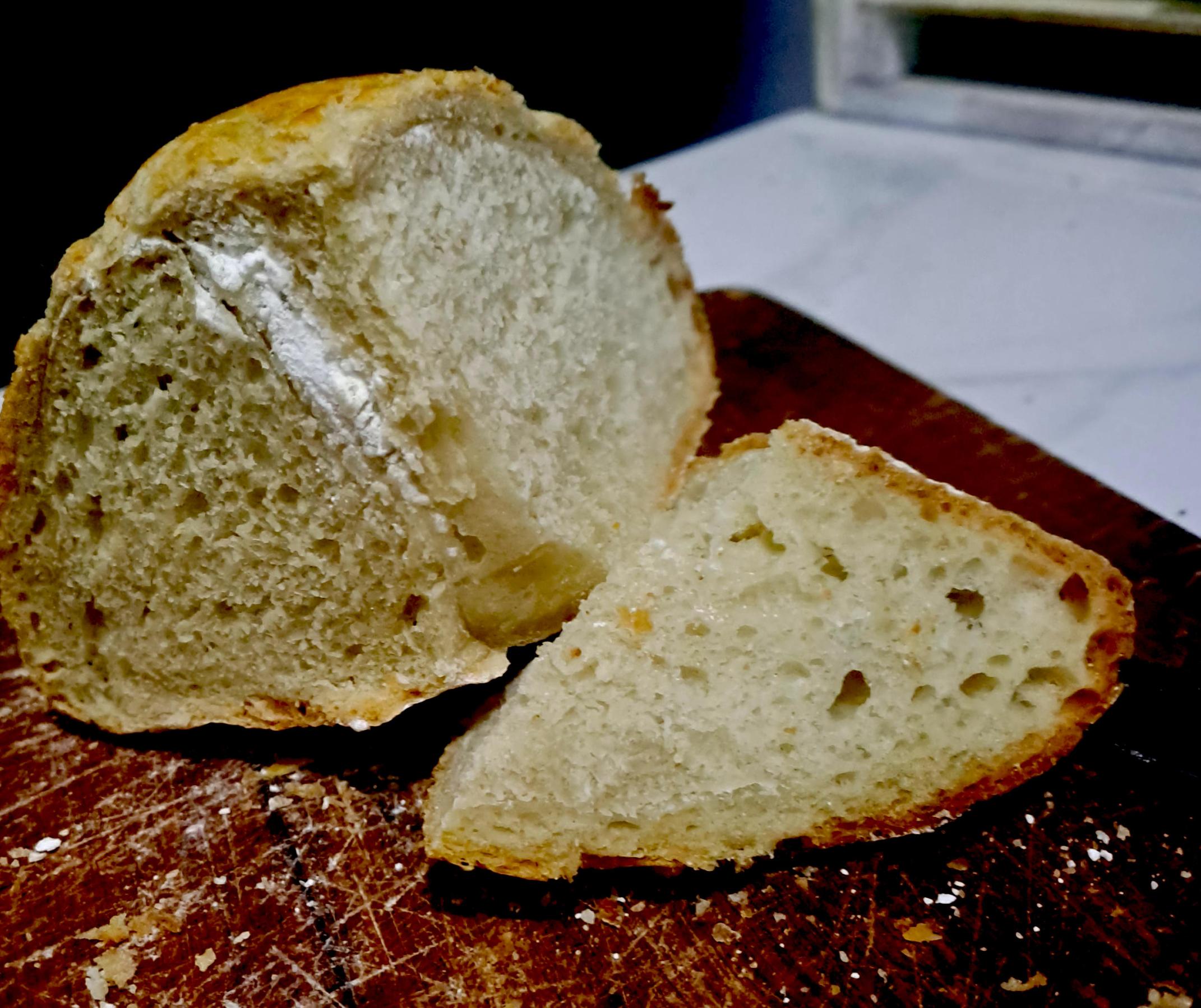
Crumb (showing white pocket of... flour?)
So with the over-proofing issue solved (I hope), now I’m looking for that airy crumb. More water? Scoring? Also the dough wasn’t stretchy which made the Coil-Folds difficult. Back to 20-min rests between Coil-Fold sessions? And were the pockets of raw flour due to improper mixing?
I gotta say I’m not a fan of all this folding, stretching and coiling. Not digging-in and kneading the dough takes away all the fun.
Katie
That's real progress, Katie, especially given the flour. You may never be able to get as airy a crumb as you would like; I think your picture shows a decent crumb anyway.
You could knead it more at the start, but you would have to pay attention to two things:
That white streak of flour looks like the dough was floured before shaping. If it was, see if you can use less flour. If the dough is just too sticky, maybe it can't be helped, but it might only be a matter of practice. You could try wetting your hands, just a little, before shaping instead of adding flour.
TomP
Thanks Tom... couldn’t do it without you and the others. And yes, I used lots of flour on the dough and the peel. I was very concerned about tucking and shaping and getting the sticky dough from the peel into the oven. I guess some of that flour got folded into the dough. No big deal.
I might go back to letting the dough rest for 20-min between Coil-Fold sessions to see if I can increase extensibility. The dough just didn’t want to stretch under its own weight. I’ll do some tweaking later this week.
Katie
Can you get some kind of parchment (aka baking) paper? I put it on top of the peel and slide the whole works, paper and loaf, into the oven. Otherwise, see if you can get some coarse flour or meal - corn meal, I'm sure, where you are. Sprinkle it on the peel instead of flour. It should release better.
About the dough not stretching under its own weight, that happens to me sometimes too, especially when I'm only making a single loaf which is most of the time. Shaking it like you are doing is fine. You can pull the dough as far as it will go and then fold it over on itself with a quick motion. This will help stretch the dough even if not as much as you were expecting. If the dough sticks to the bowl and doesn't want to come out, hold the bowl down with one hand and fold the upper part over the bottom with your other. Or take the dough completely out of the bowl and work it on the counter. I like to leave it in the bowl so I won't have to clean the counter each time I do a S&F session.
Parchment paper is iffy, Tom, but certainly corn meal is stocked locally. And it is quite a coarse grind. I’ll pick some up tomorrow and use it next time around.
I guess stretching the dough isn’t a major problem. But I see these bakers lifting the center of the dough and stretching it shoulder-high, so soft, so elegant. But you bring up a good point: my loaves are small, only 320 grams of flour so maybe there isn’t much weight to begin with. And maybe increasing the rest between sessions by five minutes will make a difference. Anyway I’m pleased and encouraged by this loaf.
Katie
Those bakers in videos, they've got much better flour than you. And the small size of yours (and mine) work against doing that.
Congratulations Katie! You are definitely getting closer to a good loaf with very challenging conditions.
I think good temperature control and fine tuning of hydration are the ways to go. I would fine tune hydration down rather than up, however. Until you have a dough that is just easy enough to handle without too much anxiety. IMHO, better to have a slightly firmer dough that you can ferment slightly longer at a lower temperature than a very slack one that is running away from you in terms of fermentation.
I would not add all the water for the bulk ferment at the same time but keep about 30ml back and add it a little at a time until you have a final dough that is just right in terms of structure and handling and then do your calculations and see how much of the water you used for the next time.
Also, until your intuition becomes more accurate, consider putting a tsp of the final dough in a small narrow transparent container with straight sides (think test tube, I use a small shot glass!) where you can mark on the side the start point of the dough, and keeping that in the fridge or where ever the bulk dough is, use it to see more precisely how much the dough has grown and how far the fermentation has progressed so you can bake it at the best point.
Just some ideas for getting to the next level now you have the basics in place.
I've been wondering how Katie would do with a no-knead type of bread, like Jim Lahey's. Mix everything together with a small amount of yeast and leave it overnight. Do you think this weak flour could stand up to that process? It would probably bubble up fine, but do you think it would rise a second time before baking? Due to the hydration problems with this flour, she'd have to cut back on the water in Lahey's recipe, but it might be worth a try. I'd love to give it a shot, but don't have any weak flour.