
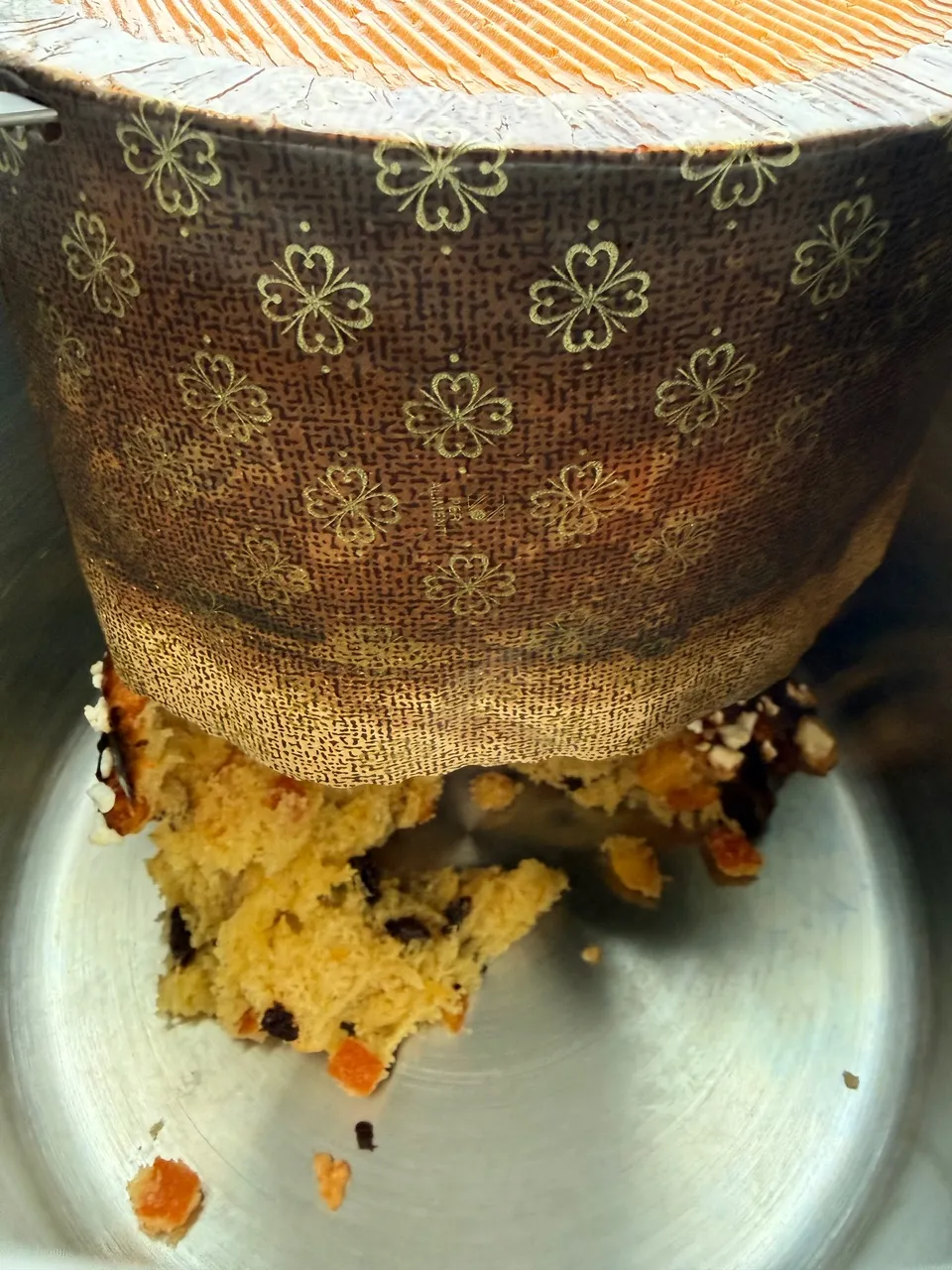
Not that my panettone have been perfect, that is definitely not the case. But up to now they have all been edible, not today. I was trying Roy’s recipe and things were going very well. I think I have a better handle on using the Ankarsrum Assistent’s dough hook for the very low hydration doughs. Both the first and the second doughs start very low hydration and I don’t find that the roller and paddle work well. I have never really used the dough hook so each panettone was a chance to practice. The first dough was great, overnight triple in size. Mixing of the second dough was going well. My condo is cold because of a cold snap so it wasn’t too hard to keep the dough temperature under 78°F even with the long mixing. I had my homemade candied orange peel in the freezer to ward off mold which I did get last year. I even briefly refrigerated the chocolate. I also froze and then grated the butter, which I then kept in the fridge that way everything being added to the dough was cold.
The dough came together great. I ensured that the gluten was really really well developed before adding butter and yolks for both the first and second doughs so they absorbed the butter and yolks very well. Then once the dough was in the form……no rise. After 6 hours at 84°F maybe a centimeter of rise maybe two. So slow, knew something was very wrong. I left it overnight and it almost rose to 1.5” of the rim of the form and was stalling. I knew at this point the gluten was degraded but why not bake it anyways?
You can see from the photo that the whole panettone fell out of the form within minutes of inversion showing that the gluten really was degraded after the prolonged fermentation. Proteolytic enzymes had a ton of time to break down the gluten. Increasing acidity and warm temperatures allowing the enzymes to work efficiently.
I can only guess that my adding frozen candied peel and about 120 g of it somehow killed the yeast, I cannot think of anything else that would have caused the loss of leavening given the first dough doing so well the yeast were there when added to the second dough.
Anyhow, I’ve made another batch of candied peel and will spend a few days feeding my starter and I’ll hopefully try again next week. In the meantime, I’ve made sesame crackers using the egg whites to make myself feel better.
Benny
Hi Benny,
I would love to scoop up your delicious bake!
That is too kind of you to say Jo, but really, this was a fail. I’m back to day 0 for a second try at this Roy panettone with a couple of changes to hopefully improve on that awful bake.
Benny
I want to salute you, Benny, for not hesitating to post your failure. My many mess ups make me a better baker.
It's the old Samuel Beckett thing: Ever tried. Ever failed. No matter. Try Again. Fail again. Fail better.
Rob
Thank you Rob, I’m hoping that my failure might help someone in the future so they don’t suffer the same issue. However, since I’m not 100% sure what went wrong, I’m not sure that I can offer a full explanation. For now I’m back at day 0 prep and hoping for a successful second attempt that this formula. Mise en place, everything that needs to be measured out and cold is prepped now. Nothing will be added frozen, only cold.
I do think that I’ve figured out the Ankarsrum Assistent better for the very low hydration start of the first dough. I also think that I’ve figured out a better way of adding the butter than I have done in the past. So at least I’ve learned a bit from this misfortune.
Benny
Benny, I agree with Rob. You have had such great successes, and I applaud you for sharing a mess up. No doubt you will be posting a revision that illustrates your abilities with bakes.
Happy baking.
Ted
Thank you Ted. I’m not that proud a person to not admit/share my mistakes, that’s for sure. I do hope that others can learn from mine and hope others will do the same and share theirs as we all can learn and continue to improve.
Benny
I’d have served them in a bowl with custard as a trifle! Too yummy to toss. I hope this next bake is a success. c
You’re right Caroline, despite the fallen panettone being still moist and a bit dense, it would have made a good trifle. After eating a little bit to assess the damage, it went into the bin. I’ll cross my fingers for this next one to work out better.
Benny
I had a few bakes like that in my first year of baking panettone. The coyotes up here in Vermont were fed more than one batch. One time a raging spring stream absorbed a bowl of dough.
While mixing a batch that ultimately failed, I saw that the second dough lost its strength, and it was downhill from there. In my case, this was due to over-acidification in the first dough during overnight fermentation.
If you try another bake, you could try adjusting the recipe so that the first dough has a higher sugar %Cu, like around 35. If you do this, shift some of the second dough sugar to the first dough. This protects (somewhat) against acid development.
Other measures that could be tried: A cooler fermentation temperature for the first dough, like 22 to 23C (Perrando goes as low as 18C)., or using a lower inoculation of starter in the first dough. If the pH of the first dough after fermentation is below 4.5, you are more likely to encounter this kind of problem in the second dough and final baked result.
Your firm starter may be somewhat too volatile/active, which is what I encountered until I had been working with it for a longer period of time. I’m being vague about the time because this can vary. However, I had better results with my starter as time went by.
This is all part of the panettone process. Every bake is an experiment in some sense. There is always more to learn….
Cheers, Sue
Hi Sue, thank you for your insights. My plan this Day 1 now of Roy’s panettone is to shift 20 g of the sugar from the second to the first dough. The higher sugar concentration should help reduce the acidity of the 1st dough when ready to be used. I didn’t do that in the bake above. I will also avoid adding anything frozen to the dough. I unfortunately didn’t take a pH of the 2nd dough or the baked panettone.
I still find it strange and somewhat difficult to explain why the 2nd dough just didn’t rise as expected when the 1st dough did so well. I would have expected lots of yeast to move the 2nd dough along quickly, but instead got a very, very slow rise. We’ll see how it goes this time with shifting the sugar and adding just cold and not frozen ingredients.
Fingers crossed.
Benny