
Went with the family on a two day excursion to Matera. Went to see the Sassi, neighborhood where the houses are built into caves in the rocks. Absolutely stunning place. But I couldn't resist doing a little bread tourism of my own while there.

So went on a quest for bakeries with the famous Matera IGP bread within walking distance from our hotel.
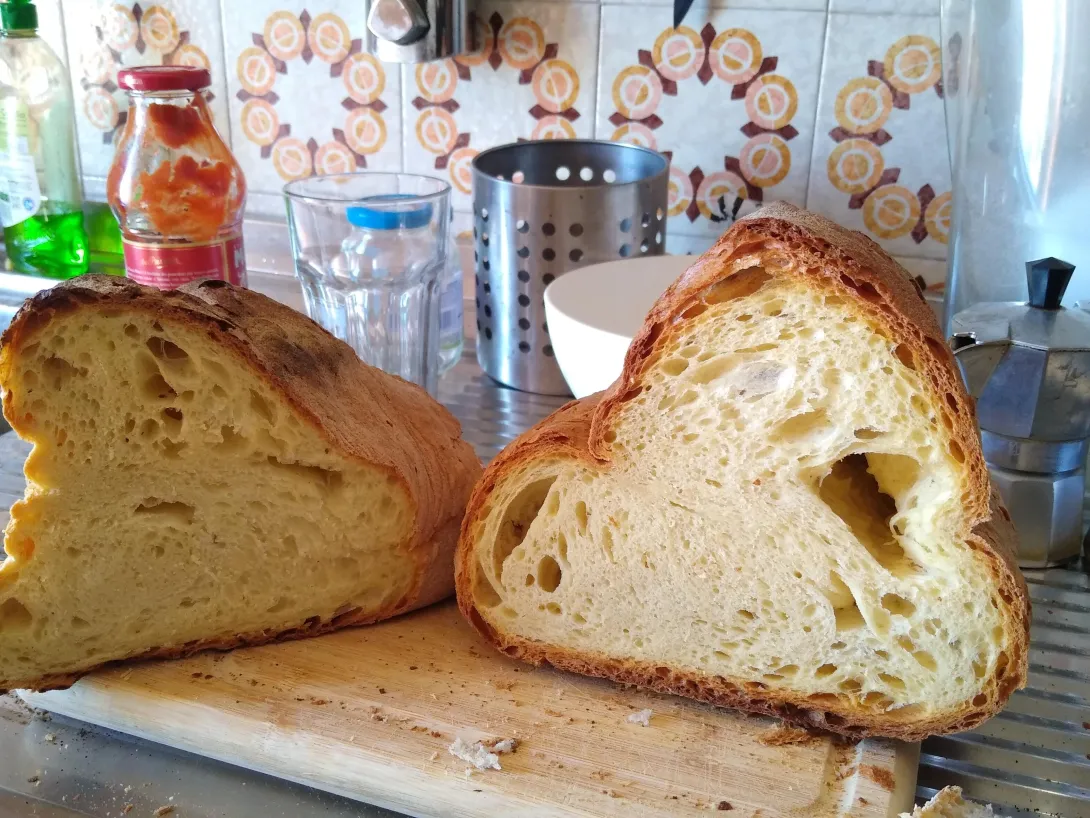
The attached picture is of the loaves from two of the historical bakerie of the town. The one on the left from Panificio Paoluccio Perrone and the one on the right from Panificio Cifarelli 3. I also got a just out of the oven loaf from a neighborhood bakery down from Calata Ridola, which didn't have a name outside but gave that to my brother in law to take with him back to Emilia Romagna, so don't have a photo and didn't try it, although it smelt and felt amazing as I carried it back to the hotel.
The two loaves pictured were both wonderful breads. Still pleasant to eat and not dry 3 days after I bought them. The one on the left maybe was less lofty and fluffy, but for me had more character in terms of taste, crumb and crust texture, and smell. Both were much nicer than the bread we had at restaurants, which was still really great.
Didn't have a chance to speak to the bakers, but did a little research in some books at the local bookshop and chatted with locals at the hotel and restaurants about the bread and got some really interesting insights.
The first one was about the origins of the bread and the use of durum wheat. That came from the days when the big landowners cultivated both soft and hard wheat, the former for sale for culinary use at premium prices and the latter primarily as animal fodder and which was considered a lower margin crop. The daily farm labourers, who would work and get paid on a daily basis, would be paid in durum wheat, and so they developed the relevant techniques to process it and use it for eating. This involved much more processing in terms of grinding multiple times, hence it's lower economic value and desirability. Ironic that this food of the poor has now become one of the most iconic breads in Italy and beyond.
The bakeries obviously follow the Matera IGP regulations when making their bread, which were covered in past posts here, but it was interesting to hear about some of the family recipes still used.
The SD starter is the same hydration as the final loaf (around 70-75%) and is entirely fed with durum wheat flour. A preferment with about 25% of the total flour is used, again at the same hydration as the final loaf, plus a generous teaspoon of honey (some would also include the honey in the feeding if the SD starter). Once the preferment has at least doubled, it is then mixed with the remaining flour, salt, and water which is a kind of yeast water prepared about two days in advance with dried figs, or other dried fruits, and strained and then mixed into the bulk ferment. This then supercharges the BF, which should be fast and strong to keep the strength of the gluten of the durum wheat flour which is very strong at first but can decay quite quickly as the BF time extends. Of course, the local Matera rimacinata Is a must in all the recipes I discussed.
Alas, I didn't get to explore the shaping with the people I spoke to, so that will have to wait for another visit. I also didn't have a chance to buy the Matera flour either...
I was wondering if the reality of the bread in Matera would match my expectations from reading about it and trying what now feel like very pale imitations at supermarkets around Italy, but I can say that my expectations were surpassed and that the bread of Matera Is really a unique and wonderful bread that deserves it's exulted status in Italy and around the world. I was left with a feeling of having been on a bread making pilgrimage a little!
Maybe time to consider another visit to go to one of the rather pricey bread making classes that were being advertised. And, of course, on the drive back passing Altamura One sees ano her reason to return and explore that iconic bread, dismissed by the Materani as a copycat gimmick!!!
If everything is the same - it will be the same. You can get close - but without the above you can't get the same. Enjoy!
What an interesting read about the family recipes. Did not know about the honey and yeast water; shall give these a go in future iterations. Such beautiful loaves you have there, that deep colour in the crust with a beautiful yellow lofty crumb!
Thank you for taking the time to give us a very interesting write up on the Matera breads and their production. It seems that you really needs to take a trip there to experience the breads at their best.
Lance