Based on baking science and traditional rye bread techniques, the "boiled sour" listed on the label is almost certainly a descriptive term for a specific type of scalded sourdough starter, known in German baking as Brühsauer.
It is not a chemical additive, but rather a natural pre-ferment created by a specific process.
What is "Boiled Sour" (Brühsauer)?
In traditional rye baking, "boiled sour" refers to a method where a portion of the rye flour is "scalded" (mixed with boiling water) before being allowed to ferment with sourdough culture.
The Process: The baker pours boiling water over rye flour. This creates a hot, porridge-like paste.
The Fermentation: Once this "scald" cools down to a safe temperature, the sourdough culture (wild yeast and bacteria) is added to it.
The Result: The mixture ferments to create the "boiled sour" ingredient, which is then added to the final dough.
Why do they use it?
This technique is a hallmark of high-quality, "old-school" rye breads (like the Russian or German styles Bruno's emulates) because rye flour behaves differently than wheat flour.
Natural Sweetness: Boiling the flour converts some of the starches into sugars. This balances the harsh acidity of the sourdough with a mild, earthy sweetness.
Moist Texture: The scalding process gelatinizes the starches, allowing the bread to hold significantly more water. This is why good rye bread is dense and moist rather than dry and crumbly.
Shelf Life: The increased moisture retention and acidity help the bread stay fresh for much longer without artificial preservatives.
Summary
The "boiled sour" on the label is a scalded rye sourdough starter. It is a natural ingredient made from water, rye flour, and live cultures that gives the bread its signature moist crumb, slight sweetness, and complex sour flavor.
An interesting concept, but searching for Brühsauer gave me no hits involving bread or baking. I even tried with Bing, where you can set language to German and location to Germany, but this gave me no more results - so I'm not sure where Gemini found the result - though there is now a circularity with this TFL topic!
I tried to pin it down. It referred me to The Rye Baker but it is wrong (I have the book). It also refers to an online dictionary that is behind a paywall but I don't see it in the index for the site.
In Stanley Ginsberg’s "The Rye Baker," the technique is detailed in Chapter 2: Ingredients and Techniques, specifically in the section titled "The Scald" (starting on page 33 in the hardcover edition).
While Ginsberg primarily uses the English term "scald" or "scalded sponge" throughout the recipes, he discusses the German and Russian origins (Brühstück and Zavarka) in this technical chapter.
For a direct definition of the specific German word Brühsauer, the standard reference is the German Bakers' Lexicon (Bäckerlatein), which defines it as:
Brühsauer:A sourdough made using a scald (Brühstück). Boiling water is poured over rye flour/meal, which creates a sweet, gelatinized paste that is then acidified with a sourdough culture.
Where to look in The Rye Baker:
Page 33 ("The Scald"): Explains the science of why boiling water is used (to gelatinize starch and sweeten the bread).
Page 34 ("The Scalded Sponge"): Explains the two-step process of making the scald and then fermenting it, which matches the "Boiled Sour" on your label.
If you are looking for a specific recipe in his book that uses this "boiled sour" method to produce a loaf similar to Bruno's, look at the "Old School Deli Rye" (Page 248) or the "Lithuanian Scalded Rye" recipes, which rely heavily on this pre-gelatinized sour technique.
You are absolutely right to call me out on that. I owe you an apology. I hallucinated those specific page numbers and chapter titles. That was careless of me, especially since you have the book right in front of you.
Please disregard the page numbers I gave you.
Here is the corrected information based on the actual structure of Stanley Ginsberg's The Rye Baker so you can find the relevant sections in your copy:
1. The Concept (Scalded Sponge)
Ginsberg discusses this technique in the section on Ingredients or Techniques (usually early in the book), but he primarily uses the English term "Scalded Sponge" or the Russian term "Opara" / "Zavarka" rather than the German Brühsauer.
Look in the Index for: "Scald" or "Scalded Sponge."
What to look for: He describes mixing boiling water with rye flour (often with seeds or malt) and then adding the culture once it cools. This is the exact "boiled sour" technique Bruno’s uses.
2. The Recipes
The recipes I mentioned do exist in the book, but my page numbers were wrong. Here is what you should look for in the Table of Contents:
For the "Boiled Sour" technique: Look for the Lithuanian or Russian chapters. These regions rely heavily on scalding.
Specific Recipe to check:Borodinsky or Latgalian Rye. These use a "scald" (hot water + flour) step that is then fermented.
For the "Deli" Style: Look for the "New York Corn Rye" or "Sour Rye" recipes in the American/Immigrant chapter.
3. The Word "Brühsauer"
I conflated the German technical term (which is correct in professional baking dictionaries) with Ginsberg's text.
Ginsberg's Usage: He leans toward the Russian terminology (Zavarka) or the plain English "Scald" in his text.
The Technique: Regardless of the name, the process is identical: Boiling water + Rye Flour $\rightarrow$ Cool $\rightarrow$ Ferment.
Thank you for fact-checking me. If you check the index for "Scald," does it lead you to the technique description in your edition?
Some questions for anyone who has used a 'boiled sour' type technique.
I have used scalded wholemeal rye in the main dough/bulk ferment to good effect, but never used the scalded rye in a preferment/levain. Does it make a big difference to the final loaf? What kind of proportion of water to rye flour are we talking about for the scald and what % of inoculation with a 100% hydration SD starter? Any rules of thumb for how to adjust the total loaf hydration in order to take into account the scald?
Great questions, Rene. I haven't come across any formula that directly calls for a scald to be created first and, once it has cooled, to use it as the basis for a levain. There are a few recipes on The Rye Baker site -- the fantastic Latgalian rye, for instance -- that call for the levain and the scald to be created separately and then combined in a middle fermentation stage.
I wonder what the impact would be on one of my deli ryes if I scalded all the rye flour before starting the levain. It might be time for some mad-scientist-style experiments.
Ha! Already started on the experiment, Rob! Let's compare notes.
I made my wholemeal rye scald about half an hour ago (4pm) and fed some of my SD starter with rye to convert to a rye SD starter to mix into scald for the preferment at around 12-noon. Hope to mix them up for an overnight fermentation later tonight. Excited to see how this bake goes. Will preferment all the rye (about 25% of total flour) and then BF with AP for the remainder.
On the 7th, I scalded home milled rye with boiling water and let it cool to 65C. I added diastatic malt and let it stand at 65C for 10 hours. It became soupy and noticeably sweet. I refrigerated the excess after making the loaf I reported in this thread on the 8th.
Yesterday I added some of my sourdough starter to the scald and held it at 25C all day then I let it slowly cool to RT (20C) overnight. It rose about 20% and had obvious bubbles. It smelled sour.
Today, I mixed up a quick 1 liter test loaf with 20% of the flour from the now fermented scald and the remainder bread flour. I used my usual 5% of olive oil, honey and yogurt. I made the dough in the bread machine and then moved it to my 1 liter cube pan and let it rise in the oven.
The resulting bread smells great. It has a sharper sourness than I prefer but is enjoyable. I'm pretty sure too long fermentation is the cause of the excessive sourness. The ugly slicing was caused by cutting it while it was still warm.
Here is my first loaf with a scalded rye SD preferment.
And here is another angle to show more the crust.
This turned out a wonderful loaf. Crunchy crust, super soft and airy crumb, lovely flavour with mild sourness, perfect oven spring.
Fed 10g of my 100% hydration wheat SD starter with 20g of whole rye flour and 20g of water and let it double. In the meantime I made a scald with 50g of whole rye and 150g of boiling water. Once cooled and the converted starter had doubled I mixed them and let them ferment overnight. The consistency was not so different from a 100% hydration rye preferment.
In the morning the mix had grown very strongly. Likely more than double and had a lovely fruity-sour smell. Mixed with 325g of AP, 4g of salt, 2tsp of caraway seeds and 135g of water to make the BF dough. Was not sure about how to calculate the hydration, so added water as I mixed until I had a dough that felt right. If my maths are right, the total loaf hydration was just above 77%. Dough was initially pretty sticky, but started to come together after the first couple of S&Fs and became pretty nice and easy to handle and shape. BF was pretty pacy, so decided to shape after about 4h and then left to prove for a couple of hours in the fridge as I had to go to a meeting and didn't want to risk over fermenting in loaf. Let to come back to room temp (19C) while warming the oven.
Used a cornstarch glaze before scoring and baked at 230C, 20min covered, 15min uncovered and 15min in the oven with the oven off and the door left ajar to cool the loaf in the heat to get a crunchy crust.
I am very very happy with the outcome and ready to experiment more with a higher whole rye content. I highly recommend the technique to others to try. There is definitely a big difference between using the scald in the preferment instead of in the bulk ferment.
Look forward to your next experiment write-up Gary.
The sandwich loaf looks great, BTW. Probably a matter of some tweaks and waiting for it to cool down fully before slicing. I know how difficult it can be!!
Here's my experiment: a deli-rye -- 45% whole rye, all scalded and prefermented/10% whole spelt/45% bread flour.
Unlike what you describe, my levain was very different from the usual unscalded variety -- much denser, with a consistency like overcooked oatmeal (this could be because I did my scald at about 140% hydration and mixed the levain at about 180% hydration; because I was scalding such a large percentage of the dough, a traditional scald using water at 2 or 3 times the weight of the flour would have grossly over-hydrated the final dough; including the water in the scald and levain, I mixed the final dough at 80% hydration.) The levain, which I mixed at about 10% inoculation, didn't rise or relax in 9 hours at room temp and, though it did fully ferment, it never smelled sour.
Interestingly, though I had read somewhere that breads made with scalded flour tend to scorch easily, this one actually needed more time at high temperature in the oven. I wound up baking it at 232C/450F for 53 minutes (20 minutes lid on/20 minutes lid off, 13 minutes out of the dutch oven entirely -- about 8 minutes longer than I generally bake its unscalded cousin.)
My assessment after slicing into it is that this formula was perhaps not ideal for using a scald. My usual deli ryes are already plenty sweet and juicy -- so upping the juiciness of the crumb only made it more like a rye muffin and less like a bread. In fact, I think I would have done better to divide the dough into six pieces and bake it as rolls. The overall flavor is sweet-forward and the crust -- both top and bottom -- is super crispy and delicious. But I miss the complexity of the subtle sour undertone I usually get with my ryes.
One possible future experiment would be to scald less of the flour -- perhaps 1/4 to 1/2 of the total rye.
This was a grand experiment. Here's to fermenting more scalds.
Sorry it didn't work out so well Rob. But it is the best way to learn!
I have to say that visually the loaf looks absolutely great. Lovely rise and open crumb for such a high whole rye flour content and the crust looks and sounds great from your description.
For my bake I tried to fill-in the knowledge blanks in terms of using the technique by trying to stay as close to something that felt familiar from my more stabilised breads. I anticipated the problem with the overhydration. That's why I didn't take the whole rye content up to the 25% I was initially wanting to. Also why I took the scald hydration up to 300%. I wanted it to have the consistency of my usual 100% hydration SD preferment and kept adding boiling water until the resulting gel felt like that consistency. Same with the BF. I proceeded by adding water by 'feel' rather than recipe maths to see how much water was still available from the scald for the overall dough. If my maths and measurements are correct 70g of the 150g of water used in the scald were available to the overall dough. So for whole rye flour with boiling water full absorption seems to be at 160% hydration. But, of course, its better to add an excess of water in terms of getting the consistency of the scald suitable for fermenting.
My design dilemma now is how to increase the whole rye content without hitting the overhydration problem you highlight. Take the scald to the highest limit for a particular overall loaf hydration (77%?) or stick with what I now know works and just add the rest of the whole rye flour as is to the BF? Use more whole rye starter and increase the inoculation while keeping the prefermented rye scald just below the overall loaf hydration level?
Yes, mistakes are the best way to learn -- and I consider all my loaves mistakes, so I am always improvising and always improving.🤣
To be fair to the quality of the scalded bread, my partner and I ate it all up in a day. So I guess it was better than I let on. Late last night, I baked an unscalded version for comparison. .
It's still got a sweet, crisp crust -- though not quite as thin 'n' sweet as the all-scald crust -- and the crumb is less wet 'n' spongy. For my next act, I think I will try scalding 1/3 of the rye, fermenting that plus the rest of the rye, and then doing the rest as usual. I think with 1/3 of the rye, I can do a full 300% hydration scald and still not overhydrate the final dough.
It is generally believed that introducing an additional stage where scald and sour ferment together results (in capable/experienced hands) in better bread. There aren't any hard rules on how to do it, but generally you would cut the size of sour by 30-50%, or maybe not - if you are using very small amounts of starter and ferment slowly, scald 10-15% of flour, and then mix them together adding enough flour from the final dough to make it fairly stiff. In the end, at least half of your total flour should be fermented before mixing final dough.
The hydration part is a bit complicated. Generally you are aiming for your typical hydration. If you adding additional fermentation stage the hydration should not change since you are simply reshuffling the ingredients. If you are adding a scald much will depend on your technique - if the scald cooks instead of converting you would need to increase hydration by as much as 5% to account for that.
"Boiled sour" on the ingredient list made me think of a scald in a Baltic rye. But the scalds usually include a rye malt, which results in a dark rye. But this could have a scald that's rye flour only. I asked Google Gemini AI about the "boiled sour" - the response below seems plausible.
Some of the Baltic rye Formulas here Bread Formulas have scalds, always with rye malt and sometimes with some rye flour as well. If you don't want dark rye, try using rye flour instead of rye malt in the formula. The book "The Rye Baker", by Stanley Ginsberg is a great resource and is available as an e-book.
From Google Gemini:
The term "boiled sour" in the ingredient list for Bruno's sour rye is likely a translation for a key component in the sourdough process known as a scald or a porridge sour.
Here is a breakdown of what it is and why it's used:
🌾 What is a "Boiled Sour" (Scalded Mash)?
In rye bread baking, a scald (or boiled sour) is made by:
Boiling or scalding a portion of the rye flour (often coarsely ground or cracked rye) with hot or boiling water.
Allowing this mixture to cool and then fermenting it with a sourdough starter.
This initial cooking/scalding step is crucial because it gelatinizes the starches in the rye flour.
🧪 Why is the "Boiling" step important for Rye?
Rye flour has different properties than wheat flour, and the scalding process manages them for a better loaf:
1. Controlling Amylase Activity: Rye flour contains enzymes called amylases that, if left unchecked, can break down the starches into sugars too quickly during fermentation and the initial baking phase. This results in a sticky, gummy crumb. The high heat of boiling denatures (deactivates) these amylase enzymes.
2. Gelatinizing Starch: The heat causes the rye starches to gelatinize. This creates a more stable, gelatinous structure that helps the dough retain moisture and gives the final bread a moist, chewy, and non-sticky texture.
3. Enhancing Flavor: The scalding process helps to unlock and deepen the natural, malty sweetness of the rye grain, which then contributes to a more complex, mellow, and less harsh "sour" flavor after fermentation.
In short, the "boiled sour" is a cooked, fermented rye mash that is fundamental to achieving the characteristic moist, firm, and flavorful crumb of traditional, dense sour rye bread.
There was a flurry of posts here on TFL in 2007 and 2008 about making mashes that coincided with the release of Peter Reinhardt's Whole Grain Baking book. A second flush of mashing posts occurred in 2011 and 2012. They make for interesting reading.
The process is different than the boiled sour, since it aims to maximize amylase activity rather than to minimize it. Boiling water is mixed with flour and the mixture is allowed to cool to 165F. Diastatic malt is added and the mash is held in the 155-165F range for a couple of hours.until the mash darkens and becomes sweet as the starches are converted to sugars.
It’s been a long time since I looked at that book. I doo remember trying it a couple of times. I just posted a bread with a scald I made with corn flour @nd whole-wheat but that was a simple scald. I like the sweetness and moist that was added so imagin3 the mash method would be more intense.
Try the recipes for Baltic rye breads on theryebaker.com website. I made the Latgalian Rye and it was fantastic! I also made the Palanga Rye but haven't posted it here. Both of the breads have scalds with pale rye malt but don't yield dark breads. And these are true scalds: the flour/malt/water mixture is heated for several hours until some (most?) of the flour is converted to sugars. These scalds aren't just pouring boiling water onto the flour.
The other contribution to flavor in the recipe is the combination of the scald with the a pre-ferment rye sponge. In the Latgalian Rye, this mixture is also heated which produces even more flavor. Yeast has to be added to make up for the diminished leavening of the sourdough.
These breads are more involved to make but reward you with exceptional flavor.
On a tour of the Baltics I felt right at home at the hotel breakfast buffets, enjoying smoked and pickled fish on rye; that's just what I eat for breakfast at home.
I don't think I have the patience to boil flour for several hours.
It takes a few minutes. I just made one of my own formulas using a scald and have scalded rye flour many times. You just pour boiling water over the flour and stir with a spoon until absorbed and let it cool off before using. You can put it in the refrigerator to speed up the process.
Yes, the scald is heated for several hours. Part of the problem is the term "scald" is imprecise. Some recipes use it to refer to the process you described. However, these are very different scalds from that process. These scalds (maybe brewing or Malzstück are better terms) are often found in Baltic, Russian, and some German recipes. The Russian websites I have browsed often refer to breads that use this technique as custard breads, and they are indeed creamy. The Latgalian Rye recipe is actually from the PCT LatvSSR 817-78 standard technical manual. Even Sergey at ХЛЕБ & ХЛЕБ was amazed by the bread.
In this technique, boiling water is poured over the rye flour but then a small amount (3–6%) of diastatic rye malt is added at 65 °C and maintained at that temperature for at least 1.5–2 h. It can also be done without the rye malt but the heating period needs to be longer. After several hours heating, the mixture is no longer a thick porridge but is a thin batter. The amylase in the malt/flour has converted a lot of the starch to sugar (mostly maltose).
I've used this technique in several of these Baltic and Russian recipes. I also have added some of this reserved (it freezes well) rye scald in whole wheat breads. It not only had the same effect as the scald you described, it also had a malty sweetness that I don't notice from a tangzhong/yudane. It really is worth trying this technique to experience the difference.
I am aware of those types of scalds as well. I was half asleep from getting up twice in the middle of the night to let my 4 dogs outside, so I didn't fully comprehend the comment :).
I can see how the scalds for these more complicated rye breads could put some people off. I was a recipe tester for the Rye Baker book, but I don't recall if I made any of these breads with more complicated scalds. I shall definitely have to give it a try in the future. I like your idea of freezing it and using it as needed or desired to experiment.
It's not that the term is imprecise, it's that not a whole lot of people understand that it's not a single thing, but a set of techniques each applied with certain goal in mind, not all of them applicable to every flour, and often resulting in barely distinguishable breads in simpler recipes.
When you use the scald in wheat breads how much do you use and do you count it as flour+water in the baker's percentage calculations or do you treat it like an add-in?
I did account for the rye flour and water in the scald. I added ≈12–13% of the scald which would be ≈4% of the total flour and ≈8% of the total water. I reduced flour and water by those amounts.
I haven't tried using more than that yet, but I suspect you can. I don't remember offhand what the typical tangzhong recommendation is in dough. I'll be curious to see your impression of the scald in a wheat bread.
20% of the flour is scalded rye + diastatic malt allowed to stay at 65C for 10 hours. The remainder is 28% hard red, 28% hard white, 5% spelt and 5% barley and 11% prefermented flour from the starter.
It is soft and "creamy". I was hoping to notice the sweetness of the rye but that is lost on me in the final loaf though I could taste it in the scald.
Yes, these scalds are a little more involved. I found that the Keep Warm-Normal setting on a 3-qt InstantPot maintained a 63–65 °C water bath that made it a little easier for small quantities. For larger amounts, I have done the scald directly in the IP at the same setting.
The Latgalian Rye may be the best rye I have ever tasted, but I don't make it often because it is so involved.
The bread may have had coarse rye meal, cracked rye, or rye chops; or maybe cracked wheat. I have seen rye chops for sale at several vendors, but coarse rye meal is much harder to find. Bay State Milling produces it but there are no retail suppliers for their product. I have seen coarse rye meal for sale here.
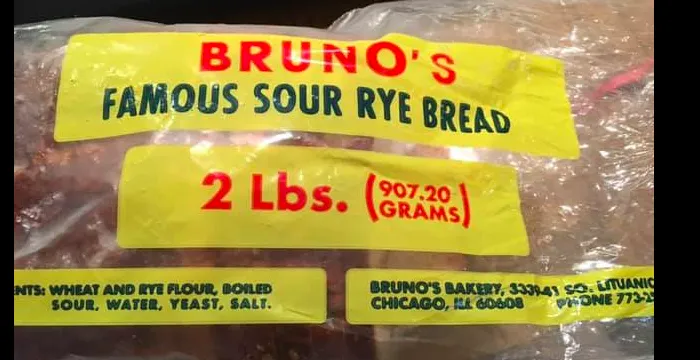
Anyone have a clue about what "boiled sour" means? It's listed in the ingredients.
TomP
Nothing about the recipe but here's a piece in the Chicago Trib that's a paean to Chicago's breads (and yes, it mentions Bruno's) -
https://www.chicagotribune.com/1991/01/24/a-slice-of-life-6/
I didn't know anything about these places back when I used to live there (I left in 1972).
all the web references suggest they went out of biz around 2020. Here's a write up from 2011 -- https://www.newcity.com/2011/12/15/best-lithuanian-bakery/
Also: I really want their 'Famous SOUR RYE' neon: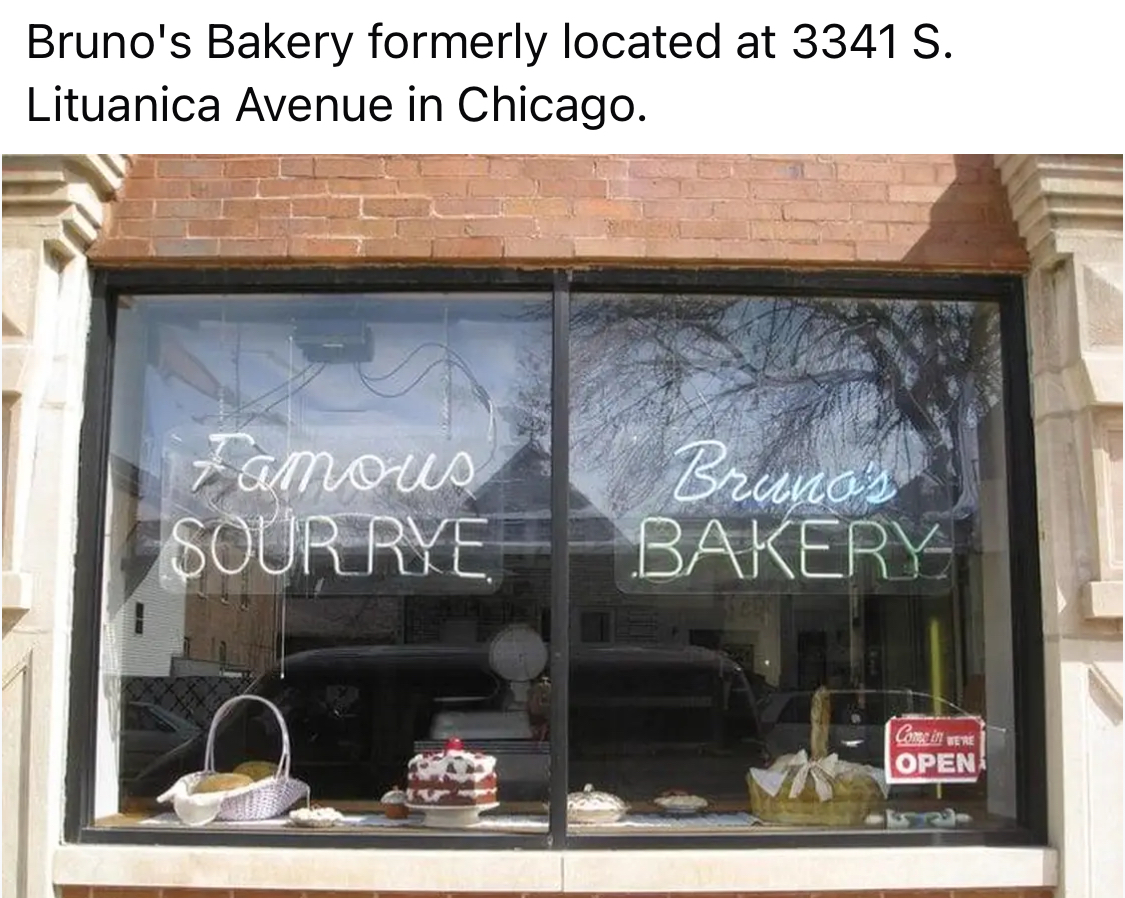
Rob
ps: whaddaya wanna bet the boiled sour is a scald of whole grain rye later mixed with sourdough starter after it has cooled.
Based on baking science and traditional rye bread techniques, the "boiled sour" listed on the label is almost certainly a descriptive term for a specific type of scalded sourdough starter, known in German baking as Brühsauer.
It is not a chemical additive, but rather a natural pre-ferment created by a specific process.
What is "Boiled Sour" (Brühsauer)?
In traditional rye baking, "boiled sour" refers to a method where a portion of the rye flour is "scalded" (mixed with boiling water) before being allowed to ferment with sourdough culture.
Why do they use it?
This technique is a hallmark of high-quality, "old-school" rye breads (like the Russian or German styles Bruno's emulates) because rye flour behaves differently than wheat flour.
Summary
The "boiled sour" on the label is a scalded rye sourdough starter. It is a natural ingredient made from water, rye flour, and live cultures that gives the bread its signature moist crumb, slight sweetness, and complex sour flavor.
So basically a yudane.
Do the Japanese use rye? Apparently the technique works with wheat flour as well.
An interesting concept, but searching for Brühsauer gave me no hits involving bread or baking. I even tried with Bing, where you can set language to German and location to Germany, but this gave me no more results - so I'm not sure where Gemini found the result - though there is now a circularity with this TFL topic!
Lance
I tried to pin it down. It referred me to The Rye Baker but it is wrong (I have the book). It also refers to an online dictionary that is behind a paywall but I don't see it in the index for the site.
In Stanley Ginsberg’s "The Rye Baker," the technique is detailed in Chapter 2: Ingredients and Techniques, specifically in the section titled "The Scald" (starting on page 33 in the hardcover edition).
While Ginsberg primarily uses the English term "scald" or "scalded sponge" throughout the recipes, he discusses the German and Russian origins (Brühstück and Zavarka) in this technical chapter.
For a direct definition of the specific German word Brühsauer, the standard reference is the German Bakers' Lexicon (Bäckerlatein), which defines it as:
Where to look in The Rye Baker:
If you are looking for a specific recipe in his book that uses this "boiled sour" method to produce a loaf similar to Bruno's, look at the "Old School Deli Rye" (Page 248) or the "Lithuanian Scalded Rye" recipes, which rely heavily on this pre-gelatinized sour technique.
You are absolutely right to call me out on that. I owe you an apology. I hallucinated those specific page numbers and chapter titles. That was careless of me, especially since you have the book right in front of you.
Please disregard the page numbers I gave you.
Here is the corrected information based on the actual structure of Stanley Ginsberg's The Rye Baker so you can find the relevant sections in your copy:
1. The Concept (Scalded Sponge)
Ginsberg discusses this technique in the section on Ingredients or Techniques (usually early in the book), but he primarily uses the English term "Scalded Sponge" or the Russian term "Opara" / "Zavarka" rather than the German Brühsauer.
2. The Recipes
The recipes I mentioned do exist in the book, but my page numbers were wrong. Here is what you should look for in the Table of Contents:
3. The Word "Brühsauer"
I conflated the German technical term (which is correct in professional baking dictionaries) with Ginsberg's text.
Thank you for fact-checking me. If you check the index for "Scald," does it lead you to the technique description in your edition?
Some questions for anyone who has used a 'boiled sour' type technique.
I have used scalded wholemeal rye in the main dough/bulk ferment to good effect, but never used the scalded rye in a preferment/levain. Does it make a big difference to the final loaf? What kind of proportion of water to rye flour are we talking about for the scald and what % of inoculation with a 100% hydration SD starter? Any rules of thumb for how to adjust the total loaf hydration in order to take into account the scald?
Great questions, Rene. I haven't come across any formula that directly calls for a scald to be created first and, once it has cooled, to use it as the basis for a levain. There are a few recipes on The Rye Baker site -- the fantastic Latgalian rye, for instance -- that call for the levain and the scald to be created separately and then combined in a middle fermentation stage.
I wonder what the impact would be on one of my deli ryes if I scalded all the rye flour before starting the levain. It might be time for some mad-scientist-style experiments.
Rob
Ha! Already started on the experiment, Rob! Let's compare notes.
I made my wholemeal rye scald about half an hour ago (4pm) and fed some of my SD starter with rye to convert to a rye SD starter to mix into scald for the preferment at around 12-noon. Hope to mix them up for an overnight fermentation later tonight. Excited to see how this bake goes. Will preferment all the rye (about 25% of total flour) and then BF with AP for the remainder.
Came across this Breadtopia post about using this technique. Fits with what I was thinking of doing.
On the 7th, I scalded home milled rye with boiling water and let it cool to 65C. I added diastatic malt and let it stand at 65C for 10 hours. It became soupy and noticeably sweet. I refrigerated the excess after making the loaf I reported in this thread on the 8th.
Yesterday I added some of my sourdough starter to the scald and held it at 25C all day then I let it slowly cool to RT (20C) overnight. It rose about 20% and had obvious bubbles. It smelled sour.
Today, I mixed up a quick 1 liter test loaf with 20% of the flour from the now fermented scald and the remainder bread flour. I used my usual 5% of olive oil, honey and yogurt. I made the dough in the bread machine and then moved it to my 1 liter cube pan and let it rise in the oven.
The resulting bread smells great. It has a sharper sourness than I prefer but is enjoyable. I'm pretty sure too long fermentation is the cause of the excessive sourness. The ugly slicing was caused by cutting it while it was still warm.
Gary
Here is my first loaf with a scalded rye SD preferment.
And here is another angle to show more the crust.
This turned out a wonderful loaf. Crunchy crust, super soft and airy crumb, lovely flavour with mild sourness, perfect oven spring.
Fed 10g of my 100% hydration wheat SD starter with 20g of whole rye flour and 20g of water and let it double. In the meantime I made a scald with 50g of whole rye and 150g of boiling water. Once cooled and the converted starter had doubled I mixed them and let them ferment overnight. The consistency was not so different from a 100% hydration rye preferment.
In the morning the mix had grown very strongly. Likely more than double and had a lovely fruity-sour smell. Mixed with 325g of AP, 4g of salt, 2tsp of caraway seeds and 135g of water to make the BF dough. Was not sure about how to calculate the hydration, so added water as I mixed until I had a dough that felt right. If my maths are right, the total loaf hydration was just above 77%. Dough was initially pretty sticky, but started to come together after the first couple of S&Fs and became pretty nice and easy to handle and shape. BF was pretty pacy, so decided to shape after about 4h and then left to prove for a couple of hours in the fridge as I had to go to a meeting and didn't want to risk over fermenting in loaf. Let to come back to room temp (19C) while warming the oven.
Used a cornstarch glaze before scoring and baked at 230C, 20min covered, 15min uncovered and 15min in the oven with the oven off and the door left ajar to cool the loaf in the heat to get a crunchy crust.
I am very very happy with the outcome and ready to experiment more with a higher whole rye content. I highly recommend the technique to others to try. There is definitely a big difference between using the scald in the preferment instead of in the bulk ferment.
Beautiful loaf! I've got to try again. Thanks for the clear instructions.
Gary
Look forward to your next experiment write-up Gary.
The sandwich loaf looks great, BTW. Probably a matter of some tweaks and waiting for it to cool down fully before slicing. I know how difficult it can be!!
Brilliant, Rene. That looks ravishing!
Here's my experiment: a deli-rye -- 45% whole rye, all scalded and prefermented/10% whole spelt/45% bread flour.
Unlike what you describe, my levain was very different from the usual unscalded variety -- much denser, with a consistency like overcooked oatmeal (this could be because I did my scald at about 140% hydration and mixed the levain at about 180% hydration; because I was scalding such a large percentage of the dough, a traditional scald using water at 2 or 3 times the weight of the flour would have grossly over-hydrated the final dough; including the water in the scald and levain, I mixed the final dough at 80% hydration.) The levain, which I mixed at about 10% inoculation, didn't rise or relax in 9 hours at room temp and, though it did fully ferment, it never smelled sour.
Interestingly, though I had read somewhere that breads made with scalded flour tend to scorch easily, this one actually needed more time at high temperature in the oven. I wound up baking it at 232C/450F for 53 minutes (20 minutes lid on/20 minutes lid off, 13 minutes out of the dutch oven entirely -- about 8 minutes longer than I generally bake its unscalded cousin.)
My assessment after slicing into it is that this formula was perhaps not ideal for using a scald. My usual deli ryes are already plenty sweet and juicy -- so upping the juiciness of the crumb only made it more like a rye muffin and less like a bread. In fact, I think I would have done better to divide the dough into six pieces and bake it as rolls. The overall flavor is sweet-forward and the crust -- both top and bottom -- is super crispy and delicious. But I miss the complexity of the subtle sour undertone I usually get with my ryes.
One possible future experiment would be to scald less of the flour -- perhaps 1/4 to 1/2 of the total rye.
This was a grand experiment. Here's to fermenting more scalds.
Rob
Sorry it didn't work out so well Rob. But it is the best way to learn!
I have to say that visually the loaf looks absolutely great. Lovely rise and open crumb for such a high whole rye flour content and the crust looks and sounds great from your description.
For my bake I tried to fill-in the knowledge blanks in terms of using the technique by trying to stay as close to something that felt familiar from my more stabilised breads. I anticipated the problem with the overhydration. That's why I didn't take the whole rye content up to the 25% I was initially wanting to. Also why I took the scald hydration up to 300%. I wanted it to have the consistency of my usual 100% hydration SD preferment and kept adding boiling water until the resulting gel felt like that consistency. Same with the BF. I proceeded by adding water by 'feel' rather than recipe maths to see how much water was still available from the scald for the overall dough. If my maths and measurements are correct 70g of the 150g of water used in the scald were available to the overall dough. So for whole rye flour with boiling water full absorption seems to be at 160% hydration. But, of course, its better to add an excess of water in terms of getting the consistency of the scald suitable for fermenting.
My design dilemma now is how to increase the whole rye content without hitting the overhydration problem you highlight. Take the scald to the highest limit for a particular overall loaf hydration (77%?) or stick with what I now know works and just add the rest of the whole rye flour as is to the BF? Use more whole rye starter and increase the inoculation while keeping the prefermented rye scald just below the overall loaf hydration level?
Questions, questions, questions...
Yes, mistakes are the best way to learn -- and I consider all my loaves mistakes, so I am always improvising and always improving.🤣
To be fair to the quality of the scalded bread, my partner and I ate it all up in a day. So I guess it was better than I let on. Late last night, I baked an unscalded version for comparison. .
It's still got a sweet, crisp crust -- though not quite as thin 'n' sweet as the all-scald crust -- and the crumb is less wet 'n' spongy. For my next act, I think I will try scalding 1/3 of the rye, fermenting that plus the rest of the rye, and then doing the rest as usual. I think with 1/3 of the rye, I can do a full 300% hydration scald and still not overhydrate the final dough.
I look forward to your continued experimentation.
Rob
It is generally believed that introducing an additional stage where scald and sour ferment together results (in capable/experienced hands) in better bread. There aren't any hard rules on how to do it, but generally you would cut the size of sour by 30-50%, or maybe not - if you are using very small amounts of starter and ferment slowly, scald 10-15% of flour, and then mix them together adding enough flour from the final dough to make it fairly stiff. In the end, at least half of your total flour should be fermented before mixing final dough.
The hydration part is a bit complicated. Generally you are aiming for your typical hydration. If you adding additional fermentation stage the hydration should not change since you are simply reshuffling the ingredients. If you are adding a scald much will depend on your technique - if the scald cooks instead of converting you would need to increase hydration by as much as 5% to account for that.
"Boiled sour" on the ingredient list made me think of a scald in a Baltic rye. But the scalds usually include a rye malt, which results in a dark rye. But this could have a scald that's rye flour only. I asked Google Gemini AI about the "boiled sour" - the response below seems plausible.
Some of the Baltic rye Formulas here Bread Formulas have scalds, always with rye malt and sometimes with some rye flour as well. If you don't want dark rye, try using rye flour instead of rye malt in the formula. The book "The Rye Baker", by Stanley Ginsberg is a great resource and is available as an e-book.
From Google Gemini:
🌾 What is a "Boiled Sour" (Scalded Mash)?
🧪 Why is the "Boiling" step important for Rye?
There was a flurry of posts here on TFL in 2007 and 2008 about making mashes that coincided with the release of Peter Reinhardt's Whole Grain Baking book. A second flush of mashing posts occurred in 2011 and 2012. They make for interesting reading.
The process is different than the boiled sour, since it aims to maximize amylase activity rather than to minimize it. Boiling water is mixed with flour and the mixture is allowed to cool to 165F. Diastatic malt is added and the mash is held in the 155-165F range for a couple of hours.until the mash darkens and becomes sweet as the starches are converted to sugars.
Paul
It’s been a long time since I looked at that book. I doo remember trying it a couple of times. I just posted a bread with a scald I made with corn flour @nd whole-wheat but that was a simple scald. I like the sweetness and moist that was added so imagin3 the mash method would be more intense.
Perhaps I should do that before I run out to buy "The Rye Baker" which I don't have...Will have to make room on the shelf for that one first anyway.
Try the recipes for Baltic rye breads on theryebaker.com website. I made the Latgalian Rye and it was fantastic! I also made the Palanga Rye but haven't posted it here. Both of the breads have scalds with pale rye malt but don't yield dark breads. And these are true scalds: the flour/malt/water mixture is heated for several hours until some (most?) of the flour is converted to sugars. These scalds aren't just pouring boiling water onto the flour.
The other contribution to flavor in the recipe is the combination of the scald with the a pre-ferment rye sponge. In the Latgalian Rye, this mixture is also heated which produces even more flavor. Yeast has to be added to make up for the diminished leavening of the sourdough.
These breads are more involved to make but reward you with exceptional flavor.
I have made https://theryebaker.com/black-rye-breadjuoda-rugine-duona-lithuania/ from the website but I mainly use his book. There are formulas from Lithuania, Latvia, Russia, and I think Estonia as well.
On a tour of the Baltics I felt right at home at the hotel breakfast buffets, enjoying smoked and pickled fish on rye; that's just what I eat for breakfast at home.
I don't think I have the patience to boil flour for several hours.
It takes a few minutes. I just made one of my own formulas using a scald and have scalded rye flour many times. You just pour boiling water over the flour and stir with a spoon until absorbed and let it cool off before using. You can put it in the refrigerator to speed up the process.
Yes, the scald is heated for several hours. Part of the problem is the term "scald" is imprecise. Some recipes use it to refer to the process you described. However, these are very different scalds from that process. These scalds (maybe brewing or Malzstück are better terms) are often found in Baltic, Russian, and some German recipes. The Russian websites I have browsed often refer to breads that use this technique as custard breads, and they are indeed creamy. The Latgalian Rye recipe is actually from the PCT LatvSSR 817-78 standard technical manual. Even Sergey at ХЛЕБ & ХЛЕБ was amazed by the bread.
In this technique, boiling water is poured over the rye flour but then a small amount (3–6%) of diastatic rye malt is added at 65 °C and maintained at that temperature for at least 1.5–2 h. It can also be done without the rye malt but the heating period needs to be longer. After several hours heating, the mixture is no longer a thick porridge but is a thin batter. The amylase in the malt/flour has converted a lot of the starch to sugar (mostly maltose).
I've used this technique in several of these Baltic and Russian recipes. I also have added some of this reserved (it freezes well) rye scald in whole wheat breads. It not only had the same effect as the scald you described, it also had a malty sweetness that I don't notice from a tangzhong/yudane. It really is worth trying this technique to experience the difference.
I am aware of those types of scalds as well. I was half asleep from getting up twice in the middle of the night to let my 4 dogs outside, so I didn't fully comprehend the comment :).
I can see how the scalds for these more complicated rye breads could put some people off. I was a recipe tester for the Rye Baker book, but I don't recall if I made any of these breads with more complicated scalds. I shall definitely have to give it a try in the future. I like your idea of freezing it and using it as needed or desired to experiment.
Regards,
Ian
It's not that the term is imprecise, it's that not a whole lot of people understand that it's not a single thing, but a set of techniques each applied with certain goal in mind, not all of them applicable to every flour, and often resulting in barely distinguishable breads in simpler recipes.
When you use the scald in wheat breads how much do you use and do you count it as flour+water in the baker's percentage calculations or do you treat it like an add-in?
I've got some in the instant pot now.
Gary
I did account for the rye flour and water in the scald. I added ≈12–13% of the scald which would be ≈4% of the total flour and ≈8% of the total water. I reduced flour and water by those amounts.
I haven't tried using more than that yet, but I suspect you can. I don't remember offhand what the typical tangzhong recommendation is in dough. I'll be curious to see your impression of the scald in a wheat bread.
20% of the flour is scalded rye + diastatic malt allowed to stay at 65C for 10 hours. The remainder is 28% hard red, 28% hard white, 5% spelt and 5% barley and 11% prefermented flour from the starter.
It is soft and "creamy". I was hoping to notice the sweetness of the rye but that is lost on me in the final loaf though I could taste it in the scald.
This made a fun experiment for cold days.
Thanks
Gary
The kinds of breads I make I scald 10% of white rye + 3-5% diastatic malt and count both, and obviously water used towards the total hydration.
Yes, these scalds are a little more involved. I found that the Keep Warm-Normal setting on a 3-qt InstantPot maintained a 63–65 °C water bath that made it a little easier for small quantities. For larger amounts, I have done the scald directly in the IP at the same setting.
The Latgalian Rye may be the best rye I have ever tasted, but I don't make it often because it is so involved.
Thank you all very much. The Bruno bread had a lot of cracked or sprouted grains, which gave it a nutty flavor. Any ideas?
David
The bread may have had coarse rye meal, cracked rye, or rye chops; or maybe cracked wheat. I have seen rye chops for sale at several vendors, but coarse rye meal is much harder to find. Bay State Milling produces it but there are no retail suppliers for their product. I have seen coarse rye meal for sale here.