
It's widely known that, by design, mainstream American butter is 80% fat (cream), 15-18% water, with salt, flavorings, etc. making up the rest. I too have known that, but never experienced it.
For health reasons, I choose to limit my salt intake, so for a decade or more I've only bought unsalted butter. But recently I wanted to try some European butters, some of which are only available locally as salted. I have been shocked at how strong the salty-ness was! Especially the American butters. 100-110mg salt in a 14g serving is way too strong for my taste.
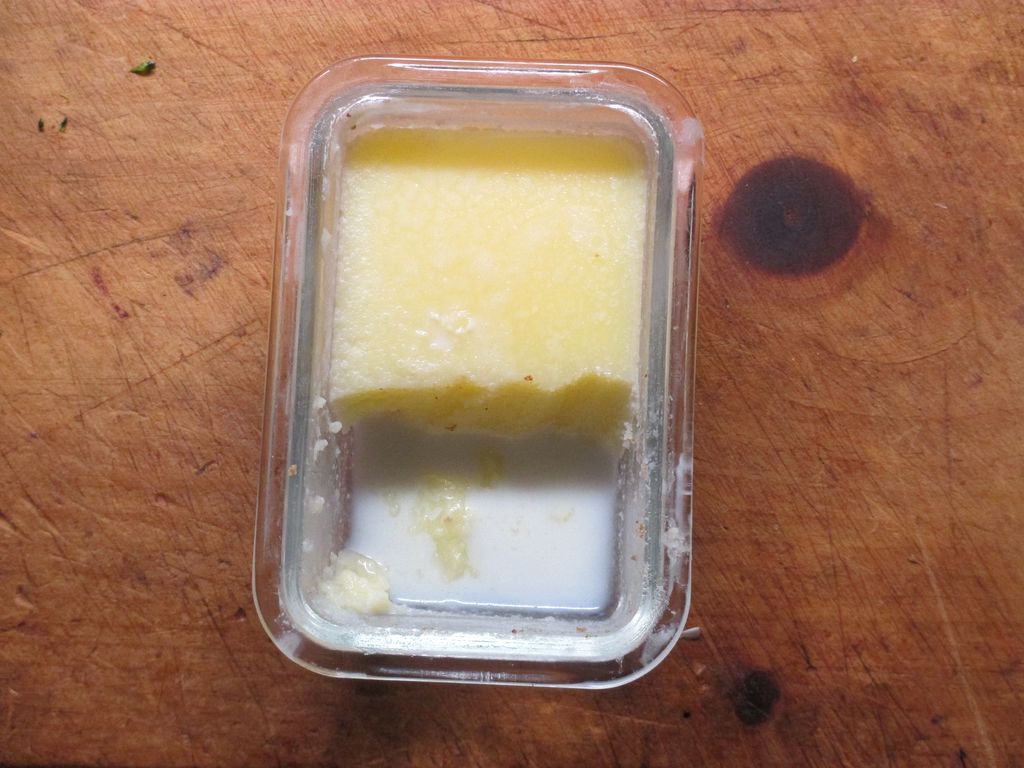
So I want to try, say, half that much. I took 1/2 stick each of salted and unsalted butter, melted and mixed them over low heat, poured it into a shallow glass storage dish, and let it solidify at room temp (about 70º).
I was surprised to find that a shallow pool of white liquid had settled at the bottom. It's the water. Not sure where the white comes from... anyone know?
The texture of the butter is quite different without the water. Melts and spreads easier. Color and taste are better, saltiness is about right.
I like the results. This might become a habit. Next time I'll weigh the sticks before, as well as the separated water, to verify the percentages.
It made me wonder how they manufacture it, to kept the water from separating. Some sort of flash cooling?
I always thought it's residual milk.
TomP
Makes sense.
you're halfway to making ghee, no?
Rob
Could be, I've never made it.
Which is easer to spread than plain butter (in this regard it is more like other animal fat spreads - chicken fat or tallow). Doesn't require refrigeration. And my wife makes it from unsalted butter. The process of making is to heat in a pan until the bubbles are at a certain stage and then pour into glass jars to set. A lot of moisture evaporates in the process.
-Jon
Sounds pretty much the same. Yes, if I heated it to a boil the water would evaporate, but not needed in my case, I can just pour it off.
essentially, you've created a version of clarified butter.
ghee would, as you say, require a bit more time on the heat.
Thanks for 'clarifying' that :)
...butter melts into 3 layers: top floaty white stuff is milk solids, then butterfat, bottom is water with more of those milk solids. I guess the middle layer is clarified butter, no?
I believe those white parts that settle are considered milk solids. It is the component of butter that makes it brown or burn at a lower temperature. If you pour off the butterfat and leave the milk solids you have created clarified butter.
As you can see, there was almost no "top floaty white stuff", just the butterfat and white liquid. I wonder if temperature makes a difference? I used minimal temp, just enough for it to melt slowly.
is more than congealed fat, the solidified fat is actually a crystal structure which is what gives it that great mouth feel.
If you ever make homemade butter, you will find a lot of this opaque white liquid comes out of your cream. Before fridges people would usually let their milk stand for a day or two at room temperature to maximize cream rising to the top. Then they would skim the cream and make butter. Cream is churned and then pressed to separate and force out as much buttermilk as possible. Cream made from good-quality raw milk begins to develop healthy cultures on its own when left at room temp long enough. The resulting butter is cultured butter. The resulting buttermilk is naturally cultured buttermilk. Depending on how long the cream was left at room temperature, the buttermilk could either be sweet and fresh or quite tart. If left to ferment longer, the buttermilk would become a thick white liquid that's more tart. This is where the storebought "buttermilk" of today comes from. No, the "buttermilk" you buy in bottles at the store is not really buttermilk. It is ordinary milk with cultures added till the milk thickens. This is technically "sour milk". I honestly never liked the taste of it. It's definitely sour. . . . if you make your own sour milk at home using good-quality raw milk, it's much tastier and less sour in my opinion. Anyway, the sour milk at the store came to be labeled as "buttermilk" because of its similar appearance and texture to true buttermilk. When you melt and re-solidify butter you are essentially forcing more buttermilk out of the butter. Old-fashioned butters are saltier because before fridges it was important to make the butter as salty as you could get away with so it would have a longer shelf life. Fresh ("sweet cream") butter was for the wealthy few. You probably didn't care to know all this.