
Since the previous posting on this, I have struggled through to something of a success: a whole grain (brown rice flour & oat flour) gluten free bread that tastes great and doesn't crumble...but craters somewhat. Rather than having people struggle through all my prior failures and confusions, I deleted the old post and am creating this new one on my first bread That Works.
Background:
My wife, age 74, has a for-real doctor diagnosed auto-immune neuropathy resulting in brain fog and narcolepsy, Her condition doesn't have any magic bullet, just things amount to a fighting retreat.. Every 2 weeks she has a daylong infusion of immunoglobulin which helps somewhat AND on top of all this she had GI tract parasite damage when young , has both lactose and gluten intolerance and a gut that we've described as Sinners in the Hand of an Angry Stomach. Doc has told her that other than the infusion, the only thing that seems to help is a strict Mediterranean diet (which means differing things to different people) but for sure a lot of restrictions : little to no starch, minimal eggs (a few a week), no sugar, no fat other than limited olive oil, lactose free skim milk, whole grains, no gluten.
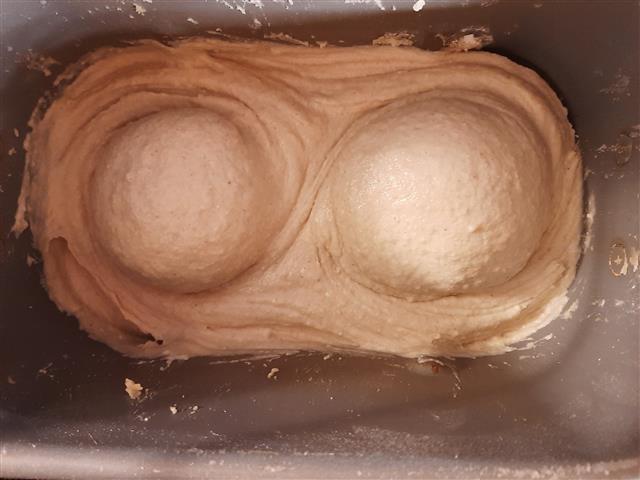
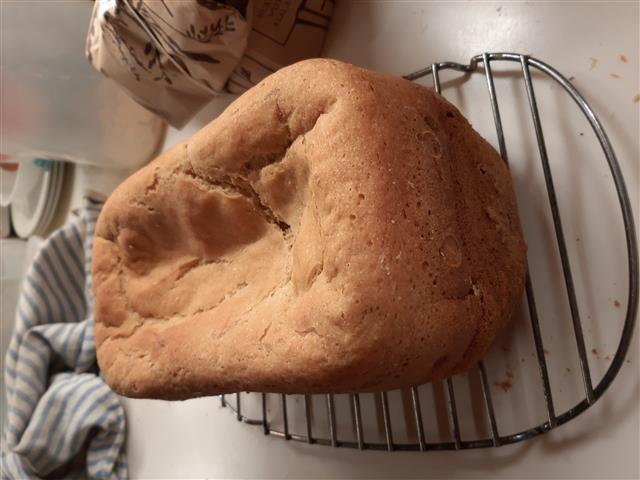
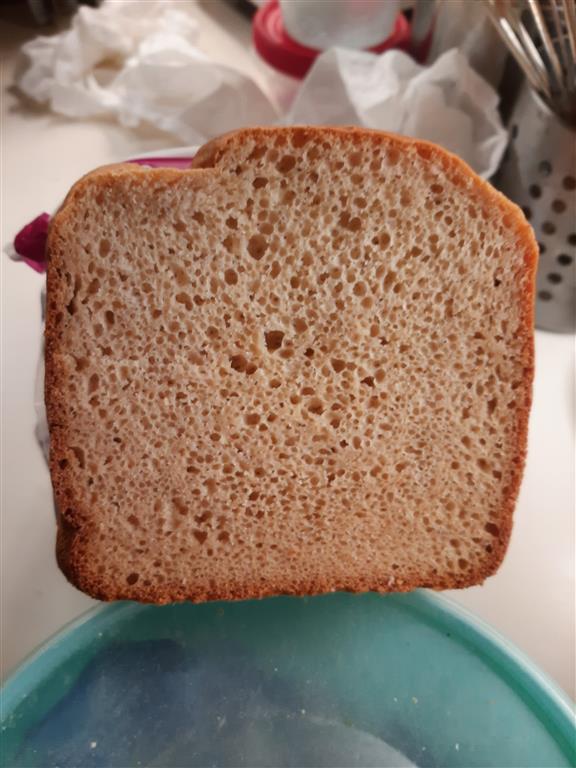
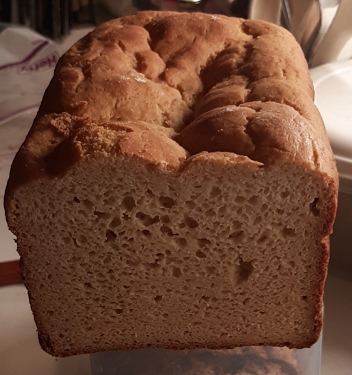
So: little eggs, whole grains, no lactose and gluten, the least starch (potato) possible. Here is my current working Rx in Word docx format. It's modeled on the Zojirushi one, changed for my wife's requirements. My previous abject failures were due to a basic misunderstanding of the difference between regular wheat-and-gluten bread dough and GF dough. The former has to be worked/kneaded to develop the gluten and ends up a cohesive sticky ball, the latter must be almost runny and does not need kneading (no gluten, after all), only complete mixing. When the mixing is complete in my Zoji machine, it looks like this and the cratered loaf looks like this
 .
. 
The internal structure of the loaf looks like this. 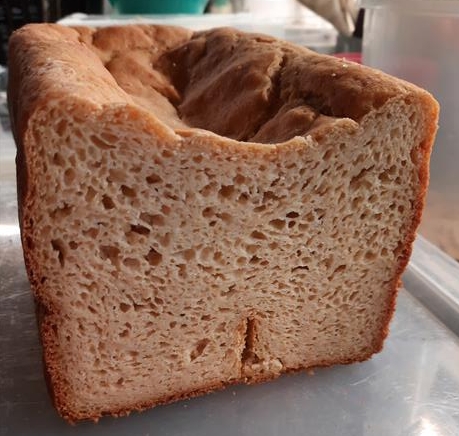 Note the big pores in the center which I presume lead to the cratering. The dry ingredients are:
• 7.8 oz brown rice flour
• 5.3 oz oat flour
• 6.24 oz potato starch
• .28 oz xanthan gum
• 3 oz salt
• 2 tsp active dry yeast
The wet:
• 19.2oz Lactose free skim milk
• one jumbo egg, room temp, beaten
• .5 oz apple cider vinegar
• 1 oz olive oil
• 2 oz maple syrup
Questions:
#1: What can I do to reduce cratering?. Or rather to reduce pore size in mid loaf....Less syrup, less yeast, some change to the salt?
#2: I wish to have as little starch as possible; can I reduce it? How important is starch to structure? I would like to increase the flours and decrease the starch,
#3: How much xanthan gum is really necessary? The bread is slightly gummy.
All in all this Rx is a roaring success after my previous abject failures. It's delicious, though it requires longer toasting than the regular wheat/barley/buckwheat bread I make for myself.
It's worth mentioning that there's no way to adjust the baking temperature in the Zoji. OTOH, given that there's no gluten to develop in a GF bread, a bread machine isn't really necessary...just mix the ingredients and put it in the oven....so if there's some oven adjustments that would help with cratering I could just mix and bake it. FWIW, I have the Zoji programmed to mix/knead for 17 minutes, then rise for 35 and bake for 80.
Comments, suggestion? Thank you all for your patience with my blundering around in the dark.
I use a 4x4x4 inch one for experiments and a 9x4x4 inch (USA Pan) for full sized bakes. Read about Caroline's (trailrunner) recent Pullman bakes. She mixes the dough, gives it a few folds and puts it in the pan. When it has risen she either bakes it immediately or puts it in the fridge overnight.
I've been doing it and it works great for my normal whole grain gluten loaded bread.
Your bread sounds similar to whole rye bread which has no gluten. They mix it, scoop it into the pan, let it rise and bake.
I hallucinate that it could work for your gluten free bread. Simply mix, pan, rise and bake.
One trick I have found to prevent the top from sinking on my loaves is to dump it out upside down and leave it that way to cool.
Gary
I would have to invert the pan halfway through the bake....the falling happens towards the 2nd half of the bake. That might work...
Can anyone tell me why the pores of the middle of the bread are so much bigger?
Hi sdean7855
You might consider converting the recipe to a quick-bread by swapping the yeast for baking powder once to try it out. It would be easier to make and bake.
To replace 2 teaspoons of active dry yeast with baking powder, you would use 2 teaspoons of baking powder. Baking powder is a direct 1:1 substitute for yeast in many recipes.
Explanation:
Baking powder
is a leavening agent that reacts immediately when exposed to liquid and heat, unlike yeast which requires a longer rise time.
The 1:1 ratio
means you can simply measure out the same amount of baking powder as the recipe calls for yeast.
Considerations:
While baking powder is a simple substitute, the leavening effect might not be as distinct as with yeast, and the baked goods may rise more quickly.
Procedure—Muffin Method
1. Sift together the dry ingredients (a).
2. Combine all liquid ingredients, including melted fat or oil.
3. Add the liquids to the dry ingredients and mix just until all the flour is moistened. The batter will look lumpy. Be careful not to
overmix (b).
4. Pan and bake immediately (c). The dry and liquid mixtures may be prepared in advance, but once the mixtures are combined, the
batter should be baked without delay, or loss of volume may result.
Tony
But why would I want to replace the yeast with baking powder? What profiteth a man(Mark 8:36). Will that make the pores more uniform and ensure smaller pores in the middle?
So it rises like a gluten bread
Hi SDean,
To reduce starch what you can try is a recipe that is without starch because it is 100% made from a single flour that is not a root vegetable (so you then won't then use the potato or tapioca starches).
Here's a great article about single flour gluten free breads:
https://glutenfreegourmand.blogspot.com/2022/05/one-flour-bread-how-to-make-gf-bread.html
Good luck!
-Jon
Thanks for the link. I don't bake gluten free but I imagine the tortilla test could be applied to any flour. This makes me want to try one of these flours.
Gary
🙏🙏🙏
I really have two issues: the cratering and the wish to reduce the starch...you seem to address only the second or are you saying it would help with the cratering? The loaves in the link seem a bit like what I used to call Klunk bread, very dense, achieved by the addition of Psyllium husk. I like the airy loaf I'm getting now....just don't want it to crater.
Which leads to another question: the dynamic of dough expansion in a round loaf vs a bread pan....also in scoring the top. All my bread making has been in the Zoji, which is sort of like a regular bread pan, see image (this is of my daily wheat/barley/buckwheat bread)
It's 5"x8.5" and about 5"tall. Would I have less cratering with a bigger pan or less dough? The problem is that everyone has something that works for them and so tends to say, well, if you did it like this, you don't have problems. I do have bread pans so I could try various pans
The reply above was only about starch as I don't know how to answer the cratering problem (don't use a bread machine). Cratering, sinking and flying crusts seem to be more prevalent in gluten free baking in general. My thinking on it is that smaller, shorter gluten free loaves give me less problems, and some commercial gluten free loaves are also small and short too, I have noticed.
When it comes to psyllium gluten free breads, I've managed to achieve similar open crumb to your original bread even when using psyllium (so not always klunkers).
Keep us posted, think we're all invested in your breads now.
-Jon
How is that going to reduce starch? All the flours in that link are mostly starch. If it's not fat, protein, or cellulose it's going to be starch.
TomP
My wife's requirement is for whole grains. Yes they are carbs, but complex ones. Potato starch not.
Does that rule out white rice, too? Or does it have to be brown. If she needs complex carbs, I suppose that means brown rice.
TomP
Yes, my Rx lists brown rice. And yes, I know of the arsenic hazard in brown rice....also that it can't be ameliorated as cooked brown rice by soaking first.
Can anyone directly address what I think (but what do I know?) is the problem, namely why the pores in the center and top of the loaf are so big...and therefore create a weak structure leading to the collapse? Is there some way or a different yeast to have the pores form more evenly perhaps more slowly. Could it be that the yeast gets hyperactive towards the end? Should I try less yeast
Thanks all!!!
They are bigger in the middle and top because it is easiest for them to grow there.
Maybe in a Pullman pan with the lid on and just the right amount of dough, being constrained on all sides would allow for uniform sized holes?
Gary
Huh...as it happens, I have (somewhere) a pullman pan, but it's a long thing...and get the dough volume right will be interesting.....
https://www.amazon.com/dp/B0838YTSV8?ref_=ppx_hzsearch_conn_dt_b_fed_asin_title_3
I don't shed too many tears over wasted ingredients when my experiments fail.
Gary
Go with what ya know and experiment. You'll get it eventually. Enjoy!
I think the different pore sizes might reflect two things going on: the higher pressure at the bottom of the pan, and a weak dough/batter. The dough is weak, and the weight of the upper compresses the pores at the bottom. There is probably plenty of yeast, maybe even too much. The gas released could be drifting to diffusing upwards and collecting more towards the top. The collapse of the top could be the extreme end of this process.
For example, (wheat) breads with very high hydration can produce large mouse tunnels just under the top surface. One example is "glass" bread, AKA pan de cristal. The standard way to deal with this is to invert the dough before baking. That might be hard with your batter, but maybe with the bread contained in a Pullman pan it could be made to work. If you can discover the right amount of batter to completely fill the pan when it's ready to bake, that would give you the best chance of success.
There is a Pullman-style loaf pan made by Chefmade that it 3 X 3 X 8. It holds about 1/2 the amount of dough of a 4 X 4 X 9 Pullman pan does. The difference in depth might be enough. Here's the one I have (it' s called a "toast box"):
https://chefmade.com/products/3-x-8-corrugated-toast-box-300g-dough-capacity
If this idea of dough weakness correct, possibly making a thicker batter would help. Also a faster bake might be a good idea, and you could cause the interior to bake faster by applying heat to more of the loaf's interior. One way to do that would be to use a Bundt pan. Don't fill it all the way up, so as to reduce the pressure at the bottom.
If your wife can tolerate it, you could also add the white of another egg to try to provide more structure.
Please keep us filled in with how it goes!
TomP
I wonder....the dough is thin compared to the normal cohesive ball of wheat bread dough. Maybe I'll try just one tsp of yeast...it may be than the GF is so comparitively thin that the yeast has less opposition and so expands with more omph.
Thanks for all the encouragement.
Tune in next week after this loaf runs out for the next thrilling episode of The Mysteries of Gluten Free Bread....
I get my ingredients from azurestandard.com
As Gary suggested, I would start with using a different pan. The Zoji pans waste (i.e. conduct) a lot of heat into thermal mass other than the dough (the heavy-duty handles and base). Heat transfer to the center of the loaf is poor. And I would bake it elsewhere, too, at higher temps (375ºF). The Zoji's are notoriously low-temperature bakers (around 300º max). It shouldn't take 80 minutes to bake a loaf of bread.
I haven't found the link yet, but 2-3 years ago I found a good article online comparing several bread machines that have gluten-free modes. The tester didn't point this out, but I later discovered that the ones that gave the best results baked at higher temperatures than the others.
Edit: Just found the link: https://gfjules.com/reviews-of-best-bread-machines-for-gluten-free-bread/
She has changed the article quite a bit since first posting it. In the first version, the Zo didn't fare well; the winners were the Panasonic R2550 and T-fal Actibread. Both are excellent bakers; the latter is no longer made.
her all purpose GF flour
https://shop.gfjules.com/collections
My wife diet mandates whole grains, no starch. Bingo.
Her bread machine GF reviews were interesting and helpful. I already have the base model that's #1, the Zojirushi Virtuoso...she has the Plus version of it.
She does have a whole grain flour, the NADA
...but it's $12+ a pound...
Any updates?
I've tried a lot of things since last I wrote. One of my wife's issues is that she has developed nausea...which can be exacerbated by xanthan gum...so I've cut that back from the .3 Oz of the original Zojirushi Rx to .1. To compensate, I've researched xanthan gum alternatives, and added 1 Tbsp ground psyllium and let it bloom in 5 oz of milk for 15 minutes before adding it to the liquid ingredients. The result is the "bread" on the right...which is gummy and needs to be heavily toasted. Wife Carol is happy with it (would you stop messing with the Rx), but it offends me, both because it craters and is gummy, particularly at the bottom, where the bread is sort of a wad.
Rx is here.
So possible changes are:
If you go to gfjules website, she shows all kinds of GF bread, but seemingly with a ton of starch....where my wife's mandated diet calls for whole grains.
Puff, puff, puff....a lot to document and consider. Your suggestions?
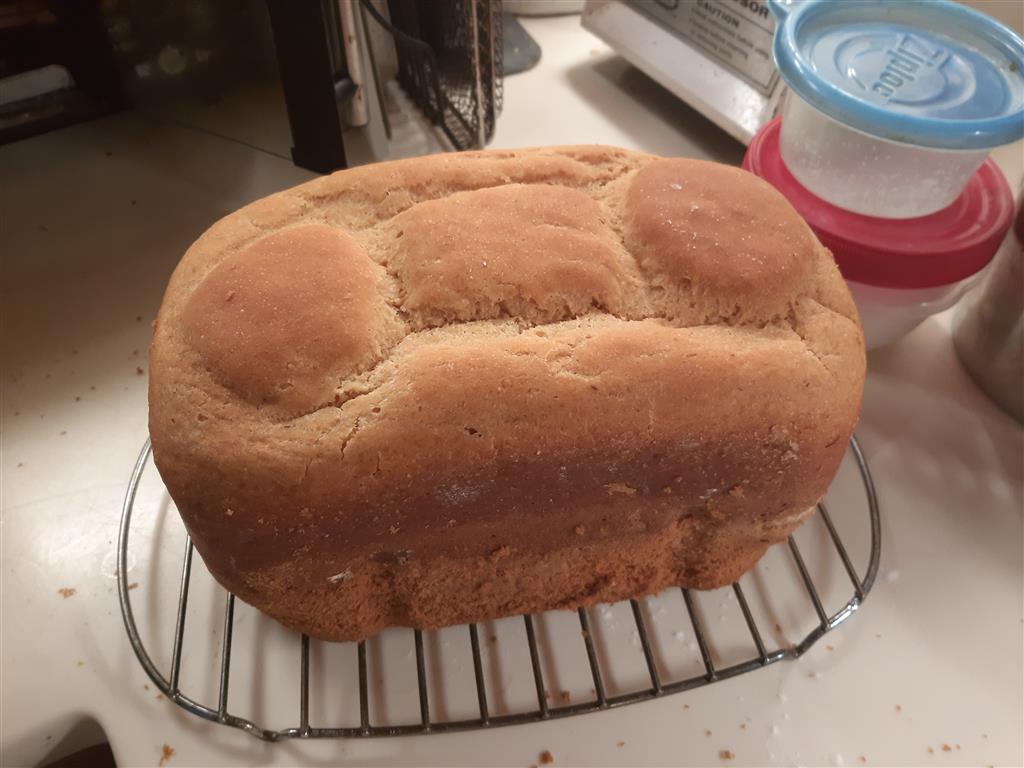
I added, as suggested, an egg white. Also:
No crater! I believe the mounds are from the domes that formed over the beaters during mixing. Next time, I will try smoothing the top of the dough after the mixing stage completes
.
Rx is here
Note that unlike the myriad other GF Rx, this one is:
It looks great. I salute your careful experimentation!
Gary
They would bring some fiber and nutrients along. I use them as a substitute for yudane to keep my bread soft longer.
Gary
Nutrition per 100g of dry potato flakes
Where do you get them? ...are they processed as in highly processed? Any idea how they're made?
I wouldn't want to get something that would be just another form of instant mashed potatoes....which is a wretched sin against Nature....
And yes, I am sure potato starch is highly processed. Next iteration, I will cut back on it to see if its increase or the extra egg white is what did the trick..... \
Will also try cutting out the Psyllium, as that didn't seem to help the cratering that much heretofore.
At this point, my main wish is that the loaf was softer, fluffier like what you get from kneaded wheat gluten. Any suggestions on that?
I use Bob's Red Mill Potato Flakes. They have a single ingredient "dehydrated potatoes". Lots of our local stores sell them. You can read more about their effects on wheat bread in Potato Flakes as Yudane Alternative and the linked article.
I think they must be much less processed than potato starch. I have no idea if they will produce the same result but I guess it might be worth an experiment.
Gary
Congrats. That's a very nice crumb.
Background: While the last load looked GREAT, my wife complained that it was tasteless and crumbled easily. Oh well.
Also, she wants maximum whole grain, minimal starch for her Med. Diet. Most gluten-free diet are nothing but various starches.
Online says that the most potato minerals/vitamins found in potato flakes, with less in flour and little in its starch.
SO:
I cut potato starch from 6.25 oz to 4.25, added 2 oz BRM potato flakes. Needed more hydration (watched mixing) so increased the LF FF milk from 18.25 to 20.75 oz. 1 & 1/4 tsp yeast. Nice texture, looked like this, tho crumb not as nice as before. What hydration looked like in the Zoji at mix step end on right
While baking strong potato smell...and when toasted, it smells off (toasted potato I guess). I hesitate to add more yeast for taste as it may make for ballooning and then cratering. Is there something else I can add for a yeast-ier taste that won't increase the rise? Brewer's yeast? Alternately, is there something for a sourdough taste with all the fuss and bother of a sourdough culture?
Suggestions?
It is not active so won't result in too much rise. I've never used it.
Gary
Add some liquid drained from live culture yogurt. That helps but your fermentation schedule may not be long enough for the flavor to develop. I have done that with a very long fermentation. The flavor came out in between sourdough and yeasted dough.
BTW, potato flakes are 78% carbohydrates (source: https://www.baffoodservice.com/wp-content/uploads/2018/03/91977_CN_Veg-1.pdf). For peeled potatoes, if you base it on dry weight, the carb content should be almost the same. So you will only get a modest reduction in starch by replacing starch powder with potato flakes. The bread should taste better, though.
TomP
I have dabbled in GF baking and have found that nutritional yeast or even vegemite can add a yeasty flavor to a bland GF bake. For nutritional yeast, I found that different brands can have a different flavor so buy a small amount initially and try it. Trader Joe's store brand ended up best tasting, in my opinion. As for vegemite, use a small amount initially as it has a strong and salty taste. Adjust added salt. I'm not sure if the ingredients would work for your wife.
I have been following your post with interest and have a few comments.
Psyllium: I found that adding the psyllium (esp if it is powdered) to the dry flours and mixing to thoroughly integrate resulted in less gumminess. It was also less likely to form gummy pockets.
Flavor: I wonder if adding a little acid (lemon juice?) would also enhance the flavor. GF bread has a different "mouth feel" and sometimes the subtle flavors are out of balance. A little additional acid helps correct that in other cooking. I wonder if that would help here. If she can have yogurt, that can add acidity as well as additional protein-tho it doesn't add to structure.
Sourdough: If you don't want to do full-on SD with feedings,storage,etc., you could use SD as a flavorant. The day before take some of your flour and liquid and add a pinch of yeast. Mix thoroughly and let sit on the counter (cool but not refrigerated-look up Biga method). Next day add it to the dough. Yeasty flavor develops nicely and it really is just for flavor and not rise.
Structure: Structure is built by adding protein like eggwhites or gums like xanthan or psyllium or flax or chia. I think the addition of the egg white has a lot to do with the improved rise. Sinking (I have a lot of experience with that!) is usually a result of a structure that cannot support the grain-just like in building a house. Structure is provided by protein and gums- they are the frame. The bubbles are formed by the gel of the starches and liquids. I always think of bread (of any kind) as a bunch of ballons held by a netting or more simplistically as a soap bubble where the wand is the structure and helps form the bubble and the soap water is the gel. In GF baking, the trick is to get the bubble walls to set and be strong enough to support the crumb above it as it cools. I have used Angel Cake techniques in baking-cool on its side in the pan (or upside down) so the structure "sets". Mixed success.
Rising: After working on the structure, try adding a small amount of Baking Powder (start at 1/2 tsp) to enhance the bubble formation. BP is activated by the heat of the oven and may encourage more bubble formation. Using yeast and BP together is not uncommon. Or go all BP for a very easy loaf. I do that for making a faster loaf-the day I run out of bread, usually.
Can you re-post your latest recipe, please? Great thread.