
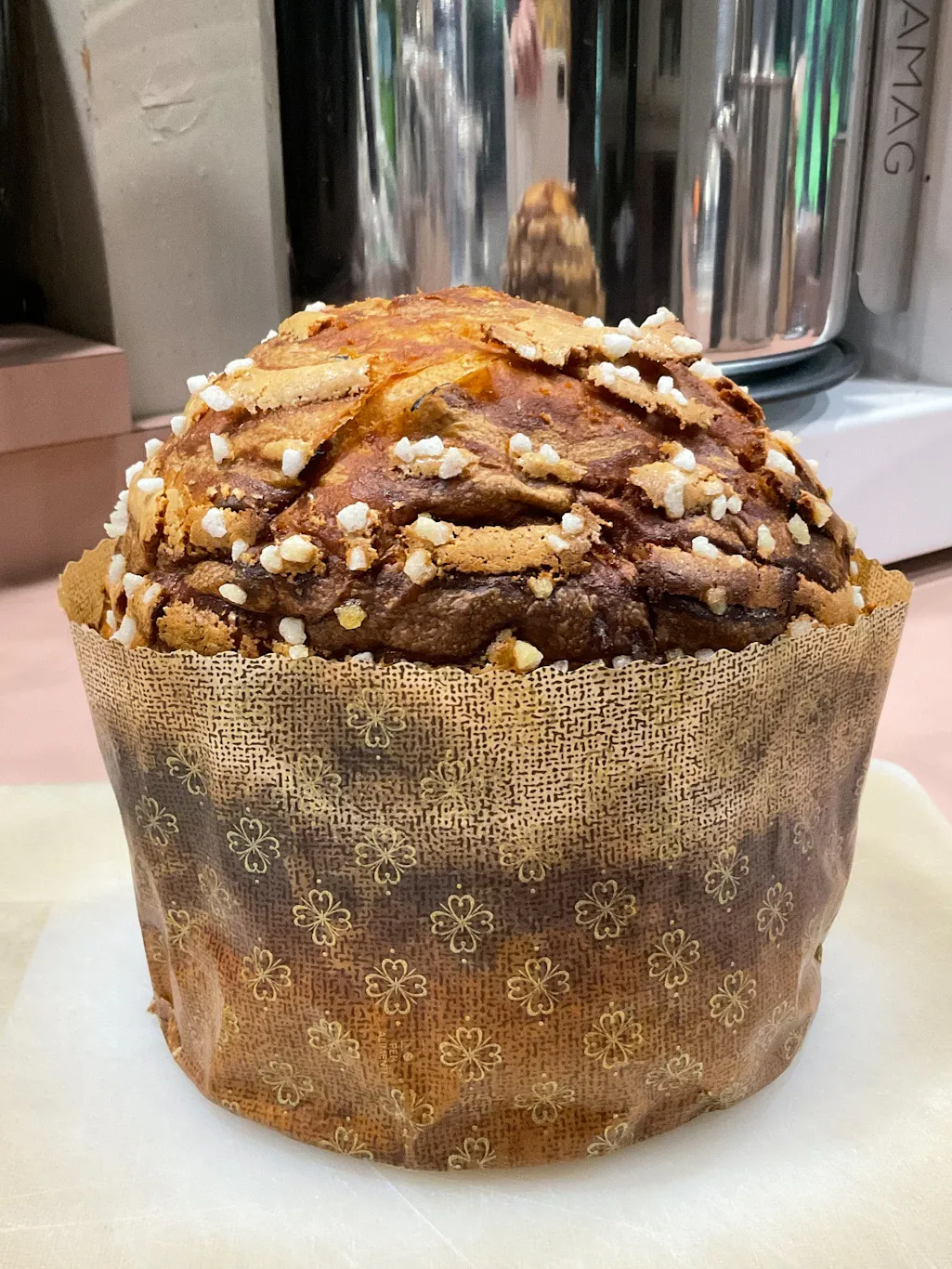
Made my latest batch of panettone using the Roy recipe from Chambelland's Sourdough Panettone and Viennoiserie. This is my third attempt, and my first successful attempt, with this recipe. It succeeded very nicely this time, producing a remarkably moist, light, delicate and springy result.
Fine tuning this bake will perhaps include slight modifications to the second impasto mixing process. This recipe is different from most, in that it includes both yolks and water added after the butter. This is like lightening an emulsion; it made me think of baking mayonnaise.
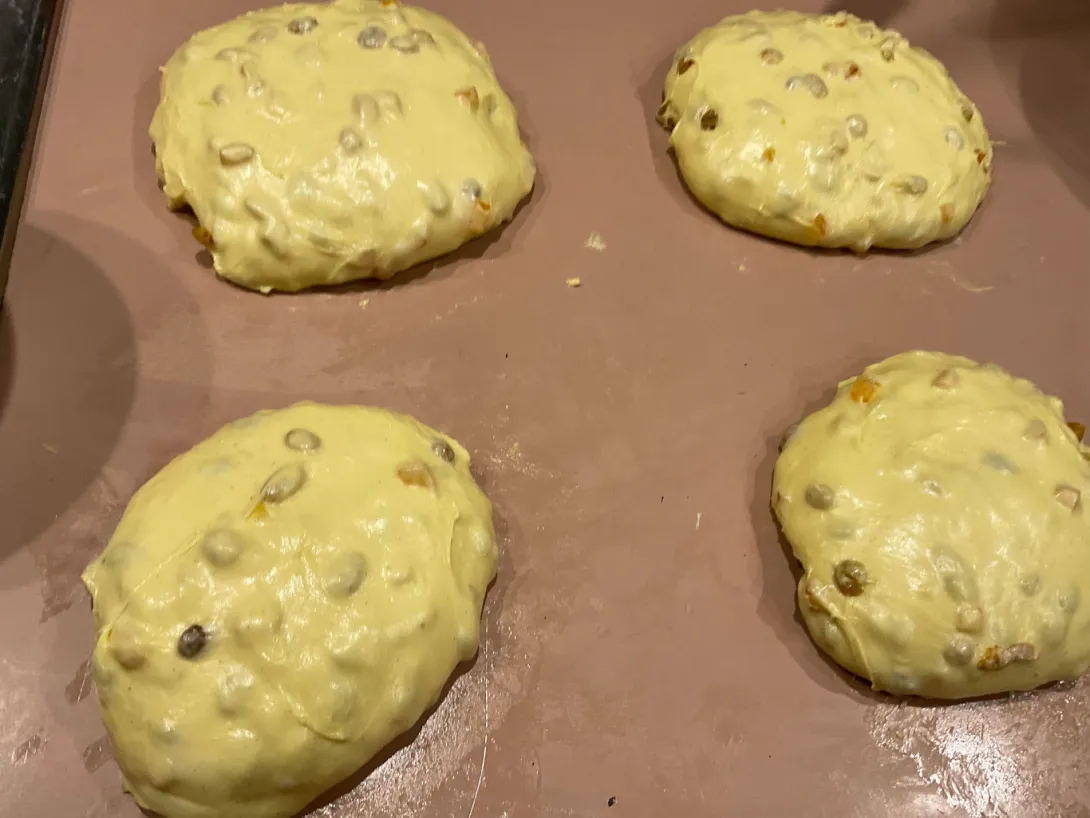
The dough had very good handling qualities. My pH is never in the zone, but always somewhat lower; still, getting very good results!
- SueVT's Blog
- Log in or register to post comments
Amazing crumb, can almost taste it through the internet. Lovely bake indeed.
-Jon
Glad you liked it! Thank you!!
Wowsers.
They have the look of Massari's panettoni!
Well done!
Your posts have been incredibly helpful to me!! From the technical papers, which I pored over, trying to understand the flora in LM, to your panettone bakes, I can't thank you enough!
I was just looking at your Panettone Paradiso post from 2013, thinking how similar it looks to this one! I have the Cresci book, and I'm going to check and compare the recipe.
I've been working on applying Chambelland's Universal Method, to be able to compare recipes more objectively. I think he is making one small error, but it probably doesn't matter that much because he applies it uniformly to everyone.
I have been making Giorilli's recipe, which I really do like, but this one is quite different. Not necessarily "better" but very different, with more emphasis on butter, and the water & yolks at the end of mixing. Quite a soft and silky dough.
Glad to be of help Sue. As you have seen I have been working on LM and Grandi lievitati for quite some years now!
It's clear to me the ‘Paradiso’ is from Achille Zoia, the co-author of Cresci, based on the formulaic structure. While added yeast is included, the same basic formula can be found in other publications, without the added yeast and in the classico type (candied orange, candied citron, sultana raisins). Because of that I chose to skip the added yeast when making the ‘Paradiso’.
No book is free of errors such as typos, theory, application methodologies. I communicated with Thomas to let him know about one particular point of theory in the book that was inaccurate, kindly he responded early the next day and said he would ‘change it immediately’!
Indeed, Roy's panettone formula includes higher levels of butter and also includes water in the second dough, to make what must be a very soft dough, certainly that appears to be the case when I looked at his Instagram. It is this point of difference that leads to the very open crumb which I originally saw as an American take on panettone but I have since discovered that Italian maestro Gino Fabbri's panettone formula to be almost identical to Roy's.
EDIT: Sorry, Fabbri not Fabri.
Thank you, I will look at Gino Fabri's formula!
Roy's bake day refreshes end up with just under 45% hydration LM. Chambelland's analysis appears to assume a lower hydration LM. I found about a point difference in dough Hu from this. I don't think it's a significant issue.
I just bought Chambelland's Sourdough Baking - a Treatise, looking forward to reading it. I also found some of his videos to be extremely helpful. I'm looking for ways to improve my LM, so that pH in the dough hits higher. How to favor lactic development I think...
Curious about the error(s) you mention. Would you happen to remember the details? Is there an errata for the book somewhere...or maybe another edition coming out (The "change it immediately" phrase suggests to me that some updates were/are made/underway)?
If I recall correctly, the tables in Chambelland's panettone book calculate Hu, factoring in the water in the lievito madre within the dough. However, not all recipes have the same percent moisture in the LM, Roy's as an example.
In retrospect, it's a small matter, just something that I think I noticed.
I believe this was directed at me. There have been some iterations of errata pushed out over email, but not in recent times and they only correct typos as typical with errata.
However, there are errors in the theory which I communicated with Thomas. I've yet to see them corrected. See below:
My Feedback:
It's undissociated acetic acid that migrates into yeast cells and not acetate! This mistake repeats throughout the text and even makes its way into his follow up book.
Only undissociated acids can pass through the yeast cell wall.
Acids occur in undissociated form in greater numbers below the pKa of the acid.
Kazachstania humilis / milleri is actually known for its strong tolerance to acetic acid unlike other common fermentative yeasts such as Saccharomyces cerevisiae.
In one oft-referenced paper Michael Ganzle described how yeasts have a competitive advantage over Lactobacillus Sanfranciscensis below pH4.5 which does not agree with Teffri-Chambelland.
---
The crux of the above he agreed with and said about updating it immediately...
Michael
Wow, goes to show that your technical knowledge is way above my own. (But then again, I've only done about a year of dabbling so far.)
I read these more "technical" books precisely for the nitty-gritty details so it sucks that most of these errors aren't super obvious (at least to me, which doesn't say a lot lol). Thank you for corrections!
Well done Sue - you seem to have got the panetonne nailed down. Sometimes I think I will jump in - and then sanity prevails....
Lance
It really is fun baking this!
Sue, how are you enjoying that spiral mixer?
That mixer is incredible! It really can mix anything. It takes some practice to use it well, but it's worth it.
Cleanup isn't too bad, because the head tilts up, and the bowl is removable.
Just gorgeous!
Thank you very much!
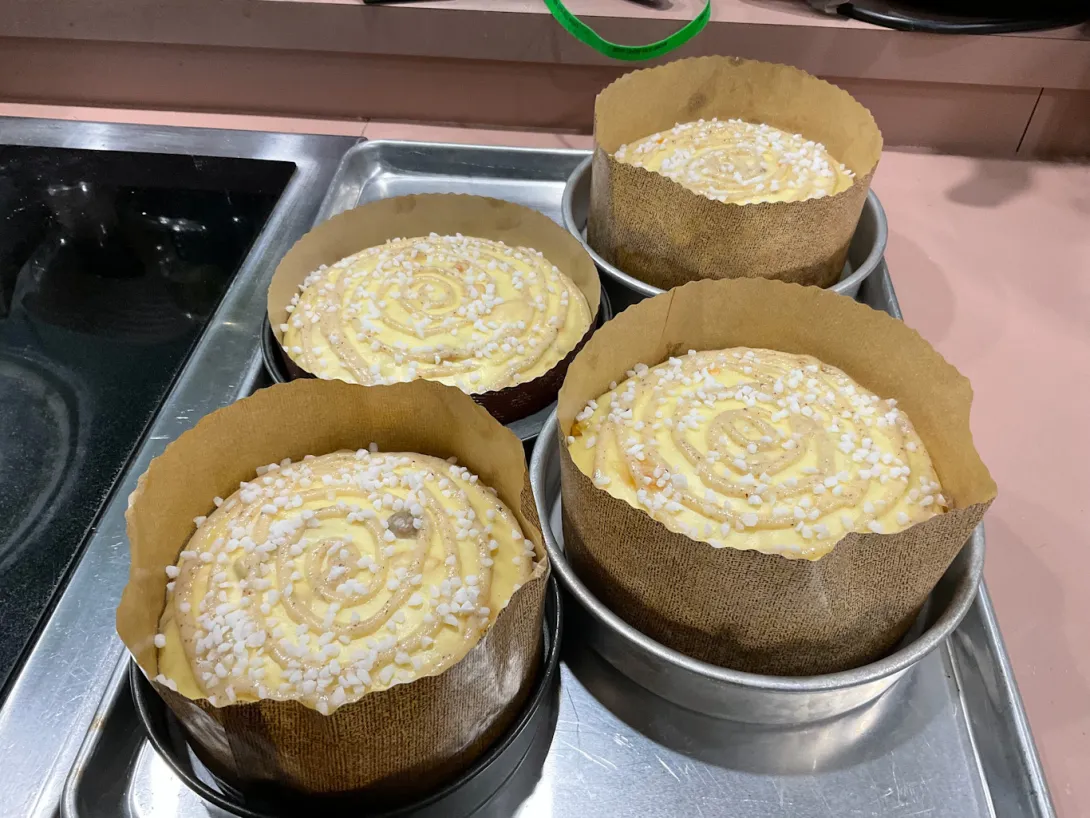
The topping! The crumb! Where is the smell-o-vision? Pure delight for the eyes!
Thank you for saying that! It's very encouraging! Worked for months to get to this point with panettone, and *maybe* it's all downhill from here, we'll see!
Wow Sue that is just incredible, both inside and out. The crumb is beautifully open, I bet it tastes amazing, well done!!
Benny
It is definitely the best bake so far, and I am really happy with the result!
Do you post recipes somewhere? I cant seem to find any. I absolutely love the Pannetone From Roy and would love to make it at home.
I would love to have the recipe too
CLASSIC PANETTONE
Roy Shvartzapel recipe
FIRST DOUGH
_________________
2,762g
PROCESS
DAY 1
6:00 a.m. Standard bagnetto for 20 min (cold water, sugar concentration of 3 g/l).
6:20 a.m. First refreshment with the starter/flour/water proportions: 1/1/0.4 followed by placing in the proofer at 30°C for 3 to 3.5 hours.
9:50 a.m. Second refreshment, with the starter/flour/water proportions: 1/1/0.45 followed by placing in the proofer at 30°C for 3 to 3.5 hours.
1:20p.m. Third refreshment, same as the second refreshment. Ferment to a pH of 4.1 after each refreshment.
5 p.m. Mixing the first dough:
SECOND DOUGH
________________________
5,946g
PROCESS
DAY 2
Between 4 a.m. and 6.a.m. - Mix the second dough (50 min total):
Notes:
Sue I’m hoping you can answer a question for me. In looking at Roy’s formula for the primo impasto the instructions say to mix all the first dough ingredients reserving the yolks. Does he really mean to start with the butter and if so, does he use melted butter or softened butter?
Benny
Hi Benny,
I’ve made Roy’s recipe many times (to say the least!), so perhaps I can offer some useful thoughts:
The instructions given in Chambelland for the 1st dough are very abbreviated, but, ordinarily (for me) the process would be:
First dough:
It’s important to get strong gluten development at the outset of the first dough, and that requires mixing just the flour, water, (optionally dissolved sugar), followed by the starter, to a well-developed state.
Depending on the mixer, this heats the dough more, or less. A portion of the yolks are added to loosen the dough a bit prior to the butter addition, and to (in my case) cool the dough a bit. My dough is often about 26C at this poiint. I then add all of the butter, which is straight out of the refrigerator (mine is 37F), which I slice lengthwise with a butter slicer. I feed the pieces in as I mix, then let it mix until incorporated. This results in a net decrease in temperature.
(Many recipes emphasize softened butter, but I first got this cold butter technique from Claudio Perrando)
Then I add in the rest of the yolks until incorporated.
The first dough only has 6 ingredients, so it is pretty easy.
Other notes that might be useful to you:
Sugar: I increase the sugar in the first dough and decrease it in an equal amount in the second dough. I make a 60% batch, so I increase it from 25 to 35g in the first dough. I do this to counter any tendency to acidification in the primo. Just FYI.
Water: Roy has a water addition at the end of the second dough. Add this very gradually, and it should be very cold. If you add a touch more water, you can get a little better crumb here. Not all recipes have water added at this point.
Baking: Since Roy’s recipe is what I think of a “low yolk”, or “American style”, it’s important to give it a boost of heat at the start of baking. That will drive oven spring.
Hope this helps! Sue
Thank you Sue that is very helpful. I hope to try a Roy Panettone in the next week or two and reading the instructions that I have didn’t completely make sense. What you’re doing makes more sense for sure.
Benny
Another note:
Roy’s recipe was the first one I saw that added the butter before the yolks in the first dough, and also in the second dough. Older recipes were (at least the ones I knew about) all the yolks and then all the butter.
There are some recipes now that reverse this in the second dough, adding butter last. The problem with this is that the dough is considerably thinner once the yolks are added, and cooler, so that the butter would have to be softened in order to incorporate.