Today's Bakes
- Log in or register to post comments
- 6 comments
- View post
- inlovewbread's Blog
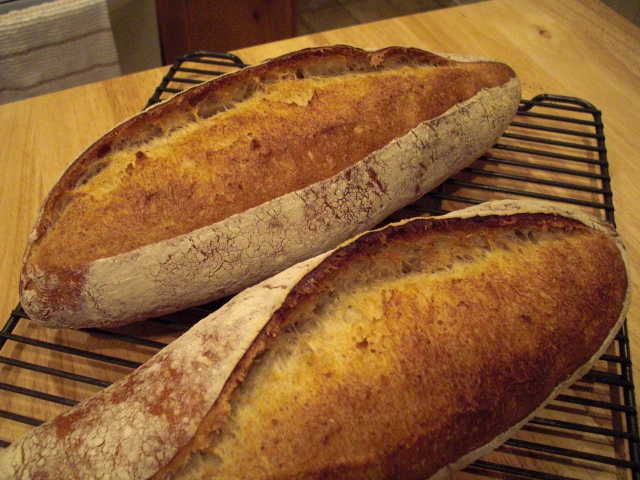
I made up another batch of dmsnyder's San Joaquin Sourdough and this is my bake. They are still singing as I type this! I got a better ear this time- I think it was a better scoring, I cut a little deeper than the last try. Also, I used the full 21 hour cold fermentation for this bake as apposed to the 14 hours on the last attempt. I don't know if this has anything to do with the better ear or not.
My question though is (I guess directed at David, but others please chime in):
My last few bakes haven't been so successful. Formulae that usually turned out well were coming out of the oven looking sad. I can't figure out if I was over or under-proofing. I kept trying at it to get the timing right on Glezer's Colombia. Incidentally I posted about it on my blog because it's the family's favorite bread, but lately the scoring just doesn't open up. The flavor is great, but I can't get it to look the way I want it to anymore! Ugh! Then I made a few other breads that just turned out so-so. How is it that my bread could be getting worse?
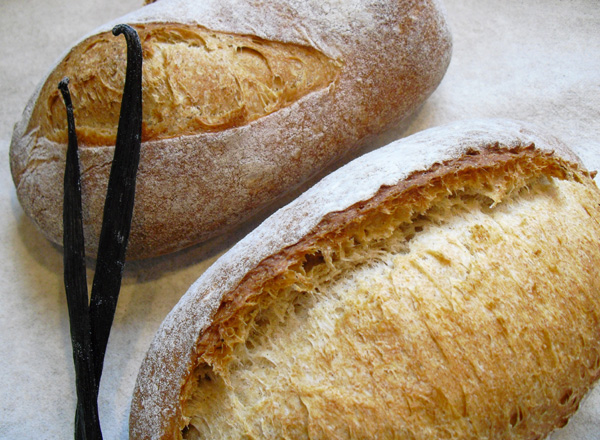
Pain au Levain a la Vanille ( sourdough bread with vanilla )
I recently was gifted some beautiful organic vanilla beans. They have been calling to me from my pantry for a few weeks now. I wanted to incorporate them into some sort of bread but couldn't think of something that would pair well with the vanilla bean and still be good in a bread. I decided to let the smell and taste of vanilla to shine through and just use it on its own.
This bread is from Maggie Glezer's gem of a book: Artisan Baking. I have been wanting to make this bread for a while because it was named after the Columbia River. As a Washington State native, I had to make it. I'm glad I did as this bread has become my new personal favorite.
Formula:
This is Potato Leek bread from SteveB's "Bread cetera" blog. His breads are amazing, and this one is no exception. The potato and leek go so well together. I used Yukon Gold potatoes instead of the red potatoes called for in the formula. I've made it both ways though and both are good (I think). The only other change I made was to use my firm starter in lieu of the 100% hydration starter.
The first rye that I made can be found here. It was a 80% Rye with a Rye Flour Soaker from Hamelman's Bread. I have to add to my previous post, that the flavor developed over the next few days and the crust softened up. I liked the bread a lot and it was good with just a little butter on it :-) At first I wasn't that impressed but as time went on I came to really like it. I saved the last third or so of the loaf for use as altus.
I've been baking my way through Hamelman's "Bread". Sometimes I don't always go in order- and right now, I'm stuck on the Sourdough Rye section. I decided to go with the "80% Rye with a Rye-Flour Soaker" (page 213) instead of starting with the first (40%) rye of the chapter. I deviated from the formula a bit as I baked a single pullman loaf instead of the 2 free-form loaves specified. I'm not afraid to shape rye- actually, I'm looking forward to seeing what it's like...but I do like the look of a pullman loaf. Same way I'm attracted to Volvo's, Frank Lloyd Wright architecture and cubism.

I'm calling this "Mixed Flour" because I used a lot of different flours. I wanted to see if I could get the characteristics I wanted in the crumb by adjusting just the flours. It seemed to have worked, so here's what I used:
Again (It's a family/personal favorite :-)), I was following Susan's Simple Sourdough formula. Only hers doesn't call for so many flours!
50g Firm Starter (mine is 50% hydration composed of 10% rye and 90% AP)
205g Water
