

Croissants

croissantsSo, how'd you spend your Bastille Day? You did celebrate Bastille Day, didn't you?

I made croissants that day. Croissants seemed like the perfect thing to make on the French national holiday because, like the French, they are a big pain in the butt to deal with.

What's that? Oh yes, I guess they are French too.

Click "Read More" for a recipe and more.

Croissants are basically a big slab of butter with dough wrapped around it which is rolled out and folded, rolled out and folded, then rolled out and folded again. The difficult part isn't the rolling or the folding: it is getting the temperature of the dough and the butter just right. You want them fairly cold, so that the dough is fairly stiff, but not so cold that the butter cracks.

From what I've read the ideal temperature for this is around 65 degrees. I didn't quite hit it right and just about gave up on making them (you'll notice a lack of photos of the cutting and the shaping... the dough was getting sticky and I thought I'd have to throw the whole thing in the garbage) but they came out quite good, so perhaps the recipe is more forgiving than it at first seems.

The recipe I used is from Bernard Clayton's New Complete Book of Breads. I prepared them over 3 days, with the butter step on the evening of the first day, the rolling on the second day, and the slicing, shaping, and baking on the third day.

Clayton recommends using a mix of cake flour and all-purpose flour. If you don't have any cake flour in the house you certainly can substitute in more all-purpose flour. You could even try whole wheat flour, if you are bold (Beth Hensberger has a whole wheat croissant recipe in her Bread Bible. I've never tried making them, so I can't tell you how they taste, but she swears they are good).

There are very few times that I think it really matters whether you use unsalted or salted butter, but there is so much butter in these that I suspect it would make a noticeable difference using salted butter. I wouldn't recommend using margarine either, but I have to admit that I've never tried it.

Croissants

Makes 20 to 30 pieces

1 1/2 cup unsalted butter, softened
3 tablespoons flour

Dough:
3 cups all-purpose unbleached flour
1 cup cake flour
2 teaspoons salt
2 tablespoons sugar
2 teaspoons instant yeast (or 1 packet instant or active dry yeast)
2 cups very warm milk (120-130 degrees)

Glaze:
1 egg plus 1 egg yoke and a pinch of salt

Combine the 3 tablespoons flour with the softened butter. Spread it out on aluminum foil to make a 6 to 8 inch square. Wrap the square in foil and refrigerate 2 to 3 hours or overnight.

Combine the flours and salt in a large bowl. Combine the warm milk, sugar, and yeast. Make a well in the flour, pour in wet ingredients, and stir them into the flour. Add additional flour or water as neccessary to make a soft dough (it will stiffen when chilled).

The dough should only be hand kneaded or mixed for 5 minutes or so to prevent the dough from toughening up. Cover the bowl with the dough and cool it in the refrigerator for at least an hour, until it is approximately 65 degrees (or place it in the refrigerator for longer and remove it to take the chill off before moving on to the next step).

Remove the butter and dough from the refrigerator and allow to warm until they are both around 65 degrees. At the proper temperature the dough will be fairly firm, the butter will be firm enough not to make your hands greasy when touching it but soft enough not to crack when bend.

(I've heard using a chilled marble work surface is a good way to keep the dough cool, but I don't have one so I didn't try it. If you have one though, it might be worth a shot.)

Stretch the dough out into a large square, roughly 10 inches per side.
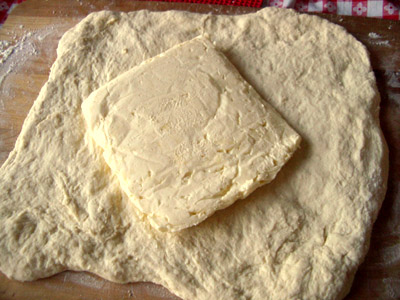
butter on dough

Place the block of butter on it diagonally and fold the corners of the dough over the butter, forming a large packet.
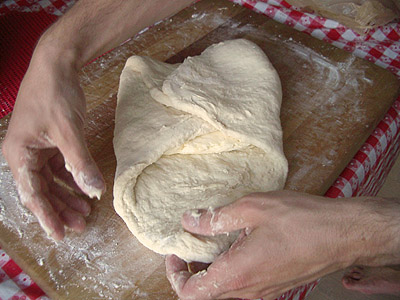
butter packet

Roll the dough out into a long thin rectangle. Fold it in thirds like a letter, then rotate the dough 90 degrees and repeat this process.
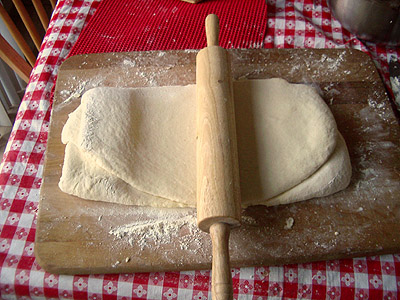
rolling dough

Wrap the package of dough in a cloth that has been soaked in cold water and wrung dry (I also placed this package in a plastic bag). Place the wrapped dough in the refrigerator for at least an hour.
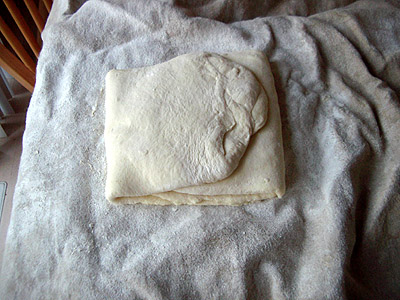
dough on cloth

Unwrap the dough from the towel and roll it out and fold it a third time. Wrap it back in the towel and refrigerate it overnight.

The next morning, roll the dough out into a large rectangle. The dough should be extremely thin, approximately 1/8 inch thick. Cut the dough into a series of triangles, approximately 5 inches on each of the short sides and... quick... the third side is.... A squared + b squared = c squared... the square root of 50... just over 7 inches. (My high school geometry teacher would be so proud!)

Roll the triangles up from the long side toward the tip. Tuck the tip under the center and slightly stretch and curve the ends to make the crescent shape.

Place the croissants on a baking sheet and cover lightly with plastic wrap or wax paper. I just place the entire baking sheet in a clean garbage bag.

Set the croissants aside to rise until they've doubled in size, roughly 1 to 2 hours.

When they are close to risen, preheat the oven to 425. Remove the plastic from the baking sheets and gently glaze the croissants with the egg wash.
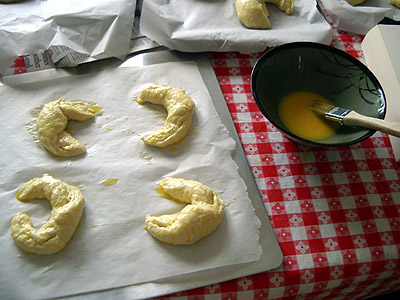
egg washing croissants

Bake the croissants for approximately 20 to 25 minutes. It is difficult not to burn them: because they contain so much fat they basically fry themselves when they get hot. I was surprised to find that the ones that came out most evenly browned but not burnt were the ones I baked on the double layer cookie sheet (shown in picture above) on the middle rack. They came out even better than the ones I baked on a standard baking sheet on the top rack. So watch them carefully, and adjust their location in the oven as necessary.

Croissants freeze very well. To reheat them, simply remove them from the freezer and place them in a toaster oven for 5 minutes. Good as new!
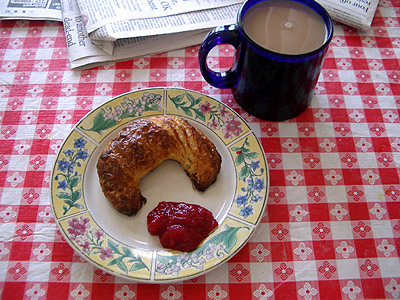
croissant and coffee

Advice on how to make croissants? Please share your experiences by adding comments below.

I've gotta say... the

I've gotta say... the picture at the top of your croissants looks darn tasty! I'm going to give them a shot... thanks for the inspiration.

I love the nice dark golden color you've gotten on them. As of late I've tried several croissants at commercial bakeries.... and while they appear picture perfect in terms of form - the have absolutely zero flavor. Not one iota.

Man I wish I could get a croissant like the ones at the top look.

heavy sigh...

So...I start with stars in my eyes ready to make the "bestest" croissants. I've slated the entire weekend as "the croissant weekend". Everything seemed to be going as planned...the dough seemed easy to work with and the butter packet measured out and fit perfectly...blah blah blah... so I make the cuts, roll them up, let them rise for 2-3 hours and... oh, I forgot... I let them free to rise but they decided not to... I was using the recipe in this month's Living magazine and I was faithful to the tee...the only thing I can think of is that the water wasn't warm enough when I mixed the yeast?.?.? Any ideas? I'm open to suggestions and I don't want this to kill my croissant spirit.

i did it!

..i came across your croissant recipe the other day and decided to give it a shot. it came out perfect! just like the real ones you usually get in bakeries! I couldn't believe that I actually pulled it off- I did half of the original recipe and didn't actually change anything-except I added a bit more cake flour to the dough. I have to say the dough was quite sticky. But you were right, once you take it out of the fridge, it was easier to manage. I didn't actually leave the butter and the dough in the fridge for 1hour++ ( being the impatient me :P ) but after adding the butter into the dough, I did leave it in the fridge, wrap in wet cloth overnight, I did the cutting and shapping this morning, left it to proof for a couple of hours and baked them! And, my God! the croissants turned out beautiful! I'm quite impressed with myself now ( haha! ) Thanks a lot for the great recipe! ( and the step-by-step guide- I guess getting the temp right when making croissants is important!)

Criossants: 9 hours to thaw and rise, necessary??

I am purchasing wonderful frozen raw croissants in sets of four from a bakery in town which sells through our local upscale grocery store. They cost $3.99 for the four frozen croissants and they come with directions to allow them to thaw and rise for 9 hours between certain warmish temps before baking. I was wondering whether 9 hours seems rather excesive and whether I can shorten this time when our ambient temps are slightly higher than those recommended during the summer?

user icon

9 hour rise

I don't think 9 hours sounds excessive if coming from frozen.

Yes, you could shorten the rise time by increasing the room temperature.

With a 9 hour rise, I'd be most inclined to pull them out of the freezer right before bed and bake them first thing in the morning.

Thank you :)

Yes, that is what I have been doing, in fact I have placed them under a large glass dome, which seems to help pevent any drying of the outermost surface as they rise. I have been surprised by how easily these are to bake this way - well, with the exception of that 9 hr wait. But I find they bake quickly in our convection oven and they are quite delicate in every respect. Thank you for your reply, I am new to this and the group - and I appreciated your other posts which I had encountered in my earlier travels.

Lard in CROISSANTS

I have a recipe for croissants tht calls for lard n u need to mix it in the flour to make the dough in the initial stage and finally when the dough is risen, the incorporation of butter. what actually is lard? and wht other alternative is there if I dont want to use lard?

Lard - doesn't make a croissant!

Lard is "rendered" (gently melted out, strained and resolidified) pig fat.

Really, it has no place in a proper croissant.


That said, one of the health hazards of my birthplace was the "buttery" (or "rowie" - little roll).

This must originally have been produced by a Scots baker who had seen (or heard of) the croissant, and produced a local version - using a vast amount of lard (cheaper than butter) and rather a lot of salt for 'taste'.

Actually very addictive. Hence the health risk.


The recipe at the top of this thread is very much more like what a croissant should be...

Though personally, I'd suggest that you should also take a look at

EDIT - (since the thread resurfaced)  updated link http://www.danlepard.com/forum/viewtopic.php?t=2107 

help!

Hi!

I tried making croissants yesterday and this morning rolled it out into a long rectangle. But the butter was too hard... I left it out for a while but it was too greasy. When I started to roll it out, the dough began to tear and it just became a big mess. I feel so defeated... :( 
Any suggestions?

triangles

I think the triangles work well when they are long and skinny - you get more distance to roll and get more layers,  the base is about one third of the lengths of the sides.

Not as nice looking as yours

Mine aren't looking as nice as yours but they were still very tasty, I made them with white spelt flour and gluten free cake flour. 

Thanks for the recipe.

Janice

Hey - I just made this recipe

Hey - I just made this recipe (in fact, it's in the oven now) and it seems to have turned out quite nicely. The only problem is that I don't think the dough has risen at all. I was confused at the recipe calling for "very warm" milk to dissolve the dough, but I did it anyway. Now I suspect maybe this is why my dough hasen't risen. I'm not the expert bread maker, so I don't really know, but aren't you only supposed to use room temperature liquid to dissolve yeast? Hot liquids kill it? I think I killed my yeast.

Just wondering if anyone else had this problem.

Oh, and as far as evince's comment, I saw on a youtube video (yes..) that if you flatten the dough by hitting it in sequence, it will make the butter more maleable. Then you can start rolling. It seemed to work for me, anyway.

about the 9 hours

eventhu there is yeast in this dough it is not the only thing that will make your dough rise, do to the soft butter it will evaporate and start to rise, and in a fairly hot room the outside will begin at first stretching the inner layers of the dough, either do it slowly, or put them right into the oven from the freezer.

flour cant really be frozen in a normal freezer, so "icecold" flour is very very usefull for this.

and yes yeast does die from too much heat, along with salt, its a pure killer, dont mix out your yeast into a cup of milk and salt like many does, its gonna die.

suggar also kills yeast, but it needs alot more than the salt. suggar is also the "food" of the yeast helping it to work faster, but if you wrap your yeast in a layer of suggar its just gonna die.

and about the gluten free flour, the longer you work your dough the more gluten your gonna get, so, if you want a gluten free cake, then mix it together fast and no more.

i hope this helps alittle

temperature

I don't understand why most of the process is made at low temperature but later we leave the croissants at room temperature while the yeast works.

Isn't the butter going to melt?

Comment viewing options

Select your preferred way to display the comments and click "Save settings" to activate your changes.