
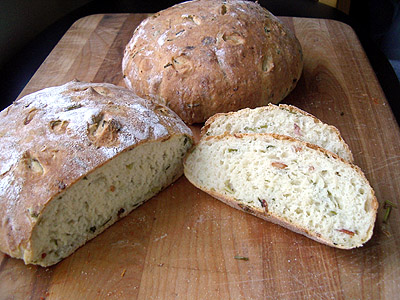
 This weekend I found myself staring out the window at the abundant chives growing in my garden. What could I possibly do with them, I wondered, except eat them on baked potatoes? And how many baked potatoes can I eat before I never want to see another spud again?
 Then it occurred to me that I've made potato bread before, so why not add chives to potato bread? And, heck, while I'm at it, why not throw in some other tater toppings like sour cream and bacon and have a full-on Baked Potato Bread?
By the time I had second thoughts about it, all of the ingredients were mixed together. But, you know what? It turned out excellent, the perfect accompaniment to a pot of corn chowder on a rainy day.
The full recipe is below.
Freestyle Baking
As I have written about time and time again, I think the real fun in baking comes once you have mastered the basics and understand how adding different ingredients in different proportions will change the character of your loaf.
Whether I am making up a recipe or checking out a new recipe in a cookbook, my point of reference is always the loaf I introduced in lesson 1, which is 3 cups flour, 1 + a little cups of water, 2 teaspoons yeast, 2 teaspoons salt. If I read a recipe and it has more water than, say, a cup and a quarter of water per three cups of flour I know it is going to a slack dough; more fats (butter, milk): a softer loaf; contains sugars: a sweet loaf; and so on.
When thinking up this recipe, I took the lesson one recipe, substituted potatoes for about 20 percent of the flour, substituted sour cream for about 50% of the water, and added the chives and bacon and bacon fat. It sounded easy enough, though I made some adjustments as I started baking, as you'll see below.
Potato Bread
I don't believe that I've every posted about a potato bread on this site, so a little introduction is in order.
Replacing between 10 and 30 percent of your flour with mashed potatoes results in a wonderful soft, moist loaf of bread. Potato flakes or potato starch can be used, as well, but leftover mashed potatoes work great even if they have some butter or milk or salt in them.
Do be careful, though: potatoes are considerably lower in gluten than wheat, so add too much potato and you will end with a dense, moist loaf, probably too much like a baked potato for anyone's liking. I find 1/2 cup potatoes to around 3 cups flour to be plenty.
In this recipe I used a couple of small red potatoes that we had steamed up as a side dish for dinner the night before. All I did was mash them up with a fork and mix them into the flour. I left the skins on before mashing them because I find the little red flakes speckling the loaf to be quite attractive.
Bacon isn't to everyone's liking, either for dietary or religious reasons. I see no reason why this recipe wouldn't be good even if you excluded it, but if it something you are able to indulge in I suggest you do. I definitely think it improved the flavor and consistency (and appearance, for that matter) of the loaf.
Enough blabbing. On to the recipe!
Baked Potato Bread
Makes 2 small (one pound) loaves or one large loaf
1/2 cup mashed potatoes
3 to 4 cups all-purpose unbleached flour (I'll explain the ambiguity below)
3/4 cup water
1/2 cup sour cream
2 teaspoons instant yeast
1 teaspoon salt
1/4 cup cooked bacon
1/2 cup chopped fresh chives
To begin, chop up two or three slices of bacon and fry them up. Remove them from the heat.
Mix the mashed potatoes, yeast, salt, and 2 cups of the flour together in a large mixing bowl or the bowl of an electric mixer. If you have active dry yeast and want to substitute, read this. Add the sour cream, water, chives, and bacon and mix together until all ingredients are combined. I also mixed in the bacon fat, which there was about a tablespoon of in the pan, because it improves the flavor of the loaf.
At this point you'll have a very wet, sticky mess, probably more of a batter than a dough. Add additional flour a handful (1/8 cup) at a time and mix or knead it in.
(I lost track of exactly how much extra flour I added, but it seems like it was around 9 or 10 hands full. I added 4 or 5 hands full and mixed them in while the dough was still in the bowl, then I poured the dough out onto a well-floured cutting board and added more, kneading it with my hands which I repeatedly dipped in flour to keep the dough from sticking to them. After 5 or 10 minutes of this I ended up with something that was still quite sticky, but was definitely in the realm of a dough and not a batter: it could be formed into a ball and generally held its shape.)
Once you have combined the ingredients well and gotten the balance of flour and water to a level that seems acceptable, return the dough to a well-oiled bowl. Cover the bowl with plastic wrap and allow the dough to rise for 90 minutes at room temperature or until it has doubled in size.
Remove the dough from the bowl and shape the loaf or loaves. Notice how moist and gummy my dough was when I cut it to shape it into two loaves:
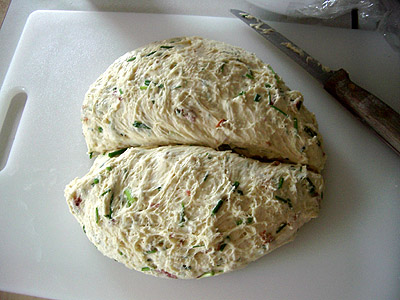
One probably could add more flour and make an acceptable loaf of bread with a drier dough, but I've been finding that I get better results the wetter I am able to leave it. But this really is an art, not a science, so use your own best judgement.
At this point you need to shape the loaves, cover them loosely and let them rise until they double in size again, about 45 minutes. You could put them in greased baking pans and let them rise and bake them in those. I wanted round loaves, so I put them in a couple of couche lined baskets:
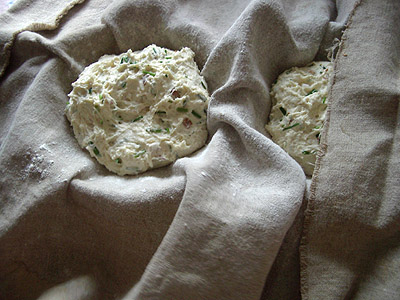
Professional bakers use these kinds of baskets
 , which are very nice but completely out of my price range. I found two small baskets at Goodwill for 49 cents each and have found that they help keep the shape of my rounds very well.
The baking couche
I got from a neighbor who works in bakery. It works very well, but you can fake the same thing with a well floured kitchen towel (the linen kind, not a fuzzy one). As you can see in the picture above, I placed the baskets on a table, the couche over the baskets, and the dough in the floured couche in the baskets. I wrapped the edges of the couche around the balls of dough and let them rise. When they had risen I simply unwrapped the loaves and shook them out of the couche onto my peel (which I dust with semolina flour) and threw them into the oven.
While the loaves are rising again, preheat the oven to 425. If you have a baking stone, be sure to put it in early to heat.
When they have doubled in size (as I said before, about 45 minutes after shaping), put the loaves in the oven to bake. I baked them at 425 for 5 minutes and then reduce the temperature to 350 and baked them another half an hour. The loaves are done when the internal temperature reaches the 185 to 195 degree range (as read with an instant-read thermometer) or when they are nice and brown on the outside and sound hollow when tapped on the bottom. For me this took about 35 minutes.
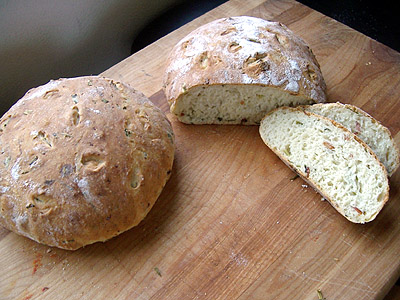
And there we have it. The bread was wonderful while still warm with a pot of soup, but I actually think I preferred it the next day cold. With the bacon fat and sour cream, there was plenty of fat in the bread so it didn't need to be buttered; just plain it was rich and moist enough.
Comments
_Laurel's Kitchen Bread Book_ also has a discussion in their chapter on Other Ingrediants.
sPh PS If anyone could explain paragraph spacing on this site to me, and particularly why it behaves totally differently in forum comments and blog comments, I would be most grateful.
I don't know how this bread isn't served at every steak house in america. It is AWESOME! But I just made it last night and I wanted to get a recipe down that was a little more exact than the first version given above. Before I do that, I want to take a second to thank Floydm for giving this a try and coming up with it. I just needed a metric recipe and now I feel I have it. So I converted the best I could the volumetric recipe to weights than I scaled it up a little bit but since I knew I was going to have to play with the flour amount I didn't know how much dough it would weigh. When I make this again I will probably scale it up a little more to make two slightly larger loaves. But I kept track of how much flour I added so I feel very confident that this formula is pretty good.
This gave me a very wet dough just as pictured in Floydm's description and here's how it turned out. The water content seems very low but I guess a lot of water comes from the mashed potatoes and sour cream because I did get a very wet dough. Some important notes: I measured the bacon first then fried and chopped it, I put the bacon grease into the dough as well. The grocery store was strangely out of chives so I felt green onions would work as they are also commonly found on baked potatoes. The potatoes were boiled until soft, the potatoes were then drained, some of the water for boiling the potatoes was reserved to be used as the water in the dough, the remainder of the water was discarded. Then the drained potatoes were mashed. I think thats all the important stuff.
demegrad
http://www.demegrad.blogspot.com
I tried making this bread a couple of weeks ago. While it had a good crumb and texture, and I'm sure that the flavor was right, it just didn't click with my me and the wife. Probably too many loaves of Wonder Bread in our past, I guess.
However, with a few extra seasonings and a bit more salt, this bread made *excellent* croutons for us. I think I'll probably try that recipe again just for the croutons, if nothing else.
Holy Cow! I made this last night. The Kitchen smelled like a loaded baked potato while it rose and cooked. I was drooling! Incredible texture and taste. This will become a regular item in my bread rotation. When the loaves came out of the oven I covered them very loosely with foil which seemed to soften up the crust. I think I like it that way though. The softer crust goes nice with the smooth bread texture.
tried this today, with some variations, since we're in Japan visiting, and don't have access to regular materials. No bacon, since we're vegan. No chives; not available, so used chopped green onions instead. Added a cup of whole wheat flour, and a cup of cornmeal. Delicious, even with the variations, although the dough was less slack than the original. Still baked up well, good spring in the oven. Thanks! And since we're here, this was the first bread I've baked with commercial yeast rather than the KA "New England" sourdough starter in a decade (although after a decade, I think the starter is more a central Ohio one than a New England one)
Alan in Columbus, Ohio, posting for the first time, having just discovered the site a couple of days ago. Look forward to much more inspiration.
Sounds like you were too close to overproofing. Try transferring it to parchment (to bake)before it rises too much. Use the finger poke test. If you don't have a basket, try making a sling with the floured cloth by tying the corners together and let it hang from a cupboard handle. This also lets the air get to the surface of the dough to dry it just enough to help it hold it's shape.
I've also proofed on parchment but then I've also let the bread bake in the bowl shape, a casserole, or small fry pan. I do final proof pizzas on parchment and baguettes. To keep the dough from flattening out and "going south" turn it onto the parchment just before putting it into the oven, if it is very soft, don't score it. If you are using a stone, pre-heat for 50min to an hour to make sure the stone is hot through and through. If it colapses, even a little, reshape it and let it rise again but not so long. Good luck!
Mini O
Danke.
I would never have thought of using a sling to shape the bread. I do it all the time when I am draining my Kefir and yoghurt. And I also do it from a cupboard handle. Sounds like an excellent idea.
Hi, I'm fairly new here, this is my first post, I have been lurking on & off for awhile as I've been learning little by little about baking. This site has been a great resource for me - thanks everyone for all for the great information!
I baked a loaf inspired by this post this morning. I left out the bacon as I have a vegetarian in my household (also because I knew I was planning to leave it out at fairly pork-unsafe temps for quite awhile). I also used about a cup of sourdough in place of the yeast suggested. I actually didn't really measure anything much, but mostly went by feel (I didn't really know how much water/flour the starter should be counted as, and winging it is a way of learning for me).
Anyways, it came out very tasty, the whole household raved about it. I took some pictures, but haven't yet messed with them to get them to web size (I'm not very good at that, so I'm not going to guarantee I'll actually get them posted).
Thanks for the recipe, this bread is a great idea - I have a feeling my gf is going to insist I try it again sometime soon!
Russ
I have this sitting on my board right now for a rest, then I'm going to knead in the salt for about 10 minutes to develop the gluten before I let it sit for first rise.
I didn't have chives so, instead, I subbed cheddar cheese. I figured that adding cheese to the bread would give it even more tang, which I like.
I'm going to do one loaf and bake it in my 4.5 quart dutch oven. I don't have a stone or anything to spritz the oven, so I figure the pan will do all right.
Hi Floyd and Hi to eveyone else,
This is my first post. My Dad and Mom owned a retail bakery in upstate New York, so we always had fresh bread when I was growing up in the 50's. When I became a hippie in the 70's I got started and got hooked. My specialty was Tassajara Whole Wheat bread (The Tassajara Bread Book, from the Tassajara Zen monastery in California).
Fast forward to the present: A few months ago, I discovered a superb store bought bread, Country Oven brand 100% Whole White Wheat. It is so good that it became the only bread I bought. It reminded me of how good bread can be, and I once again got that itch to craft my own.
I just baked some potato bread, with mixed results. I wanted to make it somewhat healthier, but I had no whole wheat flour on hand. I did have some Bob's Red Mill brand whole wheat farina breakfast cereal. By the way, I now live in Portland, Oregon and Bob's mill is not 12 miles from here.
So I cooked some farina using extra water, to make it soupy. My Fleishman's yeast package advised me to "add liquids that have been heated to 120 to 130 degrees Farenheit". I didn't take it's temperature as I tend to fly by the seat of my pants, but it was cooled down substantially.
The first rise was textbook, although it only took an hour. I formed two loaves on an 11" by 17" cookie sheet, and perhaps this was my downfall. I expected them to rise into a classic shape, but they just sort of spread out. When they came out of the oven, they were a foot long, five inches wide and one inch tall. It did, however taste good, and my apartment smelled just like I remembered it.
I welcome any suggestions, and thank you Floyd for creating this meeting place for all of us.
Floyd, et al,
So intrigued was I about a potato bread that I rushed in. Did I have all the ingredients? A resounding NO, but I certainly didn't let that small detail stop me. I haven't replenished my larder with respect to bread flour in some time. The result is a potato rye. Its actually a mix of unbleached white, med. whole wheat and rye. Some of this and that.
I used what I had-- measuring cups, no scale. KA45 mixer. Boiled new potatoes. But, Steve, did you follow the recipe? Did you do the calculations and percentages? No, I just mixed some dough, man. Hey, it had potatoes!! Score!
Mark, I used that pull it to you twice, then rotate dance you do in Montana. It is retarding in the fridge for a bake off tomorrow.
It felt great!! I am another Edward Espe Brown disciple having baked according to the monk's mantra from Tassajara. Is it any wonder I didn't use a scale? Its on my wish list but I am going to bake until I have it. I am dreaming and imagining a fresh off the hearth Potato Rye cooling on the make table in front of my brick oven.
Floyd, and all you Fresh Loafians out there, thanks for your part in this.
der Hinterhof
Has anyone added chunks of potatoes (not mashed) to their SD bread? If so, do you roast the potatoes whole or cut them up and then roast them? When do you add them to the dough? I have bushels of blue and all red potatoes that I think would look very interesting in a loaf of bread, along with some chunks of garlic.
A wonderful recipe, thank-you. I followed your formulation but added two small cloves of garlic, (finely rasped.)
After the second rise I dropped it carefully on a heated pizza stone (425). At 30 minutes I removed the loaf and stone from the oven, tented it with foil and served it an hour later. It was enjoyed very much.
I had a bunch of chives still growing on the back deck (frost to be upon us in the next few days) and they were absolutely perfect in the bread.
Thanks much !
Anna
No chives or bacon here (winter, and kosher!), but I love roasted garlic in potato bread, so I added two partly-roasted cloves of overwintered local garlic (pulled them out of the oven too soon, but puréed with a bit of oil and threw them in anyway).
Rose like a charm, nice and fast, and now it's shaped (1 1lb loaf, 1 500-something-g boule) and proofing.
Sometimes, in my love of no-knead, long-rising, and sourdough breads, I forget about straight doughs and think, around noon, "too bad there's not enough time to have bread for supper." Then I remember - oh, yeah; just toss in that instant yeast stuff I keep in the fridge. Magical! :-)))
Will edit once I've actually tasted this, but it's sure to be a treat as, also for kosher reasons, we don't often have dairy-based breads. Thanks for brightening a dreary late-winter day with BREAD...
Edited to add:
This was an extremely soft, rich bread. I think something went wrong with the garlic, and the flavour was perhaps slightly off. I would try it again with fully-roasted and in-season fresh garlic. I think it also needed a bit more salt. Will keep trying - thanks again for posting!
Hiee :-)
Thank you for sharing this recipe and detailing your method. Your bread looks quite tempting. I plan to bake this tomorrow and the only question i had was when you mix the ingredients before the first rise - do you knead it well for 10-15 mins or you just mix till everything is well incorporated ? I mean do you have to keep kneading it till gluten development or just mixing will do ?
Thanks !
I think I just hand kneaded it. It is wet enough that with time the gluten development should happen on its own.
Good luck!
-Floyd
This was a great recipe! I modified it a bit and made pinwheels instead of loaves, which made the rolls extra cheesy.
http://theprudenttart.blogspot.com/2013/03/loaded-baked-potato-pinwheels.html
had some leftover potato, and some sour cream...so thought I'd give this a try.
being a UK baker, I'm used to weighing everything, so I just tried to get the dough to feel right. Started with 210 gm of potato, used around 8 gm each of instant yeast and salt, handful of chives from the garden and two rashers of smoked bacon. Around 2 dessertspoons of sour cream, plus enough white bread flour ...maybe 350 gm, plus handhot water to get to a decent dough.
I use in bowl kneading..really stretch n fold..for most breads, same here. so 30 minutes between each s n f, did 3 altogether. Managed, just about, to shape into a boule, and then to rice-floured banneton.
Second prove around 60 minutes. Pre heated steel baking sheet to 240ºc - 465ºf, and steel pan for steam...semolina'd my wooden peel, flipped the boule onto it and then onto baking sheet, added boiling water to the steel pan in base of oven, baked for 5 minutes, turned, another 5 then reduced heat to 200ºc - 400ºf.
35 minutes later..smelt fantastic.
.https://db.tt/pVC0OuLU
https://db.tt/lowIxkq5
lovely
I love potato bread. Just love it. I need to make it more.
The "flour + mashed potato = fluffy soft bread" equation is counter-intuitive, but I've been pondering it recently and I reckon it works the same way as a tang zhong (cooked flour goop), or porridge in porridge bread - a dose of gelatinised starch that absorbs and retains water, making the crumb softer and delaying staling.
Plus it tasted wonderful. Did you actually use baked potatoes in your baked potato bread, or were they just boiled? If you baked them for a good long time you might get some of the baked potato flavour coming through in the bread, like in baked potato soup (which I've never tried but I'm told is good, and worth the effort, despite how odd it sounds).
I know this recipe is 10 years old. Have you made it again?
Such an easy way to prepare baked potato bread at home. Loved it. Will try one day for sure..Thank u for the recipe.
so this is my second time making this bread but the first time making it properly (used turkey bacon before and no chives). But I let it rise in the fridge almost 24 and want to add a little flour like you said could be done. do I just knead it into the dough? The. Let it rise again the 90 minutes? Or is it too late for that?
so this is my second try the first time it was really good. Here I'm trying to get sweet and salty. It was good too.